Ceryneian Hind
Template:Short description Template:Infobox mythical creature
In Greek mythology, the Ceryneian hind (Template:Langx Kerynitis elaphos, Latin: Elaphus Cerynitis), was the enormous hind of Ceryneia, larger than a bull,<ref name=":3">Template:Cite book</ref> with golden antlers<ref name=":1">Template:Cite book</ref> like a stag,<ref name=":4">Template:Cite book</ref> hooves of bronze or brass,<ref name=":0">Template:Cite book</ref> and a "dappled hide",<ref name=":2">Template:Cite book</ref> that "excelled in swiftness of foot",<ref name=":5">Template:Cite book</ref> and snorted fire.<ref name=":4" /> To bring her back alive to Eurystheus in Mycenae was the third labour of Heracles.
Other names and descriptions for her were: doe with the golden horns,<ref name=":6">Template:Cite book</ref> golden-horned hind,<ref name=":2" /> Ceryneia hind,<ref name=":0" /> Cerynitian hind,<ref name=":1" /> beast with golden antlers,<ref name=":7">Template:Cite book</ref> Parrhasian hind,<ref>Template:Cite book</ref> nimble hind of Maenalus<ref name=":8">Template:Cite book</ref> and beast of Maenalus.<ref name=":10">Template:Cite book</ref> Frazer says that the hind took her name from the river Cerynites, "which rises in Arcadia and flows through Achaia into the sea".<ref name=":1" />
One tradition says that Artemis found a mighty herd of five Ceryneian hinds playing on the base of Parrhasian hill far away from the banks of the "black-pebbled Anaurus"<ref name=":3" /> where they always herded. Artemis was so impressed by the hinds that she yoked four of them to her golden chariot with golden bridles, but at the suggestion of Hera let one escape to the Ceryneian hill to be a future labour for Heracles.<ref name=":3" /> Whilst in Ceryneia, the hind chased farmers from vineyards.<ref name=":4" />
The Ceryneian hind was sacred to Artemis.<ref name=":0" /> "The hind is said to have borne the inscription 'Taygete dedicated [me] to Artemis'."<ref name=":1" /> Because of her sacredness, Heracles did not want to harm the hind and so hunted her for more than a year, from Oenoe<ref name=":1" /> to Hyperborea,<ref name=":6" /> to a mountain called Artemisius, (a range which divides Argolis from the plain of Mantinea) before finally capturing the hind near the river Ladon.<ref name=":1" />
Euripides says Heracles slew the hind and brought her to Artemis for propitiation.<ref name=":2" /> Another tradition says he captured her with nets while she was sleeping or that he ran her down,<ref name=":5" /> while another says he shot and maimed her with an arrow just before she crossed the river Ladon.<ref name=":1" /> Once Heracles captured the hind, and only after explaining to Artemis and Apollo ("who would have wrested the hind from him"<ref name=":1" />) that he had only hurt the sacred hind out of necessity, was he allowed to take her alive to Eurystheus in Mycenae, thus completing his third labour.<ref name=":1" />

Art
-
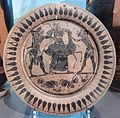 Athenian plate, c. 560 BC
 -
 Roman bronze, 1st century BC, probably a copy from Lysippus
 -
 Roman-era bronze, 1st–2nd centuries AD
 -
 Mosaic from Roman Spain, 3rd century AD
 -
 Statuette by J. M. Félix Magdalena (b. 1941)


_03.jpg)

Stag or Hind or female deer
"Pindar says that in his quest of the hind with the golden horns Hercules had seen "the far-off land beyond the cold blast of Boreas. [Hyperborea]"<ref name=":6" /> Robert Graves thinks that this myth relates to the Hyperborea.<ref name=":6" /> Likewise, the theory of Sir William Ridgeway argues that the hind is a reindeer, this being the only species of deer of which the female has antlers"<ref name=":1" /> However, Pindar is describing the length and breadth of the chase, not the origin of the deer. This female deer is unlikely to be a reference to a reindeer, since castrated male reindeer are the ones who are harnessed and used as draft animals, not females.<ref>Template:Cite web</ref>
A European female deer bearing antlers, moreover, was not unknown in Greece. Recent scholarship documents this phenomenon both in real life and in Greek culture (with images).<ref>Template:Cite journal</ref> Although rare, female deer who experience unusual levels of testosterone, whether in utero or as a result of an injury or illness, can grow antlers. In literature such deer are usually connected in some way with Artemis, e.g. Callimachus' Hymn to Artemis lines 98-106. Further, from the Greek Bronze Age on down, there is visual evidence for female deer bearing antlers, a motif that continues into the Byzantine era, as on a relief sculpture in the Ravenna Archaeological Museum (illustrated at D-DAI-ROM 58.913).
Authoritative primary source translations say the creature was a:
- doe<ref name=":6" />
- hind<ref name=":2" /><ref name=":8" /><ref name=":1" /><ref name=":9">Template:Cite book</ref>
- deer<ref name=":3" /><ref name=":9" />
- hart<ref name=":5" />
- stag<ref name=":4" /><ref name=":7" /> plus Pseudo-Hyginus, Fabulae 30, (trans. Grant)
- beast<ref name=":7" /><ref name=":10" />
Classical Literature Sources
Chronological listing of classical literature sources for the Ceryneian Hind:
- Pindar, Olympian Odes III 28 ff. (trans. Sandys) (Greek lyric poetry C5th BC)
- Euripides, The Madness of Hercules 375 ff. (trans. Way) (Greek tragedy C5th BC)
- Callimachus, Hymn 3 to Artemis 98 ff. (trans. Mair) (Greek poetry C3rd BC)
- Diodorus of Sicily, Library of History 4. 12. 13 (trans. Oldfather) (Greek history C1st BC)
- Virgil, Aeneid 6. 801 ff (trans. Dewey) (Roman epic poetry C1st BC)
- Philippus of Thessalonica, The Twelve Labors of Hercules (The Greek Classics ed. Miller Vol 3 1909 p. 397) (Greek epigrams C1st AD)
- Seneca, Hercules Furens 222 ff. (trans. Miller) (Roman tragedy C1st AD)
- Seneca, Agamemnon 833 ff (trans. Miller) (Roman tragedy C1st AD)
- Seneca, Hercules Oetaeus 1237 ff (trans. Miller) (Roman tragedy C1st AD)
- Pseudo-Apollodorus, The Library 2. 5. 3-4 (trans. Frazer) (Greek mythography C2nd AD)
- Aelian, On the Characteristics of Animals 7. 39 (trans. Scholfield) (Greek natural history C2nd AD):
- Pseudo-Hyginus, Fabulae 30 (trans. Grant) (Roman mythography C2nd AD)
- Quintus Smyrnaeus, Fall of Troy 6. 223 ff. (trans. Way) (Greek epic poetry C4th AD)
- Nonnus, Dionysiaca 25. 223 ff (trans. Rouse) (Greek epic poetry C5th AD)
- Nonnos, Dionysiaca 25. 242 ff
- Tzetzes, Chiliades or Book of Histories 2. 265 ff (trans. Untila et al.) (Greco-Byzantine history C12 AD)
- Tzetzes, Chiliades or Book of Histories 2. 495 ff