File:A Guiding Star.jpg
Jump to navigation
Jump to search
Size of this preview: 400 × 600 pixels. Other resolutions: 160 × 240 pixels | 320 × 480 pixels | 512 × 768 pixels | 682 × 1,024 pixels | 1,365 × 2,048 pixels | 3,372 × 5,058 pixels.
Original file (3,372 × 5,058 pixels, file size: 4.11 MB, MIME type: image/jpeg)
Summary
| Description |
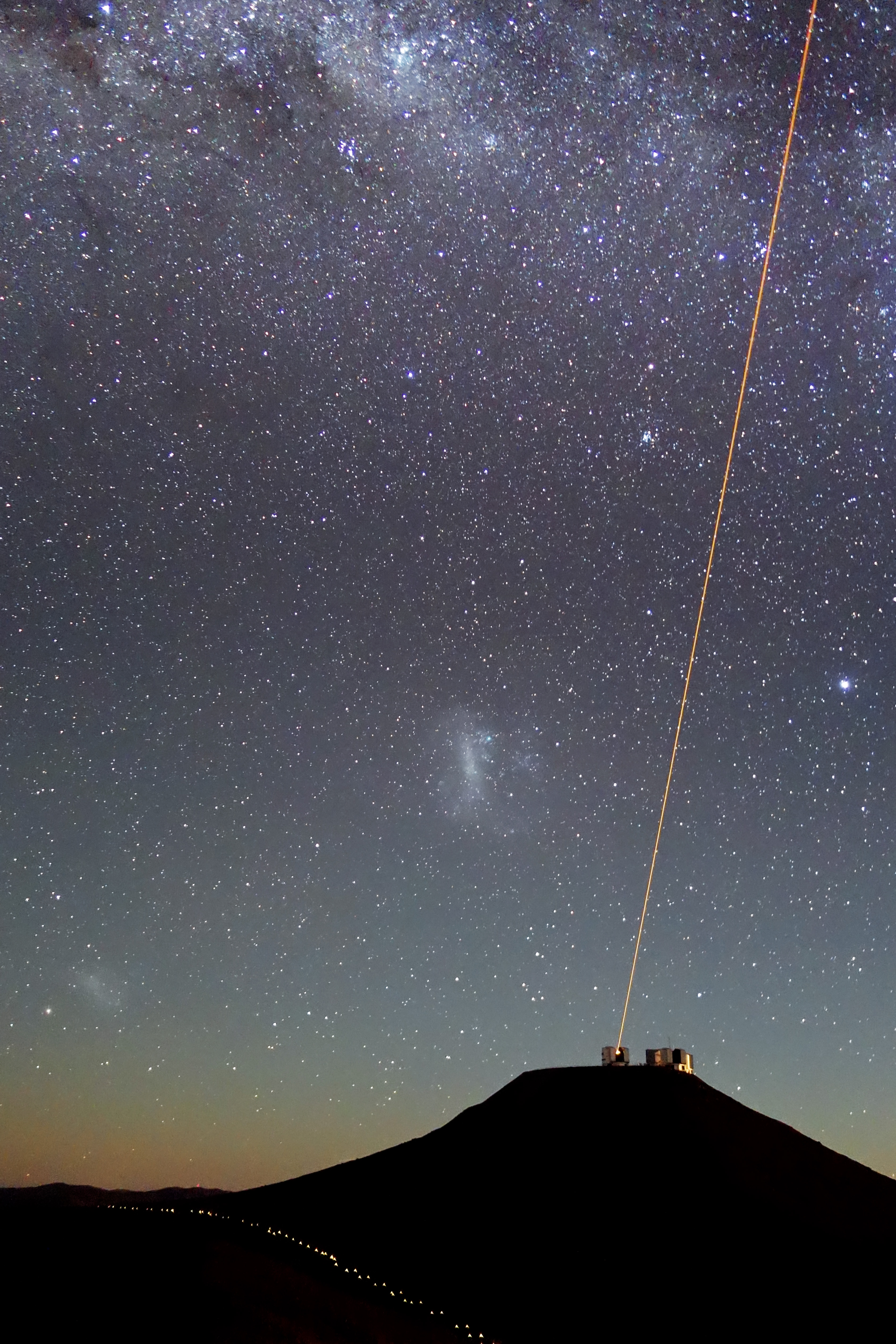
English: A solitary laser beam cuts through the night sky. It streaks upwards from Unit Telescope 4 of ESO's Very Large Telescope, located at Paranal Observatory in Chile. The two Magellanic Clouds are visible to the left of the beam as faint, fuzzy patches against the starry background. The particularly bright star to the right of the beam is Canopus, the second brightest star in our night sky after Sirius. When ground-based telescopes view stars, the light they collect must travel through the layers of our atmosphere. The same water vapour, pollution, and turbulence that causes the stars in the sky to twinkle also result in blurred images— so in comes a technique known as adaptive optics. Adaptive optics systems use sophisticated deformable mirrors to counteract the negative effects of our atmosphere. The laser shines up into the sky, creating an artificial star about 90 kilometres from the ground. Astronomers can then measure how this fake star twinkles in time, and can correct for this distortion. Telescopes that use adaptive optics can produce images sharper than those from space-based telescopes at certain wavelengths. A similar system is to be installed on the European Extremely Large Telescope (E-ELT). The E-ELT willhave six lasers, which will provide even higher-quality astronomical images over a much larger field-of-view — and provide more opportunities for striking snaps like this one. This image was taken on 4 March 2013 from the Visible and Infrared Survey Telescope for Astronomy (VISTA) platform by ESO photo ambassador Julien Girard, a staff astronomer at ESO. It was taken using a point and shoot compact camera which nowadays can perform night photography. |
||
| Date | Taken on 27 October 2014, 10:00:00 | ||
| Source |
|
||
| Author | ESO/J. Girard (djulik.com) |


Licensing
_logo.svg) |
This media was created by the European Southern Observatory (ESO).
Their website states: "Unless specifically noted, the images, videos, and music distributed on the public ESO website, along with the texts of press releases, announcements, pictures of the week, blog posts and captions, are licensed under a Creative Commons Attribution 4.0 International License, and may on a non-exclusive basis be reproduced without fee provided the credit is clear and visible." To the uploader: You must provide a link (URL) to the original file and the authorship information if available. |
  This file is licensed under the Creative Commons Attribution 4.0 International license. Attribution: ESO/J. Girard
| |
File history
Click on a date/time to view the file as it appeared at that time.
| Date/Time | Thumbnail | Dimensions | User | Comment | |
|---|---|---|---|---|---|
| current | 19:07, 2 October 2018 | | 3,372 × 5,058 (4.11 MB) | wikimediacommons>Sergkarman | size |
File usage
The following page uses this file:
