File:Blue-white test.jpg

Original file (800 × 800 pixels, file size: 288 KB, MIME type: image/jpeg)
Summary
| Description |
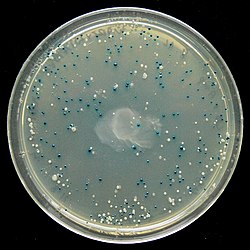
English: Blue-white screening is a popular and efficient molecular biology technique for the identification of recombinant bacteria in cloning experiments.
It relies on the activity of the enzyme β-galactosidase (β-gal), naturally occurring enzyme in E. coli cells, which cleaves lactose molecules into glucose and galactose. β-gal is encoded by the lacZ gene in the bacterial chromosome. There is also the M15 strain of E. coli with a deletion mutation of a fragment of the Lac gene that produces an inactive β-gal (called ω-peptide).
Due to α-complementation process, E. coli strains with lacZΔM15 deletion mutation that carries the plasmid vector containing the lacZα sequence can produce the functional β-gal enzyme.
For screening the clones with recombinant DNA, X-gal, Isopropyl β-D-1-thiogalactopyranoside (IPTG) along with an antibiotic (such as ampicillin) is added to the medium. X-gal is a chromogenic substrate, and IPTG is a galactose analog that induces lacZ gene expression.
The plasmid vector is designed to contain multiple cloning site (MCS) is present within the lacZ sequence. Consequently, in the plasmid with an insert (foreign DNA), α-complementation does not occur, thus a functional β-galactosidase enzyme is not formed. Blue colonies contain E. coli producing a functional enzyme that hydrolyzes X-gal, resulting in an insoluble blue pigment. In other words, these are bacteria without the insert that have a a functional LacZ gene. White colonies are formed when a plasmid vector containing insert with foreign DNA (which disrupts the lacZ gene) is taken up by the E. coli, α-complementation does not occur, and therefore the functional enzyme β-gal is not produced. Next, the desired white recombinant colonies can be easily selected and cultured. The presence of the antibiotic in the medium ensures that only E.coli containing a plasmid-borne antibiotic-resistance gene (eg. ampR selectable marker) can grow at all.Polski: Test blue-white. Płytka agarowa z wyrośniętymi białymi i niebieskimi koloniami E. coli. |
||
| Date | |||
| Source | Own work | ||
| Author | Stefan Walkowski | ||
| Permission (Reusing this file) |
I, the copyright holder of this work, hereby publish it under the following licenses:
   This file is licensed under the Creative Commons Attribution-Share Alike 4.0 International, 3.0 Unported, 2.5 Generic, 2.0 Generic and 1.0 Generic license.
You may select the license of your choice. |




File history
Click on a date/time to view the file as it appeared at that time.
| Date/Time | Thumbnail | Dimensions | User | Comment | |
|---|---|---|---|---|---|
| current | 17:05, 13 January 2010 | | 800 × 800 (288 KB) | wikimediacommons>Navaho | {{Information |Description={{en|1=Blue white screen. Agar plate with blue and white bacterial colonies.}} {{pl|1=Test blue-white. Płytka agarowa z wyrośniętymi białymi i niebieskimi koloniami E. coli. }} |Source={{own}} |Author=Navaho |
File usage
The following page uses this file:
