File:Language families of Asia.png
Jump to navigation
Jump to search
No higher resolution available.
Language_families_of_Asia.png (741 × 580 pixels, file size: 35 KB, MIME type: image/png)
 Any autoconfirmed user can overwrite this file from the same source. Please ensure that overwrites comply with the guideline.
Summary
| Description |
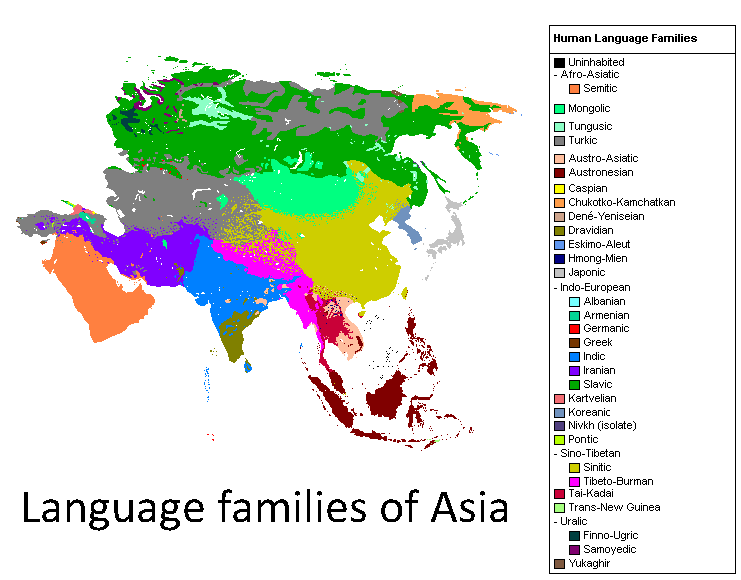
English: Of the many language families of Asia, Indo-European (purple, blue, and medium green) and Sino-Tibetan (chartreuse and pink) dominate numerically, while Altaic families (grey, bright green, and maroon) occupy large areas geographically. Regionally dominant families are Japonic in Japan (light gray), Austronesian in the Malay Archipelago (dark red), Kadai and Mon–Khmer in Southeast Asia (azure and peach), Dravidian in South India (khaki), Turkic in Central Asia (grey), and Semitic in the Mideast (orange). |
| Date | 29 January 2012 (original upload date) |
| Source | |
| Author | Industrius at English Wikipedia, Mttll at English Wikipedia, Kwamikagami at English Wikipedia, etc. |


|
This image could be re-created using vector graphics as an SVG file. This has several advantages; see Commons:Media for cleanup for more information. If an SVG form of this image is available, please upload it and afterwards replace this template with
{{vector version available|new image name}}.It is recommended to name the SVG file “Language families of Asia.svg”—then the template Vector version available (or Vva) does not need the new image name parameter. |
Licensing
Kwamikagami at English Wikipedia, the copyright holder of this work, hereby publishes it under the following licenses:


This file is licensed under the Creative Commons Attribution-Share Alike 3.0 Unported license.
Attribution:
- You are free:
- to share – to copy, distribute and transmit the work
- to remix – to adapt the work
- Under the following conditions:
- attribution – You must give appropriate credit, provide a link to the license, and indicate if changes were made. You may do so in any reasonable manner, but not in any way that suggests the licensor endorses you or your use.
- share alike – If you remix, transform, or build upon the material, you must distribute your contributions under the same or compatible license as the original.

|
Permission is granted to copy, distribute and/or modify this document under the terms of the GNU Free Documentation License, Version 1.2 or any later version published by the Free Software Foundation; with no Invariant Sections, no Front-Cover Texts, and no Back-Cover Texts. A copy of the license is included in the section entitled GNU Free Documentation License. |
You may select the license of your choice.
Original upload log
Transferred from en.wikipedia to Commons by Quadell using CommonsHelper.
The original description page was here. All following user names refer to en.wikipedia.

- 2012-01-29 14:21 Kwamikagami 841×407× (32209 bytes) {{Information |Description = Language families of Asia |Source = Clipped from [[:File:Human Language Families Map.PNG]] |Date = ~~~~~ |Author = ~~~ |other_versions = }}
File history
Click on a date/time to view the file as it appeared at that time.
| Date/Time | Thumbnail | Dimensions | User | Comment | |
|---|---|---|---|---|---|
| current | 15:19, 19 June 2024 | No thumbnail | 741 × 580 (35 KB) | wikimediacommons>SamBrev | The previous edit inadvertently mis-coloured the Arabian peninsula; this edit reverts that error, while keeping the changes made re. Azerbaijan |
File usage
The following page uses this file:
