File:PIA18078-PossibleBeginning-NewMoonOfPlanetSaturn-20130415.jpg

PIA18078-PossibleBeginning-NewMoonOfPlanetSaturn-20130415.jpg (496 × 496 pixels, file size: 11 KB, MIME type: image/jpeg)

Summary
| Description |
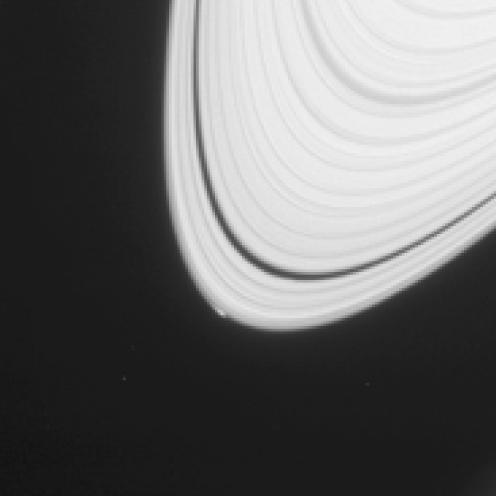
English: Commotion at Ring's Edge May Be Effect of Small Icy Object
http://www.jpl.nasa.gov/spaceimages/details.php?id=PIA18078 http://www.jpl.nasa.gov/news/news.php?release=2014-112 The disturbance visible at the outer edge of Saturn's A ring in this image from NASA's Cassini spacecraft could be caused by an object replaying the birth process of icy moons. The image is adapted from one in a paper in the journal Icarus, reporting the likely presence of an icy body causing gravitational effects on nearby ring particles, producing the bright feature visible at the ring's edge. The object, informally called "Peggy," is estimated to be no more than about half a mile, or one kilometer, in diameter. It may be in the process of migrating out of the ring, a process that one recent theory proposes as a step in the births of Saturn's several icy moons. This image is a portion of an observation recorded by the narrow-angle camera of Cassini's imaging science subsystem on April 15, 2013. The bright feature at the edge of the A ring is about 750 miles (about 1,200 kilometers) long. This view looks toward the illuminated side of the rings from about 53 degrees above the plane of the rings. It was obtained from a distance of approximately 775,000 miles (1.2 million kilometers) from Saturn, with a sun-Saturn-spacecraft, or phase, angle of 31 degrees. The scale is about 4 miles (about 7 kilometers) per pixel. The Cassini-Huygens mission is a cooperative project of NASA, the European Space Agency and the Italian Space Agency. NASA's Jet Propulsion Laboratory, a division of the California Institute of Technology in Pasadena, manages the mission for NASA's Science Mission Directorate, Washington. The Cassini orbiter and its two onboard cameras were designed, developed and assembled at JPL. The imaging operations center is based at the Space Science Institute in Boulder, Colo. For more information about the Cassini-Huygens mission visit http://saturn.jpl.nasa.gov and http://www.nasa.gov/cassini. The Cassini imaging team homepage is at http://ciclops.org. |
| Date | |
| Source | http://photojournal.jpl.nasa.gov/jpeg/PIA18078.jpg |
| Author | NASA/JPL-Caltech/Space Science Institute |
Licensing

|
The copyright holder of this file, NASA/JPL-Caltech, allows anyone to use it for any purpose, provided that the copyright holder is properly attributed. Redistribution, derivative work, commercial use, and all other use is permitted. |
|
|
 
|
According to JPL's image use policy additional restriction is that no endorsement of any product or service by Caltech, JPL or NASA is claimed or implied.
Caltech's disclaimer: Caltech makes no representations or warranties with respect to ownership of copyrights in the images, and does not represent others who may claim to be authors or owners of copyright of any of the images, and makes no warranties as to the quality of the images. Caltech shall not be responsible for any loss or expenses resulting from the use of the images, and you release and hold Caltech harmless from all liability arising from such use. Usage on the English Wikipedia: On the English Wikipedia you can use the {{JPL Image}} template to display the copyright notice. (See w:Wikipedia:Using JPL images for details) |
File history
Click on a date/time to view the file as it appeared at that time.
| Date/Time | Thumbnail | Dimensions | User | Comment | |
|---|---|---|---|---|---|
| current | 01:06, 15 April 2014 | | 496 × 496 (11 KB) | wikimediacommons>Drbogdan | User created page with UploadWizard |
File usage
The following page uses this file:
