File:Phase diag iron carbon.PNG
Phase_diag_iron_carbon.PNG (409 × 379 pixels, file size: 3 KB, MIME type: image/png)


|
File:Brosen ironcarbon.svg is a vector version of this file. It should be used in place of this PNG file when not inferior.
File:Phase diag iron carbon.PNG → File:Brosen ironcarbon.svg
For more information, see Help:SVG. |
 |
An English version of Diag phase fer carbone.png, with grey tones cleaned up and some modification of text. Adaptation by Polyparadigm. Description of original image follows:
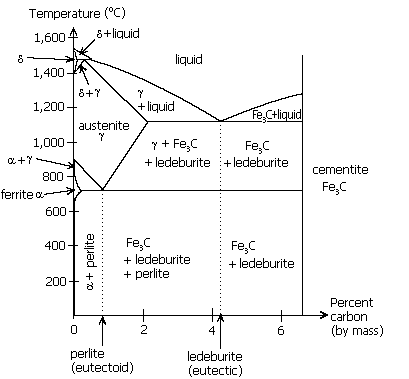
Iron-carbon phase diagram under atmospheric pressure
This diagram is limited by pure iron on the left and by iron carbide on the right. The mains phases are:
- α iron: ferrite, ferritic steel
- γ iron: austenite, austenitic steel
- iron carbide: cementite, Fe3C.
We can see an eutectic and an eutectoid; these phases crystallise as a stacking of fine strips of pure phases (iron and cementite) in case of the eutectoid, or a pure iron containing small balls of cementite for the eutectic. Although it is heterogeneous, these phases behave like homogeneous pure bodies.
Steel is between 0 and 2 mass percent of carbon. Cast iron is between 1,7 and 6,67%.
Author : Christophe Dang Ngoc Chan

|
Permission is granted to copy, distribute and/or modify this document under the terms of the GNU Free Documentation License, Version 1.2 or any later version published by the Free Software Foundation; with no Invariant Sections, no Front-Cover Texts, and no Back-Cover Texts. A copy of the license is included in the section entitled GNU Free Documentation License. |
  
|
This file is licensed under the Creative Commons Attribution-Share Alike 3.0 Unported license. | |
| ||
| This licensing tag was added to this file as part of the GFDL licensing update. |
derivative works
Derivative works of this file: Wykres zelazo wegiel.jpg

File history
Click on a date/time to view the file as it appeared at that time.
| Date/Time | Thumbnail | Dimensions | User | Comment | |
|---|---|---|---|---|---|
| current | 18:34, 9 July 2005 | | 409 × 379 (3 KB) | wikimediacommons>Polyparadigm~commonswiki | An English version of Diag phase fer carbone.png, with grey tones cleaned up and some modification of text. Adaptation by Polyparadigm. Description of original image follows: ---- Iron-carbon phase diagram under atmospheric pressure This diag |
File usage
The following page uses this file:
