File:S74-15583skylabsunview.jpg
Jump to navigation
Jump to search
Size of this preview: 782 × 600 pixels. Other resolutions: 313 × 240 pixels | 626 × 480 pixels | 1,002 × 768 pixels | 1,280 × 982 pixels | 2,560 × 1,963 pixels | 4,367 × 3,349 pixels.



Original file (4,367 × 3,349 pixels, file size: 2.81 MB, MIME type: image/jpeg)

Summary
| Description |
English: caption:
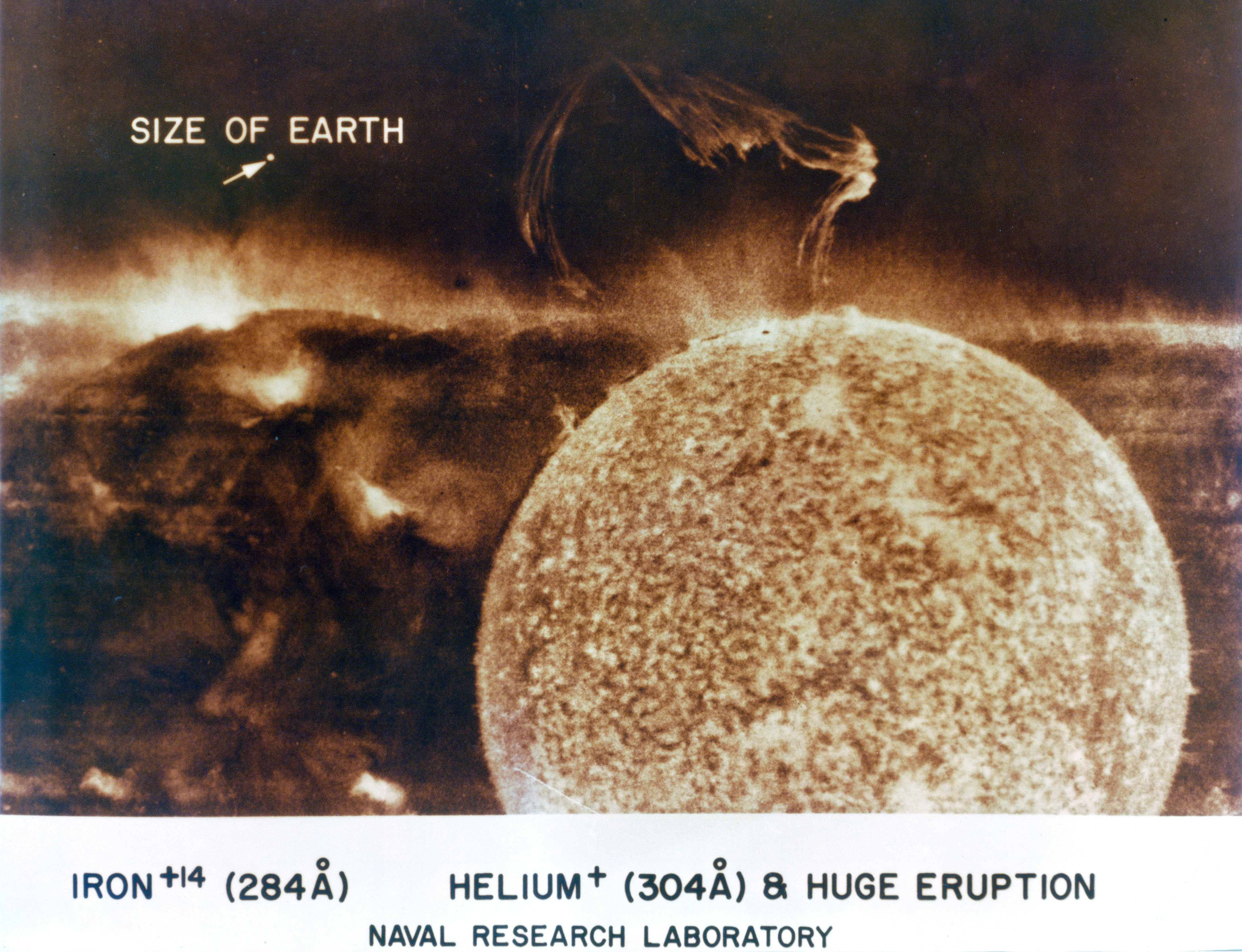
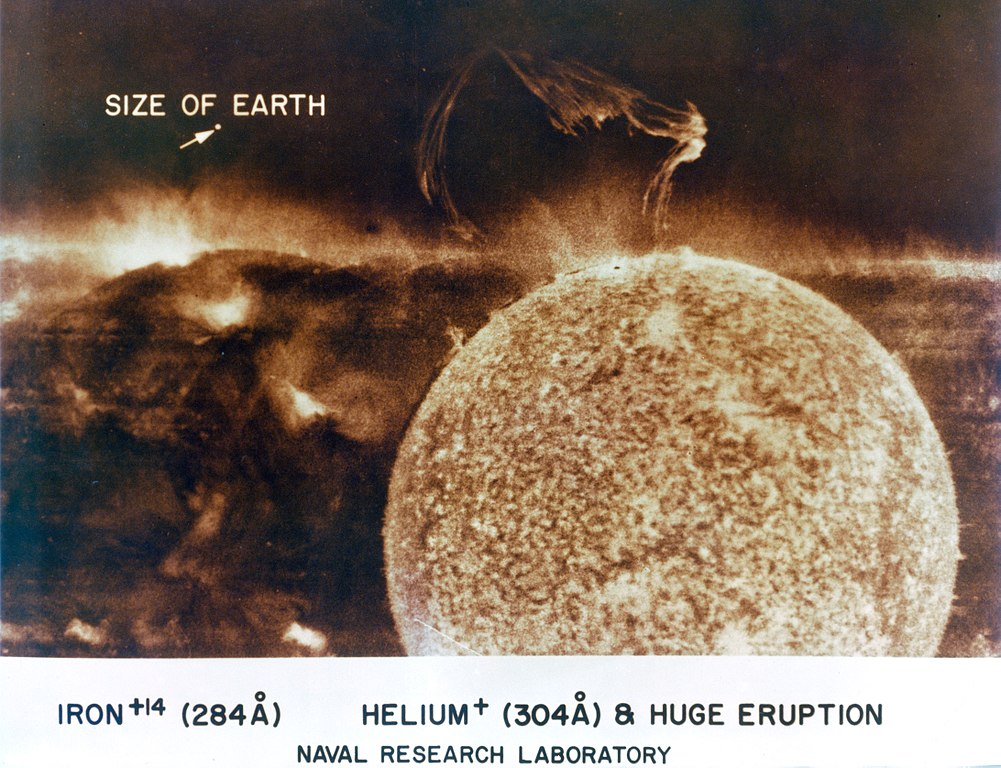
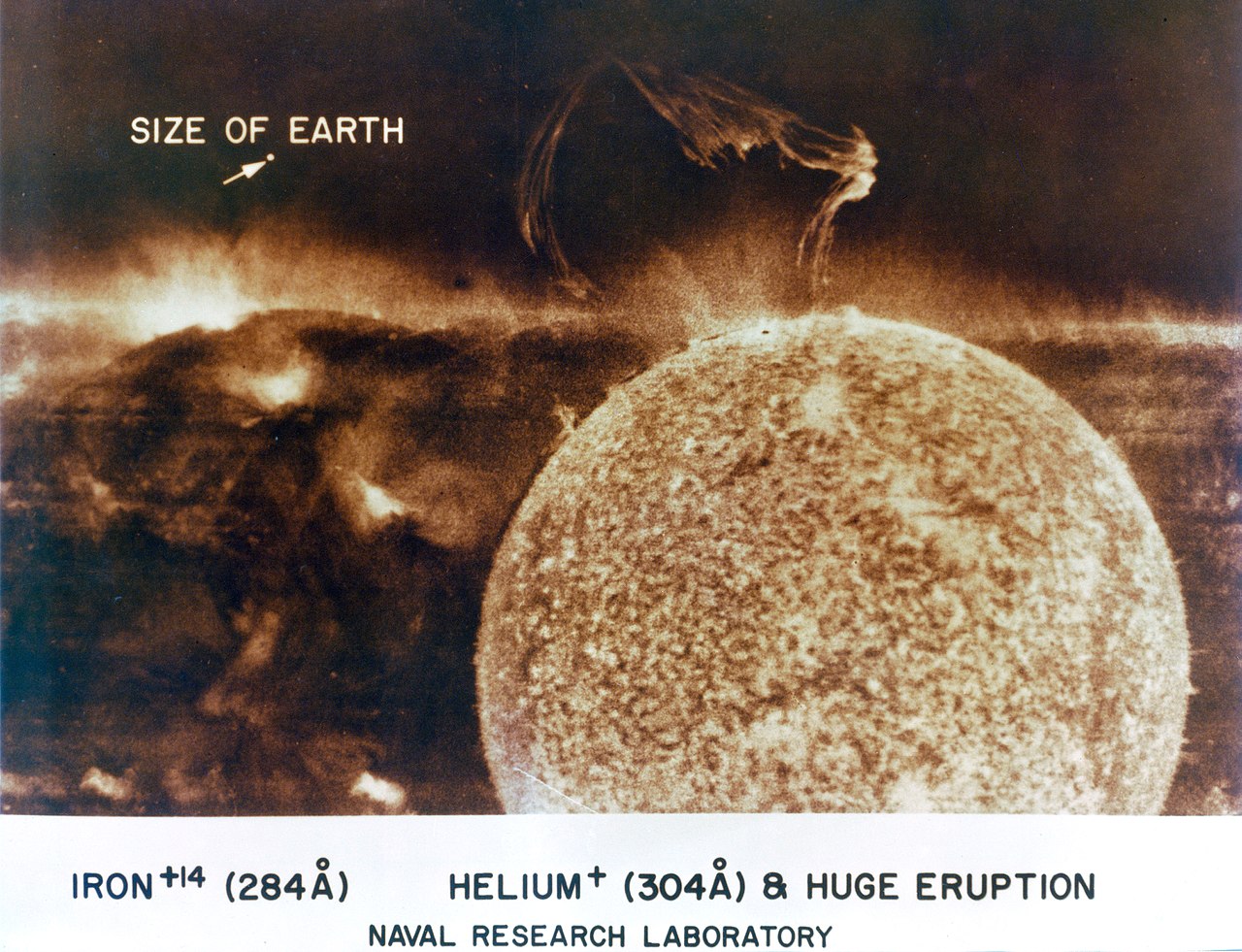
S74-15583 (July 1973) --- A huge solar eruption can be seen in this Spectroheliogram obtained during the Skylab 3 mission by the Extreme Ultraviolet Spectrograph/Spectroheliograph SO82A Experiment aboard the Skylab space station in Earth orbit. SO82 is one of the Apollo Telescope Mount experiments. The SO82 A instrument covers the wavelength region from 150-650 angstroms (EUV regions). The magnitude of the eruption can be visualized by comparing it with the small white dot that represents the size of Earth. This photograph reveals for the first time that helium erupting from the sun can stay together to altitudes of up to 500,000 miles. After being ejected from the sun, the gas clouds seem to have come to a standstill, as though blocked by an unseen wall. Some materials appear to have been directed back toward the sun as a rain, distinguished by fine threads. At present it is a challenge to explain this mystery--what forces expelled these huge clouds, then blocked its further progress, yet allowed the cloud to maintain its threads. Both magnetic fields and gravity must play a part, but these curious forms seem to defy explanation based on magnetic and gravitational fields alone. The EUV spectroheliograph was designed and constructed by the U.S. Naval Research Laboratory and the Ball Brothers Research Corporation under the direction of Dr. R. Tousey, the principal investigator for this NASA experiment. On the left may be seen the sun's image in emission from iron atoms which have lost 14 electrons by collision in the sun's million-degree coronal plasma gas. |
| Date | |
| Source | http://spaceflight.nasa.gov/gallery/images/skylab/skylab3/html/s74-15583.html |
| Author | Photo credit: NASA |
Licensing

|
This file is in the public domain in the United States because it was solely created by NASA. NASA copyright policy states that "NASA material is not protected by copyright unless noted". (See Template:PD-USGov, NASA copyright policy page or JPL Image Use Policy.) |  |
 |
Warnings:
|

Original upload log
The original description page was here. All following user names refer to en.wikipedia.

| Date/Time | Dimensions | User | Comment |
|---|---|---|---|
| 2017-01-11 15:06 | 4367×3349× (2951113 bytes) | Fotaun | {{PD-NASA}} http://spaceflight.nasa.gov/gallery/images/skylab/skylab3/html/s74-15583.html caption: S74-15583 (July 1973) --- A huge solar eruption can be seen in this Spectroheliogram obtained during the Skylab 3 mission by the Extreme Ultraviolet Sp... |
File history
Click on a date/time to view the file as it appeared at that time.
| Date/Time | Thumbnail | Dimensions | User | Comment | |
|---|---|---|---|---|---|
| current | 08:10, 17 September 2017 | | 4,367 × 3,349 (2.81 MB) | wikimediacommons>Jcpag2010 | Transferred from en.wikipedia |
File usage
The following page uses this file:
