File:The hidden fires of the Flame Nebula.jpg
Jump to navigation
Jump to search

Size of this preview: 493 × 600 pixels. Other resolutions: 197 × 240 pixels | 395 × 480 pixels | 631 × 768 pixels | 842 × 1,024 pixels | 1,684 × 2,048 pixels | 12,564 × 15,283 pixels.
Original file (12,564 × 15,283 pixels, file size: 36.75 MB, MIME type: image/jpeg)
| Warning | The original file is very high-resolution. It might not load properly or could cause your browser to freeze when opened at full size. |
|---|
Summary
| Description |
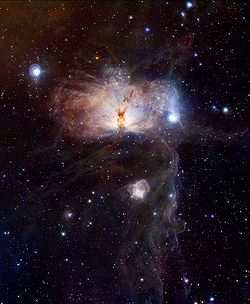
English: This VISTA image shows the spectacular star-forming region known as the Flame Nebula, or NGC 2024, in the constellation of Orion (the Hunter) and its surroundings. In views of this evocative object in visible light the core of the nebula is completely hidden behind obscuring dust, but in this VISTA view, taken in infra-red light, the cluster of very young stars at the object’s heart is revealed. The wide-field VISTA view also includes the glow of the reflection nebula NGC 2023, just below centre, and the ghostly outline of the Horsehead Nebula (Barnard 33) towards the lower right. The bright bluish star towards the right is one of the three bright stars forming the Belt of Orion. The image was created from VISTA images taken through J, H and Ks filters in the near-infrared part of the spectrum. The image shows the full area of the VISTA field and is one degree by 1.5 degrees in extent. The total exposure time was 14 minutes.
Français : Image obtenue par le télescope VISTA montrant la Nébuleuse de la flamme (ou NGC 2024), une région de formation d'étoiles dans la constellation d'Orion et ses environs. En visible, le cœur de la nébuleuse est masqué par des nuages de poussière. Dans cette vue infrarouge un groupe de très jeunes étoiles en train de se former est visible. L'étoile brillante bleue sur la droite est l'une des trois étoiles de la ceinture d'Orion. Image prise dans le proche infrarouge (filtres J, H et K) et couvrant une surface de 1 par 1,5 degrés. Temps d'exposition : 14 minutes.
Italiano: La regione di formazione stellare nota come Nebulosa Fiamma, una nebulosa a emissione visibile nella costellazione di Orione. Nella foto sono evidenziate anche le nebulose Testa di Cavallo ed NGC 2023, e la stella Alnitak, una delle tre stelle che costituiscono la Cintura di Orione. L'immagine è stata creata elaborando una serie di foto scattate dal telescopio VISTA nelle bande dell'infrarosso vicino (filtri J, H e Ks, campo di visione: 1° per 1,5° gradi, tempo di esposizione: 14 minuti) |
| Date | |
| Source | ESO |
| Author | ESO/J. Emerson/VISTA. Acknowledgment: Cambridge Astronomical Survey Unit |
| Other versions |
|


|




|
This image was selected as picture of the day on Wikimedia Commons for 7 April 2010. It was captioned as follows: English: The spectacular star-forming region known as the Flame Nebula, or NGC 2024, in the constellation of Orion (the Hunter) and its surroundings. The famous Horsehead Nebula is in the lower right part of the image. Other languages:
Català: El Complex d'Orió, un núvol molecular de la constel·lació d'Orió. Al centre hi ha la Nebulosa de la Flama (NGC 2024), amb el sistema estel·lar Alnitak, una de les «Tres Maries». A baix a la dreta, la nebulosa fosca del Cap de Cavall. Čeština: Emisní mlhovina Plamínek (NGC 2024) v souhvězdí Orionu; v pravé dolní části je vidět známá mlhovina Koňská hlava Dansk: Den spektakulære stjernedannelsesregion, der kendes som flammetågen (NGC 2024) i stjernebilledet Orion, og dens omgivelser. Den berømte hestehovedtåge ses nederst til venstre i billedet. Deutsch: Die spektakulären Kinderstuben von Sternen sind als Flammennebel oder NGC 2024 im Sternbild des Orion (der Jäger) und dessen Umgebung zu finden. Der bekannteste davon ist der Pferdekopfnebel im unteren rechten Teil des Bildes. English: The spectacular star-forming region known as the Flame Nebula, or NGC 2024, in the constellation of Orion (the Hunter) and its surroundings. The famous Horsehead Nebula is in the lower right part of the image. Español: La región de estrellas en formación conocida como Nebulosa de la Flama, o NGC 2024, en la constelación de Orión y sus alrededores. La famosa Nebulosa Cabeza de Caballo está en la parte inferior derecha de la imagen. Italiano: La regione di formazione stellare nota come Nebulosa Fiamma, una nebulosa a emissione visibile nella costellazione di Orione. Nella foto sono evidenziate anche le nebulose Testa di Cavallo ed NGC 2023, e la stella Alnitak, una delle tre stelle che costituiscono la Cintura di Orione Magyar: Az NGC 2024 csillagkeletkezési régió, a kép jobb alsó sarkában a Lófej-köddel, a VISTA távcső felvételén. Nederlands: De sterrenvormende regio Vlamnevel (NGC 2024) in het sterrenbeeld Orion en omgeving. Beneden rechts is de Paardenkopnevel (een absorptienevel) zichtbaar en schuin links daarboven de reflectienevel NGC 2023. Македонски: Спектакуларниот ѕвездотворен предел наречен „Огнена маглина“, или NGC 2024, во соѕвездието Орион и неговото окружување. Познатата маглина Коњска Глава е долу-десно на сликата. Українська: Емісійна туманність NGC 2024 (Туманність Полум'я) в сузір'ї Оріона. Внизу праворуч — знаменита Туманність Кінська Голова. বাংলা : নক্ষত্র সৃষ্টির স্থান, যা ফ্লেইম নেবুলা (জলন্ত নিহারীকা) বা এনজিসি ২০২৪ নামে পরিচিত। এটি কালপুরুষ তারকামণ্ডলে অবস্থিত। বিখ্যাত হর্সহেড নেবুলাকে (অশ্বমুণ্ডাকৃতি নিহারীকা) নিচের ডানে দেখা যাচ্ছে। עברית : אזור היווצרות כוכבים מרהיב המכונה ערפילית הלהבה בקבוצת הכוכבים אוריון וסביבתו. ערפילית ראש הסוס המפורסמת מופיעה בחלק הימני התחתון של התמונה. |
The image was created from VISTA images taken through J, H and Ks filters in the near-infra-red part of the spectrum. The image shows the full area of the VISTA field and is one degree by 1.5 degrees in extent. The total exposure time was 14 minutes.
Licensing
_logo.svg) |
This media was created by the European Southern Observatory (ESO).
Their website states: "Unless specifically noted, the images, videos, and music distributed on the public ESO website, along with the texts of press releases, announcements, pictures of the week, blog posts and captions, are licensed under a Creative Commons Attribution 4.0 International License, and may on a non-exclusive basis be reproduced without fee provided the credit is clear and visible." To the uploader: You must provide a link (URL) to the original file and the authorship information if available. |
  This file is licensed under the Creative Commons Attribution 4.0 International license.
| |
| Annotations | This image is annotated: View the annotations at Commons |
File history
Click on a date/time to view the file as it appeared at that time.
| Date/Time | Thumbnail | Dimensions | User | Comment | |
|---|---|---|---|---|---|
| current | 12:39, 11 December 2009 | | 12,564 × 15,283 (36.75 MB) | wikimediacommons>Originalwana | {{Information |Description={{en|1=This VISTA image shows the spectacular star-forming region known as the Flame Nebula, or NGC 2024, in the constellation of Orion (the Hunter) and its surroundings. In views of this evocative object in visible light th |
File usage
The following page uses this file:
