File:Tyndall setup for looking at aerosols.jpg


Original file (1,173 × 669 pixels, file size: 237 KB, MIME type: image/jpeg)

Summary
| Description |
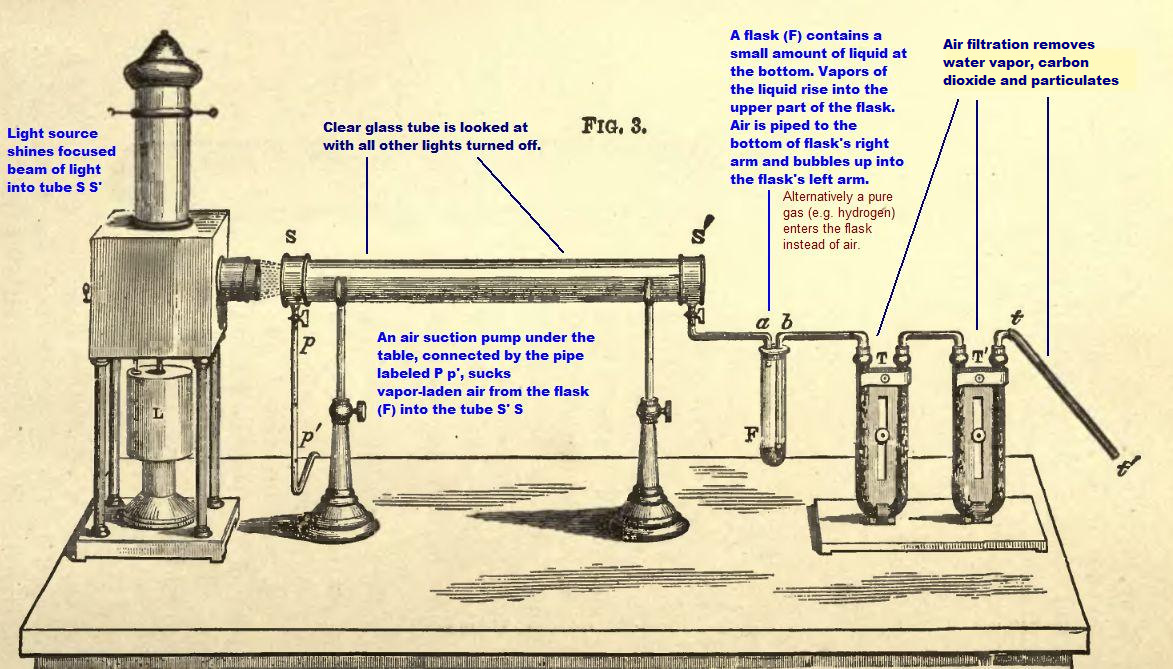
English: John Tyndall's illustration of his setup for looking at aerosols (1868), subsequently annotated in colored typeface.
The above apparatus is meant to be looked at in a dark room, i.e., a room with no light except for the illuminated glass tube at the center of the picture. Its basic idea is to bring a chemical vapor into the illuminated glass tube by a suction pump (the suction pump is under the table). The illustration dates from 1868. With this apparatus John Tyndall found that a variety of vapors, initially clear and transparent to light, became cloudy with more exposure to the light due to chemical decomposition of the vapor molecules. He verified that it was the light itself that caused this decomposition. The chemical reaction in response to the light was in some cases rapid (e.g. when the vapor was amyl nitrite) and in other cases very gradual (e.g. when the vapor was isopropyl iodide). Some vapors formed white clouds, others formed blue or purple clouds. The clouds took on distinctive shapes and swirled in "paroxysms of motion", in some cases. Tyndall demonstrated that the particular wavelengths that produced a photochemical decomposition depended on the particular type of vapor molecule that was decomposed, although in all cases the light was predominantly or exclusively in the blue and near UV area. Tyndall uses these photochemical reactions as context for talking about the question of the mechanism by which molecules absorb radiant energy. The illustration is in Tyndall's report "New Chemical Reactions Produced by Light" (1868) and again in Tyndall's "On the Action of Rays of High Refrangibility upon Gaseous Matter" (1870). It is also included in the later editions of his book Heat as a Mode of Motion even though it is not a heat phenomenon. |
| Date | |
| Source | The illustration appears in John Tyndall's book "Fragments of Science, Volume One" and has been taken from a copy of the book at Archive.org. |
| Author | John Tyndall's commissioned drawer (anon) |
Licensing

|
This work is in the public domain in its country of origin and other countries and areas where the copyright term is the author's life plus 100 years or fewer.  You must also include a United States public domain tag to indicate why this work is in the public domain in the United States. You must also include a United States public domain tag to indicate why this work is in the public domain in the United States.
|
| This file has been identified as being free of known restrictions under copyright law, including all related and neighboring rights. | |
Original upload log

| Date/Time | Dimensions | User | Comment |
|---|---|---|---|
| 2009-03-02 23:17 | 1173×669× (242796 bytes) | Seanwal111111 | Tyndall constructed this apparatus to observe various kinds of aerosols and vapors inside an illuminated glass tube. He observed that some vapors, initially clear and transparent to light, became cloudy with more exposure to the light due to chemical deco |
File history
Click on a date/time to view the file as it appeared at that time.
| Date/Time | Thumbnail | Dimensions | User | Comment | |
|---|---|---|---|---|---|
| current | 08:19, 2 April 2017 | | 1,173 × 669 (237 KB) | wikimediacommons>Frankemann | Transferred from en.wikipedia |
File usage
The following page uses this file:
