John Hinckley Jr.
Template:Short description Template:Use mdy dates Template:Infobox criminal John Warnock Hinckley Jr. (born May 29, 1955) is an American man who attempted to assassinate U.S. president Ronald Reagan as he left the Hilton Hotel in Washington, D.C., on March 30, 1981, two months after Reagan's first inauguration. Using a revolver, Hinckley wounded Reagan, police officer Thomas Delahanty, Secret Service agent Tim McCarthy and White House Press Secretary James Brady. Brady was left disabled and died 33 years later from his injuries.<ref>{{#invoke:citation/CS1|citation |CitationClass=web }}</ref>
Hinckley was reportedly seeking fame to impress actress Jodie Foster, with whom he had a fixation after watching her in Martin Scorsese's 1976 film Taxi Driver. He was found not guilty by reason of insanity and remained under institutional psychiatric care for over three decades.<ref name="foxnews.com">Template:Cite news</ref> Public outcry over the verdict led state legislatures and Congress to narrow their respective insanity defenses.
In 2016, a federal judge ruled that Hinckley could be released from psychiatric care as he was no longer considered a threat to himself or others, albeit with many conditions. After 2020, a ruling was issued that Hinckley may showcase his artwork, writings, and music publicly under his own name, rather than anonymously as he had in the past. Since then, he has maintained a YouTube channel for his music. His restrictions were unconditionally lifted in June 2022.<ref name=":0" />
Family and early life
John Warnock Hinckley Jr. was born in Ardmore, Oklahoma<ref name=UMKC>{{#invoke:citation/CS1|citation |CitationClass=web }}</ref><ref>"John Hinckley Jr Fast Facts" Template:Webarchive. CNN. Retrieved September 19, 2013.</ref> and moved with his wealthy family to Dallas, Texas at the age of four. His father was John Warnock Hinckley Sr. (1925–2008), founder, chairman, chief executive and president of the Vanderbilt Energy Corporation.<ref>Template:Cite news</ref> His mother was Jo Ann Hinckley (née Moore; 1925–2021).<ref>Template:Cite news</ref>
Hinckley's father was a financial supporter of George H.W. Bush in the 1980 election campaign. Bush was Reagan's biggest rival for the Republican Party's presidential nomination. Hinckley's older brother Scott, who became vice president of his father's oil company after graduating from college, was supposed to have dinner at Neil Bush's house the day after the assassination attempt.<ref>Arthur Wiese, Downing, Margaret: Bush's Son Was To Dine With Suspect's Brother, The Houston Post, 31 March 1981 </ref><ref>{{#invoke:citation/CS1|citation |CitationClass=web }}</ref> The connection between the two families has occasionally been used for conspiracy theories, for example by Roger Stone.<ref>{{#invoke:citation/CS1|citation |CitationClass=web }}</ref>
Hinckley grew up in University Park, Texas,<ref name=AmericanExperience>{{#invoke:citation/CS1|citation |CitationClass=web }}</ref> and attended Highland Park High School<ref>Template:Cite news</ref> in Dallas County. After Hinckley graduated from high school in 1973, his family, owners of the Hinckley oil company, moved to Evergreen, Colorado, where the new company headquarters was located.<ref name="UMKC"/> He was an off-and-on student at Texas Tech University from 1974 to 1980, but eventually dropped out.<ref>Template:Cite book</ref>
In 1975, Hinckley went to Los Angeles in the hope of becoming a songwriter. His efforts were unsuccessful, and he wrote to his parents with tales of misfortune and pleas for money. He spoke of a girlfriend, Lynn Collins, who turned out to be a fabrication. In September 1976, he returned to his parents' home in Evergreen.<ref name="Noe">{{#invoke:citation/CS1|citation |CitationClass=web }}</ref>Template:Rp
In the late 1970s and early 1980s, Hinckley began purchasing weapons and practicing with them. He was prescribed antidepressants and tranquilizers to deal with his emotional problems.<ref name=UMKC/>
Obsession with Jodie Foster
Hinckley became obsessed with the 1976 film Taxi Driver, in which disturbed protagonist Travis Bickle (Robert De Niro) plots to assassinate a presidential candidate. Bickle was partly based on the diaries of Arthur Bremer, who attempted to assassinate George Wallace.<ref name=AmericanExperience/> Hinckley developed an infatuation with Iris, a sexually trafficked 12-year-old child, played by Jodie Foster. Hinckley began to adopt the dress and mannerisms of the Travis Bickle character.<ref name="famoustrials">{{#invoke:citation/CS1|citation |CitationClass=web }}</ref>

When Foster entered Yale University, Hinckley moved to New Haven, Connecticut for a short time to stalk her. His parents had given him funds to attend a writing course at Yale. He never enrolled in the course, but instead used the money to support himself while sending Foster love letters and romantic poems, and repeatedly calling and leaving her messages.<ref name="famoustrials"/>
Failing to develop any meaningful contact with Foster, Hinckley fantasized about conducting an aircraft hijacking or killing himself in front of her to get her attention. Eventually, he settled on a scheme to impress her by assassinating the president, thinking that by achieving a place in history, he would appeal to her as an equal. Hinckley trailed President Jimmy Carter from state to state during his campaign for the 1980 United States presidential election and got to within 20 feet of him at a rally at Dayton, Ohio.<ref name="famoustrials"/>
On October 9, 1980, Hinckley was in Nashville, Tennessee, on the same day Carter was visiting the city. Hinckley was arrested at Nashville International Airport while trying to board a flight to New York with handcuffs and three unloaded guns in his hand-luggage. The airport police handed him over to the Metropolitan Nashville Police Department. Hinckley's guns and handcuffs were confiscated, and he was fined $50 plus court costs. He was released later the same day.<ref>{{#invoke:citation/CS1|citation |CitationClass=web }}</ref><ref>Template:Cite news</ref>
After Nashville, Hinckley flew to Dallas. On October 13, he bought more guns from a Dallas pawn shop. They included the .22 caliber Röhm RG-14 revolver he used five months later to attempt the assassination of Reagan.<ref>Template:Cite news</ref> The $3,600 from his parents was now exhausted and he returned home penniless.<ref name="famoustrials"/> He spent four months undergoing psychiatric treatment for depression, but his mental health did not improve.<ref name="famoustrials"/> In 1981, he began to target the newly elected president Ronald Reagan. For this purpose, he collected material on the assassination of John F. Kennedy.Template:Fact
Ronald Reagan assassination attempt
{{#invoke:Labelled list hatnote|labelledList|Main article|Main articles|Main page|Main pages}}

.jpg)
Hinckley arrived in Washington, D.C. on March 29, 1981, after travelling by Greyhound bus from Los Angeles. He spent the night in a hotel. The following morning, he read President Reagan's itinerary in a newspaper and discovered that later that day, Reagan was to be at the Hilton Hotel to address an AFL–CIO conference. Hinckley spent the morning composing a letter to Jodie Foster.<ref>{{#invoke:citation/CS1|citation |CitationClass=web }}</ref>
<templatestyles src="Template:Blockquote/styles.css" />
Over the past seven months I've left you dozens of poems, letters and love messages in the faint hope that you could develop an interest in me. Although we talked on the phone a couple of times I never had the nerve to simply approach you and introduce myself. ... The reason I'm going ahead with this attempt now is because I cannot wait any longer to impress you.{{#if:|
|}}{{#if:Excerpt from Hinckley's March 30 letter|
— {{#if:|, in }}Template:Comma separated entries
}}{{#invoke:Check for unknown parameters|check|unknown=Template:Main other|preview=Page using Template:Blockquote with unknown parameter "_VALUE_"|ignoreblank=y| 1 | 2 | 3 | 4 | 5 | author | by | char | character | cite | class | content | multiline | personquoted | publication | quote | quotesource | quotetext | sign | source | style | text | title | ts }}
After finishing the letter, he took a taxi to the Hilton Hotel.<ref name="famoustrials"/>
At 2:27 p.m. EST,<ref name=UMKC/> Hinckley was among a crowd of several hundred outside the hotel. He was carrying his Röhm revolver. When Reagan emerged from the hotel, Hinckley shot all six of the bullets in the gun at Reagan. The first shot critically wounded press secretary James Brady. The second wounded police officer Thomas Delahanty. The third shot missed, but the fourth hit Secret Service agent Timothy McCarthy, who was deliberately standing in the line-of-fire to shield Reagan. The fifth bullet struck the armoured glass of the presidential limousine. The sixth and last seriously wounded Reagan, when it ricocheted off the side of the limousine and hit him in the chest.<ref>Template:Cite news</ref><ref name="famoustrials"/>
Alfred Antenucci, a Cleveland, Ohio, labor official who stood near Hinckley and saw him firing,<ref name="ssreport19810504">{{#invoke:citation/CS1|citation |CitationClass=web }}</ref> hit Hinckley in the head and pulled him to the ground.<ref name=antenucciobit>Template:Cite news</ref> Within two seconds, agent Dennis McCarthy (no relation to agent Timothy McCarthy) dove onto Hinckley, intent on protecting Hinckley, to avoid what happened to Lee Harvey Oswald, who was killed before he could be tried for the assassination of President Kennedy.<ref name="wilber2011">Template:Cite book</ref>Template:Rp Another Cleveland-area labor official, Frank J. McNamara, joined Antenucci and started punching Hinckley in the head, striking him so hard he drew blood.<ref>{{#invoke:citation/CS1|citation |CitationClass=web }}</ref>
As a result of the shooting, Brady endured a long recuperation period, remaining paralyzed on the left side of his body,<ref>Template:Cite news</ref> until his death on August 4, 2014. Brady's death was ruled a homicide 33 years after the shooting.<ref name="Peter Hermann">Template:Cite news</ref>
Trial
Hinckley was initially held at Marine Corps Base Quantico, where he met his defense lawyer Vincent J. Fuller. He was quickly moved to Federal Correctional Complex, Butner. For four months, he was interviewed by both prosecution and defense. During his incarceration he twice tried to kill himself, in May and November 1981.<ref name="famoustrials"/>
At trial, the government emphasized Hinckley's premeditation of the shooting: noting that he had purchased a gun, trailed President Reagan, traveled to Washington, D.C., left a note detailing his plan, selected particularly devastating ammunition, and fired six shots. The defense argued that Hinckley's actions and his obsession with Foster indicated that he was legally insane.<ref name="Sallett">Template:Cite journal</ref>Template:Rp The trial was chiefly devoted to a battle of the psychiatric experts concerning Hinckley's mental state.<ref name="Sallett"/>Template:Rp Because Hinckley was charged in federal court, the prosecution was required to prove his sanity beyond reasonable doubt.<ref>Template:Cite book</ref><ref>Template:Cite news</ref>
For the defense, William T. Carpenter, who diagnosed Hinckley with schizophrenia, testified for three days, opining that Hinckley had amalgamated various personalities from fiction and real life—including Travis Bickle from Taxi Driver and John Lennon. Carpenter concluded that Hinckley could not emotionally appreciate the wrongfulness of his actions because he was consumed by the prospect of a "magical unification with Jodie Foster".<ref name="Famous Trials">{{#invoke:citation/CS1|citation |CitationClass=web }}</ref> David Bear testified that Hinckley's actions followed "the very opposite of logic" and that Hinckley did not exhibit signs of malingering.<ref name="Famous Trials"/> Bear said that his opinion was in part supported by a CAT scan of Hinckley's brain showing widened sulci, a feature Bear said was found in Template:Frac of persons with schizophrenia, but only two percent of non-schizophrenics.<ref name="Famous Trials"/><ref name="Sallett"/>Template:Rp Similarly, Ernest Prelinger testified that, while Hinckley had an above-average IQ, his results on the Minnesota Multiphasic Personality Inventory were highly abnormal—specifically, Prelinger said that only one person out of a million with Hinckley's score would not be suffering from serious mental illness.<ref name="Famous Trials"/>
For the prosecution, Park Dietz testified that he had diagnosed Hinckley with dysthymia and three types of personality disorders: narcissistic, schizoid, and mixed, with borderline, and passive-aggressive features.<ref name="Noe"/>Template:Rp Dietz found that none of these illnesses rendered Hinckley legally insane.<ref name="Noe"/>Template:Rp His report said that there was "no evidence that [Hinckley] was so impaired that he could not appreciate the wrongfulness of his conduct or conform his conduct to the requirements of the law".<ref name="Famous Trials"/> Sally Johnson, a psychiatrist in the federal prison who interviewed Hinckley more than any other doctor, emphasized that Hinckley had planned the shooting<ref>Template:Cite journal</ref>Template:Rp and that he was preoccupied with being famous.<ref>Template:Cite news</ref> Johnson said that Hinckley's interest in Foster was no different than any young man's interest in a movie star.<ref>Template:Cite news</ref>
The insanity instruction provided to the Hinckley jurors was based on the American Law Institute's Model Penal Code:
Template:Cquote The jury deliberated for a total of 24 hours over the course of four days. Hinckley was found not guilty by reason of insanity to all his 13 charges on June 21, 1982.<ref name="NYT-1982-06-22">Template:Cite news</ref>
Aftermath
Soon after his trial, Hinckley wrote that the shooting was "the greatest love offering in the history of the world" and was disappointed that Foster did not reciprocate his love.<ref>Taylor, Stuart (July 9, 1982). "Hinckley Hails 'Historical' Shooting To Win Love" Template:Webarchive. The New York Times.</ref> In 1985, Hinckley's parents wrote Breaking Points, a book detailing their son's mental condition.<ref name="Famous Trials"/>
On August 4, 2014, James Brady died. Because the medical examiner determined his death to be a result of the "gunshot wound and consequences thereof", it was labeled a homicide.<ref>Template:Cite news</ref><ref name="Peter Hermann"/> Hinckley did not face charges as a result of Brady's death because he had been found not guilty of the original crime by reason of insanity.<ref>{{#invoke:citation/CS1|citation |CitationClass=web }}</ref> In addition, since Brady's death occurred more than 33 years after the shooting, prosecution of Hinckley was barred under the year and a day law in effect in the District of Columbia at the time of the shooting.<ref>Template:Cite news</ref>
Effect on insanity defenses
Before the Hinckley case, the insanity defense had been used in less than 2% of all American felony cases and was unsuccessful in almost 75% of those trials.<ref name="Famous Trials"/> Created in 1962, the Model Penal Code's insanity test broadened the then-dominant M'Naghten test. By 1981, it was adopted in ten of the eleven federal circuits and a majority of the states.<ref name="Shoptaw">Template:Cite journal</ref>Template:Rp As a consequence of public outcry over the Hinckley verdict, the United States Congress and a number of states enacted legislation making the insanity defense more restrictive. Congress rejected the MPC test,<ref name="Grachek">Template:Cite journal</ref>Template:Rp and by 2006, only 14 states retained it.<ref>Template:Cite court</ref> Eighty percent of insanity-defense reforms between 1978 and 1990 occurred shortly after the Hinckley verdict.<ref name="Grachek"/>Template:Rp In addition to restricting eligibility for the defense, many of these reforms shifted the burden of proof to the defendant.<ref name="insanity defense">{{#invoke:citation/CS1|citation |CitationClass=web }}</ref>
For the first time, Congress passed a law stipulating the insanity test to be used in all federal criminal trials, the Insanity Defense Reform Act of 1984.<ref>Template:Cite book</ref> The IDRA excised the Model Penal Code's volitional element in favor of an exclusively cognitive test,<ref name="Grachek"/>Template:Rp affording the insanity defense to a defendant who can show that, "at the time of the commission of the acts constituting the offense, the defendant, as a result of a severe mental disease or defect, was unable to appreciate the nature and quality or the wrongfulness of his acts".<ref>Template:Cite journal</ref>Template:Rp At the state level, Idaho, Kansas, Montana, and Utah abolished the defense altogether.<ref>{{#invoke:citation/CS1|citation |CitationClass=web }}</ref>
Hinckley's acquittal led to the popularization of the "guilty but mentally ill" (GBMI) verdict,<ref name="Jacewicz">Template:Cite news</ref> typically used when a defendant's mental illness did not result in sufficient impairment to warrant insanity. A defendant receiving a GBMI verdict generally receives an identical sentence to a defendant receiving a guilty verdict, but the designation allows for a medical evaluation and treatment.<ref name="Grachek"/>Template:Rp Studies have suggested that jurors often favor a GBMI verdict, considering it to be a compromise.<ref name="Jacewicz"/>
Changes in federal and some state rules of evidence laws have since excluded or restricted the use of testimony of an expert witness, such as a psychologist or psychiatrist, regarding conclusions on "ultimate" issues in insanity defense cases, including whether a criminal defendant is legally "insane",<ref>Template:Cite journal</ref> but this is not the rule in most states.<ref>C. McCormick, Evidence (3d Ed.) § 12, p. 30.</ref>
Treatment

Hinckley was confined at St. Elizabeths Hospital in Washington, D.C.<ref name="Famous Trials"/> After Hinckley was admitted, tests found that he was an "unpredictably dangerous" man who might harm himself or any third party. In 1983, he told Penthouse that on a normal day he would "see a therapist, answer mail, play guitar, listen to music, play pool, watch television, eat lousy food and take delicious medication".<ref name="Noe"/>Template:Rp
Around 1986, Hinckley and the hospital began seeking various conditional releases,<ref name="Barker">Template:Cite news</ref> which required judicial authorization.<ref name="2003 case">Template:Cite court</ref>Template:Rp The Reagan family frequently spoke out against these requests.<ref name="Harris Release">Template:Cite news</ref><ref name="Arena & Frieden">Template:Cite news</ref> In 1986, a judge denied Hinckley's request to be transferred to a less restrictive ward.<ref name="Barker"/> In 1987, the hospital requested that Hinckley be given a 12-hour unescorted pass, allowing Hinckley to visit his parents on Easter. Glenn Miller, who had performed the initial evaluation of Hinckley, testified, "I do not believe he's suicidal, I do not believe he's a danger to Jodie Foster, I do not believe he's a danger to Mr. Reagan or Mr. Brady."<ref>Template:Cite news</ref>
But Miller also revealed that Hinckley had written to serial killer Ted Bundy, sought the address of Charles Manson, and received a letter from Manson family member Lynette Fromme.<ref>Template:Cite news</ref> The hospital subsequently withdrew the request for "administrative" reasons, though it emphasized that the "clinical" assessment was unchanged.<ref>Template:Cite news</ref> In 1992, Hinckley again submitted a request for additional privileges, but he later withdrew that request.<ref>Template:Cite court</ref>Template:Rp During this period, St. Elizabeths gradually expanded Hinckley's privileges, by allowing off-site trips under custodial supervision.<ref name="2003 case"/>Template:Rp
In 2003, Hinckley, for the first time, received judicial approval for a release proposal: six local day visits under the supervision of his parents and, upon the successful completion and evaluation of those day visits, two local overnight visits under parental supervision.<ref>Template:Cite court</ref><ref name="Arena & Frieden"/> On June 17, 2009, Judge Friedman ruled that Hinckley would be permitted to visit his mother for a dozen visits of 10 days at a time, rather than six, to spend more time outside of the hospital, and to have a driver's license. The court ordered that Hinckley be required to carry a GPS-enabled cell phone to track him whenever he was outside of his parents' home. He was prohibited from speaking with the news media.<ref name=CNN>Template:Cite news</ref> Prosecutors objected to this ruling, saying that Hinckley was still a danger to others and had unhealthy and inappropriate thoughts about women. Hinckley had recorded a song, "Ballad of an Outlaw", which the prosecutors claimed was "reflecting suicide and lawlessness".<ref>Template:Cite news</ref>
On March 29, 2011, the day before the 30th anniversary of the assassination attempt, Hinckley's attorney filed a court petition requesting more freedom for his client, including additional unsupervised visits to the Virginia home of Hinckley's mother, Jo Ann.<ref>Template:Cite news</ref> On November 30, 2011, a hearing in Washington was held to consider whether he could live full-time outside the hospital. The Justice Department opposed this, stating that Hinckley still poses a danger to the public. Justice Department counsel argued that Hinckley had been known to deceive his doctors in the past.<ref>{{#invoke:citation/CS1|citation |CitationClass=web }}</ref><ref>{{#invoke:citation/CS1|citation |CitationClass=web }}</ref> By December 2013, the court ordered that visits be extended to his mother, who lives near Williamsburg. Hinckley was permitted up to eight 17-day visits, with evaluation after the completion of each one.<ref name="more-freedom">Template:Cite news</ref>
Release and later activities
On July 27, 2016, a federal judge ruled that Hinckley could be released from St. Elizabeths on August 5,<ref name=WashPost7.27.16>Template:Cite news</ref> as he was no longer considered a threat to himself or others.<ref name=WashPost7.27.16/><ref name=NBC2018>Template:Cite news</ref><ref>Template:Cite news</ref><ref>Template:Cite news</ref><ref>{{#invoke:citation/CS1|citation |CitationClass=web }}</ref> Patti Davis, one of Reagan's daughters, and then-presidential candidate Donald Trump both denounced Hinckley's release.<ref name="Harris Release"/>
Hinckley was released from institutional psychiatric care on September 10, 2016, with many conditions—including that he was required to live full-time at his mother's home in Williamsburg, Virginia, to work at least three days a week and record his browser history.<ref name="BBC stipulations"/> He was also prohibited from a variety of activities, including contacting the Reagan, Brady, or Foster families; watching or listening to violent media; accessing pornography; and speaking to the press.<ref name="BBC stipulations">Template:Cite news</ref><ref>Template:Cite news</ref> In November 2018, Judge Friedman ruled Hinckley could move out of his mother's house in Virginia and live on his own, upon location approval from his doctors.<ref name=NBC2018/>
In September 2019, Hinckley's attorney stated that he planned to ask for full, unconditional release from the court orders that determined how he could live by the end of 2019.<ref>Template:Cite news</ref> On September 27, 2021, a federal judge approved Hinckley for unconditional release, beginning June 2022.<ref name=":0">Template:Cite news</ref> Michael Reagan, Reagan's son, spoke out in favor of the decision,<ref>Template:Cite news</ref> while Davis again denounced it.<ref>Template:Cite news</ref> On June 15, 2022, Hinckley was fully released from court restrictions.<ref>Template:Cite news</ref> In a June 2022 interview with CBS, Hinckley expressed remorse for his actions, and apologized to the Reagan and Brady families, as well as Jodie Foster.<ref>{{#invoke:citation/CS1|citation |CitationClass=web }}</ref>
On July 17, 2024, following the attempted assassination of Donald Trump, Hinckley tweeted, "Violence is not the way to go. Give peace a chance."<ref>Template:Cite tweet</ref>
Depiction in media
Template:Refexample section Phoenix, Arizona hardcore punk band Jodie Foster's Army (JFA) formed in 1981 and their name was a reference to the assassination attempt.<ref>{{#invoke:citation/CS1|citation |CitationClass=web }}</ref> Their eponymous song referred to Hinckley.<ref>{{#invoke:citation/CS1|citation |CitationClass=web }}</ref> Ohio new wave band Devo recorded the song "I Desire" for their fifth studio album, Oh, No! It's Devo (1982), which brought the band controversy because the lyrics were taken directly from a poem written by Hinckley.<ref>Template:Cite magazine</ref> Hinckley has claimed that he has not received royalties for the use of his poem by them.<ref>Template:Cite magazine</ref>
In 1984, Lansing, Michigan hardcore band the Crucifucks recorded "Hinkley Template:Sic Had a Vision", which expressed a desire to kill the president.<ref>{{#invoke:citation/CS1|citation |CitationClass=web }}</ref> Another new wave band, Wall of Voodoo, released a song about Hinckley and his life titled "Far Side of Crazy" (1985), with the name also being a quotation from his poetry.<ref>{{#invoke:citation/CS1|citation |CitationClass=web }}</ref> Singer-songwriter Carmaig de Forest devoted a verse of his song "Hey Judas" to Hinckley, blaming him for Reagan's increased popularity following the assassination attempt.<ref>{{#invoke:citation/CS1|citation |CitationClass=web }}</ref><ref>Archived at GhostarchiveTemplate:Cbignore and the Wayback MachineTemplate:Cbignore: Template:CitationTemplate:Cbignore</ref>
Hinckley is featured as a character of the Stephen Sondheim and John Weidman musical Assassins (1990), in which he and Lynette Fromme sing "Unworthy of Your Love", a duet about their respective obsessions with Foster and Charles Manson. Hinckley's life leading up to the assassination attempt is fictionalized in the 2015 novel Calf by Andrea Kleine. The novel includes a fictionalization of Hinckley's former girlfriend, Leslie deVeau, whom he met at St. Elizabeths Hospital.<ref>{{#invoke:citation/CS1|citation |CitationClass=web }}</ref><ref>Template:Cite news</ref><ref>Template:Cite news</ref>
Hinckley is portrayed by Steven Flynn in the 1991 American television film Without Warning: The James Brady Story. Hinckley appears as a character in the 2001 television film The Day Reagan Was Shot, portrayed by Christian Lloyd. He was portrayed by Kevin Woodhouse in the 2003 television film The Reagans. Hinckley is portrayed by Kyle S. More in the 2016 movie Killing Reagan. In the 2018 TV series Timeless, he is portrayed by Erik Stocklin.<ref>"Who Plays Reagan Assassin John Hinckley Jr. on Timeless?" Template:Webarchive, 2Paragraphs.com, May 6, 2018, accessed June 12, 2020</ref> Hinckley is portrayed by Lauden Baker in the 2024 film Reagan.
A skit on the sketch comedy show The Whitest Kids U' Know that satirized the presidency of Ronald Reagan depicted a fictionalized version of Hinckley.<ref>{{#invoke:citation/CS1|citation |CitationClass=web }}</ref>
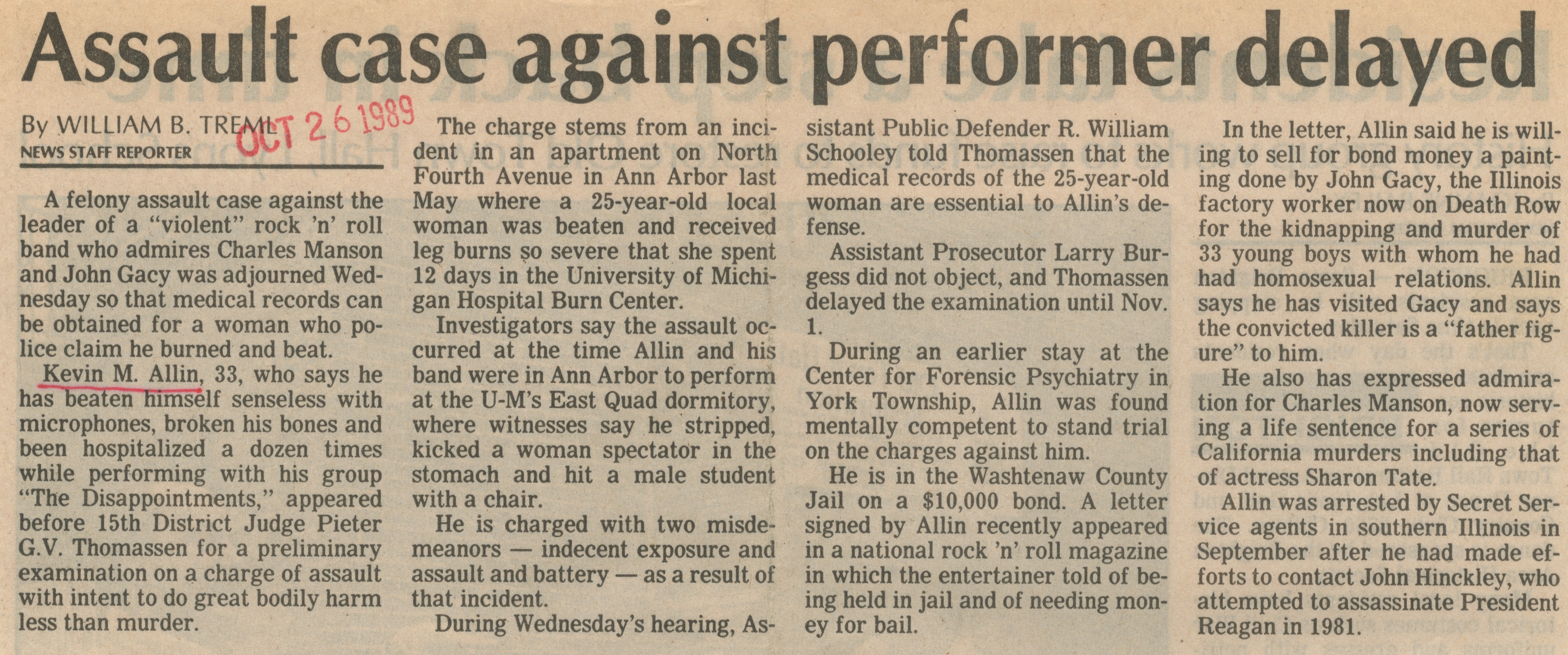
Transgressive punk rock singer GG Allin was arrested by the US Secret Service in Illinois in September 1989 after he corresponded with Hinckley and they discovered he had an outstanding arrest warrant for assault in Michigan.<ref>Assault case against performer delayed October 26, 1989</ref>
Songwriting, performance, and art
As a young adult, Hinckley made unsuccessful efforts to become a songwriter. Years later, he posted music online anonymously but received little interest.<ref name=Washingtonian6.1.21>{{#invoke:citation/CS1|citation |CitationClass=web }}</ref> In October 2020, a federal court ruled that Hinckley may showcase and market his artwork, writings, and music publicly under his own name, but his treatment team could rescind the display privilege.<ref>Template:Cite news</ref> Hinckley created a YouTube channel where, since December 2020, he has posted videos of himself performing original songs with a guitar and covers of songs such as "Blowin' in the Wind" by Bob Dylan, and the Elvis Presley song "Can't Help Falling in Love".<ref name=Washingtonian6.1.21/><ref name="youtube2">Template:Cite news</ref> His subscribers totaled over 41,000 by March 2025.<ref>{{#invoke:citation/CS1|citation |CitationClass=web }}</ref>
On June 6, 2021, Hinckley stated in a YouTube video that he was working on an album and looking for a record label to release it.<ref>Archived at GhostarchiveTemplate:Cbignore and the Wayback MachineTemplate:Cbignore: Template:CitationTemplate:Cbignore</ref> Hinckley announced in December 2021 that the album would be released in early 2022 on Emporia Records, a label he founded to "[release] the music of others, music that needs to be heard".<ref>Template:Cite tweet</ref>
On October 7, 2021, Hinckley self-published his first single called "We Have Got That Chemistry" onto streaming platforms.<ref>Archived at GhostarchiveTemplate:Cbignore and the Wayback MachineTemplate:Cbignore: Template:CitationTemplate:Cbignore</ref>
On November 10, 2021, Hinckley self-published another single called "You Let Whiskey Do Your Talking" onto multiple streaming platforms.<ref>Archived at GhostarchiveTemplate:Cbignore and the Wayback MachineTemplate:Cbignore: Template:CitationTemplate:Cbignore</ref> Hinckley has also continued to release other original songs on his YouTube channel.
In January 2022, Hinckley announced that he was looking for members for his own band.<ref>{{#invoke:citation/CS1|citation |CitationClass=web }}</ref>
On June 15, 2022, after his restrictions were unconditionally lifted, it was announced that what would have been Hinckley's first live performance in front of a physically present audience at a Brooklyn, New York venue had been canceled over security concerns for "vulnerable communities" after it had received threats.<ref>{{#invoke:citation/CS1|citation |CitationClass=web }}</ref> Three other planned concerts that summer, in Chicago, Hamden, Connecticut, and Williamsburg, Virginia were cancelled because of threats to the venues. In July 2022 Asbestos Records decided to release some of Hinckley's songs on vinyl later that year.<ref>Template:Cite news</ref> The album was released on July 12, 2023.<ref>{{#invoke:citation/CS1|citation |CitationClass=web }}</ref>
Following his release, Hinckley took up painting, using his pet cat as a reference. As of May 2023, he had sold several pieces on eBay.<ref>Template:Cite news</ref>
In December 2024, Hinckley announced he would open a music store in Williamsburg, Virginia,<ref>{{#invoke:citation/CS1|citation |CitationClass=web }}</ref> but these plans were quickly scrapped by Hinckley due to negative publicity and security concerns.<ref>{{#invoke:citation/CS1|citation |CitationClass=web }}</ref>
See also
- United States federal laws governing defendants with mental diseases or defects
- John Schrank (attempted Theodore Roosevelt 1912)
- Samuel Byck (attempted Nixon 1974)
- Lynette Fromme (attempted Ford 1975)
- Sara Jane Moore (attempted Ford 1975)
- Vladimir Arutyunian (attempted Bush 2005)
- Thomas Matthew Crooks (attempted Trump 2024)
References
Further reading
- Clarke, James W. (2006). Defining Danger: American Assassins and the New Domestic Terrorists.
- Clarke, James W. (1990). On Being Mad or Merely Angry: John W. Hinckley Jr. and Other Dangerous People. Princeton University Press.
- Hinckley, John W. (September 20, 1982). "The Insanity Defense and Me". Newsweek.
External links
- Template:YouTube
- Template:Twitter
- {{#invoke:citation/CS1|citation
|CitationClass=web }}
- Linder, Douglas (2002). The Trial of John Hinckley Jr. University of Missouri–Kansas City School of Law.
- Dean, Eddie (July 25, 1997). "Stalking Hinckley". Washington City Paper.
- Footage of the Ronald Reagan assassination attempt
- Pages with broken file links
- 1955 births
- 20th-century American murderers
- 20th-century people from Oklahoma
- 21st-century people from Oklahoma
- 21st-century American guitarists
- 21st-century American songwriters
- American male criminals
- 20th-century American trials
- American failed assassins
- Attempted assassination of Ronald Reagan
- Criminals from Oklahoma
- Failed assassins of presidents of the United States
- Highland Park High School (University Park, Texas) alumni
- Living people
- American music YouTubers
- American outsider musicians
- People acquitted by reason of insanity
- People from Ardmore, Oklahoma
- People from University Park, Texas
- People from Williamsburg, Virginia
- People with mood disorders
- People with schizophrenia
- People with schizoid personality disorder
- People with narcissistic personality disorder
- Stalking
- Texas Tech University alumni
- YouTubers from Oklahoma
- YouTubers from Texas
- Trials in Washington, D.C.
- YouTubers with disabilities