Kyoto University
Template:Short description Template:Infobox university
Template:Nihongo, or Template:Nihongo, is a national research university in Kyoto, Japan. Founded in 1897, it is one of the former Imperial Universities and the second oldest university in Japan.
The university has ten undergraduate faculties, eighteen graduate schools, and thirteen research institutes. The university's educational and research activities are centred in its three main campuses in Kyoto: Yoshida, Uji and Katsura. The Kyoto University Library Network, consisting of more than 40 libraries spread across its campuses,<ref>Template:Cite web</ref> has a collection of more than 7.49 million books,<ref>Template:Cite web</ref> making it the second largest university library in the country.<ref>Template:Cite web</ref> In addition to these campuses, the university owns facilities and lands for educational and research purposes around the country.<ref>Template:Cite web</ref>
As of 2024, Kyoto University counts two prime ministers of Japan amongst its alumni. Additionally, three prime ministers of Japan attended the Third Higher School, a university preparatory school that merged into KyotoU in 1951. There have been 21 Nobel Prize laureates, 2 Fields Medalists, 1 Abel Prize winner, 1 Gauss Prize winner, and 5 Lasker Award recipients affiliated with KyotoU either as alumni or faculty members.
History
Founding
Kyoto University can trace its roots back to the Template:Nihongo, an institution for Chemistry and Physics founded in Osaka in 1869. Seimi is a Japanese transcription of the Dutch word chemie, meaning chemistry.<ref>Template:Cite web</ref> In 1894, this institution was replaced by the Third Higher School, which was a specialised boys' boarding school. Back then, the country had only one university, the Imperial University (today's University of Tokyo), and the call for the nation's second university in the Kansai region was gaining momentum. However, due to financial reasons, the government was reluctant to do so.<ref name=":0">Template:Cite web</ref>
The situation changed when the aristocratic politician Saionji Kinmochi, who was from a prominent kuge family in Kyoto, suggested the founding of the nation's second university using war reparations from the First Sino-Japanese War.<ref name=":0" /> This plan was edicted accordingly in 1896, and Template:Nihongo was established on June 18, 1897,<ref name="ku-sketch">Template:Cite webTemplate:Dead linkTemplate:Cbignore</ref> as the second university in the country. The University started using Third Higher School's buildings, and the higher school moved to a patch of land across the street, where the southern section of the Yoshida Campus stands today. The Imperial University in Tokyo was renamed Tokyo Imperial University following the founding of its counterpart in Kyoto.
It started teaching with the College of Science and Engineering in the year of its foundation, which was followed by the establishment of the College of Law in 1898. Other faculties and colleges were established during its first decade as a university. The low rates of success of its graduates in the Higher Civil Service Examinations led to the Chief Commercial Law Professor Yoshihito Takane (高根義人) adopting a distinct style of teaching, which he called the 'German way of cherishing the freedom of research, teaching, and learning'. He is said to be the originator of the current motto 'freedom of academic culture (自由の学風, Jiyū no Gakufū)'.<ref>Template:Cite webTemplate:Dead link</ref>
Post-war period
The Allied Occupation Period following Japan's defeat in the Second World War saw a radical reform in the country's educational system, and Kyoto University was not immune from it. Along with other Imperial Universities, Kyoto Imperial University dropped the word 'imperial' from its name and came to be known as Template:Nihongo in October 1947. In May 1949, as a result of the American-led reform, former Imperial Universities merged with higher schools and became four-year universities as they are today. Kyoto University merged with the Third Higher School, which had been coexisting with the university since its founding as a university-preparatory boys' boarding school. The now-integrated higher school became the Template:Nihongo within the university in September 1949, and came to be in charge of equipping all first-year undergraduates with general knowledge such as mathematics and foreign languages.<ref>Template:Cite web</ref><ref>Template:Cite web</ref> The college was replaced by the Template:Nihongo in 1992.<ref>Template:Cite web</ref>
Kyoto University has been incorporated as a national university corporation along with all the other national universities, gaining a greater independence from the MEXT.
Campuses


Kyoto University is organised across three main campuses: Yoshida, Uji, and Katsura, each playing a distinct role in the university's academic and research activities.
Situated in Sakyo, Kyoto, the Yoshida Campus is the oldest and serves as the university's central hub. This campus is characterised by its mix of architectural styles, from historic brick buildings such as the Clock Tower Centennial Hall to modern research facilities. It encapsulates the university's history and is subdivided into seven areas, including the North Campus and the Yoshida-South Campus, which used to be occupied by the Third Higher School.<ref name=":1">Template:Cite web</ref><ref>Template:Cite web</ref>
The Uji Campus, located in Uji, Kyoto, was formerly occupied by the Imperial Japanese Army. The university acquired it just after its reorganisation into its current form, in 1949. Today, it houses several research institutes and centres focusing on natural sciences and energy. Along with its large laboratories, Uji Campus is recognised for its greenery and serene environment.<ref name=":1" />
The Katsura Campus, in Nishikyo, Kyoto, is recognised as a 'Techno-science Hill' for its forward-looking approach to research and education in engineering and informatics. Established in October 2003, Katsura aims to pioneer new knowledge domains in the 21st century. This campus is organised into four sections, each dedicated to different facets of technological and scientific exploration.<ref name=":1" />
Organization
Kyoto University is organised into 10 undergraduate faculties and 19 graduate schools. The president of the university is Nagahiro Minato, who assumed the office in October 2020 and expected to serve until September 2026.<ref>Template:Cite web</ref>
As of 1 May 2023, the university's student body consists of 13,038 undergraduates and 9,577 postgraduates. Apart from audit students and research students, there are 2,249 international students.<ref>Template:Cite web</ref>
Faculties


Kyoto University has 10 faculties.<ref name="Departments"/>
- Faculty of Integrated Human Studies
- Faculty of Letters
- Faculty of Education
- Faculty of Law
- Faculty of Economics
- Faculty of Science
- Faculty of Medicine
- Faculty of Pharmaceutical Sciences
- Faculty of Engineering
- Faculty of Agriculture
Graduate schools
Kyoto University has 19 graduate schools.<ref name="Departments">Template:Cite web</ref>
Academic
- Graduate School of Letters
- Graduate School of Education
- Graduate School of Law
- Graduate School of Economics
- Graduate School of Science
- Graduate School of Medicine
- Graduate School of Pharmaceutical Sciences
- Graduate School of Engineering
- Graduate School of Agriculture
- Graduate School of Human and Environmental Studies
- Graduate School of Energy Science
- Graduate School of Asian and African Area Studies
- Graduate School of Informatics
- Graduate School of Biostudies
- Graduate School of Global Environmental Studies
Professional
- School of Government
- Graduate School of Management
- Kyoto University Law School
- Kyoto University School of Public Health
Notable research institutes and facilities
- Yukawa Institute for Theoretical Physics
- Research Institute for Mathematical Sciences
- Primate Research Institute
- Kosobe Conservatory
- Seto Marine Biological Laboratory
International Programmes
Kyoto University offers a range of international programmes aimed at both its students and international students seeking to study there, across undergraduate and postgraduate levels.
Undergraduate Programmes
Kyoto University provides undergraduate degrees available for international students across all 10 faculties, with many general education modules available in English to cater to the needs of international students. Department-specific subjects are delivered primarily in Japanese with the exception of the Undergraduate International Course Program of Civil Engineering, which is a fully English-taught program.<ref>Template:Cite web </ref>
The Kyoto University International Undergraduate Program (Kyoto iUP) is another notable initiative, offering a comprehensive 4.5-year program that consists of a six-month preparatory course (mainly intensive lessons of the Japanese language) followed by a four-year undergraduate degree program. This program is designed for students with no prior Japanese language proficiency and offers various financial support options, including admission/tuition fee waivers and monthly scholarships. Students are expected to acquire sufficient Japanese proficiency to attend specialised lectures within the first two-and-a-half years of the program, then go on to pursue advanced studies in their final two years. The acceptance rate was 5.9% for the 2024 intake.<ref>Template:Cite web</ref><ref>Template:Cite web</ref>
Graduate Programmes
At the graduate level, Kyoto University has 18 Graduate Schools offering master's, doctoral, and professional degree programmes, all of which are available for international students. International students are well-represented, with over 2,000 international students enrolled. The university facilitates a conducive learning environment with English-taught programmes, Japanese language education, and scholarships tailored to international students' needs.<ref>Template:Cite web</ref> <ref>Template:Cite web</ref>
Academic rankings and reputation
Template:Infobox Japanese university ranking
Kyoto University maintains a high academic reputation, and is regarded as one of the nation's top two universities, along with the University of Tokyo.
Times Higher Education World University Rankings ranked Kyoto University 55th in the world in 2023 (2nd in Japan).<ref>Template:Cite web</ref> QS World University Rankings ranked Kyoto University 50th in the world in 2024 (2nd in Japan).<ref>Template:Cite web</ref> The Times Higher Education World Reputation Rankings 2022 ranked Kyoto University 26th in the world (2nd in Japan).<ref>Template:Cite web</ref> The Academic Ranking of World Universities ranked Kyoto University 39th in the world in 2023 (2nd in Japan).<ref>Template:Cite web</ref>
In the Nature index 2023 annual table, Kyoto University was ranked 44th for its output in selected journals in the fields of natural sciences and Health Sciences research, among all leading research institutions in the world (2nd in Japan).<ref>Template:Cite web</ref>
Subject rankings
Template:Col-begin Template:Col-break
| Subject | Global | National |
|---|---|---|
| Arts & humanities | Template:Center | Template:Center |
| Business & economics | Template:Center | Template:Center |
| Clinical & health | Template:Center | Template:Center |
| Computer science | Template:Center | Template:Center |
| Education | Template:Center | Template:Center |
| Engineering | Template:Center | Template:Center |
| Life sciences | Template:Center | Template:Center |
| Physical sciences | Template:Center | Template:Center |
| Psychology | Template:Center | Template:Center |
| Social sciences | Template:Center | Template:Center |
Popularity and selectivity
Kyoto University is one of the most selective universities in Japan. The selectivity for its undergraduate degrees is usually regarded as among the top two, along with the University of Tokyo.<ref>Template:Cite book</ref><ref>Template:Cite web</ref><ref>Template:Cite web</ref>
Athletics
Template:Expand section Kyoto University competes in 48 sports. The university is a member of the Kansai Big Six Baseball League.
Controversy
Template:Expand Japanese Members of the university's American football team, the Kyoto University Gangsters, were arrested in 2006 for gang rape, which had been recently added to the Penal Code in January 2005 following the Super Free rape controversy. The three students had forced a female university student to drink liquor to the point of unconsciousness, at which point they gang-raped her. They were all convicted.<ref>Template:Cite web</ref><ref>Template:Cite web</ref><ref>Template:Cite news</ref>
Notable people
Template:Main Template:See alsoOf the twenty-one Nobel Prize winners who have been affiliated with Kyoto University in some way, eight attended the university as undergraduate students.<ref>Template:Cite web</ref> Fields Medal winners Heisuke Hironaka (1970) and Shigefumi Mori (1990) and one Carl Friedrich Gauss Prize winner Kiyosi Itô are also affiliated with the university.<ref>Template:Cite web</ref>
- Alumni or faculty of Kyoto University that received the Nobel Prize
-
 Hideki Yukawa, Physics, 1949
 -
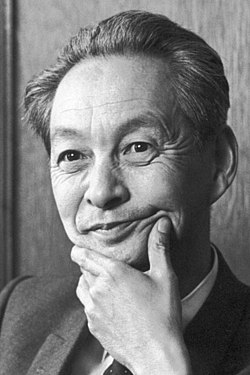 Shinichiro Tomonaga, Physics, 1965
 -
 Kenichi Fukui, Chemistry, 1981
 -
 Susumu Tonegawa, Physiology or Medicine, 1987
 -
 Ryōji Noyori, Chemistry, 2001
 -
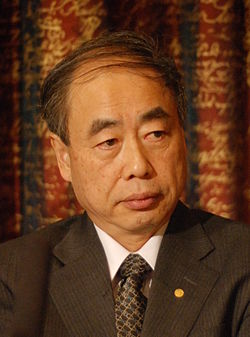 Makoto Kobayashi, Physics, 2008
 -
 Toshihide Maskawa, Physics, 2008
 -
 Shinya Yamanaka, Physiology or Medicine, 2012
 -
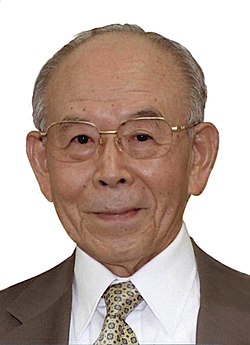 Isamu Akasaki, Physics, 2014
 -
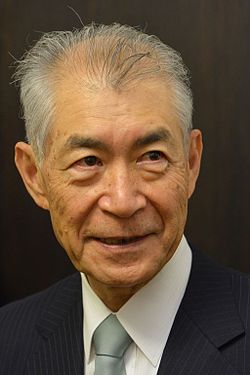 Tasuku Honjo, Physiology or Medicine, 2018
 -
 Akira Yoshino, Chemistry, 2019
 -
 Shimon Sakaguchi, Physiology or Medicine, 2025
 -
 Susumu Kitagawa, Chemistry, 2025


.jpg)


.jpg)


- Japanese Prime Ministers who attended Kyoto University
-
 Prince Fumimaro Konoe, Prime Minister of Japan from 1940 to 1941
 -
 Hayato Ikeda, Prime Minister of Japan from 1960 to 1964
.jpg)

Two Prime Ministers of Japan, Fumimaro Konoe and Hayato Ikeda, attended Kyoto University:<ref>Template:Cite web</ref> Apart from these two, Osachi Hamaguchi, Kijūrō Shidehara, and Tetsu Katayama attended the Third Higher School before going on to study at UTokyo. The former President of Taiwan, Lee Teng-hui, attended KyotoU when Taiwan was a Japanese colony but transferred to National Taiwan University after Japan lost the Second World War.
See also
- List of Nobel laureates affiliated with Kyoto University
- Kikuchi Dairoku
- List of National Treasures of Japan (archaeological materials)
- Yoshida dormitory, Kyoto University
- Hitoshi Okamura
Notes
References
External links
Template:Commons category-inline
Template:Kyoto University Template:Kansai Big Six Template:National Seven Universities Template:RU11 Template:Super Global University Template:Kansai Collegiate American Football League navbox Template:Authority control