Mokpo
Template:Short description Template:Use dmy dates Template:Infobox settlement Mokpo (Template:Korean; Template:IPA) is a city in southwestern South Korea. It is the third largest and most densely populated city in South Jeolla Province, located at the southwestern tip of the Korean Peninsula, close to Yudal mountain. Mokpo has frequent high-speed train services to Seoul, and is the terminus for a number of ferry routes serving islands in the adjacent Yellow Sea and Dadohae National Maritime Park. To the southwest of the city is Yudalsan Mountain, which is surrounded by strange cliffs like a wall. There are six populated and five uninhabited islands.<ref>Template:Cite web</ref>
The Mokpo Special Tourist Zone covers Template:Convert from the northern port to Yudalsan, Old Town Area, Samhakdo, and Gatbawi. It is home to attractions such as the Mokpo Natural History Museum and the National Maritime Museum. To live up to its name as a coastal city, the city's traditional dishes include a variety of seafood dishes, including raw croaker, braised hairtail, skate, and seasoned crab.<ref>Template:Cite web</ref>
Etymology
Mokpo means literally "tree harbor". This terminology initially appeared in the Goryeosa (History of Goryeo). Therefore, some historians argue that the city's name referred to trees within the region of the port of Mokpo. Another theory suggests that the "mok" in the city's name refers to "the throat," a metaphor for the importance of the city's location as an entrance to the Yellow Sea.<ref>Template:Cite bookTemplate:Page needed</ref>
History
Mahan and Three Kingdoms eras
Mokpo belonged to the Mahan confederacy during the early era of the three Han confederacies during the Samhan period, and was called Mul'ahye-gun while under the control of the Baekje kingdom. After Silla defeated Baekje, Mokpo's region was absorbed, and its name was changed to Myeonju. In 946, its name was once again changed to Mullyang-gun, and it became part of the Muan prefecture, in the Haeyang province. At the time, the prefecture of Muan referred to a much larger area, which incorporated not only Mokpo but also the area currently called Muan and several islands of Sinan county.<ref>Template:Cite web</ref> According to a KBS documentary, coastal and offshore areas of Mokpo witnessed superior productivity of crops, and important shipping routes to Naju were established along the Yeongsan River.<ref>Template:Cite book</ref>
Goryeo and Joseon dynasties

What is today known as Mokpo had its origins in the Goryeo period. That dynasty's founder, Wang Geon, was serving as a general for later Goguryeo (also known as Taebong), ruled by Gung Ye. Taebong covered the central area of the Korean peninsula including current-day Gaeseong, which was then called Song'ak.
As a naval power, Wang Geon was ordered to attack the kingdom of Later Baekje, which, like later Goguryeo, was a kingdom which emerged after the disintegration of Unified Silla. The operation met fairly successful results. During this time, Wang Geon met his second queen, Queen Janghwa, with whom he had a son, who eventually became Hyejong of Goryeo.
In 1439, 21 years after King Sejong of the Joseon Dynasty came to power, the Mokpo garrison (jin) was established, which was designed to control twelve offshore islands. During the Japanese invasions of Korea (1592–1598), Admiral Yi Sun-sin established a garrison of naval forces at Mokpo and the island of Goha, to secure a base for provisions and ship repairs, such as the turtle ships, also known as the geobukseon and panokseon.<ref>Template:Cite book</ref>
Open port
On 1 October 1897, Mokpo became an open port, fifteen years after the opening of the port of Incheon. For Japan, Mokpo held a geographical advantage being located midway between Nagasaki, Japan, and the Chinese mainland. Japan also valued Mokpo for its proximity to the abundant crops of the Jeolla provinces. After its opening, housing for Japanese settlers was rapidly developed to establish self-government.<ref>Template:Cite bookTemplate:Page needed</ref> The Japanese settled predominately in what is today the Yudal-dong neighborhood, close to the main port. The Japanese consulate remained there until the establishment of the Japanese protectorate over Korea.
The Japanese settlers gradually bought farmland in the vicinity of Mokpo, which had previously been illegal. These agricultural fields were desirable because they were inexpensive and not heavily taxed. The resulting harvests from these fields made rice cheaper in Japan, although the price of rice in Jeolla province doubled as a result.<ref>Template:Cite book</ref> After 1905, the influx of Japanese settlers increased and they expanded into Geumhwa-dong, where many cherry trees were planted along the street. Japanese called this area "Sakuramachi", which means "the downtown of cherry blossom trees."<ref>Template:Cite book</ref> With Korea's full annexation by Japan in 1910, the city was given a new name, Mokpo-bu, and saw the construction of the colonial institution, the Oriental Development Company that facilitated land, agriculture, and settlement projects in the city.<ref>Template:Cite encyclopedia</ref>
Under Japanese rule
Template:See also Mokpo's status as an open port made it a viable option to use the nearby county of Wando as a link to the region's many offshore islands. In 1914, the completion of the Honam railway line connected the city to Daejeon. On 1 April 1914, the county of Mokpo-bu was divided into several administrative sections. Only the county's urban downtown area, Bunae-myeon, became what is today Mokpo City. Following Order Number 11 of the General Japanese Government of Korea, Muan county incorporated Jido, Palguem, and Docho, which were the other areas formerly comprising Mokpo-bu. During the Japanese colonial period, Mokpo's harbor was used to forcibly export the produce of the region.
In 1918, the colonists established ginning facilities for manufacturing large amounts of goods in both Mokpo and Iri (current Iksan in North Jeolla province).<ref>Template:Cite book</ref> In 1932, the city incorporated parts of Muan, becoming the 6th largest city in the Korean peninsula with a population of 60,000. Indigenous products were cloth, rice, salt, and coastal foods.<ref>Template:Cite web</ref> The harbor played an important role, supplying goods to Japan, including large quantities of cotton.<ref>Template:Cite web</ref>
After independence
In 1949, Mokpo-Bu was redesignated Mokpo City, after the government altered the administrative region. In 1973 and 1987, large areas were added to Mokpo city, including one of the most famous tourist spots, Samhakdo (Three Crane Island). Samhakdo was reclaimed by connecting a series of islands, a process of landfill operations which lasted from 1968 to 1973. The island is divided into three major sections, and over six years the city constructed five bridges to link those three sections. In 2000, the city initiated a plan to restore a naturalized island for tourism, which brought tremendous criticism from environmental groups. On 1 March 2007, Samhakdo was opened to the public.<ref>Template:Cite web</ref><ref>Template:Cite web</ref> Other projects in Mokpo included a coastal filling process near the North Harbor and the building of a new port in Chungmu-dong.
In 1980, the Gwangju Democratization Movement swept the area. In Mokpo, student movements were initiated by several people marching along the boulevard from Mokpo Station to the second plaza, carrying cards displaying the word "Freedom." Mokpo Station served as a hub for many groups supporting the people of Gwangju.<ref>Template:Cite web</ref>
On 1 October 1997, Mokpo celebrated its centennial as a port city, and announced the second opening of the port. Mokpo is the hometown of former President Kim Dae-jung, who received the Nobel Peace Prize in 2001.<ref>Template:Cite web</ref>
Following the sinking of MV Sewol on 16 April 2014, the ship was moved to Mokpo for salvage operations.<ref>Template:Cite web</ref>
Administration
Mayor
Mokpo began its local government in 1994. In July 1995 it inaugurated its first mayor, Gwon I Dam, who had been the president of the Munhwa broadcasting corporation. The city's lack of supply in the past caused Gwon to focus on improving the city's water supplies. In 2000, the mayor officially provided aid for North Korea in the form of rice shipments.<ref>Template:Cite web</ref> However, Gwon came into conflict with the leaders of the Democratic Party over fair election practices, causing him to leave the party. He filed a lawsuit against the Democratic Party, which the courts subsequently rejected.<ref>Template:Cite web</ref>
Jeon Tae Hong, the next mayor, made some important contributions to Mokpo's government,Template:Clarify<ref>Template:Cite web</ref> but he died suddenly in 2005.<ref>Template:Cite web</ref> Following his death, Jeong Jong Deuk was elected mayor, promising protection of the tourism industry.<ref>Template:Cite web</ref><ref>Template:Cite web</ref> Once in office, Deuk responded to concerns about the depressed condition of the old downtown area by establishing the Office of Original City Replanning and adopted the slogan "City of Light."<ref>Template:Cite webTemplate:Dead link</ref>
Deuk was re-elected in 2006 and, during his second term, the city received several civil and tourism awards.<ref>Template:Cite web</ref><ref>Template:Cite web</ref> He faced criticism from the local press regarding Mokpo's ability to draw people into the city and changing the attitudes regarding the city's imbalanced economy.<ref>Template:Cite webTemplate:Nonspecific</ref><ref>Template:Cite webTemplate:NonspecificTemplate:Dead link</ref>
Another dispute arose in 2009, when non-governmental organizations based in Mokpo sued the government to disclose information about budgetary spending, which had been controlled by a city committee chosen by the mayor. The courts sided with the organizations, saying that the budget plan should be reported and monitored.<ref>Template:Cite web</ref>
Disputes upon merge
In 2004, civil groups promoted merging the three adjacent communities: Sinan, Muan and Mokpo. On 25 September 2009, the city council of Mokpo officially submitted a plan to merge into one central government,<ref>Template:Cite web</ref><ref>Template:Cite news</ref> but the plan was voted down due to objections from the community.<ref>Template:Cite web</ref>
Population
In 2007, the population of Mokpo had increased to 90,000 households, with an average of 2.7 people per household. The population density was the 10th highest in South Korea, and it was the second fastest-growing region (after Gyeonggi Province). In 2010, the Bank of Korea reported that the population of western South Jeolla province was declining due to several economic, social and educational issues.<ref>Template:Cite web</ref>
Education
Template:See also One of the oldest elementary schools, Bukgyo, was established in 1897 for the aristocracy during the Joseon period, following Order No. 145 of Gojong.<ref>Template:Cite web</ref> However, after its annexation by Japan, education in Mokpo was directed towards Japanese students.
Mokpo Commercial High School opened in 1920 as the first secondary-level school. Its name was later changed to Jeonnam Jeil High School. Former president Kim Dae Jung graduated from Jeil.
Universities
Mokpo National University (MNU) became a nationally supported school in 1976, after 30 years of existence. The school has become regionally famous for its shipbuilding research and other culturally related fields of study.<ref>Template:Cite webTemplate:Nonspecific</ref><ref>Template:Cite web</ref> A 2007 study of national universities ranked MNU highly, equal with Seoul National University and Jeonnam National University.<ref>Template:Cite web</ref> Mokpo National Maritime University is a government-funded school specializing in maritime-related studies.<ref>Template:Cite webTemplate:Nonspecific</ref> Mokpo Catholic University was established in 1967 as Sungshin Nursing College, and later expanded its vocational training to include other fields.<ref>Template:Cite web</ref>
Economy

The harbor began operations earlier than other port cities on the Korean peninsula, allowing the city to experience growth, whereas growth in the country since its independence has concentrated on the Yeongnam area, where trade with Japan and Russia are viable due to the access of coastal routes. The addition of the Chinese economy into the local trade prospects increases the city's potential as a trade center via the Yellow Sea.<ref>Template:Cite book</ref>
Commerce

Until late 1980s, commerce had been concentrated around the original downtown near Mokpo Station. In the late 1990s, large residential areas were built in Yeonsan dong and Hadang, resulting in a significant outflow of the population of the city. This resulted in the city council adopting a bylaw to support the old downtown area,<ref>Template:Cite webTemplate:Dead link</ref> however, the outward flow has only worsened.<ref>Template:Cite web</ref>
Economic power has been notably imbalanced by the opening of Lotte Mart in 2001 and E-Mart in 2002.<ref>Template:Cite web</ref> Home plus is the solitary large-scale market in Mokpo, located in old downtown near the Munhwa broadcasting corporation.<ref>Template:Cite web</ref>
The one exception to the declining economy of the city are the fish markets of Dongmyeong and North Harbor which have been a magnet for tourists and local people looking for octopus or other indigenous products. The economic bureau of the city has spent ₩300 million on promoting the market since early 2009.<ref>Template:Cite web</ref>
Companies
Companies with operations in Mokpo include the Bohae brewing company and Haengnam chinaware. Bohae Brewing Company produces a brand of soju from the Honam area, of which the best selling product is maple soju (Template:Lang), the first company to using maple in the brewing of soju. Bohae also entered into a joint development with Asahi Breweries in Japan to expand its soju production operations. In 2008, Bohae became the first Korean brewing company to open up wine sales in the United States, with the exportation of its Rugby Ball wine.<ref>Template:Cite web</ref><ref>Template:Cite web</ref>
Another major company is Haengnam chinaware, established in May 1942. Its headquarters is in Mokpo, with two other branches, one in Seoul for design and public relations, and another in Yeoju for production. In 1953, the company was the first in Korea to develop coffee cup sets.<ref>Template:Cite web</ref> In 1963, they began trade in Hong Kong, with exports to China growing to more than 2 million dollars in 2008.<ref>Template:Cite web</ref> In 2011, its president signed a Memorandum of Understanding (MOU) with the Ministry of Environment of South Korea to develop a less pollutant-emitting process. The project also includes a publicity campaign to raise public awareness on environmental issues and their effect on rare species.<ref>Template:Cite web</ref><ref>Template:Cite web</ref>
Farming and fishing
Mokpo is made up of sparsely populated farmland, with 1,326 households under a half hectare. The area produces high quantities of rice, barley, and beans, with greens and fruits such as tomatoes, cucumbers, and oriental melons increasing in popularity since 2001.Template:Citation needed
Ships from the harbor often travel to Heuksando to fish for skate and hairtail. Mokpo's yield of marine products reached 26,862 tons in 2006, consisting chiefly of fish, with of shellfish, mollusks, and seaweeds also contributing to the total. Mokpo is known for its harvest of small octopus, although this has declined in recent years. The number of fishermen had dropped to fewer than 3,000, but has been rising since 2007.Template:Citation needed
Industries
The regional economy relies heavily on the Daebul industrial complex and Hyundai Samho Heavy Industries located near Yeongam. The imports of merchandise support the local economy of Mokpo as they pass through its harbor. The Halla group was the initial owners of Heavy Industries, until they were taken over by Hyundai, which changed the company name to Hyundai Samho Heavy Industries, with Samho meaning three lakes. By 2007, corporate profits amounted to more than 460 million, an increase of about 25% over those from 2006.<ref>Template:Cite web</ref><ref>Template:Cite book</ref> South Jeolla province succeeded in attracting a series of investors for renewable energy companies like solar panels. Innovation Silicon Ltd, invested 10bn won in developing a silicon producing complex.<ref>Template:Cite web</ref>
Geography

Mokpo sits at the southern end of the Muan peninsula, although the city lies within Sinan county, which mostly consists of 1004 islands. Its neighbor, Muan county, extends northeastward, separated from Mokpo by the Yeongsan river. Yudal mountain (228m) sits at the center of old downtown, and is a source of pride within the city. Its nickname is Gaegol (Template:Korean), meaning weird-shaped rocks and peaks. The side of the mountain caused roads around the downtown area to have a hilly aspect. Nojeokbong is a historic site where General Yi Soon Shin made use of its shape during the Japanese invasion. The city has small mountains nearby: Mt. Ibam (121m) to the east, and Yangeul (156m) and Daebak (156m) to the north.<ref>Template:Cite book</ref><ref>Template:Cite web</ref> The mouth of the Yeongsan River flows along the southern side of the city, containing 13 islands. The existence of a natural seawall created a natural safe harbor.
Most of the area of Mokpo consists of land reclamation, including Samhakdo, North harbor (Template:Korean), and the new city of Hadang. According to the research by Mokpo National University, tributaries of the Yeongsan river crossed the central area of old downtown. This can be seen in the historic names of the Mokone Dong area: Namgyo-dong (southern side of bridge) and Bukgyo-dong (Northern side of bridge). Both names contained "gyo" (Template:Korean), meaning the bridge, indicating a bridge used to link the areas. Tideland reclamation projects removed large amounts of mud flats, including Daebandong, Baekryundong and the coastal shore around Gatbawi. Additionally, the municipal boundaries include 7 desert islands.
The wall at the end of the Yeongsan river prevented damage from flooding during harsh typhoons. Meanwhile, the water quality of the river has worsened to the point where the ministry in charge of environmental protection began studying the impacts made by man-made structures. In 2010, the ministry's report recommended that the seawall should be widened and that the dirty water be pumped out of the riverbeds into the harbor.<ref>Template:Cite web</ref>
Climate
Mokpo's weather station was built along with five other sites in Korea, and began observing weather conditions on 25 March 1904.<ref>Template:Cite book</ref> Mokpo's climate features a short spring and autumn, and it is cold and dry in the winter and warm and humid with seasonal winds in the summer. There is also significant rain in the summer, averaging Template:Convert. Mokpo is usually windy and foggy in the spring and autumn due to its location near the ocean. Mokpo's long period (annual average of 223 days) without frost creates suitable conditions for rice farming. However, its seacoast location and the influence of the continental climate on the city often cause a great disparity between the rise and fall of daily and yearly temperatures. Mokpo, along with the rest of Sinan County, has the highest level of sunlight in Korea, enabling more efficient use of solar energy plants and related energy sources.<ref>Template:Cite web</ref> The frequency of yellow dust is quite similar to that of other cities like Seoul and Incheon, occurring about 10–11 days per year.<ref>Template:Cite web</ref>
The climate of Mokpo is a humid subtropical climate (Köppen: Cfa). Unexpected blizzards can sweep the region with strong gusts during winter, and the city experiences more than 30 days of snow, and 60 days below Template:Convert.Template:Citation needed Mokpo sometimes falls within the range of passing typhoons, and may suffer peripheral damage, including heavy precipitation during the summer and early autumn. In 2004, Typhoon Mindulle gave Mokpo a record rainfall of Template:Convert per hour.
Transportation
Railroad

Mokpo station opened 15 May 1913, it is the final destination of Honam Line and accommodates over 1.2 million annually, as well as cargo shipments.<ref>Template:Cite web</ref>
The station is located near the mountain Yudalsan, in the southwestern part of the city. The railroad ends inside the station, although a freight-only line continued on to Samhakdo, carrying coal for the industrial factories. Because of potential danger, the city removed the rail extension in 2011.<ref>Template:Cite web</ref>
On 1 April 2004, Korea Train Express advertised a three-hour travel time from Seoul to Mokpo, however, the actual time was longer due to the number of stops along the Honam Line. Three-hour travel was only possible when limiting the train to four stops: Seodaejeon, Iksan, Gwangjusongjeong, and finally Mokpo. However, that service has not been available since 2008. Then, there were 10 trains from Yongsan station to Mokpo, with a travel time of 195 minutes.
Since 2015, there has been a high-speed KTX service linking Mokpo and Yongsan Station within an average of 140 minutes. Limited services also allow passengers to travel further north to Seoul Station and Haengsin station in the city of Goyang.Template:Citation needed
Inland road
Template:See also The Seohaean Expressway connects Mokpo to Seoul via a 4-hour car ride. The Muan-Gwangju Expressway was opened in 2008 to ease access to the Muan International Airport.Template:Citation needed In 2012, the Mokpo to Gwangyang Highway opened, connecting the eastern and western ends of South Jeolla Province, as well as continuing on to Busan.<ref>Template:Cite web</ref>
National Route 1 was planned to connect Mokpo to Sineuju in North Korea. After the Korean War, however, the route was cut off at Imjingak near the truce village of Panmunjeom. It was not until 2000 when Route 1 was extended to North Korea's second largest city, Gaesung.
Bus
Two companies provide most of the bus service in the local area. Since 2005, the companies and the city council agreed to expand the number of buses fueled by natural gas (NG), following a 3-year negotiation. The city agreed to assist the companies with a 21,000 US dollar per bus subsidy for each bus equipped with the NG equipment. As of 2006, 32 buses had been retrofitted with the natural gas equipment.<ref>Template:Cite webTemplate:Dead link</ref> The growing suburbs around the city created a demand for additional lines, but there is conflict between the needs of the city and the profit margin of those new lines.
Riders may transfer between buses, free of charge, beginning on 1 March 2007. The lines are classified as inner circle, outer line and artery, which follows the commuting system of Seoul Buses.<ref>Template:Cite web</ref> Buses with a low-floor level were first deployed in South Jeolla province in 2007, although they still remain in limited service.<ref>Template:Cite web</ref>
Airport
Muan International Airport is the airport serving Mokpo. Previously, Mokpo Airport, in Yeongam County,<ref name=Youngamloc>Template:Cite web</ref> operated as the region's airport. The crash of Asiana Airlines Flight 733 in 1993 increased concerns about the airport, resulting in extending the runway by 100 meters. However, the site still had fundamental drawbacks due to common foggy weather and the lack of related facilities.<ref>Template:Cite web</ref> Korean Air abolished the Gimpo-Mokpo route and Asiana Airlines started to slash services in 2004 with the removal of the Mokpo-Jeju route. The airline companies announced deficits due to the high-speed railroad.<ref>Template:Cite web</ref><ref>Template:Cite web</ref>
The alternative to Mokpo Airport was Muan International Airport, whose construction was delayed for many years, leading to disappointment among the local people. Eventually, however, the airport was constructed, and Mokpo Airport closed its doors on November 9, 2007.<ref>Template:Cite web</ref>
Sea

Mokpo has three harbors: one each for ferry service, trading and fishing. The main harbor is used to ferry customers and cargoes around nearby islands, while North harbor conducts ferry service to Nonghyup. Additionally, the newly built harbor is used for container shipping to China.
Over 80 sea-going lines have been available, notably for Heuksando, Hongdo and Jeju, as well as ferries linking Sinan county. In 2002, the first cruise-line to Shanghai was opened for operation,<ref>Template:Cite web</ref> however, bankruptcy concerns forced the discontinuance of the cruise line after only five months. In July 2004, another attempt to start a cruise route to Shanghai, with a newly designed, smaller boat, failed due to Chinese objections.<ref>Template:Cite web</ref>
The Mokpo coastal terminal was originally built during the 1980s, with the government beginning an update in 2003. The 30bn won, 4-story terminal opened in February 2007.<ref>Template:Cite web</ref> Mokpo coastal terminal is currently configured to divide coastal from international travel.
The newly built harbor in Mokpo has seen a growing number of cargoes since it opened in 2004. The harbor set a record for civil investment in a seaport in South Korea.<ref>Template:Cite web</ref> Currently, sea routes have been established for China, Japan, Thailand, and Indonesia with municipal support.<ref>Template:Cite web</ref> In January 2011, Samsung electronics decided to choose Mokpo as their chief exporting harbor for merchandise from its factory in Gwangju.<ref>Template:Cite web</ref>
Ferries at coastal terminal
| Line | Company | Number | Remarks |
|---|---|---|---|
| Heuksando, Hongdo, Gageodo | Namhae Express/Dongyang | Twice per day | Fastsailing |
| Chuja-Byeokpa-Heuksan-Hongdo | Jindo Transportation | Unverified | |
| Jeju | Seaworld ferry | Twice per day | |
| Eupdong (Anjwa), Palguem, Amtae, Jaeun, Bigeum, Docho | Daeheung | Also available to depart from Aphae harbour of Sinan | |
| Bokho (Anjwa), Jangsan, Haui, Sinui, Sangtae | Joyang | Clippery Angel | |
| Uidal, Dali, Yuledo and other islands | Sinjin, Johang | 5 times per day | 11 times during seawater pool in Uidal island |
Nonghyup ferry at North harbor
| Depart | Arrival | Company | Remarks |
|---|---|---|---|
| North Harbor Songgong of Aphae |
Eupdong (Anjwa) | Nonghyup at Anjwa | |
| North Harbor Songgong of Aphae |
Gosan (Palguemdo) 5 small islands of Amtae |
Sinan Nonghyup | |
| North Harbor | Biguem | Biguem Nonghyup | |
| North Harbor | Docho | Docho Nonghyup |
Culture


Festivals
A flower festival is held at Yudal mountain every April and May. The festival of Largehead Hairtail (Template:Korean) takes place around Yeongsan Lake every October. The festival is extremely popular among fishing fans and family tourists. A fishing contest is held, wherein great numbers of people take part, which is followed by a fireworks display.<ref>Template:Cite web</ref>
The Nanyeong Singing Memorial celebrates the famous singer, Lee Nan-young, whose song, "Tears of Mokpo" gained wide popularity. The memorial was started in 1968 by the Honam Maeil newspaper but was stopped, but was restarted by MBC Mokpo and is held every autumn.
City of Light
The city has a plan for promoting tourism in the old downtown, and South Jeolla province agreed to offer support for the city's plan.<ref>Template:Cite web</ref> This city's population decline has resulted in the closure of many shops, as well as a drastic reduction in the city's school system. For example, student enrollment at Sanjeong Elementary School has dropped to below 300 from a high of more than 3,000.<ref>Template:Cite web</ref> The project, entitled, "A City of Light", called for establishing a light show along the street which runs next to the railway station.Template:Citation needed However, environmentalists have lodged objections, arguing that the plan will have an irrevocable impact, harming the ecological balance of the mountain.<ref>Template:Cite web</ref>
In the new downtown area, there is now a fountain, which times its waters and light show to the beat of the song. This was to be expanded, but has confronted opposition from several civil groups since 2009.<ref>Template:Cite web</ref>
Islands offshore
Outside of the harbor, thousands of islands dot the Yellow Sea, several of which are actually part of Mokpo. The government has promoted a program of constructing infrastructure on each island. With the slogan of "Lovely island, Uai-dal", Hanok residences on these islands, each with a saltwater pool, have served as accommodations for tourists during the summer.
One of the most famous islands, Goha-do, was used as a base for naval forces in the late 16th century when Japan invaded Joseon. The Japanese navy created artificial caves on this island to conceal armaments from the Allies during the Second World War. Two air-raid shelters have been found. The Mokpo Bridge was publicly opened in June 2012.
Museums
Many museums in Mokpo are located near Gatbawi street, due to the city concentrating its investment to exhibition space in this area. The National Maritime museum is one of the oldest museums dedicated to the Korean naval and shipping traditions. The museum changed its name in 2009 to the Research Institute for Maritime History, due to its broadened function.<ref>Template:Cite web</ref> The Institute conducts surveys and research related to ancient ships, trade routes and relics, and is the only research institute for maritime relics in South Korea.<ref>Template:Cite web</ref><ref>Template:Cite book</ref>
The Mokpo Natural History Museum has a large collection of fossils from all over the world. It originally began as a single building, but has expanded into a second building, the Cultural Heritage Hall, which specializes in local relics dating as far back as prehistoric time. The museum has an extensive collection of samples and data regarding everything from dinosaur fossils to insects and cetaceans found in the Yellow Sea. One of the most significant displays is a nest of dinosaur eggs, found on Aphae island, which was restored and opened to the public in 2010. The eggs reach lengths greater than 40 cm, and have been dated to approximately 80 million years ago, during the Mesozoic period.<ref>Template:Cite web</ref> The Korea Forest Service chose the museum to record its samples of insects in a national database for biological resources in 2009.<ref>Template:Cite web</ref>
Namnong Memorial Hall commemorates the famed calligrapher, Heo Gun. The Hall is situated within a Korean traditional garden and features exhibitions on different series of his works.
The Mokpo Ceramic Museum opened in 2008, was funded by the government to establish ceramics and china exhibits from notable manufacturers. Meanwhile, the Literature hall of Mokpo (Template:Korean) is not far from the ceramic museum, and hosts literature classes for the general public, featuring specific writers or novels, to promote literature among the local population.<ref>Template:Cite web</ref>
The Mokpo Modern History Museum I, officially opened in 2014 as a museum celebrating Mokpo's history and culture over time. The museum currently features seven exhibits, framing Mokpo within Korea's broader colonial history and touching on themes like resistance against Japanese colonial rule, the spread of foreign culture, and the development of pop culture, among others.<ref>Template:Cite web</ref> The museum is housed in the former Japanese consulate and administrative center used during the Japanese colonial period, which was built in 1900 in order to serve the growing Japanese population in the city.<ref>Template:Cite book</ref> The building was also used as Mokpo's city hall immediately following Korea's liberation until 1974 and as a municipal library until it became a cultural center in 1990.<ref>Template:Cite web</ref> Additionally, the building was named a historic cultural heritage site in 1981, with the Korea Heritage Service describing it as “one of the positive remnants of Japanese rule which can remind us of the lessons of our history<ref>Template:Cite web</ref>.”
Mokpo Modern History Museum II is located in the former Mokpo branch of the Japanese colonial-era Oriental Development Company. Built in 1920 in a neoclassical style, the building reflects Japan's efforts to modernize and control Korea's economy through land acquisition and settlement.<ref>Template:Cite journal</ref> After liberation, the building was used by the Korean Navy until 1989. It was restored and reopened as a museum in 2006 by the Mokpo city government. Today, it exhibits materials on colonial development, local resistance, and daily life in 1920s Mokpo.<ref>Template:Cite web</ref>
Cuisine
Being located close to the sea, the city's cuisine is characterized by seafood dishes. Mokpo is famous for hongeo-hoe (Template:Korean), a strong smelling fermented dish featuring the skate, a kind of ray fish. Other delicacies of Mokpo are: kimchi and pyeonyuk (Template:Korean); a variant of yeonpo-tang containing long arm octopus; hoe; and seasoned Portunus trituberculatus. The city started a public market for vendors selling their own delicacies, located downtown. <ref>Template:Cite web</ref>
Facilities for sports and cultural entertainment
Yudal Stadium is located next to the 100 Year Memorial Avenue. The stadium consists of ballpark and an eight lane track. Behind the stadium, local groups are able to use public tennis courts. The ground floor of the stadium houses committees of diverse sports.
The city has attracted many athletes to train in the area during the winter, due to sunny and warm weather, and numerous accommodations. The city has been very successful in reaching agreements with 127 teams, totaling almost 6,000 athletes, who trained during the winter in 2004.<ref>Template:Cite web</ref> Since 2005, the focus has been on track and field sports to boost the number of visiting athletes.<ref>Template:Cite webTemplate:Dead link</ref>
Recreational parks are located sparsely around Yudal mountain, while the city is in the process of constructing an additional park in the Samhakdo area.
The Mokpo Cultural Complex is located along the shore near Gatbawi, consisting of two buildings, one for performance and the other for exhibition. However, the complex is limited by its seating capacity: a maximum of 700 people for the two-story building.<ref>Template:Cite web</ref>
The Mokpo Civil Culture & Sports Center was built in 2003 to meet the needs of the increasing population in the downtown area. However, the operating fees have proven a burden to the province. It consists of three halls, with a capacity of more than 1,200 people.<ref>Template:Cite web</ref><ref>Template:Cite web</ref>
There are two libraries in Mokpo. The Civil Library of Mokpo opened in 1974 at the old consulate of Japan. In 1989, it moved closer to Yudal stadium, and consists of 4 stories, with 1,636 seats. The library is home to over 360,000 books, as well as having internet-access research rooms.<ref>Template:Cite news</ref><ref>Template:Cite webTemplate:Nonspecific</ref> The Public Library of Mokpo is located near North Harbor. It began as part of the Mokpo Educational Institute, but has since gained independence.Template:Citation needed
Tourism


Gatbawi is a natural Sandstone and Tafoni formation found on the shore of Mokpo's east harbor, near the mouth of the Yeongsan River.
Media
Branch offices of KBS and MBC exist in Mokpo. KBS Mokpo was established in 1942, at a location close to the Yeon dong area, prior to its move next to the current city hall in Yongdang. MBC Mokpo was initially planned as a radio station when it opened in 1967, using a frequency of 1386 kHz.<ref>Template:Cite web</ref>
FEBC Mokpo opened an office in 1999, for Christian missions around the Honam area. For cable broadcasting, Honam Hanguk cable has its office in Hadang.
South of Mokpo at 34.679364 N 126.445148 E, there is a VLF-transmitter with two very tall masts ( height unknown).
Notable people from Mokpo
- Hyginus Kim Hee-jong (born 21 January 1947), the 5th Archbishop of Gwangju (Template:Korean)
- Seo Su-yeon (born 8 January 1986), South Korean para table tennis player (Template:Korean)
- Kim Bo-mi (born 7 October 1985), South Korean field hockey player (Template:Korean)
- Eun Mihee (born 20 September 1960), South Korean novelist, writer, columnist, and college lecturer (Template:Korean)
- Choi Jin-hyuk (born 9 February 1986), South Korean actor (Real Name: Kim Tae-ho, Template:Korean)
- Jung Man-sik (born 11 December 1974), South Korean actor (Template:Korean)
- Kim Kyung-ho (born 7 June 1971), South Korean singer and rock star (Template:Korean)
- Soon-Tek Oh (1932–2018), Korean–American actor (Template:Korean)
- Park Na-rae (born 25 October 1985), South Korean comedian (Template:Korean)
- Lee Nan-young (1916–1965), South Korean singer and actress (Template:Korean)
- Nam Jin (born 27 September 1946), South Korean trot singer (Real Name: Kim Nam-jin, Template:Korean)
- Donghae (born 15 October 1986), singer-songwriter, rapper, dancer, model, producer, actor, businessman and K-pop idol, member of K-pop boygroup Super Junior and its subgroups Super Junior-D&E and Super Junior-M (Real Name: Lee Dong-hae, Template:Korean)
- Youngjae (born 17 September 1996), singer, dancer, actor, radio DJ, songwriter, producer and K-pop idol, member of K-pop boygroup Got7 (Real Name: Choi Young-jae, Template:Korean)
- Zelo (born 15 October 1996), singer, rapper, dancer, model, beatboxer and K-pop idol, former member of K-pop boygroup B.A.P (Real Name: Choi Jun-hong, Template:Korean)
- Oh Ji-ho (born 14 April 1976), a South Korean actor. (Template:Korean)
Health care
As of 2008, the number of doctors per capita was 11.41 per thousand, increasing from 10.45 of the prior year. The council of doctors in Mokpo has stated that the ongoing economic improvement, as well as the growing populations, will cause the need for the construction of middle-sized or larger hospitals and clinics.<ref>Template:Cite web</ref>
Mokpo National hospital was established in 1962, specifically for the treatment of tuberculosis. Originally a city hospital, the state took over operations in 2002.<ref>Template:Cite web</ref>
The ministry of Health chose Mokpo and Incheon as a sites for operating medical helicopters. Hankook hospital was officially designated the location for these emergency services.<ref>Template:Cite web</ref>
Template:Col-begin Template:Col-2
Public medical institute
- Mokpo Medical Center
- Mokpo National Hospital
General hospital
- Hankook Hospital
- Dongshin University Oriental Hospital
- Mokpo Christian Hospital
- Joongang Hospital
- Mokpo Miz-i Hospital
- Mokpo MIR Dental Hospital
Template:Col-2 Template:Col-end
Sister cities
- Template:Flagdeco Beppu, Ōita, Japan (1984.10.01)<ref>Template:Cite web</ref>
- Template:Flagdeco Hammerfest, Norway (1962.03.23)<ref>Template:Cite web</ref>
- Template:Flagdeco Lianyungang, Jiangsu, China (1992.11.01)Template:Citation needed
- Template:Flagdeco Changwon, South Korea (1998.12.24)<ref>Template:Cite web</ref>
- Template:Flagdeco Seodaemun District, Seoul (2005.04.18)Template:Citation needed
- Template:Flagdeco Xiamen, Fujian, China (2007.07.25)Template:Citation needed
- Template:Flagdeco Jeonju, South Korea (2020.08.15)
Symbols of Mokpo
- City Flower – White Magnolia
- City Tree – Loquats
- City Bird – Crane
Images
-
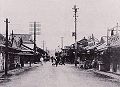 Bokman neighbourhood during Korea under Japanese rule's period.
 -
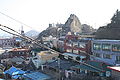 Residential area in Mokpo
 -
 Squid out to dry
 -
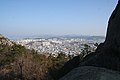 View of Mokpo from Yudalsan
 -
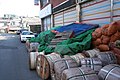 Street in Mokpo
 -
 Mokpo Marine Cable Car
 -
 Hoe center at North Harbor
 -
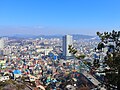 A view of Mokpo


.jpg)
See also
References
Notes
- Two Jeolla provinces which Mokpo pertains to have been the critical base of the Democratic Party of South Korea. Before former president Kim took the presidency, he caught the strongest power in the reason as a root of his political supporting base. In this context, Mokpo and near area has been called the garden of Democrats.
- Nonghyup ferries refer to the regular ferry operated by Nonghyup which is kind of banking and cooperating organ for farmers. The ferry connects each branch in several islands in Sinan and Mokpo.
External links
Template:Wikivoyage Template:Commons category
Template:South Jeolla Template:Metropolitan cities of South Korea Template:Most populous cities in South Korea