Prince Eugen, Duke of Närke
Template:Short description Template:Infobox royalty


Prince Eugen of Sweden and Norway, Duke of Närke (Eugen Napoleon Nicolaus; 1 August 1865 – 17 August 1947) was a Swedish painter.
Background
Prince Eugen was born at Drottningholm Palace as the fourth and youngest son of Prince Oscar, Duke of Östergötland. His mother was Sophia of Nassau. The newborn prince was granted the title of Duke of Närke. Upon his father's accession to the thrones of Sweden and Norway as King Oscar II, the Duke of Närke became fourth in line to the throne. Showing early artistic promise, he studied in Paris, and went on to become one of Sweden's most prominent landscape painters.<ref name="Prins"/> Throughout his life Prince Eugen was a supporter of fellow artists, and also involved in many cultural organisations and committees. A homosexual bachelor,<ref>Arne Norlin i Familjen Bernadotte, makten, myten, människorna, ISBN 978-91-86597-96-2, p168</ref> he bequeathed his villa Waldemarsudde at Djurgården in Stockholm, and its collections, to the nation. It is now one of Sweden's most popular museums.
Norway
The Duke of Närke was a great admirer of Norwegian nature and frequently visited Christiania (later known as Oslo). His letters show that he preferred its artistic milieu to the more constrained Stockholm one. His most notable Norwegian friends were the painters Erik Werenskiold and Gerhard Munthe; he remained attached to them and to Norway until his death.<ref name="Barton">Template:Cite book</ref>
In 1905, the personal union between Norway and Sweden was broken by the Parliament of Norway. The writer Bjørnstjerne Bjørnson mentioned the possible candidature of Prince Eugen for the throne of Norway. Another writer, Knut Hamsun, had suggested the Prince as a suitable candidate already in 1893.<ref name="Barton"/> His father, however, refused to allow any of his sons to ascend the Norwegian throne.<ref>Haakon VII Biography of King Haakon VII in connection with NRK's series "Store norske" (Great Norwegians) Template:In lang</ref>
Prince Eugen was the only Swede represented at an exhibition in Oslo in 1904.Template:Citation needed The explanation was that he was a prince of Norway until 1905 and that his relations with the Norwegian artists caused him to be seen as Norwegian until the dissolution of the union.<ref name="Barton"/>
Art
After finishing high school, Prince Eugen studied art history at Uppsala University. Although supported by his parents, Prince Eugen did not make the decision to pursue a career in painting easily, not least because of his royal status. He was very open-minded and interested in the radical tendencies of the 1880s.<ref name="Artsmia">Template:Cite web</ref> He was first trained in painting by Hans Gude and Wilhelm von Gegerfelt.
Between 1887 and 1889,<ref name="Artsmia"/> he studied in Paris under Léon Bonnat, Alfred Philippe Roll, Henri Gervex and Pierre Puvis de Chavannes.<ref name="Artsmia"/><ref name="Store">Template:Cite web</ref> When he arrived, the Finnish artist Albert Edelfelt became his cicerone in the studios and at the exhibitions in Paris - a close friendship between Eugene and Edelfelt arose.<ref>Template:Cite book</ref> Puvis de Chavannes's classical simplicity had the greatest influence on Prince Eugen's work.<ref name="Artsmia"/> The Duke devoted himself entirely to landscape painting,<ref name="Artsmia"/> becoming one of the era's most prominent landscape painters.<ref name="Prins"/> He was mainly interested in the lake Mälaren, the countryside of Stockholm (such as Tyresö, where he spent his summers), Västergötland (most notably Örgården, another summer residence) and Skåne (especially Österlen).<ref name="Artsmia"/>
Prince Eugen's works
-
 Painting of an anchored ship
 -
 A Summer Night at Tyresö. 1895. 78 × 144 cm. Nationalmuseum, Stockholm.
 -
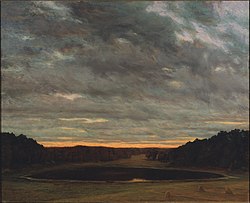 Calm Water. 1901. 142 × 178 cm. Nationalmuseum, Stockholm.
 -
 View of Vadstena from the surrounding fields
 -

-

-
 Djurgård Church
 -
 Porcelain flower pot designed by Prince Eugen, popular in Sweden.<ref>Template:Cite web</ref>
 -
 The old castle (1893)
 -
 The Cloud (1927)


Death and legacy
Prince Eugen bought Waldemarsudde, in Djurgården in Stockholm, in 1899 and had a residence built there within a few years.<ref name="Artsmia"/> After his death at Drottningholm Palace on 17 August 1947, the residence became an art museum and, in accordance with his will, property of the state.<ref name="Prins">Template:Cite web</ref> Eugen never married, in an era when royal princes almost always found princesses to wed. His homosexual orientation was unknown to the general public.<ref>Template:Cite news</ref>
Honours and arms
Honours
National honours<ref name="(Sveriges statskalender / 1947)">Template:Citation</ref>
- Knight and Commander of the Seraphim, 1 August 1865
- Knight of the Order of Charles XIII, 1 August 1865
- Commander Grand Cross of the Sword, 1 August 1865
- Commander Grand Cross of the Polar Star, 1 August 1865
- Commander Grand Cross of the Order of Vasa, 15 May 1897<ref name="(Sveriges statskalender / 1925)">Template:Citation</ref>
Foreign honours<ref name="(Sveriges statskalender / 1947)"/> Template:Columns-list
Arms
 Arms as Prince of Sweden and Norway, Duke of Närke 1865 to 1905 |
.svg) Arms as Prince of Sweden and Duke of Närke 1905 to 1947 |
 Royal Monogram of Prince Eugen of Sweden |
References
- Swedish princes
- Norwegian princes
- Dukes of Närke
- House of Bernadotte
- 19th-century Swedish painters
- 19th-century Swedish male artists
- Swedish male painters
- 20th-century Swedish painters
- 20th-century Swedish male artists
- Swedish art collectors
- 1865 births
- 1947 deaths
- LGBTQ royalty
- Knights of the Order of Charles XIII
- Commanders Grand Cross of the Order of the Sword
- Commanders Grand Cross of the Order of the Polar Star
- Commanders Grand Cross of the Order of Vasa
- Knights of the Order of the Norwegian Lion
- Swedish people of French descent
- Recipients of the King Haakon VII Freedom Cross
- Honorary Knights Grand Cross of the Royal Victorian Order
- Grand Crosses of the Order of Saint Stephen of Hungary
- Artists from Stockholm
- Swedish Lutherans
- Swedish Army colonels
- Art Nouveau painters
- Knights of the Golden Fleece of Spain
- Recipients of the Order of the Netherlands Lion
- Grand Crosses of the Order of Saint-Charles
- Grand Crosses of the Order of the Star of Romania
- Sons of kings
- 19th-century Swedish LGBTQ people
- 20th-century Swedish LGBTQ people
- LGBTQ Lutherans