Puʻu ʻŌʻō
Template:Short description Template:Use mdy dates Template:Infobox mountain
PuTemplate:Okinau Template:OkinaŌTemplate:Okinaō (also spelled Pu‘u‘ō‘ō, and often written Puu Oo, {{#invoke:IPA|main}}, Template:Respell) is a volcanic cone on the eastern rift zone of Kīlauea volcano in the Hawaiian Islands. The eruption that created PuTemplate:Okinau Template:OkinaŌTemplate:Okinaō began on January 3, 1983, and continued nearly continuously until April 30, 2018, making it the longest-lived rift-zone eruption of the last two centuries.<ref name="debate">Template:Cite news</ref><ref>{{#invoke:citation/CS1|citation |CitationClass=web }}</ref>
By January 2005, Template:Convert of magma covered an area of more than Template:Convert and added Template:Convert of land to the southeast coast of [[Hawaii (island)|HawaiTemplate:Okinai]]. The eruption claimed at least 189 buildings and Template:Convert of highways, as well as a church, a store, the WahaTemplate:Okinaula Visitor Center, and many ancient Hawaiian sites, including the WahaTemplate:Okinaula heiau. The coastal highway has been closed since 1987, as parts of the road have been buried under lava up to Template:Convert thick.
Etymology
The hill was initially nicknamed "PuTemplate:Okinau O" by volcanologists, as its position when marked on a map of the area coincided with an "o" in "Lava flow of 1965". Later, the elders of the village of Kalapana were asked to name the new hill, and chose Puʻu ʻŌʻō, meaning hill of the digging stick.<ref>C. Heliker, D.A. Swanson, T.J. Takahashi: The PuTemplate:Okinau Template:OkinaŌTemplate:Okinaō-Kūpaianaha Eruption of Kīlauea Volcano, HawaiTemplate:Okinai: The First 20 Years. In: U.S. Geological Survey Professional Paper. 1676, 2003. Online Version</ref> The name is also often translated as "Hill of the [[Hawaiʻi ʻŌʻō|Template:OkinaŌTemplate:Okinaō Bird]]". In 2021, the Hawaiʻi Board of Geographic Names updated the spelling of the cone as Pu‘u‘ō‘ō for consistency with the board's spelling guidelines. The Hawaiian Volcano Observatory began following the new recommended naming convention shortly thereafter.<ref>{{#invoke:citation/CS1|citation |CitationClass=web }}</ref><ref>Template:Cite report</ref>
Geologic history
1983 – 1986: High lava fountains build tall cinder and spatter cone

The PuTemplate:Okinau Template:OkinaŌTemplate:Okinaō eruption began when fissures split the ground in the remote rainforest of the eastern rift zone, on January 3, 1983. By June 1983, the activity had strengthened and localized to the PuTemplate:Okinau Template:OkinaŌTemplate:Okinaō vent. Over the next three years, 44 eruptive episodes with lava fountains as high as Template:Convert stopped traffic at points across east HawaiTemplate:Okinai. The fallout of cinder and spatter from the towering lava fountains built a cone Template:Convert high.
1986 – 1991: Eruption shifts east to KūpaTemplate:Okinaianahā
In July 1986, the conduit feeding magma to PuTemplate:Okinau Template:OkinaŌTemplate:Okinaō ruptured, and the eruption abruptly shifted Template:Convert downrift to form the KūpaTemplate:Okinaianahā vent. With the new vent came a new style of eruption: continuous, quiet effusion from a lava lake replaced the episodic high fountaining. After a few weeks, a roof formed over the main lava outflow channel, which created a lava tube. The lava tube allowed the fluid pahoehoe lava to retain heat and flow long distances. In less than a year, overflow from the lake created a broad and low shield about Template:Convert above KūpaTemplate:Okinaianahā.
Lava streams were first visible from the town of [[Kapaau, Hawaii|KapaTemplate:Okinaau]] in November, 1986. In the course of that month, lava cut a swath through KapaTemplate:Okinaahu, covered the coastal highway, and finally reached the ocean Template:Convert from the vent. Some weeks later, the lava flow shifted eastwards and buried 14 houses in the town of Kalapana within one day. The lava flow at Kalapana ceased when the lava tube system shut down.

In 1990, the eruption entered its most destructive phase, when flows turned eastward and completely destroyed the villages of Kalapana and Kaimū. Kaimū Bay and Kalapana Black Sand Beach were also completely covered with lava. Over 100 homes were destroyed by the ever-broadening flow field in a nine-month period. New tubes diverted lava away from Kalapana early in 1991, and lava once again entered the ocean within Hawaii Volcanoes National Park.
1992 – 2013: Steady lava effusion
The volume of lava erupted from KūpaTemplate:Okinaianahā declined steadily through 1991, and in early 1992, the vent died. The eruption then returned to PuTemplate:Okinau Template:OkinaŌTemplate:Okinaō, where flank vents on the west and southwest sides of the cone constructed a new lava shield. Soon lava tubes were feeding lava from the vents to the ocean, with few surface flows in between. The flank vents have held center stage ever since, with the exception of a two-month pause in activity, early in 1997, which followed a brief fissure eruption in Nāpau Crater, a short distance southwest of PuTemplate:Okinau Template:OkinaŌTemplate:Okinaō.
On the evening of January 29, 1997, a series of earthquakes struck Kīlauea's east rift zone. Deep within the rift zone, magma was escaping from the conduit leading to the PuTemplate:Okinau Template:OkinaŌTemplate:Okinaō vent, cutting off the supply to the ongoing eruption. The lava pond at PuTemplate:Okinau Template:OkinaŌTemplate:Okinaō drained, and residents Template:Convert away heard a low, rumbling roar as the crater floor dropped Template:Convert and the west wall of the PuTemplate:Okinau Template:OkinaŌTemplate:Okinaō cone collapsed. A few hours later, as magma found a new path to the surface, the ground cracked in nearby Nāpau Crater, and lava fountains lit up the night sky. However, activity in this area was short-lived, and the center of activity soon shifted back to PuTemplate:Okinau Template:OkinaŌTemplate:Okinaō.


As of January 2007, 3.1 cubic km of lava had covered Template:Convert and added Template:Convert to Kīlauea's southern shore. The new shoreline was Template:Convert long. The lava flows have destroyed 189 structures and covered Template:Convert of highway with as much as Template:Convert of lava.
In 2007, after a cluster of earthquakes, activity in PuTemplate:Okinau Template:OkinaŌTemplate:Okinaō subsided and the crater floor collapsed, with no incandescence visible in the crater after the end of August. Lava began emerging from a series of cracks in the northeast rift zone and spread slowly east and south as a perched flow, with slow advances of Template:OkinaaTemplate:Okinaā. The flow spread mostly over flows of 1983–1986, with minor incursions into adjoining forests.

In late July 2008, additional flows extended from the eastern vents of PuTemplate:Okinau Template:OkinaŌTemplate:Okinaō and in October multiple new fissures opened along the length of the tube expanding into Royal Gardens Subdivision and covered a large area of the coastal flats in November 2008.
On March 5, 2011, the floor of the PuTemplate:Okinau Template:OkinaŌTemplate:Okinaō crater deflated, then collapsed. Two hours later, a new eruption occurred in Kīlauea's middle east zone, between PuTemplate:Okinau Template:OkinaŌTemplate:Okinaō and Napau Crater.<ref>{{#invoke:citation/CS1|citation |CitationClass=web }}</ref> Lava fountains were reported to be Template:Convert high.Template:Citation needed
On March 26, 2011, lava began to refill the crater's floor, being visible in USGS HVO webcam. The USGS stated that the accumulation of lava had put the crater floor about Template:Convert below the eastern crater rim, as of June 1.<ref name="volcanoes.usgs.gov">{{#invoke:citation/CS1|citation |CitationClass=web }}</ref>
On September 21, 2011, lava in the west lava lake in PuTemplate:Okinau Template:OkinaŌTemplate:Okinaō Crater fed a series of lava flows that traveled down the west flank of PuTemplate:Okinau Template:OkinaŌTemplate:Okinaō during September 20–21. At about 0225 UTC on September 21, activity in the crater and overflows to the west suddenly decreased, as lava broke through the upper east flank of PuTemplate:Okinau Template:OkinaŌTemplate:Okinaō, bypassing the crater. The new fissure fed a channelized [[Lava#ʻAʻā|Template:OkinaaTemplate:Okinaā]] lava flow that advanced rapidly downslope Template:Convert southeast. A second flow to the west of the first began the next day. In addition, a small pad of lava actively refilled the bottom of the drained east lava lake and small flows were barely active at the west edge of PuTemplate:Okinau Template:OkinaŌTemplate:Okinaō Crater. The channelized Template:OkinaaTemplate:Okinaā lava flow reached Template:Convert long on 23 September and then stalled within the Kahaualeʻa Natural Area Reserve. Most of the active lava spread south and west of Puʻu Halulu (Template:Convert northeast of PuTemplate:Okinau Template:OkinaŌTemplate:Okinaō) during 23–27 September. Minor lava activity resumed within Puʻu ʻOʻo Crater with short lava flows issuing from the base of the east wall on 25 September and from the west wall base during 25–26 September. The crater floor of PuTemplate:Okinau Template:OkinaŌTemplate:Okinaō slowly subsided. Lava activity resumed within the east lake on 26 September. The floor of the crater continued to subside during 26–27 September, opening up cracks in the north crater floor.<ref name="volcanoes.usgs.gov"/><ref>{{#invoke:citation/CS1|citation |CitationClass=web }}</ref>
The 2011 activity ultimately destroyed all remaining homes in the Royal Gardens Subdivision. Jack Thompson evacuated his home March 2, 2012. His evacuation and return to the property was documented by Leigh Hilbert.<ref>{{#invoke:citation/CS1|citation |CitationClass=web }}</ref><ref>{{#invoke:citation/CS1|citation |CitationClass=web }}</ref>


2014 – 2016: Lava flow threatens Pāhoa
On June 27, 2014, new vents opened on the northeast flank of the PuTemplate:Okinau Template:OkinaŌTemplate:Okinaō cone that fed a narrow lava flow to the east-northeast. On August 18, the flow entered a ground crack, traveled underground for several days, then resurfaced to form a small lava pond. The sequence was repeated twice more over the following days with lava entering other cracks and reappearing farther downslope. In this way, the flow had advanced approximately Template:Convert from the vent, or to within Template:Convert of the eastern boundary of the Wao Kele o Puna Forest Reserve, by the afternoon of September 3.<ref name="kilaueastatus">{{#invoke:citation/CS1|citation |CitationClass=web }}</ref> Advancing to the northeast at intermittent rates, the flow had entered the village of Pāhoa and was within Template:Convert of the waste recycling center on October 31.<ref>{{#invoke:citation/CS1|citation |CitationClass=web }}</ref>
In December 2014, a sustained lava breakout from this lava flow (informally named the "June 27 flow" by Hawaiian Volcano Observatory scientists)<ref>USGS map July 29,2014</ref> threatened to enter the town of Pāhoa, and to cut Highway 130, the only route into and out of Lower Puna. As a result, work was begun to reopen Chain of Craters Road, initially as a one-lane gravelled surface, and to make Railroad Avenue and Government Beach Road usable as emergency routes.<ref>{{#invoke:citation/CS1|citation |CitationClass=web }}</ref><ref>{{#invoke:citation/CS1|citation |CitationClass=web }}</ref> However, the flow stopped just short of entering Pāhoa.
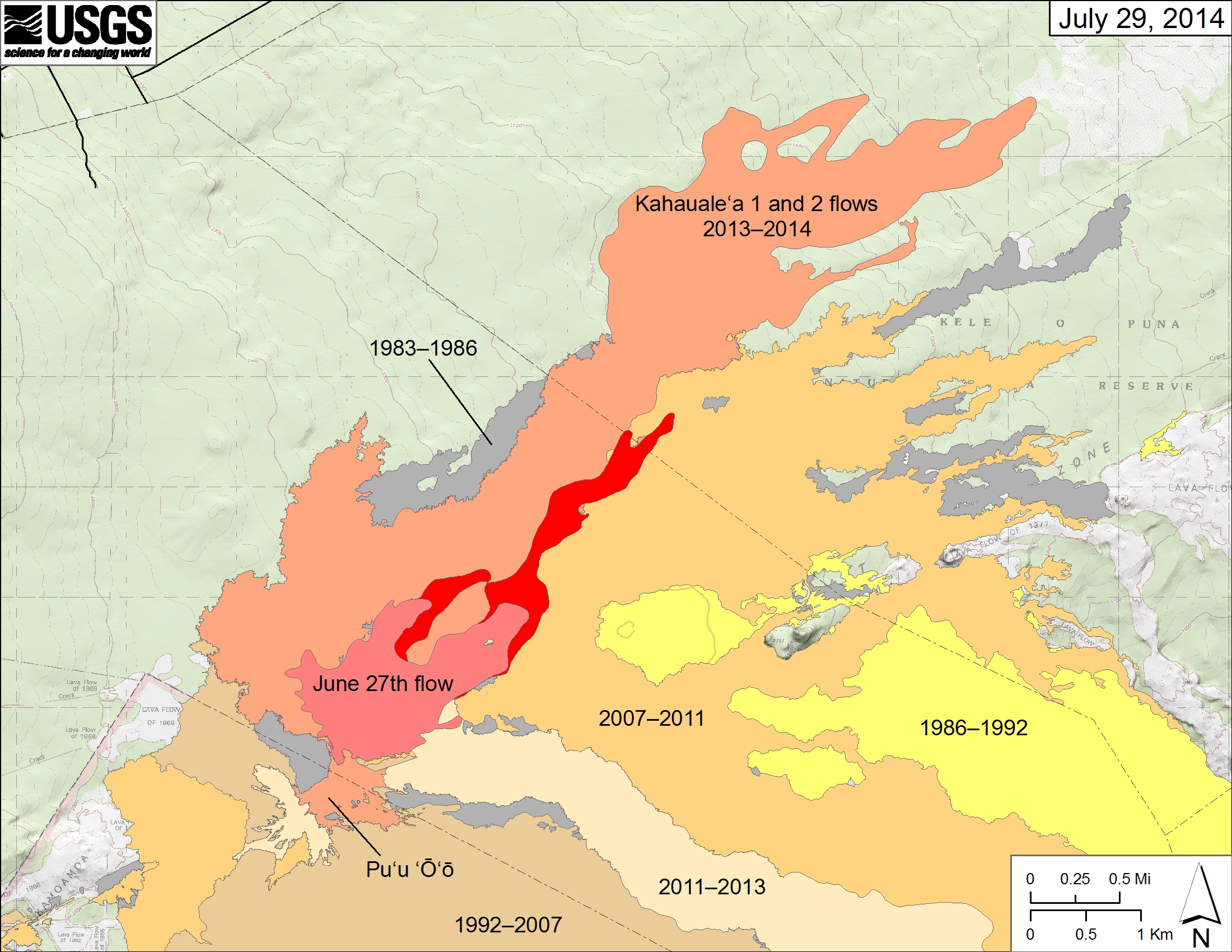
By March 2015, the June 27 flow retreated to within 6 kilometers of Pu‘u ‘Ō‘ō, greatly reducing the threat to Pāhoa.<ref>{{#invoke:citation/CS1|citation |CitationClass=web }}</ref> Lava from the June 27 flow remained active in this area through the remainder of 2015.<ref name="hvo-eruption-summary">{{#invoke:citation/CS1|citation |CitationClass=web }}</ref>
On May 24, 2016, a new vent opened on the east flank of Pu‘u ‘Ō‘ō that cut the supply of lava to the June 27th flow, which became inactive by June 8, 2016. Lava from the new vent, informally named the "61g" flow by the Hawaiian Volcano Observatory, flowed south and began entering the ocean at Kamokuna on July 26, 2016.<ref name="hvo-eruption-summary" /> Lava from the 61g flow covered part of the regraded (but never reopened) new section of the Chain of Craters Road. The road is kept flat for use by authorities, but is no longer a public thoroughfare.
2018: Activity at Pu‘u ‘Ō‘ō stops; eruption shifts to the Lower East Rift Zone
{{#invoke:Labelled list hatnote|labelledList|Main article|Main articles|Main page|Main pages}}

On April 30, 2018, Pu‘u ‘Ō‘ō's crater floor collapsed<ref name="collapse">April 30, 2018; cf. Hawaiian Volcano Observatory Daily Update, U.S. Geological Survey; Tuesday, May 1, 2018, 8:49 AM HST (Tuesday, May 1, 2018, 18:49 UTC): {{#invoke:citation/CS1|citation |CitationClass=web }}</ref> as magma drained from the area beneath the cone.<ref name="2018geonarrative">{{#invoke:citation/CS1|citation |CitationClass=web }}</ref> Following the collapse, seismicity and ground deformation increased downrift of Pu‘u ‘Ō‘ō. On May 3, fissures opened up at the Leilani Estates, marking the beginning of the 2018 lower Puna eruption.<ref name="2018geonarrative" /> Through the rest of 2018, Pu‘u ‘Ō‘ō continued to experience intermittent collapses.<ref name="2018geonarrative" />
In January 2019, Hawaiian Volcano Observatory scientists stated that, considering historical data of prior rift zone eruptions and criteria used by the Global Volcanism Program to determine the end of an eruption, the Pu‘u ‘Ō‘ō eruption was most likely over.<ref>Template:Cite news</ref>
References
Template:Reflist Template:Refbegin