Kra–Dai-speaking peoples
Template:Short description Template:Use dmy dates Template:Infobox ethnic group
The term Kra–Dai peoples or Kra–Dai-speaking peoples refers collectively to the ethnic groups of southern China and Southeast Asia, stretching from Hainan to Northeast India and from southern Sichuan to Laos, Thailand and parts of Vietnam, who not only speak languages belonging to the Kra–Dai language family, but also share similar traditions, culture and ancestry.Template:NoteTag
Origin
Chamberlain (2016) proposes that the Kra–Dai language family was formed as early as the 12th century BCE in the middle of the Yangtze basin, coinciding roughly with the establishment of the state of Chu and the beginning of the Zhou dynasty.<ref name="Chamberlain 2016">Template:Harvp</ref> Following the southward migrations of Kra and Hlai (Rei/Li) peoples around the 8th century BCE, the Yue (Be-Tai people) started to break away and move to the east coast in the present-day Zhejiang, in the 6th century BCE, forming the state of Yue and conquering the state of Wu shortly thereafter.<ref name="Chamberlain 2016" />
According to Chamberlain, the Yue (Be-Tai) began to migrate southwards along the east coast of China to what are now Guangxi, Guizhou, and northern Vietnam after Yue was conquered by Chu around 333 BCE. There they formed the Luo Yue, who moved into Lingnan and northern Vietnma, and then westward into northeastern Laos and Sip Song Chau Tai, and later became the Central-Southwestern Tai, followed by the Xi Ou, which became the Northern Tai).<ref name="Chamberlain 2016" />
Tao et. al (2023), however, suggests that the Kra-Dai language family originated from coastal south China, around the Fujian, Guangdong, and Guangxi provinces, and underwent a radial expansion into the Guizhou-Yunnan region, Hainan Island, and Mainland Southeast Asia. This language dispersal might also be associated with environmental change and demographic changes.<ref>Template:Cite journal</ref>
Kra–Dai peoples are thought to have originated in Taiwan, where they spoke a dialect of proto-Austronesian or one of its descendant languages. The Kra–Dai-speaking peoples migrated to southern China, where they brought with them the Proto-Kra–Dai language. They may originally have been Austronesian peoples.Template:Sfn Unlike the Malayo-Polynesian-speaking group that sailed south to the Philippines and other parts of maritime Southeast Asia, the ancestors of the modern Kra–Dai people sailed west to mainland China and possibly traveled along the Pearl River, where their language greatly changed from other Austronesian languages under the influence of the Sino-Tibetan and Hmong–Mien languages.Template:Sfn However, no archaeological evidence has been identified which would correspond to this Daic expansion in its earliest phases.
Aside from linguistic evidence, the connection between Austronesian and Kra–Dai can also be seen in shared cultural practices. Roger Blench (2008) demonstrates that tooth ablation, face tattooing, teeth blackening, and snake worship are shared between the Taiwanese indigenous peoples and the Kra–Dai peoples of southern China.Template:SfnTemplate:Sfn
Overall, most theories suggest that Kra-Dai peoples are closely related to Austronesians,<ref>Template:Cite journal</ref><ref>Template:Cite journal</ref> especially Taiwanese indigenous peoples.<ref name=":2" /> They descend from a local Austronesian-related lineage in continental southeast China, ranging from Zheijiang to Guangdong, with additional gene flow from an Austroasiatic-related lineage.<ref name=":6">Template:Cite journal</ref> Genetic characteristics of the Baiyue are also well-preserved in Kra-Dai groups from South China and mainland Southeast Asia,<ref name=":64">Template:Cite journal</ref> although it's likely that the Baiyue themselves were multi-ethnic.<ref name=":43">Template:Cite book</ref>
-
 Proposed genesis of Daic languages and their relation with Austronesian languages (Blench, 2018)<ref name="Blench 2018">Template:Cite bookTemplate:Self-published inline</ref>
 -
 Kra-Dai migration route according to James R. Chamberlain (2016).<ref>Template:Harvp</ref>
 -
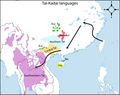 Kra–Dai migration route according to Matthias Gerner's Northeast to Southwest Hypothesis.<ref>Template:Cite conference</ref>


Linguistic subdivisions
There are five established branches of the Kra–Dai languages, which may not directly correspond to ethnicity:
- the Tai peoples of China and much of Southeast Asia (including most notably the Thai, Lao, Isan, Shan and Zhuang, and Saek people of Laos and Thailand)
- the Hlai people and Be people of China, especially on Hainan
- the Kra peoples of China and Vietnam (also known as the Geyan peoples)
- the Kam–Sui peoples (which may or not include the Biao people) in central China
The Lakkia people of Guangxi Autonomous Region of China (Tai Lakka in neighboring portions of Vietnam) are ethnically of Yao, but speak a Kra–Dai language called Lakkia.<ref name="Lakkia on Ethnologue">Lakkia on Ethnologue</ref> These Yao were likely in an area dominated by Tai speakers and assimilated an early Kra–Dai language (possibly the language of the ancestors of the Biao people).
- The Lingao people in Hainan Province of China speak a Kra–Dai language called Be or Lincheng, although the ethnicity of the Lingao traces back to the Han nationality.<ref name="Lingao on Ethnologue">Lingao on Ethnologue</ref>
Geographic distribution
The Kra-Dai have historically resided in China, continental Southeast Asia and parts of northeastern India since the early Kra-Dai expansion period. Their primary geographic distribution in those countries roughly forms an arc extending from northeastern India through southern China and down to Southeast Asia. Recent Kra-Dai migrations have brought considerable numbers of Kra-Dai peoples to Japan, Taiwan, Sri Lanka, the United Arab Emirates, Europe, Australia, New Zealand, North America and Argentina as well. The greatest ethnic diversity among the Kra-Dai is found in China, their prehistoric homeland.
The Kra peoples are clustered in the Guangxi, Guizhou, Yunnan, Hunan and Hainan provinces of China, as well as the Hà Giang, Cao Bằng, Lào Cai and Sơn La provinces of Vietnam.
The Kam–Sui peoples are clustered in China as well as neighboring portions of northern Laos and Vietnam.
List of Kra–Dai-speaking peoples per country
China
In southern China, people speaking Kra-Dai languages are mainly found in Guangxi, Guizhou, Yunnan, Hunan, Guangdong, and Hainan. According to statistics from the 1990 Chinese census, the total population of these groups was 23,262,000. Their distribution is as follows:
- Dai (or Tai) have a population of about 19 million, mainly inhabiting Guangxi, Yunnan, Guangdong and parts of Guizhou and Hunan provinces.
- Kam-Sui (Kam-Shui) have a population of about 4 million and live mainly in Hunan, Guizhou, and in Guangxi.
- Kra have a population of about 22,000 and live mostly in Yunnan, Guangxi and Hunan.
The following is a list of the Kra–Dai ethnic groups in China:
Tai and Rauz peoples
- Thai (Central Thai)
- Bouyei
- Tai Chong (Template:Langx tai chong)
- Dai (Template:Langx tai léu), including the Lu, Han Tai, Huayao Tai and Paxi people
- Tai Dam
- Dong (Template:Zh, Template:Langx), including the Northern and Southern Dong people
- E (Template:Langx ĕe)
- Tai Eolai (Template:Langx Tai eo laai)
- Fuma (Template:Langx Fū ma)
- Hongjin Tai
- White Thai people
- Tai Kaihua (Template:Langx tai kăi hŭa)
- Kang
- Tai Lai (Template:Langx tai laai)
- Minggiay (Template:Langx ming-gia)
- Mo
- Isan people
- Tai Nuea (Template:Langx tai nĕua), including the Tai Mao and Tai Pong people
- Pachen (Template:Langx bpaa chayn)
- Tai Payee (Template:Langx tai bpaa yêe)
- Pemiayao (Template:Langx bpay-mia wor)
- Pulachee (Template:Langx bpoo-laa jee)
- Pulungchee (Template:Langx bpoo-lung-jee)
- Puyai (Template:Langx bpôo)
- San Chay (also referred to as the Cao Lan people)
- Shan (Template:Langx yài tai), including the Cun (Template:Langx)
- Tay (Template:Langx)
- Thuchen (Template:Langx dtoo chayn)
- Thula (Template:Langx dtù-laa)
- Tai Ya people (Template:Langx tai yàa)
- Yoy (Template:Langx tai yói)
- Tay (including the Tho people)
- Zhuang (Template:Langx jûang), including the Buyang, Dianbao, Pusha, Tulao, Yongchun and Nùng (Template:Langx) people
Hlai people
The Hlai reside primarily, if not completely, on Hainan island province in China.
Kra peoples
The Kra peoples are clustered in the Guangxi, Guizhou, Yunnan, Hunan and Hainan provinces of China, as well as the Hà Giang, Cao Bằng, Lào Cai and Sơn La provinces of Vietnam. Template:For
Kam–Sui peoples
- Bouyei of Guizhou (including Ai-Cham, Mak and T'en, although most Bouyei are nuclear Tai)
- Kam of Guizhou, Hunan, and Guangxi, referred to as the Dong in China
- Mulao of Guizhou
- Maonan of Guangxi
- Sui of Guizhou, Yunnan, and Guangxi; also referred to as the Shui
Cao Miao people
The Cao Miao people of Guizhou, Hunan, and Guangxi speak a Kam–Sui language called Mjiuniang, although they are believed to be of Hmong–Mien descent.
Kang people
The Tay Khang of Yunnan and Laos speak a Kam–Sui language but are ethnically related to the Dai people.
Biao
The Biao are clustered in Guangdong, China.<ref name="Biao on Ethnologue">Biao at Ethnologue</ref>
Lakkia people
The Lakkia are an ethnic group clustered in the Guangxi Province of China and neighboring portions of Vietnam, whose members are of Yao descent, but speak a Tai–Kadai language called Lakkia.<ref name="Lakkia on Ethnologue"/> These Yao were likely in an area dominated by Tai speakers and assimilated an early Tai–Kadai language (possibly the language of the ancestors of the Biao people).
Lingao people
The Lingao are an ethnic group clustered in Hainan, China whose members are classified as Han Chinese under Chinese nationality law, but speak a Tai–Kadai language called Lincheng.<ref name="Lingao on Ethnologue"/>
Laos
Nuclear Tai peoples
- Tai Daeng<ref name="Ethnologue report for Laos">Ethnologue report for Laos</ref>
- Tai Dam<ref name="Ethnologue report for Laos"/>
- Tai Gapong
- Tai He
- Tay Khang<ref name="Ethnologue report for Laos"/>
- Tai Kao<ref name="Ethnologue report for Laos"/>
- Kongsat
- Kuan (Population of 2,500 in Laos)<ref name="Ethnologue report for Laos"/>
- Tai Laan
- Tai Maen<ref name="Ethnologue report for Laos"/>
- Northern Thai (Lanna)<ref name="Ethnologue report for Laos"/>
- Lao (Population of 3,000,000 in Laos)<ref name="Ethnologue report for Laos"/>
- Lao Lom<ref name="Ethnologue report for Laos"/>
- Tai Long<ref name="Ethnologue report for Laos"/>
- Dai (Population of 134,100 in Laos<ref name="Ethnologue report for Laos"/> including the Lu people))
- Northeastern Thai (including the Lao Kaleun and Isan people)
- Tai Nuea<ref name="Ethnologue report for Laos"/>
- Nùng<ref name="Ethnologue report for Laos"/>
- Nyaw
- Tai Pao<ref name="Ethnologue report for Laos"/>
- Tai Peung
- Phuan (Population of 106,099 in Laos)<ref name="Ethnologue report for Laos"/>
- Phutai (Population of 154,400 in Laos)<ref name="Ethnologue report for Laos"/>
- Pu Ko<ref name="Ethnologue report for Laos"/>
- Rien<ref name="Ethnologue report for Laos"/>
- Tai Sam
- Tayten
- Yoy<ref name="Ethnologue report for Laos"/>
- Zhuang (including the Nùng people)
- Shan
- Yang<ref name="THE RESEARCH AND CLASSIFICATION OF THE ETHNIC GROUPS IN LAOS">The Research and Classification of the Ethnic Groups in LaosTemplate:Dead link</ref>
- Thai (Central Thai)
Kam–Sui peoples
Template:See also The Kam–Sui peoples are clustered in China as well as neighboring portions of northern Laos and Vietnam.
Saek people
The center of the Saek population is the Mekong River in central Laos. A smaller Saek community makes its home in the Isan region of northeast Thailand, near the border with Laos.
Thailand
Nuclear Tai peoples
- Chiang Saeng
- Central Thai (Thai<ref name="The Thai and Other Tai-speaking Peoples">The Thai and Other Tai-speaking Peoples</ref> and Khorat Thai)
- Northern Thai (Tai Wang, Lanna and Thai Yuan)
- Southern Thai (including the Tak Bai Thai people)
- Tai Dam
- Tai Daeng
- Phuan<ref name="The Thai and Other Tai-speaking Peoples"/>
- Tai Song
- Lao–Phutai
- Lao<ref name="The Thai and Other Tai-speaking Peoples"/> (Lao Loum, Lao Ga, Lao Lom, Lao Ti, Lao Wiang and Lao Krang)
- Northeastern Thai (Tai Kaleun and Isan)
- Phutai<ref name="The Thai and Other Tai-speaking Peoples"/>
- Nyaw
- Northwestern Tai
- Tai Bueng
- Tai Gapong
- Khün
- Lao Ngaew
- Nyong
- Yoy
Saek people
The center of the Saek population is the Mekong River in central Laos. A smaller Saek community makes its home in the Isan region of northeast Thailand, near the border with Laos.
Vietnam
Nuclear Tai peoples
- Buyei
- Tày Tac
- Tai Chong
- Tai Daeng
- Tai Dam<ref name="Thai Ethnic Group in Vietnam">Thai Ethnic Group in Vietnam</ref><ref name="Vets With a Mission">Vets With a Mission</ref>
- Giáy
- Tai La
- Tsun-Lao
- Tai Kao
- Lao
- Dai
- Tai Man Thanh<ref name="Thai Ethnic Group in Vietnam"/>
- Nang
- Zhuang (including the Nùng people)
- Phutai
- Tai Taosao
- Tay<ref name="Thai Ethnic Group in Vietnam"/> (including the Tho people)
- Tai Do (including the Tay Muoi<ref name="Thai Ethnic Group in Vietnam"/> and Tay Jo people)
- Tai Yung
- Ka Lao
- Thu Lao
- Tai So
- Tai Chiang
- Tai Lai
- Pu Thay<ref name="Thai Ethnic Group in Vietnam"/>
- Tai Hang Thong<ref name="Thai Ethnic Group in Vietnam"/>
- San Chay (also referred to as the Cao Lan people)
- Lu
- Yoy
Kra peoples
Myanmar
- Shan (including the Khamti people)
- Dai (including the Lu people)
- Lao
- Tai Khun
- Tai Yong
- Tai Nuea (including the Tai Mao people)
- Tai Laeng
- Tai Phake
- Thai (Central Thai)
- Tai Piw
- Tenasserim Thai
Cambodia
India
The following groups are found in Assam, India:
Genetics of Kra–Dai-speaking peoples
Template:Unreferenced section Template:See also
Li (2008)
The following table of Y-chromosome DNA haplogroup frequencies of modern Kra-Dai speaking peoples is from Li, et al. (2008).<ref name="LiHui2008">Template:Cite journal</ref>
| Ethnolinguistic group | Language branch | n | C | D* | D1 | F | M | K | O* | O1a*-M119 | O1a2-M50 | O2a*-M95 | O2a1-M88 | O3*-M122 | O3a1-M121 | O3a4Template:Broken anchor-M7 | O3a5-M134 | O3a5a-M117 | P |
|---|---|---|---|---|---|---|---|---|---|---|---|---|---|---|---|---|---|---|---|
| Qau (Bijie) | Kra | 13 | 15.4 | 7.7 | 23.1 | 15.4 | 30.8 | 7.7 | |||||||||||
| Blue Gelao (Longlin) | Kra | 30 | 3.3 | 13.3 | 60.0 | 16.7 | 3.3 | 3.3 | |||||||||||
| Lachi | Kra | 30 | 3.3 | 3.3 | 13.3 | 13.3 | 16.7 | 6.7 | 10.0 | 3.3 | 6.7 | 23.3 | |||||||
| Mulao (Majiang) | Kra | 30 | 10.0 | 3.3 | 13.3 | 3.3 | 3.3 | 63.3 | 3.3 | ||||||||||
| Red Gelao (Dafang) | Kra | 31 | 3.2 | 6.5 | 22.6 | 22.6 | 16.1 | 12.9 | 16.1 | ||||||||||
| White Gelao (Malipo) | Kra | 14 | 35.7 | 14.3 | 42.9 | 7.1 | |||||||||||||
| Buyang (Yerong) | Kra | 16 | 62.5 | 6.3 | 18.8 | 12.5 | |||||||||||||
| Paha | Kra | 32 | 3.1 | 6.3 | 6.3 | 9.4 | 3.1 | 71.9 | |||||||||||
| Qabiao | Kra | 25 | 32.0 | 4.0 | 60.0 | 4.0 | |||||||||||||
| Hlai (Qi, Tongza) | Hlai | 34 | 35.3 | 32.4 | 29.4 | 2.9 | |||||||||||||
| Cun | Hlai | 31 | 3.2 | 6.5 | 9.7 | 38.7 | 38.7 | 3.2 | |||||||||||
| Jiamao | Hlai | 27 | 25.9 | 51.9 | 22.2 | ||||||||||||||
| Lingao | Be | 30 | 3.3 | 16.7 | 26.7 | 13.3 | 3.3 | 10.0 | 26.7 | ||||||||||
| E | Northern Tai | 31 | 3.2 | 3.2 | 9.7 | 16.1 | 6.5 | 54.8 | 3.2 | 3.2 | |||||||||
| Zhuang, Northern (Wuming) | Northern Tai | 22 | 13.6 | 4.6 | 72.7 | 4.6 | 4.6 | ||||||||||||
| Zhuang, Southern (Chongzuo) | Central Tai | 15 | 13.3 | 20.0 | 60.0 | 6.7 | |||||||||||||
| Caolan | Central Tai | 30 | 10.0 | 10.0 | 53.3 | 3.3 | 20.0 | 3.3 | |||||||||||
| Biao | Kam–Sui | 34 | 2.9 | 5.9 | 14.7 | 17.7 | 52.9 | 5.9 | |||||||||||
| Lakkia | Kam–Sui | 23 | 4.4 | 52.2 | 4.4 | 8.7 | 26.1 | 4.4 | |||||||||||
| Kam (Sanjiang) | Kam–Sui | 38 | 21.1 | 5.3 | 10.5 | 39.5 | 10.5 | 2.6 | 10.5 | ||||||||||
| Sui (Rongshui) | Kam–Sui | 50 | 8.0 | 10.0 | 18.0 | 44.0 | 20.0 | ||||||||||||
| Mak & Ai-Cham | Kam–Sui | 40 | 2.5 | 87.5 | 5.0 | 2.5 | 2.5 | ||||||||||||
| Mulam | Kam–Sui | 40 | 2.5 | 12.5 | 7.5 | 5.0 | 5.0 | 25.0 | 30.0 | 7.5 | 5.0 | ||||||||
| Maonan | Kam–Sui | 32 | 9.4 | 9.4 | 15.6 | 56.3 | 9.4 | ||||||||||||
| Then | Kam–Sui | 30 | 3.3 | 3.3 | 33.3 | 50.0 | 6.7 | 3.3 | |||||||||||
| Cao Miao | Kam–Sui | 33 | 8.2 | 10.0 | 3.0 | 66.7 | 12.1 |
Full genome analysis
The core Kra-Dai population from Southern China has more Late Neolithic Fujianese-related ancestry (39.0%–53.9%) than Neolithic Mekong-related ancestry (24.9%–32.3%), which was similarly observed for present Southeastern Han Chinese (28.9%–40.3% for Late Neolithic Fujianese and 21.8%–25.2% for Neolithic Mekong).<ref name=":8">Template:Cite journal</ref> Alternatively, they could be modeled as having Atayal-related and Tibetan-related ancestry, with Atayal-related ancestry being estimated at ~3–38%.<ref name=":0">Template:Cite journal</ref> Other studies estimate their Atayal-related ancestry at 50%, with the rest being Yellow River-related. They can also be modeled as having Southeastern Asian ancestry (represented by Paiwan and other Taiwanese aborigines), Northern East Asian ancestry (represented by Late Neolithic Shimao) and Southern East Asian ancestry (represented by Dushan). The first two components contributed to the Kra-Dai genome in similar proportions. There's also evidence of strong affinities between Kra-Dai groups and ancient Guangxi populations, such as GaoHuaHua, BaBanQinCen, LaCen and ShenXian.<ref name="Wang Wu Sun Extensive genetic admixture">Template:Cite journal</ref> Kra-Dai groups from Guangxi, for example, cluster with the 1,500 year old BaBanQinCen population, who have Dushan-related ancestry (5%–64%), Northern East Asian-related ancestry (19%–40%) and Southern East Asian-related ancestry (5%–72%).<ref name="Wang2021-Guangxi">Template:Cite journal</ref> Using the Dai as proxies for the ancestral Kra-Dai population, they can also be modeled as a mixture of North Indian-related (6%) and Naxi/Miao-related groups (94%).<ref>Template:Cite journal</ref><ref>Template:Cite journal</ref>
Hlai people are considered to be one of the most isolated Kra-Dai groups, with minimal foreign admixture.<ref>Template:Cite journal</ref><ref name=":2">Template:Cite journal</ref><ref name=":4" /><ref name=":5">Template:Cite journal</ref> They could be modeled as having Austronesian-related ancestry and to a lesser extent, Austroasiatic-related and Northeast Asian-related ancestries. In particular, they cluster with Austronesians that harbor more divergent ancestry, such as the Ami, Atayal, and Kankanaey. Compared to other Kra-Dai groups, the Hlai have less genetic input from ancient Guangxi populations and Han Chinese<ref name=":5" />and tenuously have no Denisovan introgression. These findings suggest that Hlai and Ami/Atayal form a 'clean clade'.<ref name=":2" /> However, there is evidence of substantial Han Chinese admixture in some Hlai.<ref name=":5" /><ref name="Wang Wu Sun Extensive genetic admixture" /> In addition, the Kinh Vietnamese diverged from Hlai much earlier than the Dai diverged from Hlai.<ref name=":63">Template:Cite journal</ref> Other studies suggest that Longli Bouyei and Qiandongnan Dong are equally as good as Hlai in representing the ancestral Kra-Dai population. This is evident by how they cluster with Iron Age Taiwanese populations like Gongguan and Hanben, along with Neolithic to Bronze Age Fujianese populations like Xitoucun and Tanshishan. They also cluster with Kinh Vietnamese.<ref name=":4" />
Kra-Dai groups like the Gelaos (from Daozhen, Guiyang, Longlin or Zunyi), Dong (from Hunan, Guizhou, Qiandongnan), Longli Bouyei and Guangxi Zhuang share more alleles with Ancient Northern East Asian-related groups, who are closely related to Neolithic millet farmers from the Yellow River basin. Meanwhile, groups like Dai, Hlai and other Kra-Dai groups in Southeast Asia share more alleles with Ancient Southern East Asian-related groups. However, Longli Bouyei and Qiandongnan Dong have slightly more Ancient Southern East Asian-related ancestry. Overall, a genetic cline exists for Kra-Dai groups, with Taiwan Hanben-related ancestry increasing in southern Kra-Dai groups.<ref name=":4">Template:Cite report</ref>
A common haplogroup among Kra-Dai peoples is O1a-M119, which increases further east in China. It is also more common among Taiwanese aborigines than Austronesian populations from Southeast Asian islands.<ref>Template:Cite journal</ref> Haplogroup O1b1a1a (O-M95) is likewise common in groups like Hlai, Dai and Kinh Vietnamese.<ref name=":62">Template:Cite journal</ref> Maternal haplogroups B, C and D are common for Kra-Dai peoples in Mainland Southeast Asia whilst M7b and M7c are common for all Austronesians and Kra-Dai peoples.<ref>Template:Cite journal</ref>
Contributions to East and Southeast Asian populations
There is evidence that Kra-Dai ancestry represents the 'southern ancestry' that was introduced in the ancestors of Han Chinese although this ancestry increases further south in China.<ref name=":8" /><ref name=":42">Template:Cite journal</ref> This ancestry can also be represented by Taiwan Hanben ancestry.<ref name=":4" />
Han Chinese from Fujian and Guangdong show excessive ancestries from Late Neolithic Fujianese sources (35.0–40.3%). This Late Neolithic Fujianese ancestry peaks in present Ami, Atayal and Kankanaey (66.9–74.3%) and are less significant in Han Chinese from Zhejiang (22%), Jiangsu (17%) and Shandong (8%). This suggests a significant genetic contribution from Kra-Dai-speaking peoples, or groups related to them, to Southern Han Chinese. Other studies suggest actual ancient population admixture between Ami and Atayal and Han Chinese from Guangdong and Sichuan.<ref>Template:Cite journal</ref><ref name="Lo Cheng Hsiung Detecting Genetic Ancestry">Template:Cite journal</ref> This admixture is also present in the ancestors of Taiwanese Han.<ref name="Lo Cheng Hsiung Detecting Genetic Ancestry" /> Han Chinese from Fujian and Guangdong also have ancestry from Neolithic Mekong sources but this is less significant (21.8–23.6%).<ref name=":1">Template:Cite journal</ref> Guangxi Han, who possess the lowest Northern East Asian ancestry among Han subgroups (33.8 ± 4.8%), are believed to descend from Kra-Dai speakers who adopted Chinese dialects.<ref>Template:Cite journal</ref> Both Guangxi and Hainan Han are also closely related to Guangdong Han.<ref>Template:Cite journal</ref><ref>Template:Cite journal</ref><ref name=":13">Template:Cite journal</ref>However, there is evidence that Han Chinese from Northern Guangxi have more Southeast Asian-related ancestry, which is closely related to Austronesian, Kra-Dai and Austroasiatic groups, than those from Southern Guangxi.<ref name=":12">Template:Cite journal</ref> Overall, Cantonese, Taiwanese Han and Fujianese are considered to be the most southern-shifted Han subgroups.<ref>Template:Cite journal</ref><ref>Template:Cite report</ref><ref>Template:Cite journal</ref> Southern Chinese also significantly share a genetic component that's more abundant in Dai and Kinh Vietnamese.<ref>Template:Cite journal</ref>
Among Kra-Dai groups in Northeast Thailand near the Laos border, there is 95% Lao-related ancestry although Bru have <1% Lao-related ancestry due to being an isolated Austroasiatic group. Lao-related ancestry makes up >50% of the ancestry of Central Thai whilst southern Thai have 66% Nayu-related ancestry, which is a mixture of Austroasiatic, Austronesian and Kra-Dai. Zhuang-related ancestry also makes up 41% of the ancestry found in Kra-Dai groups in northern Thailand. These findings reflect historic migrations of Kra-Dai groups to Thailand via Laos or the heavy assimilation of Laotians by Thais.<ref name=":7">Template:Cite journal</ref> Compared to other Austroasiatic groups in Southeast Asia, Laotians have high affinities with Kra-Dai groups from China.<ref name=":7" /> Whilst Kinh Vietnamese also have high affinities with Kra-Dai groups,<ref name=":14">Template:Cite journal</ref><ref>Template:Cite report</ref><ref>Template:Cite journal</ref><ref>Template:Cite journal</ref><ref name=":03">Template:Cite journal</ref> they are mixed with Austroasiatic groups from Mainland Southeast Asia although this can be found in Laotians to a lesser extent.<ref name=":7" /><ref>Template:Cite journal</ref><ref name=":33">Template:Cite journal</ref><ref>Template:Cite journal</ref>
Notes
References
Works cited
- Template:Cite web Presented at the 12th EURASEAA meeting Leiden, 1–5 September 2008.
- Template:Cite conference
- Template:Cite conference
- Template:Cite journal
- Template:Cite journal