William Feller
Template:Short description Template:Distinguish Template:Infobox scientist
William "Vilim" Feller (July 7, 1906 – January 14, 1970), born Vilibald Srećko Feller, was a Croatian–American mathematician specializing in probability theory.
Early life and education
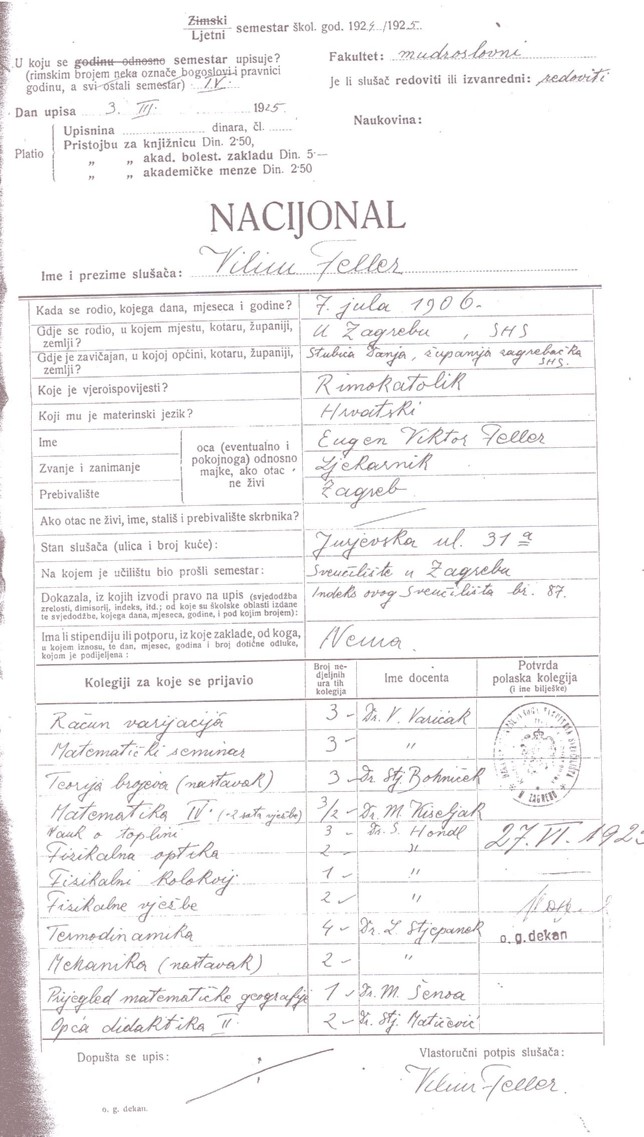
Feller was born in Zagreb to Ida Oemichen-Perc, a Croatian–Austrian Catholic, and Eugen Viktor Feller, son of a Polish–Jewish father (David Feller) and an Austrian mother (Elsa Holzer).<ref>Zubrinic, Darko (2006). "William Feller (1906-1970)". Croatianhistory.net. Accessed 3 July 2018.</ref>
Eugen Feller was a famous chemist and created Elsa fluid named after his motherTemplate:Clarify. According to Gian-Carlo Rota, Eugen Feller's surname was a "Slavic tongue twister", which William changed at the age of twenty.<ref>Template:Cite book</ref> This claim appears to be false. His forename, Vilibald, was chosen by his Catholic mother for the saint day of his birthday.<ref>Template:MacTutor Biography</ref>
Career and later life
Feller held a docent position at the University of Kiel beginning in 1928. Because he refused to sign a Nazi oath,<ref>{{#invoke:citation/CS1|citation |CitationClass=web }}</ref> he fled the Nazis and went to Copenhagen, Denmark in 1933. He also lectured in Sweden (Stockholm and Lund).<ref>Template:Cite book</ref> As a refugee in Sweden, Feller reported being troubled by increasing fascism at the universities. He reported that the mathematician Torsten Carleman would offer his opinion that Jews and foreigners should be executed.<ref>Template:Harv</ref>
After marrying a former student from Kiel, Clara Mary Nielsen, in 1938, he moved with her to the US in 1939. In that year he joined Brown University as an associate professor; he became a US citizen in 1944.<ref name=mt>Template:Mactutor</ref> He moved to Cornell University in 1945 and to Princeton University in 1950. At Princeton, he became Eugene Higgins Professor of Mathematics. He remained there until his death on January 14, 1970.<ref name=nas/>
Work
Template:More citations needed The works of Feller are contained in 104 papers and two books on a variety of topics such as mathematical analysis, theory of measurement, functional analysis, geometry, and differential equations in addition to his work in mathematical statistics and probability.
Feller was one of the greatest probabilists of the twentieth century. He is remembered for his championing of probability theory as a branch of mathematical analysis in Sweden and the United States. In the middle of the 20th century, probability theory was popular in France and Russia, while mathematical statistics was more popular in the United Kingdom and the United States, according to the Swedish statistician, Harald Cramér.<ref>Preface to his Mathematical Methods of Statistics.</ref> His two-volume textbook on probability theory and its applications was called "the most successful treatise on probability ever written" by Gian-Carlo Rota.<ref>Page 199: Indiscrete Thoughts.</ref> By stimulating his colleagues and students in Sweden and then in the United States, Feller helped establish research groups studying the analytic theory of probability. In his research, Feller contributed to the study of the relationship between Markov chains and differential equations, where his theory of generators of one-parameter semigroups of stochastic processes gave rise to the theory of "Feller operators".
Numerous topics relating to probability are named after him, including Feller processes, Feller's explosion test, Feller–Brown movement, and the Lindeberg–Feller theorem. Feller made fundamental contributions to renewal theory, Tauberian theorems, random walks, diffusion processes, and the law of the iterated logarithm. Feller was among those early editors who launched the journal Mathematical Reviews.
Books
- An Introduction to Probability Theory and its Applications, Volume I, 3rd edition (1968); 1st edn. (1950);<ref>Template:Cite journal</ref> 2nd edn. (1957)<ref>Template:Cite journal</ref>
- An Introduction to Probability Theory and its Applications, Volume II, 2nd edition (1971)
Recognition
In 1949, Feller was named a Fellow of the American Statistical Association.<ref>{{#invoke:citation/CS1|citation |CitationClass=web }}</ref> He was elected to the American Academy of Arts and Sciences in 1958, the United States National Academy of Sciences in 1960, and the American Philosophical Society in 1966.<ref>{{#invoke:citation/CS1|citation |CitationClass=web }}</ref><ref>{{#invoke:citation/CS1|citation |CitationClass=web }}</ref><ref>{{#invoke:citation/CS1|citation |CitationClass=web }}</ref> Feller won the National Medal of Science in 1969.<ref>{{#invoke:citation/CS1|citation |CitationClass=web }}</ref> He was president of the Institute of Mathematical Statistics.<ref name=nas>Template:Cite journal</ref>
See also
- Feller condition
- Beta distribution
- Compound Poisson distribution
- Gillespie algorithm
- Kolmogorov equations
- Poisson point process
- Stability (probability)
- St. Petersburg paradox
- Stochastic process
References
External links
- Template:MathGenealogy
- A biographical memoir by Murray Rosenblatt
- Croatian Giants of Science - in Croatian
- Template:MacTutor Biography
- "Fine Hall in its golden age: Remembrances of Princeton in the early fifties" by Gian-Carlo Rota. Contains a section on Feller at Princeton.
- Feller Matriculation Form giving personal details
- 1906 births
- 1970 deaths
- 20th-century American mathematicians
- 20th-century Croatian mathematicians
- Croatian mathematicians
- Presidents of the Institute of Mathematical Statistics
- Probability theorists
- Brown University faculty
- Cornell University faculty
- Princeton University faculty
- University of Göttingen alumni
- Faculty of Science, University of Zagreb alumni
- National Medal of Science laureates
- Croatian refugees
- American people of Polish-Jewish descent
- Croats in Austria-Hungary
- Croatian people of Austrian descent
- Croatian people of Polish-Jewish descent
- Scientists from Zagreb
- Yugoslav emigrants to the United States
- Members of the United States National Academy of Sciences
- Fellows of the American Statistical Association
- Members of the American Philosophical Society