Mycetozoa
Template:Short description Template:About Template:Automatic taxobox
Mycetozoa is a polyphyletic grouping of slime molds.<ref name="urlMycetozoa - Definition from Merriam-Websters Medical Dictionary">{{#invoke:citation/CS1|citation |CitationClass=web }}</ref> It was originally thought to be a monophyletic clade, but in 2010 it was discovered that protostelia are a polyphyletic group within Conosa.<ref name="Anna Maria Fiore-Donno et Al. 2009">Template:Cite journal</ref>
Classification
Mycetozoa can be divided into dictyostelid, myxogastrid, and protostelid groups.<ref name="pmid9342353">Template:Cite journal</ref>
The mycetozoan groups all fit into the unikont supergroup Amoebozoa, whereas most other slime molds fit into various bikont groups (fonticulids are opisthokonts).
Utility in research
The dictyostelids are used as examples of cell communication and differentiation, and may provide insights into how multicellular organisms develop.
Physarum polycephalum are useful for studying cytoplasmic streaming. They have also been used to study the biochemical events that surround mitosis, since all of the nuclei in a medium-sized plasmodium divide in synchrony. It has been observed that they can find their way through mazes by spreading out and choosing the shortest path, an interesting example of information processing without a nervous system. Myxomycete plasmodia have also been used to study the genetics of asexual cell fusion. The giant size of the plasmodial cells allows for easy evaluation of complete or partial cell fusion.
In 2006, researchers at the University of Southampton and the University of Kobe reported that they had built a six-legged robot whose movement was remotely controlled by a Physarum slime mold.<ref name="urlRobot moved by a slime moulds fears - tech - 13 February 2006 - New Scientist">{{#invoke:citation/CS1|citation |CitationClass=web }}</ref> The mold directed the robot into a dark corner most similar to its natural habitat.
Slime molds are sometimes studied in advanced mathematics courses. Slime mold aggregation is a natural process that can be approximated with partial differential equations.Template:Citation needed
Meiosis
Members of the Mycetozoa group are able to undergo sexual reproduction either by heterothallic or homothallic mating.<ref name="pmid24189663">Template:Cite journal</ref><ref name="pmid20617172">Template:Cite journal</ref><ref name="pmid21929567">Template:Cite journal</ref> An analysis of meiosis-related genes in the Dictyostelium discoideum genome revealed that 36 of the 44 genes tested were present in the genome.<ref name="Tekle">Template:Cite journal</ref> One gene, Spo11, was absent in the Mycetozoa, raising questions about the assumed universal role of Spo11 as an initiator of meiosis.<ref name="Tekle" />
-
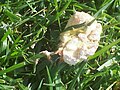 Slime mold on lawn, USA. Trail of movement can be seen.
 -

-
 Brefeldia maxima on a tree stump in Scotland.
 -
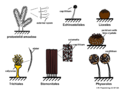 Sporangia types in the protostelids and in the myxogastrid groups (Echinosteliales, Liceales, Trichiales, Stemonitales, Physarales)


.png)
References
External links
Template:Sister project Template:EB1911 poster
- Slime Molds
- Slime Mold Solves Maze Puzzle from abc.net.au
- Hunting Slime Molds from Smithsonian Magazine
- {{#invoke:citation/CS1|citation
|CitationClass=web }}
- dictyBase is an online informatics resource for Dictyostelium, a cellular slime mould.
- nomen.eumycetozoa.com is an online nomenclatural information system of slime moulds (Myxomycetes, Dictyostelids and Protostelids) of the world.
- Photo gallery Template:Webarchive
- Introduction to the "Slime Molds"
- Slime Mold Photos Life cycle of Reticularia lycoperdon at MushooMania.com.
- Video footage of common slime moulds.
Template:Amoebozoa Template:Taxonbar Template:Authority control