Hamza Yusuf
Template:DistinguishTemplate:Short description Template:Infobox religious biography
Hamza Yusuf (born Mark Hanson; 1 January 1958) is an American Islamic scholar. A pioneer of Islamic neo-traditionalism, he has promoted Islamic sciences and classical teaching methodologies throughout the world.<ref>Template:Cite book</ref><ref>Template:Cite book</ref><ref name="Edward E. Curtis p. 405">Template:Cite book</ref><ref>Template:Cite book</ref><ref>Template:Cite thesis</ref><ref name="Pelgrave MacMillan" /><ref>Multiple sources :
Yusuf co-founded Zaytuna College in Berkeley, California in 1996 as Zaytuna Institute. He is an advisor to both the Center for Islamic Studies at the Graduate Theological Union in Berkeley and the Islamic Studies programme at Stanford University.<ref>Template:Cite web</ref><ref>Template:Cite web</ref><ref>Template:Cite web</ref> In addition, he serves as vice-president for the Global Center for Guidance and Renewal, which was founded and is currently presided over by Abdallah bin Bayyah.<ref>Template:Cite web</ref><ref>Template:Cite news</ref> He also serves as vice-president of the United Arab Emirates-based Forum for Promoting Peace in Muslim Societies, where bin Bayyah also serves as president.<ref>Template:Cite news</ref> The Forum has attracted huge controversy for its close ties to the UAE government, Yusuf's personal support for authoritarian leaders since the Arab Spring, and Yusuf's support for the Abraham Accords between Israel and the UAE.<ref>Template:Cite journal</ref><ref>Template:Citation</ref><ref name="Middle East Eye">Template:Cite web</ref><ref name="AL-AZAMI-2022">Template:Cite book</ref>
Yusuf has been listed in the top 50 of The 500 Most Influential Muslims publication.<ref>Template:Cite web</ref> His detractors, however, have widely criticised him for his stance on race, politics, the Syrian revolution, and the Palestinian-Israeli conflict.<ref name="Bokth-2019">Template:Cite web</ref><ref name="5Pillars-2016">Template:Cite web</ref><ref>Template:Cite web</ref><ref>Template:Cite web</ref>
Early life and education
Yusuf was born as Mark Hanson on 1 January 1958<ref>Template:Cite webTemplate:Cbignore</ref> in Walla Walla, Washington to two academics working at Whitman College, and was raised in northern California.<ref name="Edward E. Curtis p. 405"/> His father was a Catholic of Irish descent while his mother, who was half Greek and half Irish, was Greek Orthodox, with his grandfather being an Archon. He was raised in his mother's faith.<ref name="thecairoreview.com">Template:Cite journal</ref> He attended prep schools on both the East and West coasts. In 1977, after a near-death experience in a car accident and reading the Qur'an, he converted to Islam. He mentioned several concepts that were present in Christianity were present in Islam and described his conversion as a "fulfillment".<ref name="thecairoreview.com"/><ref name="Edward E. Curtis p. 405"/><ref name="guardian-2001">Template:Cite news</ref>
After being impressed by a young couple from Saudi Arabia who were followers of Abdalqadir as-Sufi<ref>Template:Cite book</ref>—a Scottish convert to Islam and leader of the Darqawa Sufi order and the Murabitun World Movement—Yusuf moved to Norwich, England to study directly under as-Sufi.<ref name=Grewal>Grewal, Zareena Islam Is a Foreign Country: American Muslims and the Global Crisis of Authority p 160-171</ref><ref>Ukeles, Raquel The Evolving Muslim Community in America: The Impact of 9/11 p 101</ref> In 1979, Yusuf moved to Al Ain in the United Arab Emirates where he spent the next four years studying Sharia sciences at the Islamic Studies Institute of the United Arab Emirates University,<ref>Template:Cite web</ref> more often on a one-on-one basis with Islamic scholars.<ref name=Grewal /> Yusuf became fluent in the Arabic language and also learned Qur'anic recitation (tajwid), rhetoric, poetry, Maliki jurisprudence,<ref>"Prominent Malikis in the American milieu include the founder of the Zaytuna Institute Shaykh Hamza Yusuf Hanson". Jocelyne Cesari, Encyclopedia of Islam in the United States, p 23.</ref> and theology (aqidah) among other classical Islamic disciplines.<ref name=Grewal />
In 1984, Yusuf formally disassociated himself from as-Sufi's teachings and moved in a different intellectual direction, having been influenced by a number of Mauritanian scholars residing in the Emirates. He moved to North Africa in 1984 and studied in Algeria and Morocco, as well as Spain and Mauritania.<ref>Template:Cite book</ref> In Mauritania he developed his most lasting and powerful relationship with Islamic scholar Sidi Muhammad Ould Fahfu al-Massumi, known as Murabit al-Hajj.<ref name=Grewal />
In 2020, Yusuf completed his Ph.D. at the Graduate Theological Union. His dissertation was titled, "The Normative Islamic Tradition in North and West Africa: A Case Study of Transmission of Authority and Distillation of Knowledge in Ibn Ashir's Al-Murshid al-Mu'in (The Helpful Guide)." Yusuf previously earned an associate degree in nursing from Imperial Valley College and a bachelor's degree in religious studies from San José State University.<ref name="zaytuna.edu">Template:Cite web</ref>
Scholarly career
Zaytuna College
Yusuf, Zaid Shakir and Hatem Bazian founded the Zaytuna Institute in Berkeley, California, United States, in 1996,<ref name="Edward E. Curtis p. 405"/> dedicated to the revival of traditional study methods and the sciences of Islam.<ref>Daniel Brumberg, Dina Shehata, Conflict, Identity, and Reform in the Muslim World: Challenges for U.S Engagement, p 367</ref> In fall 2010, it opened its doors as Zaytuna College, a four-year Muslim liberal arts college, the first of its kind in the United States.<ref name="Romig">Template:Cite magazine</ref> It incorporates Yusuf's vision of combining the classical liberal arts—based in the trivium and quadrivium—with rigorous training in traditional Islamic disciplines. It aims to "educate and prepare morally committed professional, intellectual, and spiritual leaders".<ref>Template:Cite web</ref> Zaytuna College became the first accredited Muslim campus in the United States after it received approval from the Western Association of Schools and Colleges.<ref name="LATimes">Template:Cite news</ref><ref name="ExpressTribune">Template:Cite news</ref>
Interfaith
Yusuf participates in the Forum for Promoting Peace in Muslim Societies hosted by the UAE. He praised the UAE for its increasing tolerance and its adoption of multi-faith initiatives and plans to build a multi-faith centre in Abu Dhabi.<ref>Template:Cite web</ref>
Views and influence
Jordan's Royal Islamic Strategic Studies Centre currently places him 36th on its list of the top 500 most influential Muslims in the world.<ref name="themuslim500.com">Template:Cite web</ref><ref>Template:Cite book</ref> In its 2016 edition, Yusuf is described "as one of the foremost authorities on Islam outside of the Muslim world" by The 500 Most Influential Muslims, edited by John Esposito and Ibrahim Kalin.<ref name="themuslim500.com" /> Additionally, Journalist Graeme Wood has referred to Yusuf "one the two most prominent Muslim scholars in the United States today".<ref>Template:Cite book</ref>
Yusuf has taken a stance against religious justifications for terrorist attacks.<ref>Template:Cite book</ref> He described the 9/11 attacks as "an act of mass murder, pure and simple". Condemning the attacks, he also stated that "Islam was hijacked ... on that plane as an innocent victim."<ref name="guardian-2001" />
Yusuf is one of the signatories of A Common Word Between Us and You, an open letter by Islamic scholars to Christian leaders calling for peace and understanding.<ref>Template:Cite web</ref> Yusuf was also one of the signatories of an open letter to former ISIS leader Abu Bakr al-Baghdadi that sought to refute the principles promoted by the terrorist organization.<ref>Template:Cite tweet</ref>Template:Primary source inline
Yusuf has been involved in controversies in recent years on issues of race, politics, and the Arab revolutions, including as a result of his support for the Abraham Accords and UAE government, and for "positing blame on the Palestinians for their suffering".<ref name="Bokth-2019" /><ref>Template:Cite web</ref><ref name="5Pillars-2016" /><ref name="Middle East Eye" />
Support for constitutional monarchy over democracy
In an interview with Turki al-Dakhil of Saudi Arabia in 2011, Hamza Yusuf argued that constitutional monarchy was a stronger form of governance than democracy. He stated:
"Firstly, kings are incorruptible unlike those who possess great wealth. [Presenter interjecting: Like the nouveau riche?] Yes, like that. Such a person can be corrupted. As for kings, he is satiated. He has everything. He does not need anything". <ref name="AL-AZAMI-2022" />
Comments on the Syrian Revolution
In 2019, in reference to Arab Spring protests against Syrian dictator Bashar al-Assad, Yusuf criticized the Syrian Revolution, stating that "If you humiliate a ruler, God will humiliate you." Although some viewed these comments as supportive of the Syrian regime, Yusuf responded, rejected this interpretation.<ref>Template:CitationTemplate:Cbignore</ref><ref>Template:Cite web</ref><ref>Template:Cite web</ref><ref>Template:Cite web</ref>
2016 Black Lives Matter comments
In December 2016, Yusuf made comments that were perceived as critical of the tactics employed by the Black Lives Matter movement. He argued that, "The United States is probably, in terms of its laws, one of the least racist societies in the world." He also stated that, "We have between 15,000 and 18,000 homicides per year. Fifty percent are black-on-black crime, literally." He added, "There are twice as many whites that have been shot by police, but nobody ever shows those videos."<ref name="Green-2017">Template:Cite web</ref> Yusuf was criticized for these comments, including on social media.<ref>Template:Cite web</ref><ref name="Green-2017" /> Zaid Shakir defended Yusuf, writing that "I can say with absolute confidence that there is not a racist bone in Shaykh Hamza's body. A racist is someone who believes in the superiority of one race over another. Shaykh Hamza, like any serious Muslim, totally rejects that idea."<ref>Template:Cite webTemplate:Cbignore</ref>
Publications
| Title | Description | Year | Type |
|---|---|---|---|
| Agenda to Change our Condition<ref>Template:Cite web</ref> | Co-authored with Zaid Shakir | 1999 | Books and Pamphlets |
| Imām al-Zarnūjī, Instruction of the Student: The Method of Learning | Translated by G.E. Von Grunebaum. | 2001 | Books with a foreword or introduction |
| Beyond schooling: building communities where learning really matters<ref>Template:Cite book</ref> | Also includes essays by John Taylor Gatto, Dorothy L Sayers and Nabila Hanson. Re-edited in 2010 as Educating Your Child in Modern Times: How to Raise an Intelligent, Sovereign & Ethical Human Being. | 2003 | Books and Pamphlets |
| Imām Busiri, The Burda: Poem of the Cloak<ref>Template:Cite web</ref> | Includes a CD of performances by The Fez Singers feat. Bennis Abdelfettah. | 2003 | Translations |
| Mostafa Al-Badawî, The Prophetic Invocations | 2003 | Books with a foreword or introduction | |
| Shaykh Al-Amin Mazrui, The Content of Character | Foreword by Ali Mazrui, son of the author. | 2004 | Translations |
| Imām Mawlūd, Purification of the Heart: Signs, Symptoms and Cures of the Spiritual Diseases of the Heart<ref>Template:Cite web</ref> | Translation and commentary of the poem Maṭharat al-Qulūb composed by a 19th-century Mauritanian scholar. | 2004 | Translations |
| Imām Ṭaḥāwī, The Creed of Imam al-Tahawi | 2007 | Translations | |
| Caesarean Moon Births: Calculations, Moon Sighting, and the Prophetic Way<ref>Template:Cite web</ref><ref>Template:Cite book</ref> | Available in | 2008 | Books and Pamphlets |
| Climbing Mount Purgatorio Template:Webarchive | 2008 | Papers | |
| The Prayer of the Oppressed by Imām Muhammad bin Nasir al-Dar'i <ref>Template:Cite web</ref> | Includes a CD of performances by The Fez Singers. | 2010 | Translations |
| Joseph Lumbard, Submission, faith and beauty: the religion of Islam | Co-edited with Zaid Shakir. | 2009 | Edited Books |
| Hamza Yusuf, Walk on Water: The Wisdom of Jesus from Traditional Islamic Sources<ref>Template:Cite web</ref> | 2010 | Article | |
| Reza Shah-Kazemi, Common Ground Between Islam and Buddhism: Spiritual and Ethical Affinities | 2010 | Books with a foreword or introduction | |
| Hamza Yusuf & Robert P. George, Pornography, Respect, and Responsibility: A Letter to the Hotel Industry<ref>Template:Cite web</ref> | 2012 | ||
| Hamza Yusuf & Robert P. George, Hotels and the Pornography Plague: An Example of Moral Responsibility from Scandinavia <ref>Template:Cite web</ref> | 2013 | ||
| Asad Tarsin, Being Muslim: A Practical Guide | 2015 | Books with a foreword or introduction | |
| Shaykh Al-Amin Ali Mazrui, The Content of Character: Ethical Sayings of the Prophet Muhammad ﷺ<ref name="zaytuna.edu"/><ref>Template:Cite web</ref> | Translation and Introduction by Hamza Yusuf. Collected by Shaykh Al-Amin Ali Mazrui | 2015 | Translation and Introduction |
| Edwin Arnold, Pearls of the Faith<ref>Template:Cite web</ref> | 2017 | Edited and Prefaced | |
| Scott F. Crider, The Art of Persuasion Aristotle's Rhetoric for Everybody<ref>Template:Cite web</ref> | The Zaytuna Curriculum Series | 2019 | Books with a foreword or introduction |
| Shaykh Ahmad Badawi Tayyib al-Asma, The Mindful Messenger: Occasional Supplications of the Prophet Muhammad ﷺ <ref>Template:Cite web</ref> | 2022 | Translations |
Poems
See also
Template:Portal Template:Div col
- List of Sufis
- Abdallah Bin Bayyah
- Sheikh Abubakr Ahmad
- Zaid Shakir
- Murabit al-Hajj
- Timothy Winter
- Ali al-Jifri
- Umar bin Hafiz
- Nazim Al-Haqqani
- Umar Faruq Abd-AllahTemplate:Div col end
References
<references />
External links
Template:Sister project links Template:Wikiquote
- Template:Commons category-inline
- Template:Official website
- Template:YouTube
- Template:C-SPAN
- Hamza Yusuf Audio Lectures
Photos
-
 Timothy Winter and Shaykh Hamza
 -
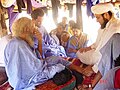 ShMurabbit_mauritania
 -
 Shaykh Hamza with Dr. Umar Faruq Abd-Allah
 -
 Shaykh Hamza with Habib Ali Al jfri and Shaykh Yahya Rhodus


Template:Sufi Template:Maliki scholars Template:Ash'ari Template:Authority control
- 1960 births
- Living people
- Asharis
- Sunni Sufis
- American Sufis
- American people of Greek descent
- Muslims from Washington (state)
- American Sunni Muslims
- American people of Irish descent
- American people of Scottish descent
- American expatriates in the United Arab Emirates
- 21st-century Muslim scholars of Islam
- American Sunni Muslim scholars of Islam
- Muslim apologists
- Muslim reformers
- Former Roman Catholics
- American former Christians
- Converts to Sunni Islam from Catholicism
- Maliki fiqh scholars
- Writers from the San Francisco Bay Area
- People from Hayward, California
- People from Walla Walla, Washington
- San Jose State University alumni
- Muslim scholars of Islamic studies