Hirado, Nagasaki
Template:Redirect Template:Infobox settlement


Template:Nihongo is a city located in Nagasaki Prefecture, Japan. Template:As of, the city had an estimated population of 28,172, and a population density of 120 people per km2.<ref name="Hirado-hp">Template:Cite web</ref> The total area of the city is Template:Cvt
Historically, Hirado has been an important port city and a gateway for foreign trade between Japan and Europe, especially during the 16th–17th centuries.<ref>Template:Cite web</ref> Its rich history blends samurai culture, foreign influence, and maritime trade. Today, Hirado is also recognized for its role in Japan’s early international connections, as part of the broader UNESCO World Heritage Sites related to Hidden Christian Sites in the Nagasaki Region.<ref>Template:Cite web</ref>
Geography
Hirado City occupies the northern part of Nagasaki Prefecture, the northwestern tip of the Kitamatsuura Peninsula, Hirado Island, which lies to the west of the peninsula across the Hirado Strait, Ikitsuki Island, which lies to the northwest of Hirado Island, Takushima Island, which lies directly north of Hirado Island, and Matoyama-Oshima Island, which lies directly north of Tsushima. It is located about 25 kilometers northwest of Sasebo City and about 80 kilometers north-northwest of Nagasaki City. The Hirado Bridge connects Hirado Island to the Kyushu mainland, and the Ikitsuki Bridge connects Hirado Island to Ikitsuki Island.
The western end of Hirado Island is west of Kōzakihana, the westernmost point of Kyushu, and is the westernmost of all areas that can be traveled between the mainland of Japan (Hokkaido, Honshu, Shikoku, and Kyushu) or the mainland of Japan by land transportation alone.
Surrounding municipalities
Nagasaki Prefecture
Climate
Hirado has a humid subtropical climate (Köppen:Cfa) with hot summers and cool winters. Precipitation is significant throughout the year, but is much higher in the summer, although the relatively low latitude and its coastal location the city receives snow in small quantities but enough to "mark" the winter every year despite being in 33 ° N receives intrusions from the Arctic cold of the Siberia air combined with the humidity of the Sea of Japan.<ref name= NOAA>Template:Cite web</ref>
Demographics
Per Japanese census data, the population of Hirado is as shown below:
Template:Historical populations
History
Hirado has been a port of call for ships between the East Asian mainland and Japan since the Nara period. During the Kamakura and Muromachi periods, the local Matsuura clan held the rights to trade with Korea and with Song-dynasty China. During the Sengoku and early Edo periods, Hirado's role as a center of foreign trade increased, especially vis-à-vis Ming-dynasty China and the Dutch East India Company (Vereenigde Oostindische Compagnie or VOC). The Portuguese arrived in Japan in 1543; after the Battle of Fukuda Bay in 1561 the Portuguese stayed for a few more years until they settled in the city of Nagasaki in 1571. The English and Dutch initially reached Japan at the beginning of the 17th century. The first step in the profitable Dutch-Japanese trading relationship was the Shōgun's grant of a trading pass (handelspas) in 1609.<ref>Template:Cite web</ref> In 1613, the British ship Clove arrived in Japan and its Captain John Saris was able to gain the shogunate's permission to establish in Hirado a commercial house of the British East India Company. However, the company soon came to consider this outpost to be unprofitable, especially due to their inability to obtain Japanese raw silk for import to China. Therefore, the British closed their factory in 1623, voluntarily leaving the Dutch as the sole European presence.<ref>Template:Cite book</ref>
At its maximum extent, the Dutch trading center covered the whole area of present-day Sakikata Park.<ref>Edo-Tokyo Museum exhibition catalog. (2000). A Very Unique Collection of Historical Significance: The Kapitan (the Dutch Chief) Collection from the Edo Period – The Dutch Fascination with Japan, p.206.</ref> In 1637 and in 1639, stone warehouses were constructed, and the Dutch builders incorporated these dates into the stonework. However, the Tokugawa shogunate disapproved of the use of any Christian year dates, and therefore demanded the immediate destruction of these two structures.<ref name="catalog207">Edo-Tokyo Museum exhibition catalog, p. 207.</ref> This failure to comply with strict sakoku practices was then used as one of the Shogunate's rationales for forcing the Dutch traders to abandon Hirado for the more constricting confines of Dejima, a small artificial island in the present-day city of Nagasaki.<ref name="catalog207"/> The last VOC Opperhoofd or Kapitan at Hirado and the first one at Dejima was François Caron, who oversaw the transfer in 1641.<ref>Caron lived in Japan from 1619 to 1641. A Collector's Guide to Books on Japan in English by Jozef Rogala, p.31 [1]</ref><ref>Asia in the Making of Europe, p.459</ref> Modern research indicated this incident might have been an excuse for the Shogunate to take the Dutch trade away from the Hirado clan.<ref name="catalog207"/> The stone warehouse from 1639 that was torn down was reconstructed back to its original form in 2011.<ref>"Kuni shitei shiato 'hirado waran shoukan ato' fukugen kenzobutsu" Hirado Oranda Shokan</ref>
During the Edo period, Hirado was the seat of the Hirado Domain. Hirado Castle is today a historical and architectural landmark.
Following the Meiji restoration, the town of Hirado and the villages of Hirado, Nakano, Shishi, Himosashi, Nakatsura, Tsuyoshi, Shijiki, Tahibira, Minami-Tabira, Ikitsuki and Oshima were established with the creation of the modern municipalities system on April 1, 1889. The village and town of Hirado merged on April 1, 1925. Ikitsuki was raised to town status on April 17, 1940. On April 1, 1954 Tabira and Minami-Tabira merged to form the town of Tabira. On January 1, 1955 - Hirado Town, and the villages of Nakano, Shishi, Himosashi, Nakatsura, Tsuyoshi, and Shijiki merged to form the city of Hirado. The city expanded by merging on October 1, 2005, with the neighboring towns of Tabira, Ikitsuki, and the village of Ōshima. The local economy is dominated by agriculture, fishing and food processing.
Government
Hirado has a mayor-council form of government with a directly elected mayor and a unicameral city council of 18 members. Hirado contributes one member to the Nagasaki Prefectural Assembly. In terms of national politics, the city is part of the Nagasaki 3rd district of the lower house of the Diet of Japan.<ref>Template:Cite web</ref> The city was previously part of Nagasaki 4th district, which was abolished in 2022.
Economy
The economy of Hirado is heavily dependent on commercial fishing, agriculture and tourism.
Education
Hirado has 15 public elementary schools and eight public junior high schools, and three public high schools operated by the Nagasaki Prefectural Board of Education.
Transportation
Railways
 Matsuura Railway - Nishi-Kyūshū Line
Highways

UNESCO World Heritage Site Listing
Hirado is part of the Hidden Christian Sites in the Nagasaki Region, a UNESCO World Heritage Site inscribed in 2018.<ref>Template:Cite web</ref> This designation recognizes locations where Japanese Christians practiced their faith in secret during the period of national isolation (Sakoku) from the early 17th to the late 19th century.<ref>Template:Cite web</ref> The sites in Hirado, including Kasuga Village and other sacred places, illustrate how Christian communities adapted and preserved their religious practices despite persecution.<ref>Template:Cite web</ref> These locations include churches, memorials, cemeteries, and other cultural landscapes associated with the Hidden Christians, highlighting both the resilience of religious faith under oppression and the cultural exchanges between Japan and Europe during the early modern period.
Sister cities
Hirado has one sister city in Japan and one sister city and one friendship city outside Japan.<ref name="Hirado Nagasaki twinnings">Template:Cite web</ref>
- Template:Flagicon Zentsūji, Kagawa, Japan (sister city)<ref name="Hirado Nagasaki twinnings"/>
- Template:Flagicon Nan'an, Fujian, China (friendship city)<ref name="Hirado Nagasaki twinnings"/>
- Template:Flagicon Noordwijk, South Holland, Netherlands (sister city)<ref>Template:Cite web</ref> (previously with Noordwijkerhout, which lost its municipal status in 2019 when it merged with Noordwijk)
Local attractions

- Hirado Castle
- Hirado Dutch Trading Post, National Historic Site
- Matsura Historical Museum
- Hidden Christian Sites in the Nagasaki Region, Kasuga Village and Sacred Places in Hirado
Notable residents of Hirado
- William Adams (1564–1620): Miura Anjin (三浦按針: "the pilot of Miura"), an English navigator and senior advisor to the Tokugawa shogunate, resided in Hirado during the 1610s and died there. He was the model for the character of John Blackthorne in James Clavell's novel Shōgun (1975).
- Camillus Costanzo (1571–1622): Italian Jesuit martyr. Burnt alive in Hirado.<ref>Boero, Giuseppe. (1868) Les 205 martyrs du Japon, béatifiés par Pie IX en 1867, p. 249.</ref>
- Richard Cocks (1565–1624): merchant of the British East India Company.
- Li Dan (d. 1625): Chinese merchant
- Koxinga (1624–1662): founder of Kingdom of Tungning and Southern Ming general. Born in Hirado.
- Kazuya Maekawa (1968–): former football player and current coach
- Inagaki Manjiro (1861–1908): Diplomat. Born in Hirado.
- Tagawa Matsu (1601–1646): wife of Zheng Zhilong, mother of Koxinga and Shichizaemon
- Willem Verstegen (1612–1659): merchant of the Dutch East India Company
- Ryusaku Yanagimoto (1894–1942): captain of the Sōryū in the Imperial Japanese Navy during World War II
- Zheng Zhilong (1604–1661): Chinese merchant and pirate, father of Koxinga
Gallery
-
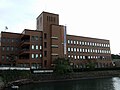 Hirado City Hall
 -
 Aerial Panoramic of Hirado Port with Hirado Castle in background
 -
 Dutch Trading House from Hirado Castle
 -
 Hirado English trading site commemorative marker
 -
 English Trading Site Location Sign in Hirado
 -
 English trading area in Hirado from 1613-1623
 -
 Nakayama Family Residence sign in Hirado historical area
 -
 Nakayama Family Residence in Hirado historical area
 -
 Location where William Adams died in Hirado
 -
 William Adams grave site sign
 -
 William Adams Grave Stone in Hirado
 -
 William Adams Gravestone noting English Wife
 -
 William Adams Grave Site Area in Hirado
 -
 Text of a letter written by William Adams in 1611
 -
 UNESCO World Heritage Site Sign: Hidden Christian Sites in the Nagasaki Region - Kasuga Village and Sacred Places in Hirado
 -
 Rice terraces in Hirado in the area of the UNESCO World Heritage Site (Hidden Christian Sites in the Nagasaki Region - Kasuga Village and Sacred Places in Hirado)


Notes
References
- de Winter, Michiel. (2006). "VOC in Japan: Betrekkingen tussen Hollanders en Japanners in de Edo-periode, tussen 1602-1795" ("VOC in Japan: Relations between the Dutch and Japanese in the Edo-period, between 1602-1795"). Template:In lang
- Edo-Tokyo Museum exhibition catalog. (2000). A Very Unique Collection of Historical Significance: The Kapitan (the Dutch Chief) Collection from the Edo Period—The Dutch Fascination with Japan. Catalog of "400th Anniversary Exhibition Regarding Relations between Japan and the Netherlands", a joint-project of the Edo-Tokyo Museum, the City of Nagasaki, the National Museum of Ethnology, the National Natuurhistorisch Museum" and the National Herbarium of the Netherlands in Leiden, the Netherlands. Tokyo.
- Satow, Ernest Mason, ed. (1900). The Voyage of Captain John Saris to Japan, 1613. London: Hakluyt Society...Link to digitized version from the collection of the University of California