Lutjegast
Template:Short descriptionTemplate:Infobox settlement
Lutjegast (Template:IPA) is a village in the municipality of Westerkwartier in Groningen, Netherlands. It had a population of around 1,125 in January 2017.<ref>Kerncijfers wijken en buurten 2017 - CSB Statline</ref>
History
The name Lutjegast originates from Gronings in which lutje means small or little and a ga(a)st is a higher, sandy ridge in an otherwise swampy area. The village was first mentioned in 1459 as "op de Lutkegast".<ref>Template:Cite web</ref> Lutjegast is a road village which developed on a sandy ridge.<ref name="monument">Template:Cite web</ref>
The Dutch Reformed church was built in 1877 and was restored in 1922. The Reformed Church is a cruciform church built in 1922 without a tower in expressionist style.<ref name="monument"/>
Lutjegast was the birthplace of the explorer Abel Tasman. He is memorialised in town by a monument, plaque and street name. In 2014, a museum dedicated to Abel Tasman opened in the village house.<ref name="plaats"/>
Until 1828, a manor house named "Rikkerdaborg" stood in Lutjegast. Its most famous occupant was Bernard Johan Prott who was the commander of Bourtange in 1672. Christoph Bernhard von Galen, the Prince-bishop of Münster had allegedly offered Prott ƒ200,000.- to take Bourtange, however Prott refused the offer and von Galen was unable to take the fortress by force.<ref>Template:Cite web</ref>
Lutjegast was home to 294 people in 1840.<ref name="plaats">Template:Cite web</ref> The village used to be part of the municipality of Grootegast. In 2019, it was merged into Westerkwartier.<ref name="plaats"/>
Notable people
- Abel Tasman (ca.1603–1659), explorer, first European to discover Tasmania and New Zealand.<ref>Template:Cite EB1911</ref>
- Arjen Lubach (born 1979), comedian, author, music producer and TV presenter.
- Klaasje Meijer (born 1995), singer, actress and flautist
Gallery
-
 Rikkerdaborg
 -
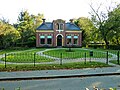 Former clergy house
 -
 View on Lutjegast
 -
 Reformed church in Lutjegast


,_kristlik_grifformearde_tsjerke.jpg)
References
External links
Template:Dutch municipality Westerkwartier Template:Authority control