Washington Allston
Template:Short description Template:Infobox artist
Washington Allston Template:Post-nominals (November 5, 1779 – July 9, 1843) was an American painter and poet, born in Waccamaw Parish, South Carolina. Allston pioneered America's Romantic movement of landscape painting. He was well known during his lifetime for his experiments with dramatic subject matter and his bold use of light and atmospheric color. While his early artworks concentrate on grandiose and spectacular aspects of nature, his later pieces represent a more subjective and visionary approach.<ref>Template:Cite book</ref>
Biography

Allston was born on a rice plantation on the Waccamaw River near Georgetown, South Carolina. His mother Rachel Moore had married Captain William Allston in 1775, though her husband died in 1781, shortly after the Battle of Cowpens.<ref>Template:Cite book</ref> Moore remarried to Dr. Henry C. Flagg, the son of a wealthy shipping merchant from Newport, Rhode Island.<ref name="Hubbell275">Template:Cite book</ref>
Named in honor of the leading American general of the Revolution,<ref>Planters, Pirates & Patriots: Historical Tales from the South Carolina Grand Strand, Rod Graff, Pelican Publishing, 2006</ref> Washington Allston graduated from Harvard College in 1800 and moved to Charleston, South Carolina, for a short time before sailing to England in May 1801.<ref name="Hubbell275"/> He was admitted to the Royal Academy Schools in London in September, when painter Benjamin West was then the president.<ref>Template:Cite ODNB</ref>
.jpg)


From 1803 to 1808, he visited the great museums of Paris and then, for several years, those of Italy, where he met Washington Irving in Rome<ref>Template:Cite book</ref> and Coleridge, his lifelong friend. In 1809, Allston married Ann Channing, sister of William Ellery Channing.<ref name="Hubbell275"/> Samuel F. B. Morse was one of Allston's art pupils and accompanied Allston to Europe in 1811. After traveling throughout western Europe, Allston finally settled in London, where he won fame and prizes for his pictures.
Allston was also a published writer. In London in 1813, he published The Sylphs of the Seasons, with Other Poems, republished in Boston, Massachusetts, later that year.<ref>Template:Cite book</ref> His wife died in February 1815, leaving him saddened, lonely, and homesick for America.<ref>Template:Cite book</ref>
In 1818, he returned to the United States and lived in Cambridge, Massachusetts, for twenty-five years. He was elected a Fellow of the American Academy of Arts and Sciences in 1826.<ref name="AAAS">{{#invoke:citation/CS1|citation |CitationClass=web }}</ref> He was the uncle of the artists George Whiting Flagg and Jared Bradley Flagg, both of whom studied painting under him.
The first American exhibition of Allston's work was in 1827 when twelve of his paintings were shown at the Boston Athenæum.<ref>Swan, Mabel Munson. The Athenæum Gallery 1827–1873: The Boston Athenæum as an Early Patron of Art (Boston: The Boston Athenæum, 1940)</ref> Allston also exhibited five paintings at the National Academy of Design, but this number is low given his place in the artistic community of the time. Four of his paintings were engraved and published in The Atlantic Souvenir and The Token annual gift books in the 1820s and 30s. Among them were Moonlight and The Mother and Child, the latter being considered by Allston to be one of his best works.<ref name="Lovejoy">Template:Cite journal</ref>
In 1830 Allston married Martha Remington Dana (daughter of Chief Justice Francis Dana), the sister of the novelist Richard Henry Dana Sr.; Dana was a cousin of Allston's first wife.<ref>Template:Cite book</ref>
In 1841, he published Monaldi, a romance illustrating Italian life, and in 1850, a volume of his Lectures on Art, and Poems.<ref>Ware's Lectures on the Works and Genius of Washington Allston (Boston, 1852) and Artist Biographies, Allston (1879).</ref> He worked for years on what he envisioned would be his masterpiece: a painting called Belshazzar's Feast; he died before finishing it.<ref name="Lovejoy" />
Allston died on July 9, 1843, at age 63. Allston is buried in Harvard Square, in the Old Burying Ground between the First Parish Church and Christ Church.
Recognition
Allston was sometimes called the "American Titian" because his style resembled the great Venetian Renaissance artists in their display of dramatic color contrasts. His work greatly influenced the development of U.S. landscape painting. Also, the themes of many of his paintings were drawn from literature, especially Biblical stories.<ref name="Poets of Cambridge, USA">{{#invoke:citation/CS1|citation |CitationClass=web }}</ref>
His artistic genius was much admired by Samuel Taylor Coleridge, and Ralph Waldo Emerson was strongly influenced by his paintings and poems, but so were both Margaret Fuller and Sophia Peabody, wife of Nathaniel Hawthorne.<ref name="Poets of Cambridge, USA"/> The influential critic and editor Rufus Wilmot Griswold dedicated his famous anthology The Poets and Poetry of America to Allston in 1842.<ref>*Template:Cite book</ref> Poet Henry Wadsworth Longfellow, 17 years after Allston's death, wrote that: "One man may sweeten a whole time. I never pass through Cambridge Port without thinking of Allston. His memory is the quince in the drawer and perfumes the atmosphere."<ref name="Hubbell275"/>
Boston painter William Morris Hunt was an admirer of Allston's work, and in 1866 founded the Allston Club in Boston, and in his arts classes passed on to his students his knowledge of Allston's techniques.<ref>Wright, Nathalia. The Correspondence of Washington Allston, Published by University Press of Kentucky, 1993, Template:ISBN</ref> Contemporary critic James Miller of the same city held him in high regard, saying, "He labors in the highest walks of art." Another contemporary critic, John Neal of The Yankee, felt Allston had unrealized talent: "Mr. Allston's faculties are a very uncommon union of the bold and beautiful", and yet he lacks "that sort of inward fervor which flashes into spontaneous combustion, whenever it is excited or exasperated." Historian David S. Lovejoy nevertheless judged Allston "doubtless the finest American romantic painter".<ref name="Lovejoy" />
The Oxford English Dictionary cites Allston as the first to use the term Objective Correlative in 1850.<ref>"objective correlative, n." OED Online. Oxford University Press, December 2021.</ref> The term, subsequently made famous by T.S Eliot in essay on Hamlet (1919), denotes a set of objects, a situation, a chain of events which shall be the formula of a particular emotion; such that when the external facts, which must terminate in sensory experience, are given, the emotion is immediately evoked.
The west Boston, Massachusetts neighborhood of Allston is named after him, as is Allston Way, in the "Poets Corner" neighborhood of Berkeley, California.


Gallery
-
 Storm Rising at Sea, 1804, Museum of Fine Arts, Boston, Massachusetts
 -
 Moonlit Landscape, 1809, Museum of Fine Arts, Boston, Massachusetts
 -
 Coast Scene on the Mediterranean, 1811, Columbia Museum of Art, Columbia, South Carolina
 -
 The Poor Author and the Rich Bookseller, 1811
 -

-
 Donna Mencia in the Robber's Cavern, 1815
 -
 Hermia and Helena, (from A Midsummer Night's Dream) from c. 1818
 -
 Beatrice, 1819, Museum of Fine Arts, Boston
 -

-
 Two Artists in the Old Library, Washington Allston's Picture, 'Jacob's Dream', Hanging over the Fireplace ('The Artist and the Amateur'), J. M. W. Turner, 1827
 -
 Portrait of William Ellery Channing
 -
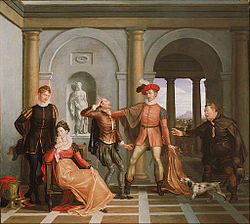 Scene from Shakespeare's "The Taming of the Shrew" (Katharina and Petruchio)


.jpeg)

_-_Google_Art_Project.jpg)
Additional works
- A Landscape after Sunset, c. 1819, Corcoran Gallery of Art, Washington, D.C.
References
Sources
- Corcoran Gallery of Art, Washington, DC [1]
Further reading
- Allston, Washington, Lectures on Art and Poems, 1850 (facsimile ed., with Monaldi, 1841, 1967, Scholars' Facsimiles & Reprints, Template:ISBN).
External links
Template:Sister project Template:Wikisource/outer core{{#invoke:Check for unknown parameters|check|showblankpositional=1|unknown=|1|2|3|diagnose|has|italic|italics|lang|nocat|position|title|wislink|works|wslink}} Template:Sister project
- Template:Art UK bio
- Washington Allston in the New Students Reference Work.
- Google Art Project, Washington Allston
- Guide to Washington Allston's papers at Houghton Library, Harvard University
- Washington Allston at American Art Gallery
- Template:Gutenberg author
- Template:Internet Archive author
- Template:Librivox author
- Template:Cite EB1911
- Template:Cite BDA1906
- Washington Allston letter fragment, 1818 Mar. 2 from the Smithsonian Archives of American Art
- Profile on Royal Academy of Arts Collections

- Pages using Wikisource with unknown parameters
- 1779 births
- 1843 deaths
- Poets from South Carolina
- 18th-century American male artists
- American male painters
- 19th-century American painters
- Fellows of the American Academy of Arts and Sciences
- People from Georgetown County, South Carolina
- Painters from South Carolina
- Harvard College alumni
- Poets from Massachusetts
- Writers from Boston
- American expatriates in England
- American expatriates in France
- Associates of the Royal Academy
- Alumni of the Royal Academy Schools
- 19th-century American male artists
- Burials at Old Burying Ground (Cambridge, Massachusetts)