Urogenital sinus
Template:Short description Template:Infobox embryology
The urogenital sinus is a body part of a human or other placental only present in the development of the urinary and reproductive organs. It is the ventral part of the cloaca, formed after the cloaca separates from the anal canal during the fourth to seventh weeks of development.Template:Sfn
In males, the UG sinus is divided into three regions: upper, pelvic, and phallic. The upper part gives rise to the urinary bladder and the pelvic part gives rise to the prostatic and membranous parts of the urethra,Template:Sfn the prostate and the bulbourethral glands (Cowper's). The phallic portion gives rise to the spongy (bulbar) part of the urethra and the urethral glands (Littré's).
In females, the pelvic part of the UG sinus gives rise to the sinovaginal bulbs, structures that will eventually form the inferior two thirds of the vagina. This process begins when the lower tip of the paramesonephric ducts, the structures that will eventually form the uterus and vaginal fornices, come in contact with the UG sinus. Shortly afterwards, the sinovaginal bulbs form as two solid evaginations of the UG sinus. Cells in these bulbs divide to form a solid vaginal plate, which extends and then canalizes (hollows) to form the inferior portion of the vagina.Template:Sfn The female urogenital sinus also gives rise to the urethra, vestibule, Skene's glands and Bartholin's glands.
Clinical significance
A urogenital sinus anomaly is also a rare birth defect in women where the urethra and vagina both open into a common channel.<ref name="Callahan 2009 p. 182">Template:Cite book</ref><ref name="Children's Hospital of Orange County 2023">Template:Cite web</ref>
A persistent cloaca is a disorder where the rectum, vagina, and urinary tract meet and fuse, creating a cloaca, a single common channel.<ref name="pmid17476318">Template:Citation</ref>
Other animals
In many mammals (excluding homonids and some rodents),<ref name=":0" /> the urogenital sinus refers to the sinus in which the openings to the female's urethra and vagina are found.<ref name=":0">Template:Cite book</ref><ref>Template:Cite book</ref><ref>Template:Cite book</ref><ref>Template:Cite book</ref> However, this term may also apply to some male mammals.
Additional images
-
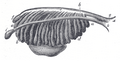 Enlarged view from the front of the left Wolffian body before the establishment of the distinction of sex.

See also
References
Sources
External links
Template:Development of urinary and reproductive systems Template:Authority control