56 (number)
Template:Pp-pc Template:Infobox number 56 (fifty-six) is the natural number following 55 and preceding 57.
Mathematics

56 is:
- The sum of the first six triangular numbers (making it a tetrahedral number).<ref>Template:Cite OEIS</ref>
- The number of ways to choose 3 out of 8 objects or 5 out of 8 objects, if order does not matter.
- The sum of six consecutive primes (3 + 5 + 7 + 11 + 13 + 17)
- a tetranacci number<ref>Template:Cite OEIS</ref> and as a multiple of 7 and 8, a pronic number.<ref>Template:Cite OEIS</ref> It is one of a few pronic numbers whose digits in decimal also are successive (5 and 6).
- a refactorable number, since 8 is one of its 8 divisors.
- The sum of the sums of the divisors of the first 8 positive integers.<ref>Template:Cite OEIS</ref>
- A semiperfect number, since 56 is twice a perfect number.
- A partition number – the number of distinct ways 11 can be represented as the sum of natural numbers.
- An Erdős–Woods number, since it is possible to find sequences of 56 consecutive integers such that each inner member shares a factor with either the first or the last member.<ref>Template:Cite OEIS</ref>
- The only known number n such that Template:Nowrap, where φ(m) is Euler's totient function and σ(n) is the sum of the divisor function, see Template:OEIS2C.
- The maximum determinant in an 8 by 8 matrix of zeroes and ones.
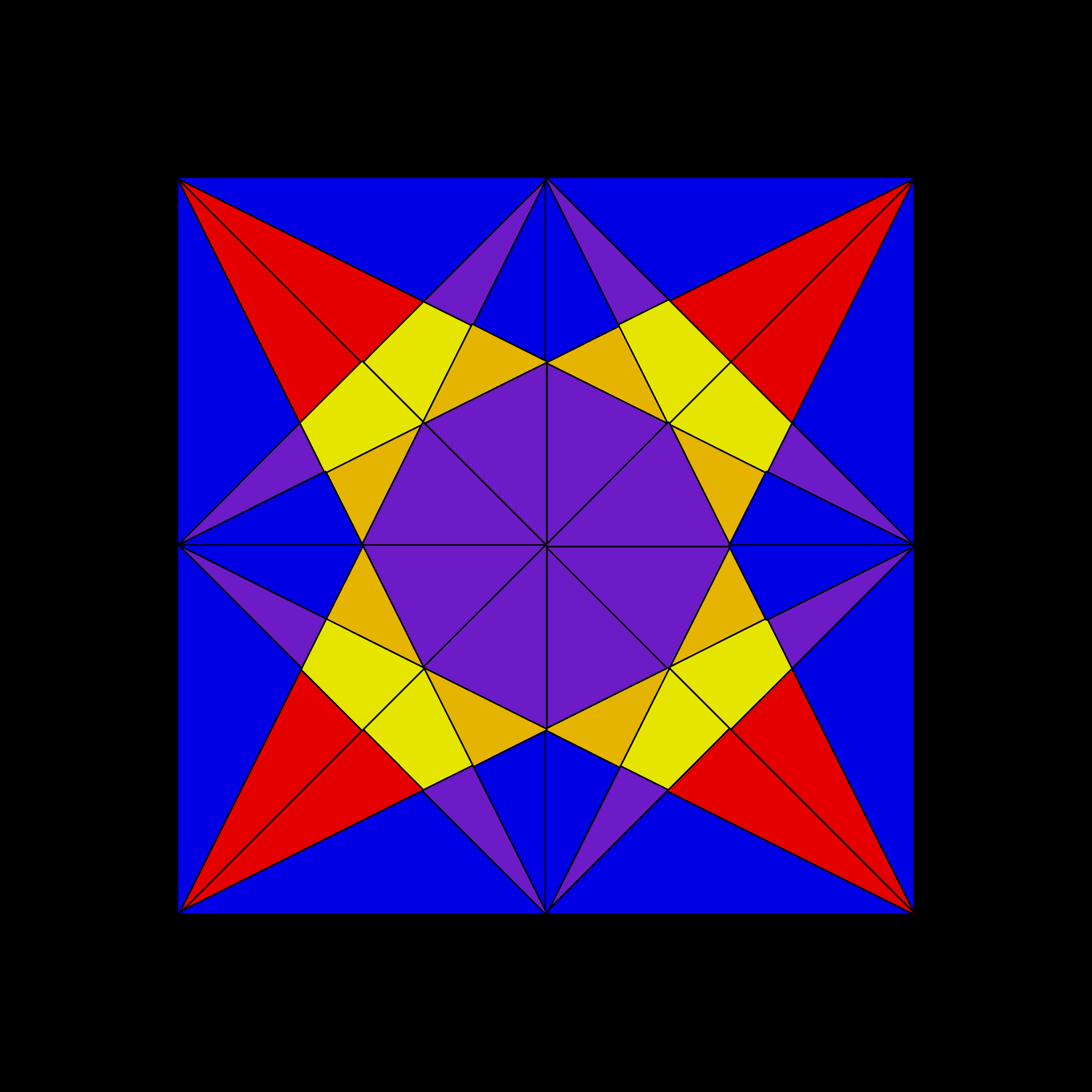
- The number of polygons formed by connecting all the 8 points on the perimeter of a two-times-two-square by straight lines.<ref>Template:Cite OEIS</ref>
Plutarch<ref>Plutarch, Moralia V: 30</ref> states that the Pythagoreans associated a polygon of 56 sides with Typhon and that they associated certain polygons of smaller numbers of sides with other figures in Greek mythology. While it is impossible to construct a perfect regular 56-sided polygon using a compass and straightedge, a close approximation has recently been discovered which it is claimed<ref>Pegs and Ropes: Geometry at Stonehenge</ref> might have been used at Stonehenge, and it is constructible if the use of an angle trisector is allowed since 56 = 23 × 7.<ref name=Eekhoff>{{#invoke:citation/CS1|citation |CitationClass=web }}</ref>
Organizations
- The symbol of the Hungarian Revolution of 1956.
- Brazilian politician Enéas Carneiro has an odd way of repeating the number of his party, "Fifty-Six" ({{#invoke:Lang|lang}}, in Portuguese), making it a widely repeated jargon in his country.
References
<references />