Al-Bassa
Template:About Template:Pp-extended Template:Main other{{#invoke:Infobox|infobox}}Template:Template other{{#invoke:Check for unknown parameters|check|unknown=Template:Main other|preview = Page using [[Template:Template:If empty]] with unknown parameter "_VALUE_"|ignoreblank=y|mapframe_args=y | alt | anthem | anthem_link | area_blank1_acre | area_blank1_dunam | area_blank1_ha | area_blank1_km2 | area_blank1_sq_mi | area_blank1_title | area_blank2_acre | area_blank2_dunam | area_blank2_ha | area_blank2_km2 | area_blank2_sq_mi | area_blank2_title | area_code | area_code_type | area_codes | area_footnotes | area_land_acre | area_land_dunam | area_land_ha | area_land_km2 | area_land_sq_mi | area_metro_acre | area_metro_dunam | area_metro_footnotes | area_metro_ha | area_metro_km2 | area_metro_sq_mi | area_note | area_rank | area_rural_acre | area_rural_dunam | area_rural_footnotes | area_rural_ha | area_rural_km2 | area_rural_sq_mi | area_total_acre | area_total_dunam | area_total_ha | area_total_km2 | area_total_sq_mi | area_urban_acre | area_urban_dunam | area_urban_footnotes | area_urban_ha | area_urban_km2 | area_urban_sq_mi | area_water_acre | area_water_dunam | area_water_ha | area_water_km2 | area_water_percent | area_water_sq_mi | blank_emblem_alt | blank_emblem_link | blank_emblem_size | blank_emblem_type | blank_emblem_sizedefault | blank_emblem_upright | blank_info | blank_info_sec1 | blank_info_sec2 | blank_name | blank_name_sec1 | blank_name_sec2 | blank1_info | blank1_info_sec1 | blank1_info_sec2 | blank1_name | blank1_name_sec1 | blank1_name_sec2 | blank2_info | blank2_info_sec1 | blank2_info_sec2 | blank2_name | blank2_name_sec1 | blank2_name_sec2 | blank3_info | blank3_info_sec1 | blank3_info_sec2 | blank3_name | blank3_name_sec1 | blank3_name_sec2 | blank4_info | blank4_info_sec1 | blank4_info_sec2 | blank4_name | blank4_name_sec1 | blank4_name_sec2 | blank5_info | blank5_info_sec1 | blank5_info_sec2 | blank5_name | blank5_name_sec1 | blank5_name_sec2 | blank6_info | blank6_info_sec1 | blank6_info_sec2 | blank6_name | blank6_name_sec1 | blank6_name_sec2 | blank7_info | blank7_info_sec1 | blank7_info_sec2 | blank7_name | blank7_name_sec1 | blank7_name_sec2 | caption | code1_info | code1_name | code2_info | code2_name | coor_pinpoint | coor_type | coordinates | coordinates_footnotes | demographics_type1 | demographics_type2 | demographics1_footnotes | demographics1_info1 | demographics1_info10 | demographics1_info2 | demographics1_info3 | demographics1_info4 | demographics1_info5 | demographics1_info6 | demographics1_info7 | demographics1_info8 | demographics1_info9 | demographics1_title1 | demographics1_title10 | demographics1_title2 | demographics1_title3 | demographics1_title4 | demographics1_title5 | demographics1_title6 | demographics1_title7 | demographics1_title8 | demographics1_title9 | demographics2_footnotes | demographics2_info1 | demographics2_info10 | demographics2_info2 | demographics2_info3 | demographics2_info4 | demographics2_info5 | demographics2_info6 | demographics2_info7 | demographics2_info8 | demographics2_info9 | demographics2_title1 | demographics2_title10 | demographics2_title2 | demographics2_title3 | demographics2_title4 | demographics2_title5 | demographics2_title6 | demographics2_title7 | demographics2_title8 | demographics2_title9 | dimensions_footnotes | dunam_link | elevation_footnotes | elevation_ft | elevation_link | elevation_m | elevation_max_footnotes | elevation_max_ft | elevation_max_m | elevation_max_point | elevation_max_rank | elevation_min_footnotes | elevation_min_ft | elevation_min_m | elevation_min_point | elevation_min_rank | elevation_point | embed | established_date | established_date1 | established_date2 | established_date3 | established_date4 | established_date5 | established_date6 | established_date7 | established_title | established_title1 | established_title2 | established_title3 | established_title4 | established_title5 | established_title6 | established_title7 | etymology | extinct_date | extinct_title | flag_alt | flag_border | flag_link | flag_size | footnotes | founder | geocode | governing_body | government_footnotes | government_type | government_blank1_title | government_blank1 | government_blank2_title | government_blank2 | government_blank2_title | government_blank3 | government_blank3_title | government_blank3 | government_blank4_title | government_blank4 | government_blank5_title | government_blank5 | government_blank6_title | government_blank6 | grid_name | grid_position | image_alt | image_blank_emblem | image_caption | image_flag | image_map | image_map1 | image_seal | image_shield | image_size | image_skyline | imagesize | image_sizedefault | image_upright | iso_code | leader_name | leader_name1 | leader_name2 | leader_name3 | leader_name4 | leader_name5 | leader_party | leader_title | leader_title1 | leader_title2 | leader_title3 | leader_title4 | leader_title5 | length_km | length_mi | map_alt | map_alt1 | map_caption | map_caption1 | mapsize | mapsize1 | module | motto | motto_link | mottoes | name | named_for | native_name | native_name_lang | nickname | nickname_link | nicknames | official_name | other_name | p1 | p10 | p11 | p12 | p13 | p14 | p15 | p16 | p17 | p18 | p19 | p2 | p20 | p21 | p22 | p23 | p24 | p25 | p26 | p27 | p28 | p29 | p3 | p30 | p31 | p32 | p33 | p34 | p35 | p36 | p37 | p38 | p39 | p4 | p40 | p41 | p42 | p43 | p44 | p45 | p46 | p47 | p48 | p49 | p5 | p50 | p6 | p7 | p8 | p9 | parts | parts_style | parts_type | pop_est_as_of | pop_est_footnotes | population | population_as_of | population_blank1 | population_blank1_footnotes | population_blank1_title | population_blank2 | population_blank2_footnotes | population_blank2_title | population_demonym | population_demonyms | population_density_blank1_km2 | population_density_blank1_sq_mi | population_density_blank2_km2 | population_density_blank2_sq_mi | population_density_km2 | population_density_metro_km2 | population_density_metro_sq_mi | population_density_rank | population_density_rural_km2 | population_density_rural_sq_mi | population_density_sq_mi | population_density_urban_km2 | population_density_urban_sq_mi | population_est | population_footnotes | population_metro | population_metro_footnotes | population_note | population_rank | population_rural | population_rural_footnotes | population_total | population_urban | population_urban_footnotes | postal_code | postal_code_type | postal2_code | postal2_code_type | pushpin_image | pushpin_label | pushpin_label_position | pushpin_map | pushpin_map_alt | pushpin_map_caption | pushpin_map_caption_notsmall | pushpin_map_narrow | pushpin_mapsize | pushpin_outside | pushpin_overlay | pushpin_relief | registration_plate | registration_plate_type | seal_alt | seal_link | seal_size | seal_type | seat | seat_type | seat1 | seat1_type | seat2 | seat2_type | settlement_type | shield_alt | shield_link | shield_size | short_description | subdivision_name | subdivision_name1 | subdivision_name2 | subdivision_name3 | subdivision_name4 | subdivision_name5 | subdivision_name6 | subdivision_type | subdivision_type1 | subdivision_type2 | subdivision_type3 | subdivision_type4 | subdivision_type5 | subdivision_type6 | template_name | timezone | timezone_DST | timezone_link | timezone1 | timezone1_DST | timezone1_location | timezone2 | timezone2_DST | timezone2_location | timezone3 | timezone3_DST | timezone3_location | timezone4 | timezone4_DST | timezone4_location | timezone5 | timezone5_DST | timezone5_location | total_type | translit_lang1 | translit_lang1_info | translit_lang1_info1 | translit_lang1_info2 | translit_lang1_info3 | translit_lang1_info4 | translit_lang1_info5 | translit_lang1_info6 | translit_lang1_type | translit_lang1_type1 | translit_lang1_type2 | translit_lang1_type3 | translit_lang1_type4 | translit_lang1_type5 | translit_lang1_type6 | translit_lang2 | translit_lang2_info | translit_lang2_info1 | translit_lang2_info2 | translit_lang2_info3 | translit_lang2_info4 | translit_lang2_info5 | translit_lang2_info6 | translit_lang2_type | translit_lang2_type1 | translit_lang2_type2 | translit_lang2_type3 | translit_lang2_type4 | translit_lang2_type5 | translit_lang2_type6 | type | unit_pref | utc_offset | utc_offset_DST | utc_offset1 | utc_offset1_DST | utc_offset2 | utc_offset2_DST | utc_offset3 | utc_offset3_DST | utc_offset4 | utc_offset4_DST | utc_offset5 | utc_offset5_DST | website | width_km | width_mi }}{{#invoke:Check for clobbered parameters|check | template = [[Template:Template:If empty]] | cat = Template:Main other | population; population_total | image_size; imagesize | image_alt; alt | image_caption; caption | settlement_type; type | utc_offset1; utc_offset | timezone1; timezone }}{{#if:
|
}}Template:Main other{{#ifexpr:{{#invoke:ParameterCount|main|mapframe|image_map|image_map1|pushpin_map}} >2 |Template:Main other}}
al-Bassa (Template:Langx) was a Palestinian Arab village in the Mandatory Palestine's Acre Subdistrict. It was situated close to the Lebanese border, Template:Convert north of the district capital, Acre, and Template:Convert above sea level.
During the 1948 Palestine War the village was stormed by Haganah troops in May 1948 and almost completely razed. Its residents were either internally displaced or expelled to neighboring countries as part of the 1948 Palestinian expulsion.<ref>Template:Cite journal</ref> Today, the ruins of the village are in the northern quarters of the town of Shlomi.<ref name="antiquities.org.il">{{#invoke:citation/CS1|citation |CitationClass=web }}</ref>
Etymology
Adolf Neubauer "proposed to identify this place with the Batzet of the Talmud".<ref>Neubauer, 1868, p 22. References: Tos. Shebiit 4:9, Yer. Demai 2:1 (Heb. 8b). See also Grootkerk, 2000, pp. 2–3 and Conder and Kitchener, 1881, SWP I, p. 167</ref> It was called Bezeth during the Roman period, and its Arabic name is al-Basah.<ref name=YonahKhalidi>Avi Yonah, 1976, p. 42. Cited in Khalidi, 1992, p. 6</ref><ref name=Pringlep116/> In the period of Crusader rule in Palestine, it was known as Le Bace or LeBassa.<ref name=Pringlep116>Pringle, 1997, p. 116</ref> Imad ad-Din al-Isfahani (d. 1201), a chronicler and advisor to Saladin, referred to the village as Ayn al-Bassa,<ref name=Khalidip6>Khalidi, 1992, p. 6.</ref> 'Ayn meaning 'spring' in Arabic.
History
The site shows signs of habitation in prehistory and the Middle Bronze Age.<ref name=Grootkerkp3/>
An ancient Christian burial place and 18 other archaeological sites were located in the village.
Roman and Byzantine empires
A Jewish settlement stood at the site between 70 and 425 CE.<ref name=Grootkerkp3>Grootkerk, 2000, p. 3</ref> Blown glass pitchers uncovered in a tomb in al-Bassa were dated to circa 396 CE.<ref name=Whitehousep182>Whitehouse and Corning Museum of Glass, 2002, p. 182</ref>
The Survey of Western Palestine, sponsored by the Palestine Exploration Fund, identified al-Bassa as, "probably a Crusading village"; however, archaeological excavations only uncovered architectural evidence of an ecclesiastical farm in operation there between the 5th to 8th centuries.<ref name=Pringlep116/>
Crusader period
Although pottery sherds found by archaeologists indicate continuous habitation throughout the Middle Ages, no Crusader-period architectural remains were discovered yet as of 1997.<ref name=Pringlep116/> A capital decorated with a cross once dated to the Crusader period was later re-dated to the Byzantine period.<ref name=Pringlep116/>
The site was used in 1189 C.E. as a Crusader encampment during a military campaign,<ref>Abu Shama, RHC Or, IV, p. 406. Cited in Petersen, 2001, p. 111 Template:Webarchive</ref> and a document dated October 1200 recorded the sale of the village by King Amalric II of Jerusalem to the Teutonic Order.<ref>Strehlke, 1869, pp. 30-31, No.38. Cited in Petersen, 2001, p. 111 Template:Webarchive and in Ellenblum, 2003, pp. 59, 146</ref> A-Bassa was the first village listed as part of the domain of the Crusaders during the hudna (Islamic ceasefire) between the Crusaders based in Acre and the Mamluk sultan al-Mansur (Qalawun) in 1283.<ref>Template:Cite journal</ref>
Ottoman Empire
In 1596, al-Bassa was part of the Ottoman Empire, a village in the nahiya (subdistrict) of Tibnin under the Safad Sanjak, with a population of 76 Muslim families and 28 Muslim bachelors. It paid taxes on a number of crops, including wheat olives, barley, cotton and fruits, as well as on goats, beehives and pasture land; a total of 7,000 Akçe.<ref>Hütteroth and Abdulfattah, 1977, p. 181.</ref>
In the 18th century, al-Bassa became a zone of contention between Zahir al-Umar and the chiefs of Jabal Amil under Sheikh Nasif al-Nassar, while under his successor, Jezzar Pasha, al-Bassa was made the administrative center of the nahiya in around 1770.<ref>Cohen, 1973, p 124. Cited in Khalidi, 1992, p.6</ref> In 1799, Napoleon Bonaparte described al-Bassa as a village of 600 Metawalis.<ref>Correspondance inédite officielle et confidentielle de Napoléon Bonaparte (Paris, 1819), vol. 4, p. 291</ref> A map by Pierre Jacotin from Napoleon's invasion of that year showed the place, named as El Basa.<ref>Karmon, 1960, p. 160 Template:Webarchive.</ref>
The European explorer Van de Velde visited "el-Bussa" in 1851, and stayed with the sheikh, Aisel Yusuf, writing that "The clean house of Sheck Yusuf is a welcome sight, and the verdant meadows around the village are truly refreshing to the eye".<ref>Van de Velde, 1854, vol 1, p. 252</ref> He further noted that "The inhabitants of Bussah are almost all members of the Greek Church. A few Musselmans live among them, and a few fellahs of a Bedouin tribe which wanders about in the neighborhood are frequently seen in the street."<ref>Van de Velde, 1854, vol 1, p. 254</ref>
In 1863, the village was visited by Henry Baker Tristram who described it as a Christian village, where "olive oil, goats´hair, and tobacco, seemed to be principal produce of the district; the latter being exported in some quantities, by way of Acre, to Egypt. Bee-keeping, also, is not an unimportant item of industry, and every house possesses a pile of bee-hives in its yard." Template:Hidden begin Template:Cquote Template:Hidden end

In the late 19th century, the village of Al-Bassa was described as being built of stone, situated on the edge of a plain, surrounded by large groves of olives and gardens of pomegranate, figs and apples. The village had about 1,050 residents.<ref>Conder and Kitchener, 1881, p. 145. Also quoted in Khalidi, 1992, p. 8</ref>
The village had a public elementary school for boys (built by the Ottomans in 1882), a private secondary school, and a public elementary school for girls.<ref name=Hassounp26>Hassoun, 2003, p. 26.</ref>
A population list from about 1887 showed that el Basseh had 1,960 inhabitants; one third Muslim, and two thirds Greek Catholic Christians.<ref>Schumacher, 1888, p. 173</ref>
British Mandate
Template:Further The Franco-British boundary agreement of 1920 described an imprecisely defined boundary between Lebanon and Palestine. It appeared to pass close to the north of al-Bassa, leaving the village on the Palestinian side but cut off from much of its lands.<ref name=Biger>Template:Cite book</ref> However the French government included al-Bassa in a Lebanese census of 1921 and granted citizenship to its residents.<ref name=Kaufman>Template:Cite journal</ref> Meanwhile, a joint British-French boundary commission was working to determine a precise border, making many adjustments in the process. By February 1922 it had determined a border that confirmed al-Bassa as being in Palestine. This became official in 1923.<ref name=Biger/><ref name=Kaufman/> In 1922, the people of al-Bassa founded a local council which was responsible for managing its local affairs.<ref name=Hassounp26/> The citizenship of the residents was changed to Palestinian in 1926.<ref name=Kaufman/>
The British census of September 1922 listed a population of 867 Christians, 366 "Mohammedans", 150 Metawilehs, and 1 Jew.<ref name="census1922">Barron, 1923, Table XI, Sub-district of Acre, p. 36</ref> The Christians were listed as Greek Catholic (Melchite) (721), Orthodox (120), Church of England (17), Armenian Catholic (8), and one Roman Catholic.<ref name="census1922"/> Asher Kaufman described the village as being "split between Sunnis and Greek Catholics".<ref name=Kaufman/> At the 1931 census, which did not distinguish Metawalis from other Muslims, the village had 868 Muslims, 1076 Christians, and 4 Bahais.<ref>Mills, 1932, p. 99</ref>
The 1938 camp of Jewish labourers and Notrim (police) for construction of Tegart's wall was located adjacent to the village, and it ultimately became the site of a Tegart fort. By 1945 the village was home to a regional college.
The village's main economic activity was olive picking.Template:Citation needed Important public structures at the time of its existence included two mosques, two churches, three schools and 18 other shrines both holy to Muslims and Christians. Al-Bassa was the only Palestinian village in the Galilee with a Christian high school.<ref name=Mansourp220>Mansour, 2004, p. 220.</ref> Some of Bassa's former public structures have been preserved and are found today within the Israeli localities of Shlomi and Betzet.
Arab Revolt and 1938 massacre
{{#invoke:Labelled list hatnote|labelledList|Main article|Main articles|Main page|Main pages}} On 7 September 1938 a massacre of Palestinian Arabs was perpetrated by the British Army in the village. The massacre was committed as a part of British efforts to suppress the 1936-1939 Arab Revolt in Palestine, and was conducted by a company of the Royal Ulster Rifles (RUR) and a detachment of the 11th Hussars. The village was razed and about 50 Arabs from the village were collected by the RUR and some attached Royal Engineers. Some who tried to run away were shot. Then, according to British testimony, the remainder were put onto a bus which was forced to drive over a land mine laid by the soldiers, destroying the bus and killing many of the occupants. The village's inhabitants were then forced to dig a pit and throw all the remnants of the maimed bodies into it. Arab accounts reported torture and other brutality. At least 20 Palestinians were killed in the attack.<ref>Matthew Hughes, The Banality of Brutality: British Armed Forces and the Repression of the Arab Revolt in Palestine, 1936–39, The English Historical Review, Volume CXXIV, Issue 507, April 2009, Pages 313–354, https://doi.org/10.1093/ehr/cep002</ref>
The village of al-Bassa was targeted as a punitive reprisal operation after four Royal Ulster Rifles soldiers were killed and two seriously wounded by a landmine on September 6. Professor Mark McGovern of Edge Hill University states that the attack on al-Bassa was part of a pattern of British counterinsurgency tactics:<ref>Mark McGovern, The 1938 al-Bassa Massacre and the Royal Ulster Rifles, Sept 7 2015, https://www.patfinucanecentre.org/legacy-colonialism/1938-al-bassa-massacre-and-royal-ulster-rifles</ref>
"Nor was the massacre at al-Bassa an isolated incident. Rather, it was part of a much wider policy of ‘reprisals’ that marked the British Mandate’s repression of the Arab Revolt. As conflict escalated this official reprisals policy saw houses blown up, or groups of houses demolished, property looted, food stores systematically destroyed, forced labour, ‘punitive village occupations’, the imposition of crushing collective fines and wholesale destruction of ‘bad villages’. Torture centres were set up and many Arab prisoners shot ‘while trying to escape’. ‘Special Night Squads’, consisting of British and Jewish settler policemen and moving at night (often disguised as Arabs) terrorised Arab villages, humiliating and killing Arab civilians."
In 2022, a Nablus businessman, Munib al-Masri (88) who was shot by British troops in 1944, after an independent review of documentation by two international legal scholars, Luis Moreno Ocampo and Ben Emmerson, stated that he would present the British government with a 300 page dossier on this and other incidents, seeking accountability and a formal apology for abuses during the period of the British mandate.<ref name="Apology">'UK apology sought for British war crimes in Palestine'.Template:Dead link BBC News 7 September 2022-</ref>
1940s

Al-Bassa was one of the largest, most developed villages in the north of the country, covering a land area of some 20,000 dunams of hills and plains, 2,000 of which were irrigated. A regional commercial center, it contained over sixty shops and eleven coffeehouses, a few of which sat along the Haifa-Beirut highway. The active village council had paved roads, installed a system of running water, and oversaw the convening of a wholesale produce market there every Sunday. An agricultural cooperative in the village counted over 150 members that promoted agricultural development, while also providing loans to local farmers. The population of about 4,000 was divided almost evenly between Muslims and Christians. Among the village institutions were a government run elementary school, a "National High School", a Greek Orthodox church, a Catholic church, and a mosque.<ref name=Benvenistip139/> The village was situated in the territory allotted to the Arab state under the 1947 UN Partition Plan.
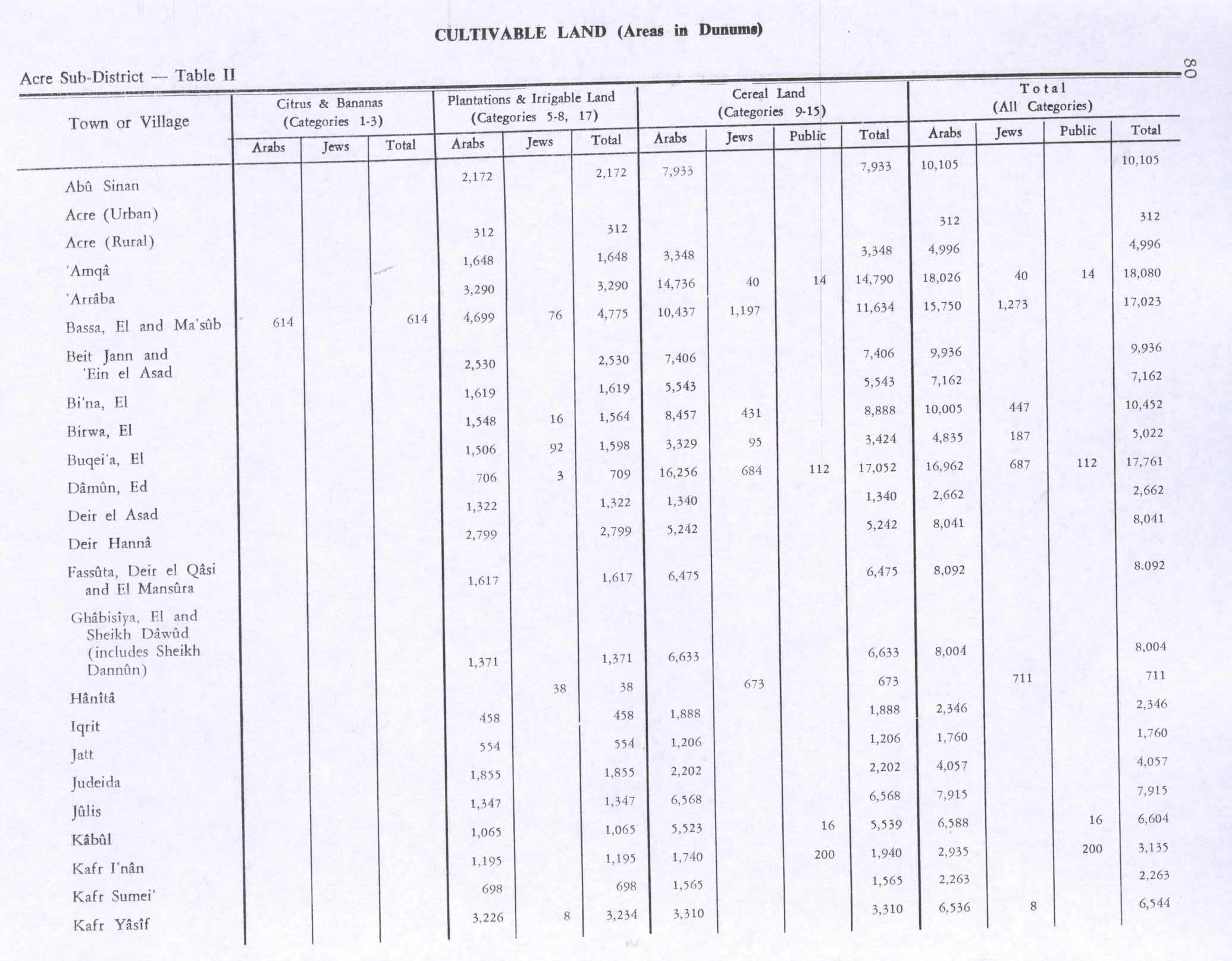
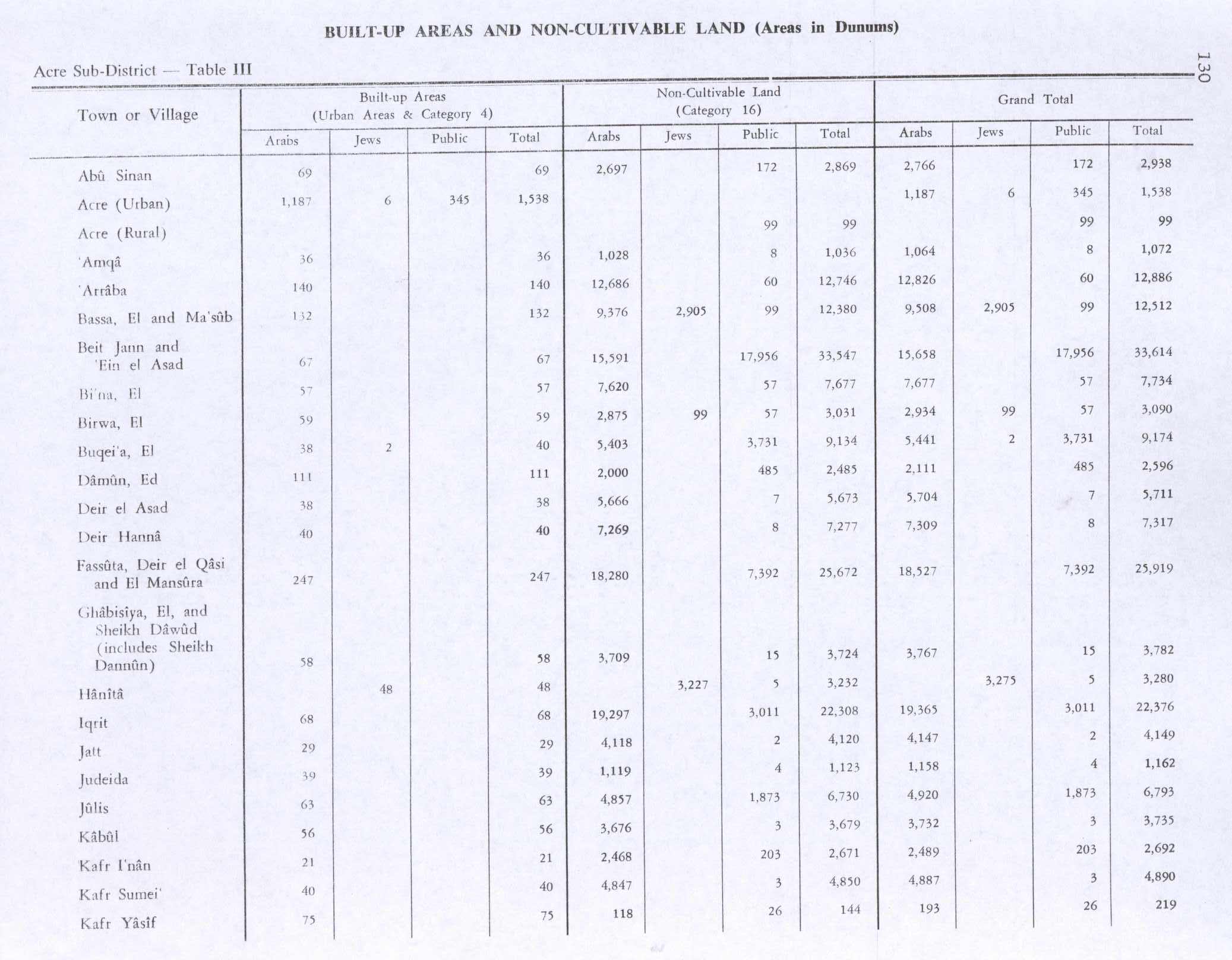
In the 1945 statistics, the population had grown to 2,950; 1360 Muslims and 1590 Christians,<ref name=1945p4/><ref>Government of Palestine, Village Statistics, 1945 Template:Webarchive, p. 2</ref> with Template:Convert of land according to an official land and population survey.<ref name=Hadawi40/> Of this, Arabs used 614 dunams for citrus and bananas, 14,699 dunams were plantations and irrigable land; 10,437 were used for cereals,<ref>Government of Palestine, Department of Statistics. Village Statistics, April, 1945. Quoted in Hadawi, 1970, p. 80 Template:Webarchive</ref> while 132 dunams were built-up (urban) land.<ref name=Hadawi130>Government of Palestine, Department of Statistics. Village Statistics, April, 1945. Quoted in Hadawi, 1970, p. 130 Template:Webarchive</ref>
1948 Palestine war
Al-Bassa was captured by paramilitary Haganah forces during the 1948 Arab–Israeli War, in Operation Ben-Ami, on May 14, 1948. Al-Bassa's defenders were local militia men. Following its capture, the Haganah's Palmach forces concentrated the villagers in the local church where they shot and killed a number of youths before chasing the villagers out.<ref name=Quigleyp62>Quigley, 2005, p. 62.</ref>Template:Refn One witness to the expulsion said that it was preceded by soldiers shooting and killing five villagers inside the church, while another said seven villagers were shot and killed by soldiers outside the church.<ref name=Benvenistip139>Benvenisti, 2000, pp. 139 -140.</ref>
Al-Bassa's residents were expelled as part of the 1948 Palestinian expulsion and flight, and the village was completely destroyed by the Israelis with the exception of a few houses, a church, and a Muslim shrine.
At least 60 of the Christian villagers of Al-Bassa were taken by the Haganah to Mazra'a, where they remained for more than a year.<ref name=Abassi>Template:Cite journal</ref> Altogether 81 residents of al-Bassa became Israeli citizens as internally displaced Palestinians who lost their land rights and ended up in places like Nazareth.<ref name=Hassounp26/><ref name=Arrej>Areej Sabbagh-Khoury, The Internally displaced refugees.</ref><ref name=Masalhap217>Masalha and Said, 2005, p. 217</ref> The only day on which Palestinians did not require a permit to travel during that period was Israel's Independence Day.<ref name=Masalhap217/> On this day internally displaced Palestinians would visit their former villages.<ref name=Masalhap217/> Wakim Wakim, an attorney from Al-Bassa and a leading member of the Association for the Defense of the Rights of the Internally Displaced explains: "The day when Israel celebrates is the day we mourn."<ref name=Masalhap217/>
Most of the former villagers of al-Bassa (circa 95%) were pushed north towards Lebanon, concentrating in the Dbayeh refugee camp near Jounieh east of Beirut.<ref name=Hassounp26/> Prior to and during the Lebanese Civil War, this camp suffered severe damage in the fighting and was largely destroyed, though it still has a population of some 4,233 people who are mostly Palestinian Christian refugees.<ref name=Hassounp26/> Other former residents of Al-Bassa and the refugee camp in Lebanon ended up in Lansing, Michigan where they established an international village club and hold annual gatherings attended by over 300 people.<ref name=Hassounp26/>
_in_1950_after_its_depopulation,_and_subsequent_repopulation_with_Israeli_immigrants.jpg)
The site was repopulated by Jewish immigrants and renamed as Betzet in 1951, and is today a part of the State of Israel.<ref>Template:Cite book</ref>
The village was inspected in 1992, when it was found that although most of the houses of Al-Bassa had been destroyed, a number of historic buildings survived, including two churches, a mosque, and a maqam.<ref name=Petersen111>Petersen, 2001, p. https://www.academia.edu/21619490/Gazetteer_3._A-C Template:Webarchive 111</ref>
Landmarks
Mosque
According to Petersen, the mosque appears to be a relatively modern construct, probably built in the early 1900s. It consists of a tall square room with a flat roof supported by iron girders. There is a cylindrical minaret at the north-east corner. There are tall pointed windows on all four sides, and a mihrab in the middle of the south wall. At the time of the inspection, 1992, the building was used as a sheep pen.<ref name=Petersen111/>
Maqam

The maqam is located about 20 meters east of the mosque. It consists of two parts: a walled courtyard, and a domed prayer room. In the courtyard there is a mihrab in the south wall, and a doorway in the east wall leads into the main prayer room. Pendentives springing from four thick piers support wide arches and the dome. In the middle of the south wall there is a mihrab, next to a simple minbar, made of four stone steps.<ref name=Petersen111/>
Template:AnchorKhirbet Ma'sub
The site of Khirbet Ma'sub, immediately to the east of Bassa, is where the Phoenician Ma'sub inscription was found in the 1880s.
Culture
Henry Baker Tristram during his 1863 visit to the village made a detailed description of the women's Palestinian costumes. Template:Hidden begin Template:Cquote Template:Hidden end
Weir, after quoting what Tristram wrote about the head-dresses in Al-Bussah, notes that coin headdresses went out of use for daily wear in Galilee at the beginning of the 20th century, but continued to be worn by brides for their weddings.<ref>Weir, 1989, pp.175-176</ref>
See also
References
Bibliography
- Template:Cite journal
- Template:Cite book
- Template:Cite book (p. 333)
- Cohen, A. (1973), Palestine in the Eighteenth Century: Patterns of Government and Administration. Hebrew University, Jerusalem. Cited in Khalidi, (1992)
- Template:Cite book ( p.156 )
- Template:Cite book
- Template:Cite book
- Template:Cite book
- Template:Cite book
- Template:Cite book
- Template:Cite book
- Template:Cite journal
- Template:Cite book
- Template:Cite book
- Template:Cite book
- Template:Cite book
- Template:Cite book
- Template:Cite book
- Template:Cite book
- Template:Cite book
- Template:Cite book
- Template:Cite book
- Template:Cite book
- Template:Cite book
- Template:Cite journal
- Template:Cite book
- Template:Cite book
- Template:Cite book
- Template:Cite book
- Template:Cite book
External links and references
- Welcome to al-Bassa
- al-Bassa, Zochrot
- Survey of Western Palestine, Map 3: IAA, Wikimedia commons
- Al-Bassa at Khalil Sakakini Cultural Center
- Template:Usurped Dr. Moslih Kanaaneh
- Al-Bassa International Association - an "international forum" for former residents of al-Bassa.

Template:Palestinian Arab villages depopulated during the 1948 Palestine War