Alisma plantago-aquatica
Template:Short description Template:Speciesbox
Alisma plantago-aquatica, also known as European water-plantain, common water-plantain or mad-dog weed, is a perennial flowering aquatic plant widespread across most of Europe and Asia, and apparently spread elsewhere in both the Old and New World.
Description

Alisma plantago-aquatica is a hairless plant that grows in shallow water, consists of a fibrous root, several basal long stemmed leaves Template:Convert long, and a triangular stem up to Template:Convert tall. It has branched inflorescence bearing numerous small flowers, Template:Convert across, with three round or slightly jagged, white or pale purple petals. The flowers open in the afternoon. There are three blunt green sepals and six stamens per flower. The carpels often exist as a flat single whorl.<ref>Flora of North America v 22, Alisma plantago-aquatica </ref> It flowers from June until August.<ref name=":0">Template:Cite book</ref> The fruits appear as a ring of seeds inside each flower.<ref name=":0" />
Chemistry
Chemical constituents of {{#invoke:Lang|lang}}—rhizomes of Alisma orientale (syn. Alisma Template:Nowrap var. orientale) as a traditional Chinese medicine—include alisol A 24-acetate and alisol B 23-acetate.<ref>{{#invoke:citation/CS1|citation |CitationClass=web }}</ref> The content of these two compounds are significantly different in {{#invoke:Lang|lang}} of different areas.
Similar species
Narrow-leaved water plantain Alisma lanceolatum differs only in that the leaf tips are acuminate and shape is narrow lanceolate.
_-_Theodore_Green_-_26_1931_10.jpg)
According to some sources, presumed specimens found in North America are actually the similar A. subcordatum and A. trivale.<ref name=":0" />
Taxonomy
The word alisma is said to be a word of Celtic origin meaning "water", a reference to the habitat in which it grows. Early botanists named it after the Plantago because of the similarity of their leaves.<ref name="The Wild Flower Key">Template:Cite book</ref>
Distribution and habitat
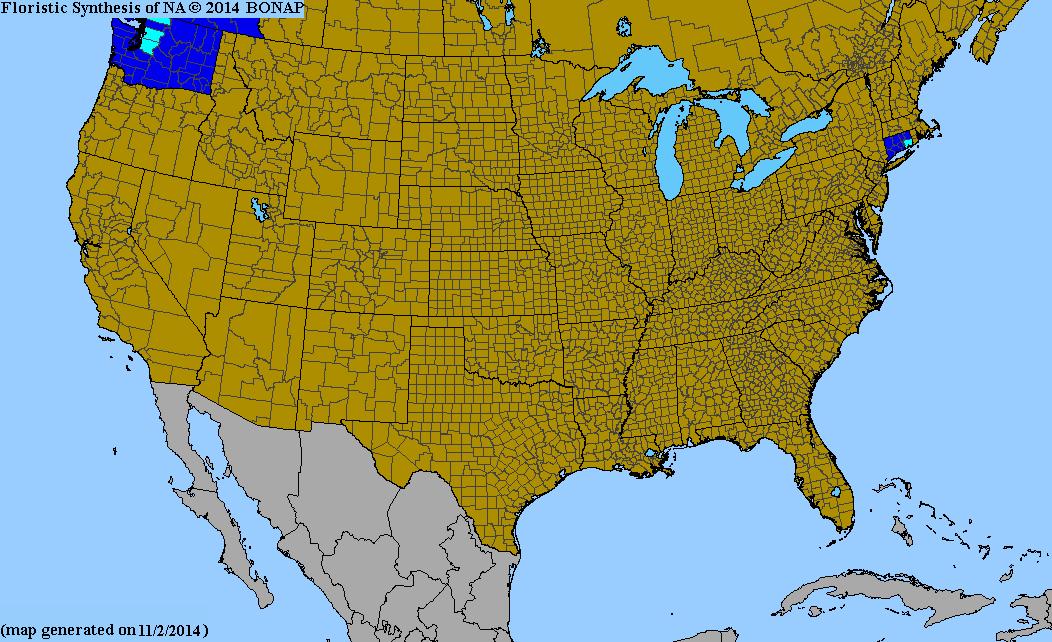
The species is widespread across most of Europe and Asia from Portugal and Morocco to Japan, Kamchatka and Vietnam. It is also regarded as native in northern and central Africa as far south as Tanzania, and in Australia.<ref>{{#invoke:citation/CS1|citation |CitationClass=web }}</ref> It is reportedly naturalized in southern Africa, New Zealand, Alaska, British Columbia, Washington state and Connecticut.<ref>{{#invoke:citation/CS1|citation |CitationClass=web }}</ref><ref>Biota of North America Program</ref><ref>{{#invoke:citation/CS1|citation |CitationClass=web }}</ref> Some sources maintain that the species is widespread across North America, but these reports appear to have been based on misidentified specimens.<ref>Björkquist, I. 1968. Studies in Alisma L. II. Chromosome studies, crossing experiments and taxonomy. Opera Botanica 19: 1-138.</ref> It is found on mud or in fresh waters.<ref name=":0" />
Uses
The rootstocks contain starch and can be boiled or soaked to remove bitterness before eating. Aquatic plants in general should be cooked before consumption to kill parasites.<ref>Template:Cite book</ref>
According to Flora of the U.S.S.R. (1934), "A powder prepared from dried roots is used in popular medicine as a cure for rabies and crushed leaves are used against mammary congestion; fresh leaves are employed in homeopathy. ... Since this species is often confounded or identified with others of the genus, the reported data may also refer to [A. orientale or A. lanceolatum]."<ref>Template:Cite book</ref> A. Template:Nowrap is also known as mad-dog weed,<ref>{{#invoke:citation/CS1|citation |CitationClass=web }}</ref> as if it could be used to cure rabies, but should not be confused with Scutellaria lateriflora (mad-dog skullcap), which is also sometimes called mad-dog weed.
Alisma orientale is sometimes treated as a variety of this species (A. Template:Nowrap var. orientale).<ref>Template:GRIN</ref><ref>Template:GRIN</ref> The rhizomes of A. orientale have been used as a traditional Chinese medicine, ze xie.<ref>{{#invoke:citation/CS1|citation |CitationClass=web }}</ref> However, it may have serious side effects or even toxic effects such as hepatotoxicity in patients with chronic hepatitis B.<ref>Template:Cite journal</ref>
References
External links
Template:Sister project Template:Sister project
- line drawing from Flora of Pakistan, Alisma plantago-aquatica
- photo of herbarium specimen at Missouri Botanical Garden, collected in Ethiopia (Abyssinia) in 1898
- Kew Royal Botanic Gardens, London, Alisma plantago-aquatica (common water-plantain)
- Le Jardin du Pic Vert, Plantain d'eau, Alisma plantago-aquatica
- Tela Botanica, Alisma plantain d'eau
- NatureGate, Luontoportti, Helsinki, Water-plantain
- Altervista Flora Italiana, Piantaggine acquatica
- Royal Horticultural Society
- Alisma
- Flora of Africa
- Flora of Asia
- Flora of Australia
- Flora of Central Asia
- Flora of China
- Flora of Europe
- Flora of Gabon
- Flora of Kosovo
- Flora of New Zealand
- Flora of Russia
- Flora of Siberia
- Flora of Portugal
- Freshwater plants
- Medicinal plants of Europe
- Medicinal plants of North America
- Plants described in 1753
- Plants used in traditional Chinese medicine
- Botanical taxa named by Carl Linnaeus