Beatrice Tinsley
Template:Short description Template:For Template:Use New Zealand English Template:Use dmy dates Template:Infobox scientist Beatrice Muriel Hill Tinsley (27 January 1941 – 23 March 1981) was a British-born New Zealand astronomer and cosmologist, and the first female professor of astronomy at Yale University, whose research made fundamental contributions to the astronomical understanding of how galaxies evolve, grow and die.
Life
Beatrice Hill was born 1941 in Chester, England, as the middle of three daughters of Jean and Edward Hill.<ref name="nytimes-obit">Template:Cite news</ref> The family emigrated to New Zealand following World War II, first living in Christchurch, and then for a longer time in New Plymouth, where her father was a clergyman, Moral Re-Armer, and later became the mayor (1953–56).
While studying in Christchurch, she married physicist and university classmate Brian Tinsley, not knowing that this would prevent her from working at the university while he was employed there.<ref name="nytimes-obit" /> Tinsley completed her master's thesis in 1962.<ref>Template:Cite thesis</ref> They moved in 1963 to the United States, to Dallas, Texas, where Brian was hired by the Southwest Center for Advanced Studies (now the University of Texas at Dallas). However, she was said to have found the situation "stultifying", and had once caused a controversy by refusing to follow the custom of hosting a faculty tea.<ref name="nytimes-obit" /> In 1964, she enrolled at UT-Austin, where she was the only woman in the astronomy programme and where she would later publish her groundbreaking research.<ref name="aauw-2014">{{#invoke:citation/CS1|citation |CitationClass=web }}</ref>
Despite receiving recognition for her work, Tinsley was unable to find a permanent academic position. In 1974, after years of attempting to balance home, family and two commuting careers, she left her husband and two adopted children to take a position as assistant professor at Yale.<ref name="nytimes-obit" /> On 1 July 1978 she was appointed a professor of astronomy at Yale, becoming the first woman to hold the position.<ref name=":0">{{#invoke:citation/CS1|citation |CitationClass=web }}</ref> She worked at Yale until her death from melanoma in the Yale Infirmary in 1981.
Professional activity
Tinsley completed pioneering theoretical studies of how populations of stars age and affect the observable qualities of galaxies. She also collaborated on basic research into models investigating whether the universe is closed or open. Her galaxy models led to the first approximation of what protogalaxies should look like.
In 1974 she received the American Astronomical Society's Annie J. Cannon Award in Astronomy, awarded for "outstanding research and promise for future research by a postdoctoral woman researcher", in recognition of her work on galaxy evolution.<ref name="aas-award">{{#invoke:citation/CS1|citation |CitationClass=web }}</ref>
In 1977, Tinsley, with Richard Larson of Yale, organised a conference on 'The Evolution of Galaxies and Stellar Populations'.
Shortly after, in 1978, she became the first female professor of astronomy at Yale University.<ref name=anchestry>{{#invoke:citation/CS1|citation |CitationClass=web }}</ref> Her last scientific paper, submitted to The Astrophysical Journal ten days before her death, was published posthumously that November, without revision.<ref name="TinsleyNov81">Template:Cite journal</ref><ref group=note>The editor's note: "Deceased on 1981 March 23, thus ending prematurely a distinguished career. The text of this last paper was not revised, although Michele Kaufman kindly added some clarifying definitions and comments."</ref>
Death
Tinsley died of melanoma on 23 March 1981, at the age of 40.<ref name="nytimes-obit"/><ref name=":0" /> Her ashes are buried at Grove Street Cemetery in New Haven, Connecticut, which is surrounded by the Yale University campus.
Tributes

In 1986 the American Astronomical Society established the Beatrice M. Tinsley Prize, which recognises "an outstanding research contribution to astronomy or astrophysics, of an exceptionally creative or innovative character."<ref name="tinsley-prize">{{#invoke:citation/CS1|citation |CitationClass=web }}</ref> It is the only major award created by an American scientific society which honours a woman scientist. The award is not made with restriction on a candidate's citizenship or country of residence.<ref name="tinsley-prize"/>
The main-belt asteroid 3087 Beatrice Tinsley, discovered in 1981 at Mt John University Observatory near Tekapo, is also named after her.<ref>{{#invoke:citation/CS1|citation |CitationClass=web }}Template:Dead link</ref>
The University of Texas at Austin established from endowment in 1989 the Beatrice M. Tinsley Centennial Visiting Professorship, where a distinguished mid-career or senior professor is invited to visit for up to a semester.<ref name="UTAustin">{{#invoke:citation/CS1|citation |CitationClass=web }}</ref> In 2007 they added the Tinsley Scholars, awards for younger researchers to briefly visit Austin.<ref name="UTAustin"/>
In 2005, the Circa Theatre in Wellington produced a play called Bright Star, about the life of Beatrice Tinsley.<ref>{{#invoke:citation/CS1|citation |CitationClass=web }}</ref> The Wellington Astronomical Society held telescope viewing sessions outside the theatre, on the wharf next to the Te Papa Museum.Template:Citation needed
In December 2010 the New Zealand Geographic Board officially named a mountain in Fiordland's Kepler Mountains (which are named for astronomer Johannes Kepler) as Mt Tinsley.<ref>{{#invoke:citation/CS1|citation |CitationClass=web }}</ref><ref name="SouthlandTimes">{{#invoke:citation/CS1|citation |CitationClass=web }}</ref>
The Royal Astronomical Society of New Zealand established the Beatrice Hill Tinsley Lectures<ref name="RASNZ web site">{{#invoke:citation/CS1|citation |CitationClass=web }}</ref> in 2012.
Beatrice Tinsley Crescent in Rosedale, on Auckland's North Shore, is named for her.Template:Citation needed
On 27 January 2016, the 75th anniversary of her birth, Google published a Doodle to honour her work.<ref>"Beatrice Tinsley’s 75th Birthday". Google.com.</ref> In the same year, the New Zealand Association of Scientists renamed the Research Medal the Hill Tinsley Medal in Tinsley's honour.<ref>{{#invoke:citation/CS1|citation |CitationClass=web }}</ref> In 2017, Tinsley was one of the Royal Society Te Apārangi's "150 women in 150 words", celebrating women's contribution to knowledge in New Zealand.<ref>{{#invoke:citation/CS1|citation |CitationClass=web }}</ref>
Her obituary was published by The New York Times several decades later on 18 July 2018,<ref name="nytimes-obit"/> in their "Overlooked" project, which aims to note "the stories of remarkable people whose deaths went unreported in The Times".<ref>{{#invoke:citation/CS1|citation |CitationClass=web }}</ref>
In 2018, the Yale Society of Physics Students began an inaugural prize lecture in honour of Tinsley.<ref>{{#invoke:citation/CS1|citation |CitationClass=web }}</ref>
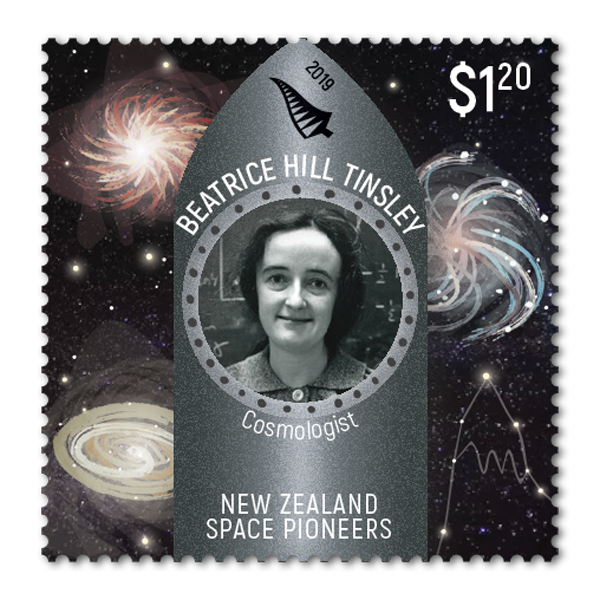
A 2019 $1.20 New Zealand postage stamp in a series of "New Zealand Space Pioneers" honours her.<ref>Stamp image bigcommerce.com</ref>
The University of Canterbury College of Science named their staff and postgraduate building after Tinsley, which was opened in October 2019 by the Honourable Dr Megan Woods, Vice-Chancellor Cheryl de la Rey, and Pro-Vice Chancellor of Science Professor Wendy Lawson.<ref>{{#invoke:citation/CS1|citation |CitationClass=web }}</ref> The building uses Pres-Lam technology developed at the university.<ref>{{#invoke:citation/CS1|citation |CitationClass=web }}</ref>
The final track on the 2022 Forenzics album Shades and Echoes, "Autumn", is credited "Words by NZ astronomer Beatrice Hill Tinsley – adapted with permission by T. Finn".<ref>Forenzics, Shades and Echoes, CD booklet</ref>
Selected publications
- "An accelerating universe". 1975. Nature 257: 454–457 (9 October 1975); doi:10.1038/257454a0
- "Correlation of the Dark Mass in Galaxies with Hubble type". 1981. Royal Astronomical Society, Monthly Notices. vol. 194, p. 63–75
- "Relations between Nucleosynthesis Rates and the Metal Abundance". 1980. Astronomy and Astrophysics. vol. 89, no. 1–2, p. 246–248
- "Stellar Lifetimes and Abundance Ratios in Chemical Evolution". 1979. Astrophysical Journal. Part 1, vol. 229, p. 1046–1056
- "Colors as Indicators of the Presence of Spiral and Elliptical Components in N Galaxies". 1977. Publications of the Astronomical Society of the Pacific. vol. 89, p. 245–250
- "Surface Brightness Parameters as Tests of Galactic Evolution". 1976. Astrophysical Journal. vol. 209, p. L7–L9
- "The Color-Redshift Relation for Giant Elliptical Galaxies". 1971, Astrophysics and Space Science, Vol. 12, p. 394
Notes
<references group=note/>
References
Further reading
- Template:Cite book
- Template:DSB
- Template:Cite journal
- Template:Cite journal
- Template:Cite book - a children's book
- Template:Cite book
- Template:Cite journal
- Template:Cite journal
- Template:Cite book
- Template:Cite news
External links
Other biographies:
- Beatrice Hill Tinsley biography, Michele Nichols, 10 June 1998.
- New Zealand Heroes biography
- Astronomical Society of the Pacific biography Template:Webarchive
- Texas History biography
Other material:
- Template:Webarchive
- Oral History interview transcript with Beatrice Tinsley 14 June 1977, American Institute of Physics, Niels Bohr Library and Archives Template:Webarchive
- Bibliography from the Astronomical Society of the Pacific
- Radio New Zealand The Stars are Comforting: The letters of Beatrice Hill Tinsley (1941–1981). Also includes an image gallery and audio of several related interviews
- New Zealand Geographic Board Report on Mount TinsleyTemplate:Dead link
- {{#invoke:citation/CS1|citation
|CitationClass=web }}
- The Beginning and End of the Universe, Season 1, Episode 2, The End. Jim Al-Khalili discusses how her PhD dissertation on the evolution of galaxies contributed to ongoing attempts to understand the expansion rate of the universe.
- Pages with broken file links
- 1941 births
- 1981 deaths
- Cosmologists
- 20th-century New Zealand astronomers
- New Zealand emigrants to the United States
- People from Chester
- Recipients of the Annie J. Cannon Award in Astronomy
- University of Canterbury alumni
- Women astronomers
- English emigrants to New Zealand
- New Zealand women scientists
- 20th-century women scientists
- People educated at New Plymouth Girls' High School