Billy Carter
Template:Short description Template:About Template:Use mdy dates Template:Infobox person
William Alton Carter (March 29, 1937 – September 25, 1988)<ref>{{#invoke:citation/CS1|citation |CitationClass=web }}</ref> was an American farmer, businessman, brewer, and politician. The younger brother of U.S. President Jimmy Carter, he promoted Billy Beer and Peanut Lolita; and he was a candidate for mayor of Plains, Georgia.
Early life
William Alton "Billy" Carter was the fourth and youngest child of Lillian and James Earl Carter Sr.<ref name="latimes/1988-09-26-mn-1791"/> He attended Emory University,<ref name="washingtonpost/1988/billy-dies">Template:Cite news</ref> served in the United States Marine Corps, and later worked in the Carter family's peanut business.<ref name="legacy/billy-carter">{{#invoke:citation/CS1|citation |CitationClass=web }}</ref>
1970s and later
In 1970, Billy Carter was managing partner and 15% owner of the Carter family's peanut business.<ref name="latimes/1988-09-26-mn-1791"/> By 1976, Billy had increased revenues to $5 million per year.<ref name="latimes/1988-09-26-mn-1791">Template:Cite news</ref>
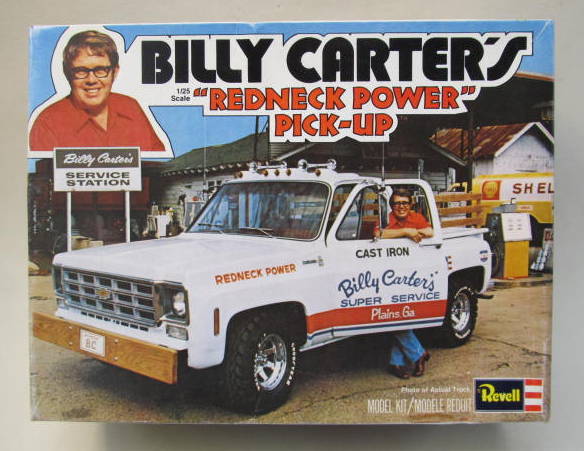
In 1972, Carter purchased a gas and service station in Plains. He owned and operated it for most of the decade.<ref>Billy Carter's Station</ref> At its peak he sold 2,000 cases of beer a month and more than 40,000 gallons of gas.<ref name="legacy/billy-carter"/> In 2009, the station became the Billy Carter Service Station Museum,<ref>
- {{#invoke:citation/CS1|citation
|CitationClass=web }}
- {{#invoke:citation/CS1|citation
|CitationClass=web }}
- {{#invoke:citation/CS1|citation
|CitationClass=web }} </ref> via the University of Georgia.<ref name="legacy/billy-carter"/>
Carter ran for mayor of Plains in 1976 but lost the election, 97 to 71 votes, to A.L. Blanton,<ref name="nytimes/1976/12/07/billy-loses">Template:Cite news</ref> an Albany airport<ref>{{#invoke:citation/CS1|citation |CitationClass=web }}</ref> air traffic controller.<ref>{{#invoke:citation/CS1|citation |CitationClass=web }}</ref>
In the 1970s, Billy Carter was the official spokesperson for Peanut Lolita liqueur.<ref>Template:Cite book</ref>
In 1977, although a Pabst Blue Ribbon drinker,<ref name="legacy/billy-carter"/> he endorsed Billy Beer, introduced by the Falls City Brewing Company, who wished to capitalize upon his colorful image as a beer-drinking Southern good ol' boy.<ref name="newspapers/clip/13776945">Template:Cite news</ref> Billy Carter's name was occasionally used as a gag answer for a Washington, D.C. trouble-maker on 1970s episodes of Match Game.Template:Cn He was known for his outlandish public behavior;<ref>
- Template:Cite news
- Template:Cite journal</ref> he once urinated on an airport runway in full view of the press and dignitaries.<ref>"Billy Carter Curbs Tongue", Spokane Daily Chronicle, January 15, 1979</ref>
By 1979, he drank half a gallon of vodka and whiskey a day.<ref name="latimes/1990-01-27-li-769">Template:Cite news</ref> In February 1979, Carter was admitted to seven weeks of rehabilitation at the Long Beach, California Navy Hospital alcohol treatment facility.<ref name="ajc/billy-dies">Template:Cite news</ref><ref name="calisphere/21198/zz0002rkdf">{{#invoke:citation/CS1|citation |CitationClass=web }}</ref> He later became sober and reportedly extended support to other addicts in their own recovery.<ref name="latimes/1990-01-27-li-769"/>
In 1981, he was forced to sell his Plains properties to pay taxes and debts and moved to Haleyville, Alabama, where he worked in sales for Tidwell Industries.<ref name="britannica/Billy-Carter"/> In 1985, he became Vice President of Scott Housing Systems.<ref name="britannica/Billy-Carter">{{#invoke:citation/CS1|citation |CitationClass=web }}</ref>
Relationship with Libya
In late 1978 and early 1979, Billy Carter visited Libya three times with a contingent from Georgia. He eventually registered as a foreign agent of the Libyan government and received a $220,000 loan, of which, The New York Times speculated,<ref name="nytimes/1988/09/26/billy-carter">Template:Cite news</ref> only $1,000 was repaid.<ref>Template:Cite news</ref> However, Edwin P. Wilson claimed he had seen a telegram showing that Libya paid Billy Carter $2 million.<ref>Joseph J. Trento, Prelude to Terror: Edwin P. Wilson and the Legacy of America's Private Intelligence Network (Carroll and Graf, 2005), p. 162.</ref> This led to a Senate hearing on alleged influence peddling, which the press named Billygate.<ref>Template:Cite news</ref> A Senate sub-committee was called To Investigate Activities of Individuals Representing Interests of Foreign Governments (Billy Carter—Libya Investigation).<ref>
- {{#invoke:citation/CS1|citation
|CitationClass=web }}
</ref>
<templatestyles src="Template:Blockquote/styles.css" />
"I am deeply concerned that Billy has received funds from Libya and that he may be under obligation to Libya. These facts will govern my relationship with Billy as long as I am president. Billy has had no influence on U.S. policy or actions concerning Libya in the past, and he will have no influence in the future."{{#if:|
|}}{{#if:Jimmy Carter, August 4, 1980<ref>Trento, Prelude to Terror, p. 164. Trento asserts that Libya's involvement with Billy Carter was instigated by Israeli intelligence in order "to compromise the president", who had ended Israel's "special status inside the CIA". Trento, 160, 157.</ref>|
— {{#if:|, in }}Template:Comma separated entries
}}{{#invoke:Check for unknown parameters|check|unknown=Template:Main other|preview=Page using Template:Blockquote with unknown parameter "_VALUE_"|ignoreblank=y| 1 | 2 | 3 | 4 | 5 | author | by | char | character | cite | class | content | multiline | personquoted | publication | quote | quotesource | quotetext | sign | source | style | text | title | ts }}
A 1985 Wall Street Journal article suggested that a series of Billygate articles written by Michael Ledeen and published in The New Republic in October 1980 were intended to influence the outcome of that year's presidential election. According to the reporting, Francesco Pazienza, an officer of the Italian intelligence agency SISMI, alleged that Ledeen was handed Billygate information by the Italian Intelligence agency and he co-authored the articles with Arnaud de Borchgrave.<ref name="Blumenthal">Template:Cite news</ref> Pazienza was later tried and convicted in absentia for using "extortion and fraud to obtain embarrassing facts about Billy Carter".<ref name=unger-2006>Template:Cite magazine</ref>
Death
Carter was diagnosed with pancreatic cancer in the fall of 1987 and received unsuccessful treatments for the disease.<ref>Template:Cite news</ref> He died in Plains the following year at age 51,<ref>
</ref> five years after the death of his sister, Ruth Carter Stapleton, who also died of pancreatic cancer at age 54. A year and a half later, his older sister, Gloria Carter Spann, died at age 63 from pancreatic cancer.<ref name="nytimes/1988/09/26/billy-carter"/> Their father, James Earl Carter Sr., also died of the disease at age 58. His mother, Bessie Lillian Gordy, died from breast cancer at age 85. His older brother Jimmy Carter died at age 100 in 2024.
After Billy died, his wife Sybil opened a cafe.<ref name="booknotes/62763-1">{{#invoke:citation/CS1|citation |CitationClass=web }}</ref><ref name="newspapers/clip/13776945"/>
Bibliography
- Carter, William "Buddy" (1999) Billy Carter: A Journey Through the Shadows (Template:ISBN).
- Template:Cite book<ref>Template:Cite news</ref>
See also
References
External links
- 1937 births
- 1988 deaths
- United States Marines
- Carter family
- Gordy family
- Deaths from pancreatic cancer in Georgia (U.S. state)
- Georgia (U.S. state) Democrats
- People from Plains, Georgia
- Emory University alumni
- Businesspeople from Georgia (U.S. state)
- Military personnel from Georgia (U.S. state)
- 20th-century American businesspeople