Campsis radicans
Template:Short description Template:About Template:Speciesbox
Campsis radicans, the trumpet vine,<ref name=GRIN>Template:GRIN</ref> yellow trumpet vine,<ref name="RHS" /> or trumpet creeper<ref name=GRIN/> (also known in North America as cow-itch vine<ref name="TvetenTveten2010">Template:Cite book</ref> or hummingbird vine<ref name="Mayer2010">Template:Cite book</ref>), is a species of flowering plant in the trumpet vine family Bignoniaceae, native to eastern North America, and naturalized elsewhere. Growing to Template:Convert, it is a vigorous, deciduous woody vine, notable for its showy trumpet-shaped flowers. It inhabits woodlands and riverbanks, and is also a popular garden plant.
Description
C. radicans is a vine that climbs on trees, other plants, or structures or trails along the ground and can grow to a length of up to Template:Convert. From the main vine, rigid or woody arching vines up to Template:Convert long extend outward. The plant can form a dense groundcover or an aggressive liana covering plants or buildings. The leaves are opposite and odd-pinnately compound, meaning there is an odd number of leaflets, with one terminal leaflet.
C. radicans climbs through aerial rootlets and twining stems; these stems grow upwards of 12 m in length.<ref name= "Fact sheet">Wennerberg, S. (2006). Plant Fact Sheet: Trumpet Creeper Campsis radicans. N.R.C.S. United States Department of Agriculture. Baton Rouge, LA. </ref> Its bark is tan in color, and shreds easily.<ref name= "Weakley 2015"> Weakley, A. S. (2015). Flora of the Southern and Mid-Atlantic States. Chapel Hill, NC, University of North Carolina Herbarium. </ref>
Leaves are up to Template:Convert long with 7 to 13 leaflets that are each about Template:Convert long and Template:Convert wide. The leaflets are emerald green when new, maturing into a shiny dark green. They are ovate to broadly lanceolate and the edges are coarsely serrate.<ref name="ANPS">{{#invoke:citation/CS1|citation |CitationClass=web }}</ref>


Inflorescences
The flowers come in terminal cymes of two to eight. Each flower is up to Template:Convert long and trumpet shaped. They are orange to reddish orange in color with a yellowish throat and 5 shallow lobes bending backward. They generally appear after several months of warm weather. The flowers have no floral scent. After flowering, a long seed capsule about Template:Convert long appears, eventually splitting in two to disperse its seeds. <ref name="IL">Template:Illinois Wildflowers</ref>

Taxonomy
The flamboyant flowering of Campsis radicans made it obvious to even the least botanically-minded of the first English colonists in Virginia. Consequently, the plant quickly made its way to England early in the 17th century.
Its botanical parentage, as a hardy member of a mostly subtropical group, made its naming problematic: according to John Parkinson, the Virginia settlers were at first calling it a jasmine or a honeysuckle, and then a bellflower; he classed it in the genus Apocynum (dogbane). Joseph Pitton de Tournefort erected a catch-all genus Bignonia in 1700, from which it has since been extricated.<ref name="COAT">Alice M. Coats, Garden Shrubs and Their Histories (1964) 1992, s.v. "Campsis".</ref>
Etymology
The Latin specific epithet radicans means 'with stems that take root'.<ref name="RHSLG">Template:Cite book</ref> The plant is commonly known as cow-itch vine because skin redness and itching is experienced by some people after coming in contact with the leaves.<ref>{{#invoke:citation/CS1|citation |CitationClass=web }}</ref>
Distribution
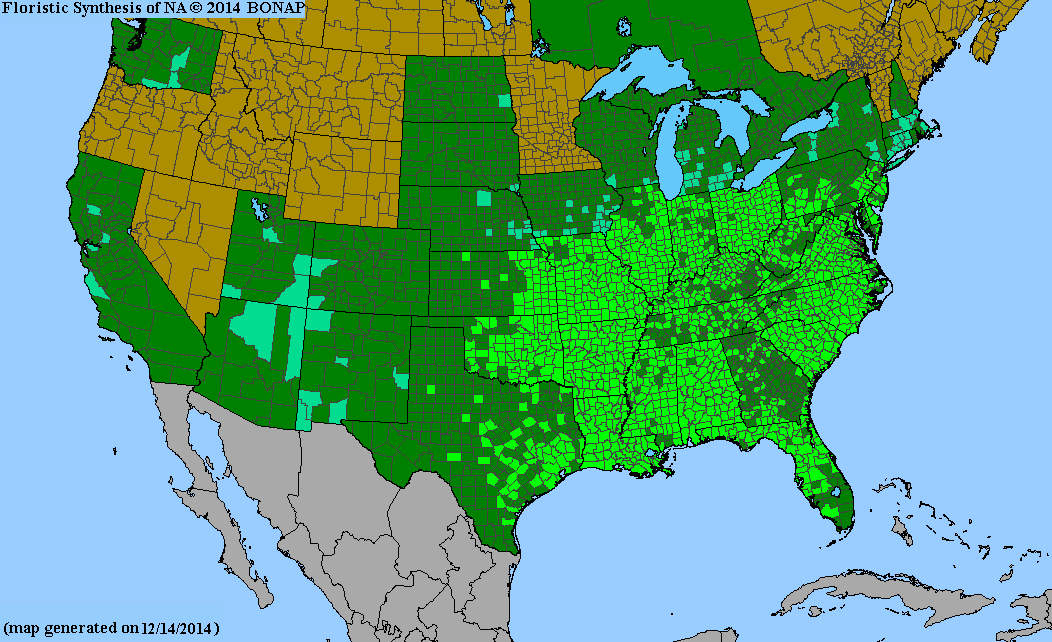
Campsis radicans is native to the eastern United States and extreme southern Ontario in Canada. It is naturalized in parts of the western United States as well as in Ontario and southern Quebec, parts of Europe, and scattered locations in Latin America.<ref name=s>Kew World Checklist of Selected Plant Families</ref><ref>Biota of North America Program, 2013 county distribution map</ref>
Ecology
In the pre-Columbian landscape, C. radicans was mostly limited to bottomlands in swamps, but has since become a successful colonizer of thickets, fencerows, and abandoned farmland.<ref name= "Weakley 2015"> Weakley, A. S. (2015). Flora of the Southern and Mid-Atlantic States. Chapel Hill, NC, University of North Carolina Herbarium. </ref> C. radicans can also be found in floodplain forests, including along their edges, and on river banks.<ref name= "Herbarium">Florida State University Robert K. Godfrey Herbarium database. URL: http://herbarium.bio.fsu.edu. Last accessed: March 2019. Collectors: Jame Amoroso, Loran C. Anderson, Kurt E. Blum, Michael B. Brooks, R. Buchanan, Andre F. Clewell, R. F. Doren, Wm. H. Ellis, Robert K. Godfrey, Norlan C. Henderson, Brenda Herring, Clarke Hudson, Ed Keppner, Lisa Keppner, R. Komarek, Elmo Law, S. J. Lombardo, Karen MacClendon, Sidney McDaniel, Richard S. Mitchell, J. B. Nelson, R. A. Norris, Sara J. Noyes, Kevin Oakes, Elmer C. Prichard, A. E. Radford, Gwynn W. Ramsey, Paul L. Redfearn, Jr., R. R. Smith, Charles S. Wallis, D. B. Ward, S. S. Ward, Roomie Wilson, D. R. Windler, and Jean W. Wooten. States and Counties: Florida: Bay, Calhoun, Columbia, Dixie, Franklin, Gadsden, Gulf, Jackson, Jefferson, Leon, Liberty, Madison, Suwannee, Taylor, Volusia, Wakulla, and Washington. Georgia: Grady. Illinois: White. Kansas: Allen. Louisiana: Lafayette and Tangipahoa. Maryland: Cecil. Mississippi: Jackson and Wilkinson. Missouri: Douglas. North Carolina: Caldwell. Oklahoma: Latimer. South Carolina: Oconee. Tennessee: Rutherford. Texas: Knox and Taylor.</ref>
The flowers bloom in the summer for about three months<ref name=ncextension>{{#invoke:citation/CS1|citation |CitationClass=web }}</ref><ref name=graves2022>Template:Cite journal</ref> and are very attractive to hummingbirds such as the ruby-throated hummingbird,<ref name="IL"/><ref name=ncextension/> while many types of birds like to nest in the dense foliage. Halictid bees, flies, and ants also feed on the nectar of the plant's extra-floral nectaries.<ref name="IL"/> Nectar robbing behavior has been observed to be performed by orchard orioles (Icterus spurius), which puncture and enlarge holes in the flower base to access nectaries.<ref name=graves2022/> Certain sphinx moths with elongate proboscises are able to successfully feed on trumpet vines while hovering in front of the flower.<ref>{{#invoke:citation/CS1|citation |CitationClass=web }}</ref>
The flowers are followed by large seed pods. As these mature, they dry and split. Hundreds of thin, brown, paper-like seeds are released. These are easily grown when stratified. Larvae of Clydonopteron sacculana (the trumpet vine moth) feed on the seed pods.<ref>Template:Cite journal</ref>
C. radicans occasionally acts as a food source for large mammals.<ref name= "USDA Plant Database"> USDA Plant Database [1] </ref> However, the plant is slightly toxic if ingested, and contact with flowers and leaves can result in swelling and skin redness.<ref name= "Fact sheet"></ref>
C. radicans is sometimes considered a weedy species.<ref name= "USDA Plant Database"/> Thinning the vines during the growing season and cutting them back during winter can help to limit their aggressive spread.<ref name= "Fact sheet"/>
Cultivation
The trumpet vine grows vigorously. In warm weather, it puts out aerial rootlets that grab onto every available surface, and eventually expand into heavy woody stems several centimeters in diameter. It grows well on arbors, fences, telephone poles, and trees, although it may dismember them in the process. Ruthless pruning is recommended.<ref name="ANPS"/> Outside of its native range this species has the potential to be invasive, even as far north as New England.<ref>{{#invoke:citation/CS1|citation |CitationClass=web }}</ref> The trumpet vine thrives in many places in southern Canada as well.
Away from summer heat, C. radicans is less profuse of flower. A larger-flowered hybrid 'Mme Galen' was introduced about 1889 by the Tagliabue nurserymen of Lainate near Milan.<ref name=COAT />
The form C. radicans f. flava has gained the Royal Horticultural Society's Award of Garden Merit.<ref name="RHS">{{#invoke:citation/CS1|citation |CitationClass=web }}</ref>
A deeper red form "Flamenco" is available.
Toxicity
The plant can cause contact dermatitis.<ref>{{#invoke:citation/CS1|citation |CitationClass=web }}</ref>