Classification of swords
Template:Short description {{#invoke:Hatnote|hatnote}}{{#ifeq:||}} Template:Original research

The English language terminology used in the classification of swords is imprecise and has varied widely over time. There is no historical dictionary for the universal names, classification, or terminology of swords; a sword was simply a single-edged or double-edged knife that grew incrementally longer and more complex with technological advances.
Historical terms without a universal consensus of definition (e.g. "arming sword", "broadsword", "long sword", etc.) were used to label weapons of similar appearance but of different historical periods, regional cultures, and fabrication technology. These terms were often described in relation to other unrelated weapons, without regard to their intended use and fighting style. In modern history, many of these terms have been given specific, often arbitrary meanings that are unrelated to any of their historical meanings.
Terminology
Some of these terms originate contemporaneously with the weapons which they describe. Others are modern or early modern terms used by antiquarians, curators, and modern-day sword enthusiasts for historical swords.
Terminology was further complicated by terms introduced<ref>e.g., "hand-and-a-half sword", "single-handed sword", "Pappenheimer"[{{#invoke:citation/CS1|citation |CitationClass=web }} {{#invoke:citation/CS1|citation |CitationClass=web }}] "Walloon sword", "Sinclair Sabre", "Mortuary sword", "spada da lato", "town sword", etc.</ref> or misinterpreted<ref>e.g., bastard sword, broadsword [{{#invoke:citation/CS1|citation |CitationClass=web }}</ref><ref name="merriam-webster1">{{#invoke:citation/CS1|citation |CitationClass=web }}] rapier</ref><ref name="salvatorfabris1">{{#invoke:citation/CS1|citation |CitationClass=web }}, estoc, flamberge, etc.</ref> in the 19th century by antiquarians and in 20th century pop culture,<ref>sword and sorcery fiction, role playing games, fighting games, etc.</ref> and by the addition of new terms such as "great sword", "Zweihänder" (instead of Beidhänder), and "cut-and-thrust sword".<ref>"cut-and-thrust sword"</ref> Historical European martial arts associations have turned the term spada da lato<ref>A term that was coined by Italian curators</ref> into "side-sword". Furthermore, there is a deprecation of the term "broadsword" by these associations. All these newly introduced or redefined terms add to the confusion of the matter.
Template:AnchorThe most well-known systematic typology of blade types of the European medieval sword is the Oakeshott typology, although this is also a modern classification and not a medieval one. Elizabethans used descriptive terms such as "short", "bastard", and "long" which emphasized the length of the blade, and "two-handed" for any sword that could be wielded by two hands.
Classification by hilt type
.jpg)
Handedness
The term two-handed sword may refer to any large sword designed to be used primarily with two hands:
- the European longsword, popular in the Late Middle Ages and Renaissance.
- the Scottish late medieval claymore (not to be confused with the basket-hilted claymore of the 18th century)
- the Bidenhänder sword favored by the Landsknechte of 16th-century Germany
The term "hand-and-a-half sword" is modern (late 19th century).<ref name="google3"/> During the first half of the 20th century, the term "bastard sword" was used regularly to refer to this type of sword, while "long sword" or "long-sword" referred to the rapier (in the context of Renaissance or Early Modern fencing).<ref name="google149"/>
The term "single-handed sword" or "one-handed sword" was coined to distinguish from "two-handed" or "hand-and-a-half" swords. "Single-handed sword" is used by Sir Walter Scott.<ref>in Death of the Laird's Jock (1831).</ref> It is also used as a possible gloss of the obscure term tonsword by Nares (1822);<ref>Robert Nares, A glossary; or, Collection of words ... which have been thought to require illustration, in the works of English authors (1822).</ref> "one-handed sword" is somewhat later, recorded from Template:Circa.
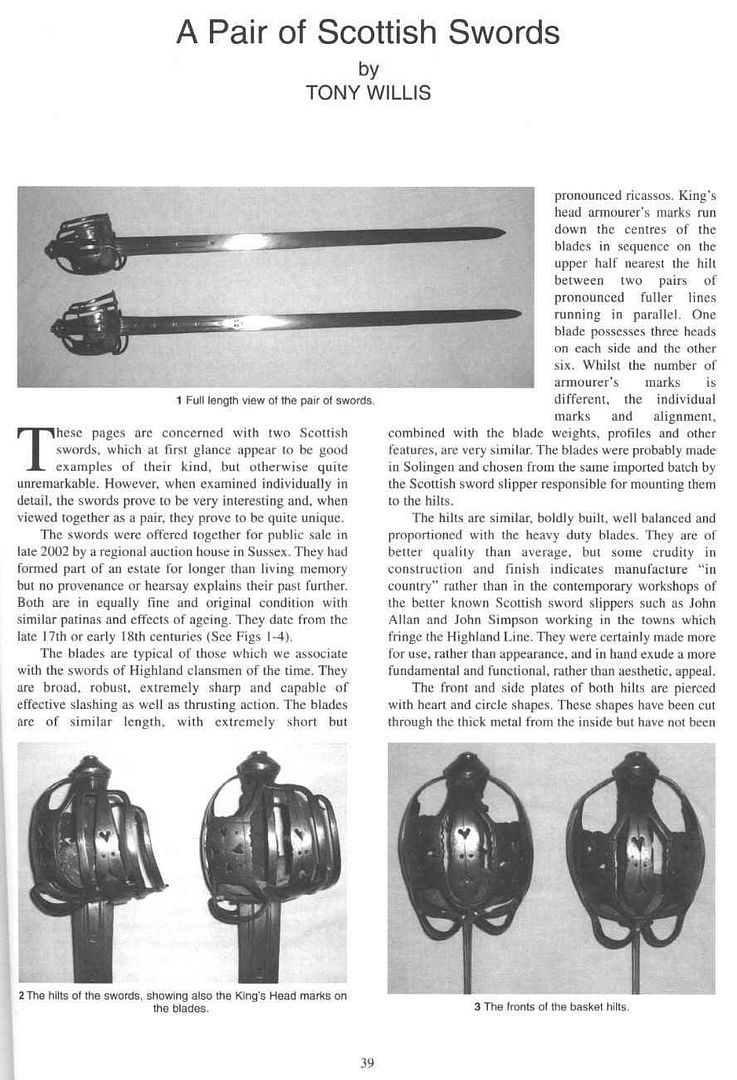
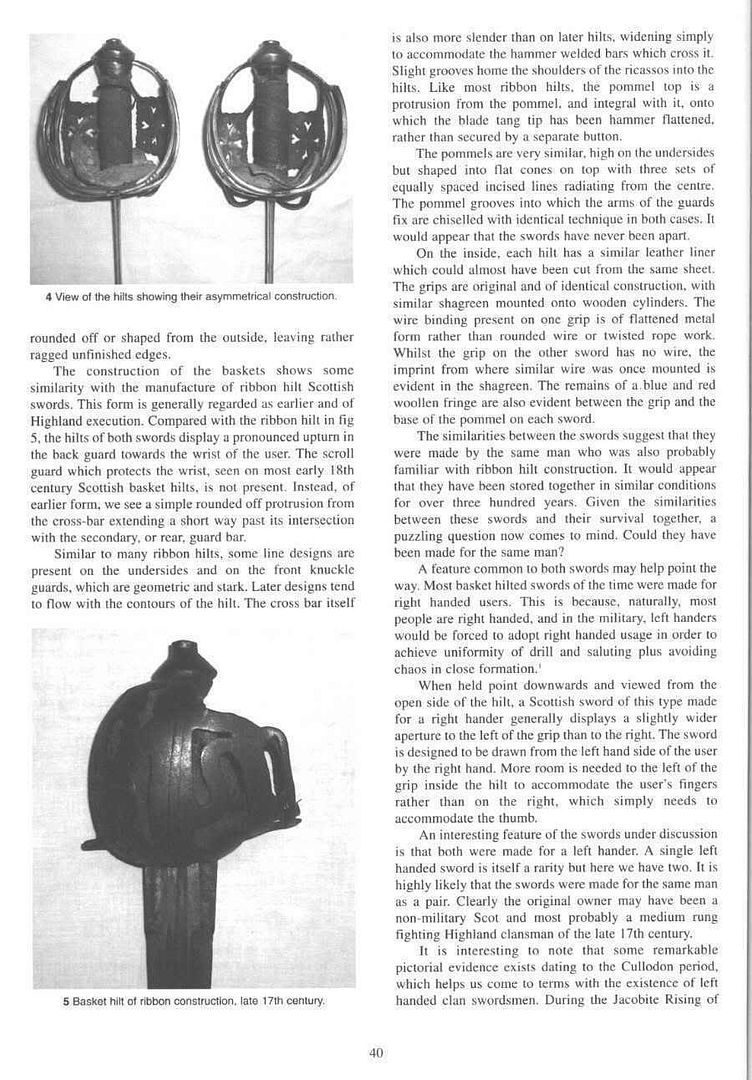
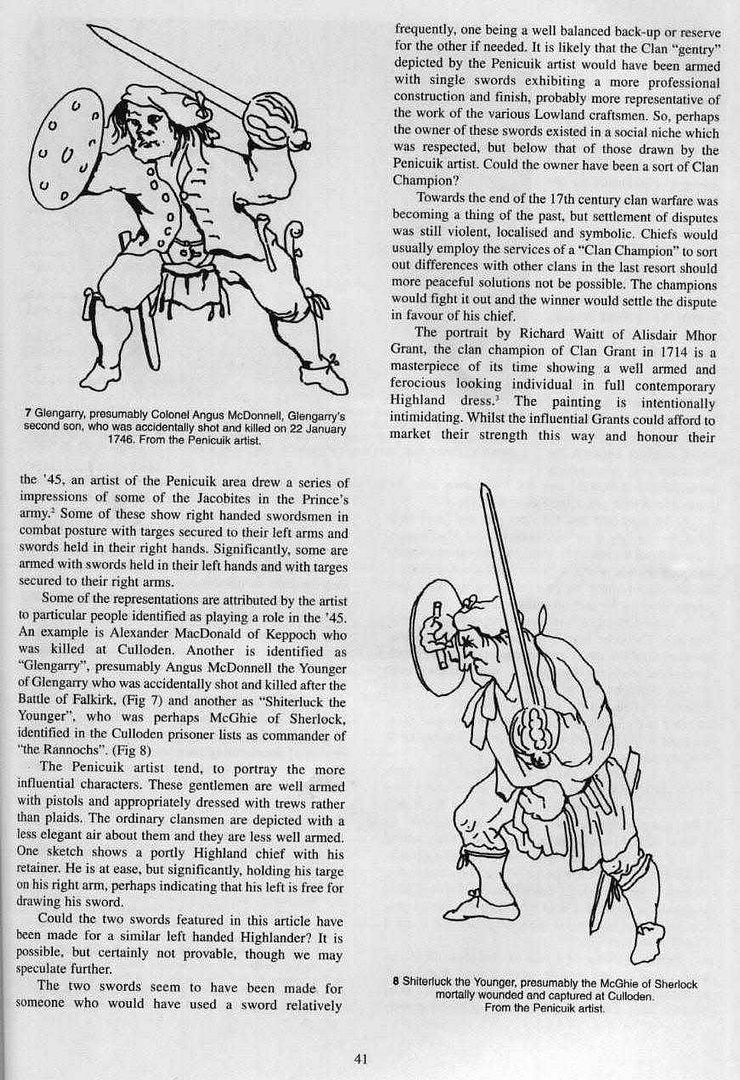
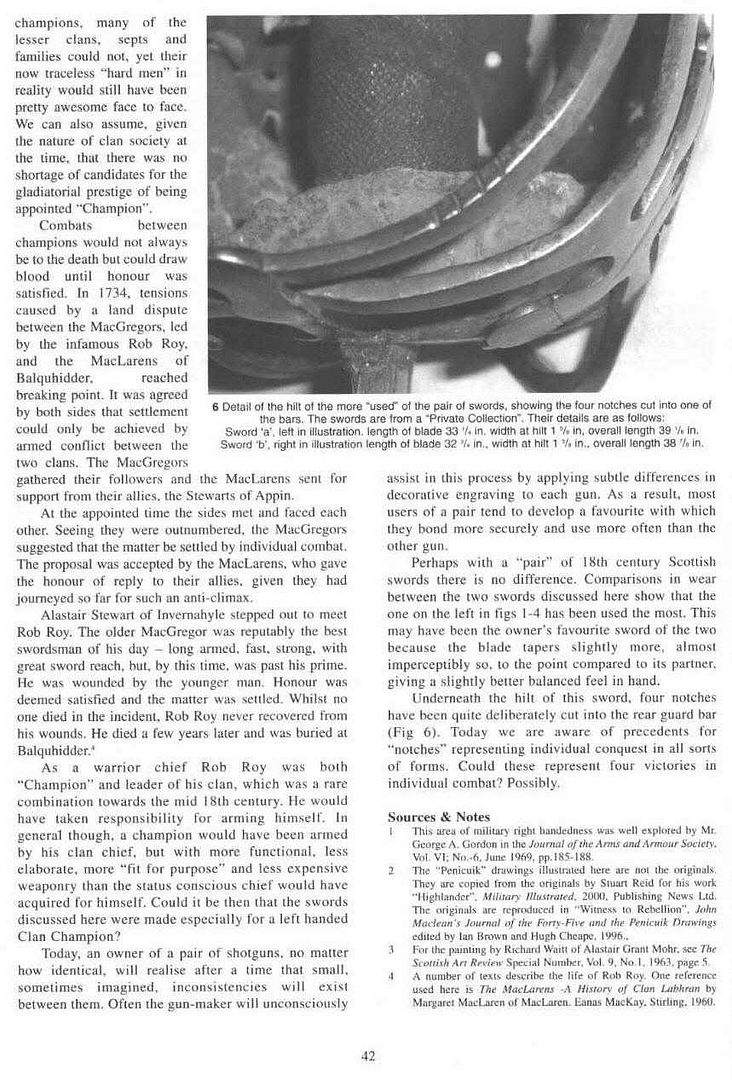
Some swords were designed for left-hand use, although left-handed swords have been described as "a rarity".<ref>Tony Willis, "A Pair of Scottish Swords", Page One, Page Two, Page Three, Page Four.</ref>
Great sword
Great swords or greatswords are related to the long swords of the Middle Ages.<ref>Template:Cite Q</ref><ref>Oakeshott, Ewart. Records of the Medieval Sword. Boydell Press 1991. Page 89 and 95.</ref><ref name="google">Template:Cite book</ref>{{ safesubst:#invoke:Unsubst||date=__DATE__ |$B= Template:Fix }} The great sword was developed during the Renaissance, but its earlier cousin the Scottish Claymore was very similar in size and use, like the "outsized specimens" between Template:Convert (approx. the same height as the user) such as the Oakeshott type XIIa or Oakeshott type XIIIa. These swords were too heavy to be wielded one-handed and possessed a large grip for leverage.
Claymore
The Scottish name "claymore" (Template:Langx, lit. "large/great sword")<ref name="chambers">{{#invoke:citation/CS1|citation |CitationClass=web }}</ref><ref name="jacobites">{{#invoke:citation/CS1|citation |CitationClass=web }}</ref> can refer to either the longsword with a distinctive two-handed grip, or the basket-hilted sword.Template:Citation needed The two-handed claymore is an early Scottish version of a greatsword.
Zweihänder
The Zweihänder ("two-hander") or Beidhänder ("both-hander") is a true two-handed sword, in the sense that it cannot be wielded in only one hand. It was a specialist weapon wielded by certain Landsknechte (mercenary soldiers), so-called Doppelsöldners. A similar weapon used in Spain and Portugal was called montante.
Classification by blade type

Double-edge and straight swords
These are double-edged, usually straight-bladed swords, designed for optimized balance, reach and versatility.
{{#invoke:Lang|lang}}
{{#invoke:Lang|lang}} (Template:Zh; Cantonese: {{#invoke:Lang|lang}}) is a double-edged straight sword used during the last 2,500 years in China. The first Chinese sources that mention the {{#invoke:Lang|lang}} date to the 7th century BC during the Spring and Autumn period;<ref>Ebrey 1999, p. 41</ref> one of the earliest specimens being the Sword of Goujian. Historical one-handed versions have blades varying from Template:Convert in length. The weight of an average sword of Template:Convert blade-length would weigh about Template:Convert.<ref>Rodell 2003, p. 19</ref> There are also larger two-handed versions used by ancient and medieval armies and for training by many styles of Chinese martial arts. Two handed jians from the time of the Chu and Han dynasty were up to Template:Convert long.
Longsword
In modern times, the term longsword most frequently refers to a late Medieval and Renaissance weapon designed for use with two hands. The German {{#invoke:Lang|lang}} ("long sword") in 15th-century manuals did not necessarily denote a type of weapon, but the technique of fencing with both hands at the hilt.Template:Citation needed
The French {{#invoke:Lang|lang}} and the English bastard sword originate in the 15th or 16th century,Template:Citation needed originally having the general sense of "irregular sword or sword of uncertain origin". It was "[a sword] which was neither French, nor Spanish, nor properly {{#invoke:Lang|lang}} [German], but longer than any of these sturdy swords."<ref>{{#invoke:Lang|lang}} Template:Cite book</ref> {{#invoke:Lang|lang}} could also historically refer to a single-handed sword with a fairly long blade compared to other short swords.<ref>Template:Cite book</ref>
Joseph Swetnam states that the bastard sword is midway in length between an arming sword and a long sword,<ref name="historical-academyii"/> and Randall Cotgrave's definition seems to imply this, as well. The French {{#invoke:Lang|lang}} was also known as {{#invoke:Lang|lang}}Template:Citation needed (i.e., bastard sword) and also {{#invoke:Lang|lang}}<ref>Template:Cite book</ref> (literally a cross-hilted blade). The term referred to a medieval single-handed sword optimized for thrusting.<ref name="google1">Template:Cite book</ref> The {{#invoke:Lang|lang}} was the sidearm of the {{#invoke:Lang|lang}} (French or Breton bowmen of the 15th and 16th centuries).<ref name="google2">Template:Cite book</ref> The term {{#invoke:Lang|lang}} comes from the fact that these swords passed ({{#invoke:Lang|lang}}) the length of a "normal" short sword.<ref name="google2"/>
The "Masters of Defence" competition organised by Henry VIII in July 1540 listed<ref>{{#invoke:citation/CS1|citation |CitationClass=web }}</ref> "two hande sworde", "bastard sworde", and "longe sworde" as separate items (as it should in Joseph Swetnam's context).<ref>Joseph Strutt, The sports and pastimes of the people of England from the earliest period: including the rural and domestic recreations, May games, mummeries, pageants, processions and pompous spectacles, 1801, p. 211.</ref><ref name="iceweasel1">{{#invoke:citation/CS1|citation |CitationClass=web }}</ref><ref>{{#invoke:citation/CS1|citation |CitationClass=web }}</ref>Template:Sps
Antiquarian usage in the 19th century established the use of "bastard sword" as referring unambiguously to these large swords.<ref>Oakeshott (1980).</ref> However, George Silver and Joseph Swetnam refer to them merely as "two hande sworde". The term "hand-and-a-half sword" is modern (late 19th century).<ref name="google3">Template:Cite book</ref> During the first half of the 20th century, the term "bastard sword" was used regularly to refer to this type of sword.<ref name="google149">Template:Cite book</ref>
The Elizabethan long sword (cf. George Silver<ref name="umass1">{{#invoke:citation/CS1|citation |CitationClass=web }}</ref> and Joseph Swetnam) is a single-handed "cut-and-thrust" sword with a Template:Convert blade<ref name="historical-academyii">{{#invoke:citation/CS1|citation |CitationClass=web }}</ref> similar to the long rapier. "Let thy (long) Rapier or (long) Sword be foure foote at the least, and thy dagger two foote." Historical terms (15th to 16th century) for this type of sword included the Italian {{#invoke:Lang|lang}} and French {{#invoke:Lang|lang}}.
The term longsword has been used to refer to different kinds of sword depending on historical context:
- {{#invoke:Lang|lang}} or two-hander, a late Renaissance sword of the 16th century {{#invoke:Lang|lang}}, the longest sword of all;
- the long "side sword" or "rapier"<ref name="salvatorfabris1" /> with a cutting edge (the Elizabethan long sword).
{{#invoke:Lang|lang}}
The {{#invoke:Lang|lang}} was a double-edged longsword used by the Romans. The idea for the {{#invoke:Lang|lang}} came from the swords of ancient Celts in Germany and Britain. It was longer than the {{#invoke:Lang|lang}}, and had more reach, so the {{#invoke:Lang|lang}} was most popular with soldiers in the cavalry. The blade could range between Template:Convert long while the handle was usually between Template:Convert.
Broadsword
- Claymore<ref name="google4">Template:Cite book</ref>
- Basket-hilted sword<ref name="myarmoury">{{#invoke:citation/CS1|citation
|CitationClass=web }}</ref>
- Sabre<ref>Template:Cite book</ref>
The term "broadsword" was never used historically to describe the one-handed arming sword.Template:Citation needed The arming sword was wrongly labelled a broadsword by antiquarians as the medieval swords were similar in blade width to the military swords of the day (that were also sometimes labeled as broadswords) and broader than the dueling swords and ceremonial dress swords.Template:Citation needed
Shortswords and daggers
Knives such as the seax and other blades of similar length between Template:Convert, they are sometimes construed as swords because of their longer blades. This is especially the case for weapons from antiquity, made before the development of high quality steel that is necessary for longer swords, in particular:
- Iron Age swords:
- Seax, a tool and weapon, common in Northern Europe.
- {{#invoke:Lang|lang}}, an early ancient Roman thrusting shortsword for legionaries<ref>Template:Cite encyclopedia</ref>
- {{#invoke:Lang|lang}}, a double-edged, single-hand blade used by the ancient Greeks;
- Certain Renaissance-era sidearms:
- Baselard, a late medieval heavy dagger;
- {{#invoke:Lang|lang}}, a civilian long dagger;
- Dirk, the Scottish long dagger ({{#invoke:Lang|lang}});
- Hanger or wood-knife, a type of hunting sword or infantry sabre;
- Certain fascine knives:
- Model 1832 Foot Artillery Sword, is a short sword designed after the Roman {{#invoke:Lang|lang}} with a blade length around Template:Convert in length. It was also known as a {{#invoke:Lang|lang}} (literally "cabbage cutter") in France.
Oversized two-handers used as parade swords or ceremonial weapons often exceeded the length and weight of practical weapons of war.
Edgeless and thrusting swords
The edgeless swords category comprises weapons which are related to or labelled as "swords" but do not emphasise hacking or slashing techniques or have any cutting edges whatsoever. The majority of these elongated weapons were designed for agility, precision and rapid thrusting blows to exploit gaps in the enemy's defences; the major joints of the arms, the opening in a visor. However they mainly saw prominence outside the battlefield as a duelling weapon.
Basket-hilted sword
The basket-hilted sword is a sword type of the early modern era characterised by a basket-shaped guard that protects the hand. The basket hilt is a development of the quillons added to swords' crossguards since the Late Middle Ages. In modern times, this variety of sword is also sometimes referred to as the broadsword.<ref name="thearma">{{#invoke:citation/CS1|citation |CitationClass=web }}</ref><ref>Template:Cite Q</ref>
{{#invoke:Lang|lang}}
{{#invoke:Labelled list hatnote|labelledList|Main article|Main articles|Main page|Main pages}} The {{#invoke:Lang|lang}} were always armed with a {{#invoke:Lang|lang}} as a secondary weapon. Among most Greek warriors, this weapon had an iron blade of about Template:Convert. The Spartan version of the sword typically had a blade about Template:Convert in length. The Spartan's shorter weapon proved deadly in the crush caused by colliding phalanx formations, as it was far more capable of being thrust through gaps in the enemy's shield wall and armour, where there was little to no room for longer edged weapons. The groin and throat were among the favourite targets.
Rapier
{{#invoke:Labelled list hatnote|labelledList|Main article|Main articles|Main page|Main pages}} The term "rapier" appeared in the English lexicon via the French {{#invoke:Lang|lang}} which comes from the Spanish ropera; recorded for the first time in the Coplas de la panadera, by Juan de Mena, written between approximately 1445 and 1450. The Spanish term refers to a sword used with clothes (espada ropera, 'dress sword'), due to it being used as an accessory for clothing, usually for fashion and as a self-defense weapon.
Some swords categorised as rapiers are completely edgeless or have only a partially sharpened blade, however the majority have effective cutting blades.
Panzerstecher and koncerz
The {{#invoke:Lang|lang}} ("armour stabber") is a German and East European weapon with a long, edgeless blade of square or triangular cross-section for penetrating armour.<ref>{{#invoke:citation/CS1|citation |CitationClass=web }}</ref><ref>{{#invoke:citation/CS1|citation |CitationClass=web }}</ref><ref>{{#invoke:citation/CS1|citation |CitationClass=web }}</ref> Early models were either two-handers or "hand-and-a-half" hilted,<ref>{{#invoke:citation/CS1|citation |CitationClass=web }}</ref> while later 16th and 17th century models (also known as koncerz) were one-handed and used by cavalry.<ref>{{#invoke:citation/CS1|citation |CitationClass=web }}</ref>
Tuck and verdun
The "tuck" (French {{#invoke:Lang|lang}}, Italian {{#invoke:Lang|lang}})Template:Citation needed is an edgeless blade of square or triangular cross-section used for thrusting.Template:Citation needed In French, {{#invoke:Lang|lang}} also means thrust or point; and {{#invoke:Lang|lang}} means thrust and cut.Template:Citation needed
The tuck may also get its name from the verb "to tuck" which means "to shorten".Template:Citation needed
Small-sword
{{#invoke:Labelled list hatnote|labelledList|Main article|Main articles|Main page|Main pages}} The small sword or smallsword (also court sword or dress sword, Template:Langx)Template:Citation needed is a light one-handed sword designed for thrustingTemplate:Citation needed which evolved out of the longer and heavier rapier of the late Renaissance.Template:Citation needed The height of the small sword's popularity was between the mid-17th and late 18th century.Template:Citation needed It is thought to have appeared in France and spread quickly across the rest of Europe.Template:Citation needed The small sword was the immediate predecessor of the Épée de Combat from which the Épée developed<ref>Evangelista, Nick. The Encyclopedia of the Sword. Westport, Connecticut: Greenwood Press, 1995. p. 208</ref> and its method of use—as typified in the works of such authors as Sieur de Liancour, Domenico Angelo, Monsieur J. Olivier, and Monsieur L'Abbat—developed into the techniques of the French classical school of fencing.Template:Citation needed Small swords were also used as status symbols and fashion accessories; for most of the 18th century anyone, civilian or military, with pretensions to gentlemanly status would have worn a small sword on a daily basis.Template:Citation needed
Single-edge and curved swords
{{#invoke:Labelled list hatnote|labelledList|Main article|Main articles|Main page|Main pages}}
These are single-cutting edged, usually thick or curved construction bladed swords, typically designed for stonger slashing, chopping, severing limbs, tripping or broad sweeping techniques; but were often very poorly designed for stabbing. Swordsmen were trained to use the bladed side in circumventing an opponent's protected flank (known as "curve into the guard"), and the dulled side for defensive and blocking techniques. The curve automatically makes a swing draw an arc making it much easier to slash.
Backsword
{{#invoke:Labelled list hatnote|labelledList|Main article|Main articles|Main page|Main pages}} The backsword was a single-edged, straight-bladed sword, typically for military use. This type of sword had a thickened back to the blade (opposite the cutting edge), which gave the blade strength. The backsword blade was cheaper to manufacture than a two-edged blade. This type of sword was first developed in Europe in the 15th century and reflected the emergence of asymmetric guards, which made a two-edged blade somewhat redundant. The backsword reached its greatest use in the 17th and 18th century when many cavalry swords, such as the British 1796 Heavy Cavalry Sword, were of this form.
{{#invoke:Lang|lang}}
{{#invoke:Labelled list hatnote|labelledList|Main article|Main articles|Main page|Main pages}} {{#invoke:Lang|lang}} are single-edged Chinese swords, primarily used for slashing and chopping. The most common form is also known as the Template:Nowrap, although those with wider blades are sometimes referred to as Template:Nowrap. In China, the dao is considered one of the four traditional weapons, along with the {{#invoke:Lang|lang}} (stick or staff), {{#invoke:Lang|lang}} (spear), and the {{#invoke:Lang|lang}} (sword). It is considered "The General of All Weapons".
Hook sword
{{#invoke:Labelled list hatnote|labelledList|Main article|Main articles|Main page|Main pages}} The hook sword, twin hooks, {{#invoke:Lang|lang}} or {{#invoke:Lang|lang}} (Template:Zh), also known as {{#invoke:Lang|lang}} (tiger head hook), is a Chinese weapon traditionally associated with northern styles of Chinese martial arts and Wushu weapons routines, but now often practiced by southern styles as well.
{{#invoke:Lang|lang}}
{{#invoke:Labelled list hatnote|labelledList|Main article|Main articles|Main page|Main pages}}
Unlike the {{#invoke:Lang|lang}}, which is a thrusting weapon, the {{#invoke:Lang|lang}} was a hacking weapon in the form of a thick, curved single edged iron sword. In Athenian art, Spartan hoplites were often depicted using a {{#invoke:Lang|lang}} instead of the {{#invoke:Lang|lang}}, as the {{#invoke:Lang|lang}} was seen as a quintessential "villain" weapon in Greek eyes.<ref>{{#invoke:citation/CS1|citation |CitationClass=web }}</ref>
Khopesh
{{#invoke:Labelled list hatnote|labelledList|Main article|Main articles|Main page|Main pages}} The khopesh is an ancient Egyptian curved short sword with a overall length of approx. Template:Convert and was typically made of bronze or iron.
Katana
{{#invoke:Labelled list hatnote|labelledList|Main article|Main articles|Main page|Main pages}} Historically, Template:Nihongo were one of the traditionally made Template:Nihongo<ref>Template:Cite Q</ref><ref>Template:Cite Q</ref> that were used by the samurai of feudal Japan.<ref name="Nagayama">Template:AnchorTemplate:Cite Q</ref> Modern versions of the katana are sometimes made using non-traditional materials and methods. The katana is characterized by its distinctive appearance: a curved, slender, single-edged blade usually with a round guard and long grip to accommodate two hands.
Hanger
The hanger (obs. whinyard, whinger, cuttoe), wood-knife, or hunting sword is a long knife or short sword that hangs from the belt and was popular as both a hunting tool and weapon of war.<ref>Template:Cite book</ref><ref>{{#invoke:citation/CS1|citation |CitationClass=web }}</ref>
Falchion and cutlass
The falchion (French {{#invoke:Lang|lang}},<ref>{{#invoke:citation/CS1|citation |CitationClass=web }}</ref> Spanish {{#invoke:Lang|lang}}) proper is a wide straight-bladed but curved edged hanger or long knife.<ref>{{#invoke:citation/CS1|citation |CitationClass=web }}</ref> The term 'falchion' may also refer to the early cutlass.
The cutlass or curtal-axe also known as a falchion (French {{#invoke:Lang|lang}}; Italian {{#invoke:Lang|lang}}; German {{#invoke:Lang|lang}}) is a broad-bladed curved hanger or long knife. In later usage, 'cutlass' referred to the short naval boarding sabre.Template:Citation needed
Sabre
{{#invoke:Labelled list hatnote|labelledList|Main article|Main articles|Main page|Main pages}} The British sabre, American saber, French {{#invoke:Lang|lang}}, Spanish {{#invoke:Lang|lang}}, Italian {{#invoke:Lang|lang}}, German {{#invoke:Lang|lang}}, Russian {{#invoke:Lang|lang}}, Hungarian {{#invoke:Lang|lang}}, Polish {{#invoke:Lang|lang}}, and Ukrainian {{#invoke:Lang|lang}} is a single-edged curved bladed cavalry sword.<ref>{{#invoke:citation/CS1|citation |CitationClass=web }}</ref>
Scimitar
The scimitar (French {{#invoke:Lang|lang}}, Italian {{#invoke:Lang|lang}}) is a type of saber that came to refer in general to any sabre used by the Turks or Ottomans ({{#invoke:Lang|lang}}), Persians ({{#invoke:Lang|lang}}) and more specifically the {{#invoke:Lang|lang}}<ref>{{#invoke:citation/CS1|citation |CitationClass=web }}</ref> (Albanian and Greek mercenaries who fought in the French-Italian Wars and were employed throughout Western Europe).<ref>{{#invoke:citation/CS1|citation |CitationClass=web }}</ref><ref>{{#invoke:citation/CS1|citation |CitationClass=web }}</ref> The scimitar proper was the {{#invoke:Lang|lang}} saber,<ref>Template:Cite book</ref><ref>Template:Cite book</ref> and the term was introduced into France by Philippe de Commines (1447 – 18 October 1511) as {{#invoke:Lang|lang}},<ref>Template:Cite book</ref> Italy (especially the Venetian Republic who hired the {{#invoke:Lang|lang}} as mercenaries) as {{#invoke:Lang|lang}}, and England as cimeter or scimitar via the French and Italian terms.