Escambia County, Alabama
Template:Short description Template:About Template:Use American English Template:Use mdy dates Template:Infobox U.S. county
Escambia County is a county located in the south central portion of the U.S. state of Alabama. As of the 2020 census, the population was 36,757.<ref name="QF">{{#invoke:citation/CS1|citation |CitationClass=web }}</ref> Its county seat is Brewton.<ref name="GR6">{{#invoke:citation/CS1|citation |CitationClass=web }}</ref>
Escambia County is coextensive with the Atmore, AL Micropolitan Statistical Area; which is itself a constituent part of the larger Pensacola-Ferry Pass, FL-AL Combined Statistical Area. <ref>{{#invoke:citation/CS1|citation |CitationClass=web }}</ref>
The county is the base of the state's only federally recognized Native American tribe, the Poarch Band of Creek Indians. They have developed gaming casinos and a hotel on their reservation here, but also a much larger business extending to locations in other states and the Caribbean.
Etymology
The name "Escambia" may have been derived from the Creek name Shambia, meaning "clearwater",<ref>Escambia County Alabama History - accessed August 18, 2009</ref> or the Choctaw word for "cane-brake" or "reed-brake".<ref>Alabama Department of Archives and History Template:Webarchive - accessed August 18, 2009</ref>
History
Template:More citations needed Historic American Indian tribes in the area included the Muskogean-speaking Creek, Choctaw, and Alabama, who had inhabited the lands for centuries and had many settlements. The former two tribes were among those in the Southeast whom the European-American settlers called the Five Civilized Tribes, as they adopted some European-American cultural ways. Many of their members had close working relationships with traders and settlers moving into the area in the early 19th century. Following the 1814 Treaty of Fort Jackson, several Creek families, including the Colberts, Gibsons, Manacs and Weatherfords, secured small reservations from federal government in the vicinity of present-day Poarch. Members of these families had remained friendly towards the United States during the Creek wars of 1813 and 1814. In 1836, the federal government permitted several additional Creek families to secured reservations.<ref name=":0">Clements, John (1991). Alabama Facts: A Comprehensive Look at Alabama Today County by County. Dallas, Texas: Clements Research H, Inc. p. 304.</ref>
Escambia County was organized and established after the American Civil War, on December 10, 1868, during the Reconstruction era. The state legislature created it from parts of Baldwin and Conecuh counties, to the west and north, respectively. The area was part of the coastal plain. It was largely agricultural into the 20th century.
The county is subject to heavy winds and rains due to seasonal hurricanes. In September 1979, the county was declared a disaster area due to damage from Hurricane Frederic. It was declared a disaster area again in September 2004 due to damage from Hurricane Ivan.
In the 20th century, the Poarch Band of Creek Indians organized to gain recognition as a tribe, and established a government under a written constitution. The federal government recognized the Boarch Band on August 11, 1984.<ref name=":0" /> It had control of some lands that were taken into trust on their behalf by the federal government as part of the federal recognition process. It is the only federally recognized tribe in the state. Since the late 20th century, they have developed three gaming resorts to generate revenues for tribal health and welfare.
In addition, Alabama has recognized nine tribes, generally descendants of Choctaw, Creek, and Cherokee Native Americans who had historically lived here.
Geography
According to the United States Census Bureau, the county has a total area of Template:Convert, of which Template:Convert is land and Template:Convert (0.8%) is water.<ref name="GR1">{{#invoke:citation/CS1|citation |CitationClass=web }}</ref>
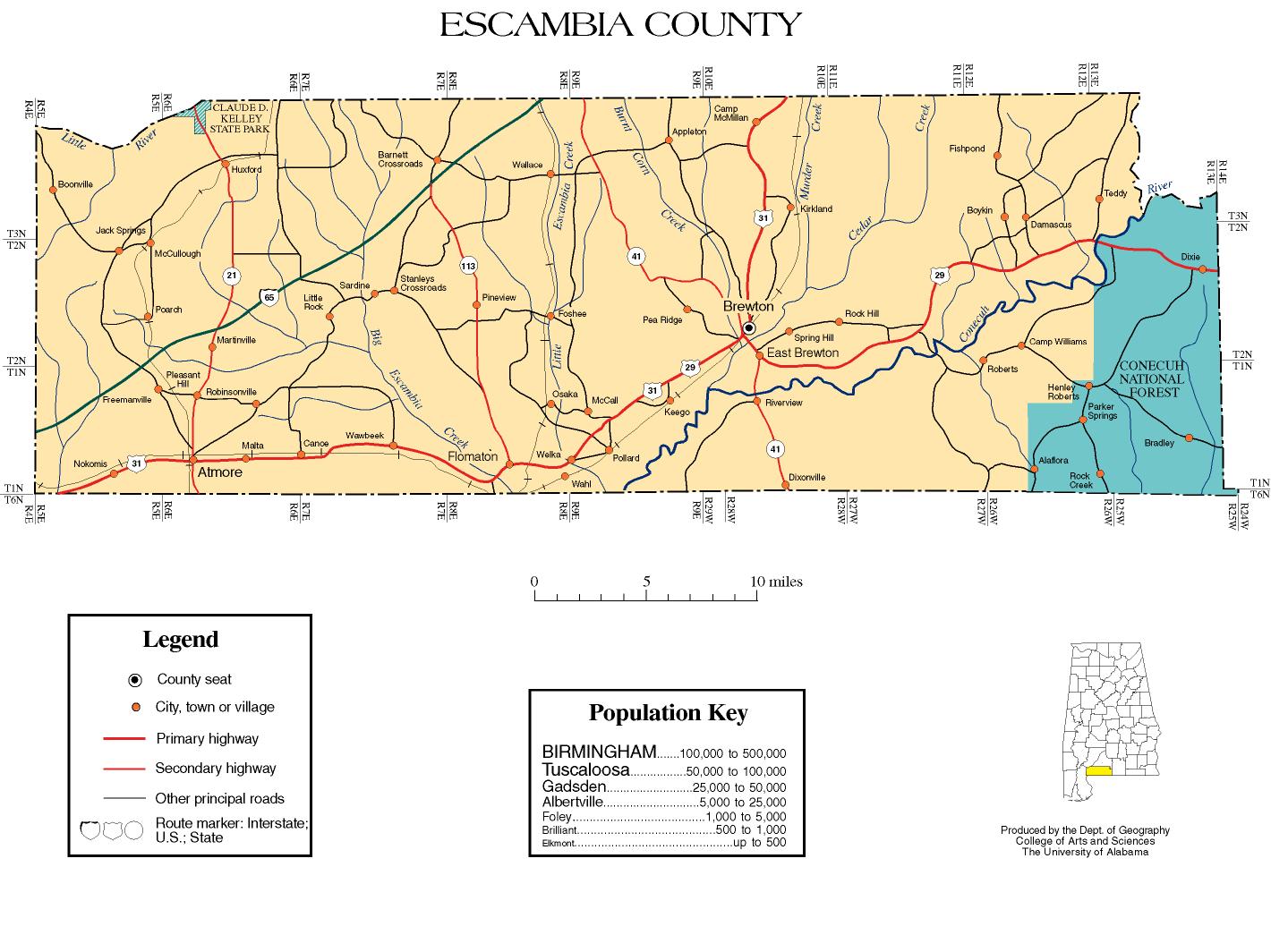
Major highways
 Interstate 65
 U.S. Highway 29
 U.S. Highway 31
- File:Alabama 21.svg State Route 21
- File:Alabama 41.svg State Route 41
- File:Alabama 113.svg State Route 113
.svg)


Adjacent counties
- Conecuh County (north)
- Covington County (east)
- Okaloosa County, Florida (southeast)
- Santa Rosa County, Florida (south)
- Escambia County, Florida (southwest)
- Baldwin County (west)
- Monroe County (northwest)
Escambia County in Alabama and Escambia County in Florida are two of 22 counties or parishes in the United States with the same name to border each other across state lines.
National protected area
- Conecuh National Forest (part)
Demographics
2020 census
| Race / Ethnicity (NH = Non-Hispanic) | citation | CitationClass=web
}}</ref> |
citation | CitationClass=web
}}</ref> |
Template:Partial<ref name=2020CensusP2>{{#invoke:citation/CS1|citation | CitationClass=web
}}</ref> |
% 2000 | % 2010 | Template:Partial |
|---|---|---|---|---|---|---|---|---|---|
| White alone (NH) | 24,575 | 23,508 | 22,004 | 63.93% | 61.35% | 59.86% | |||
| Black or African American alone (NH) | 11,799 | 12,162 | 10,922 | 30.69% | 31.74% | 29.71% | |||
| Native American or Alaska Native alone (NH) | 1,153 | 1,274 | 1,488 | 3.00% | 3.32% | 4.05% | |||
| Asian alone (NH) | 93 | 86 | 108 | 0.24% | 0.22% | 0.29% | |||
| Pacific Islander alone (NH) | 10 | 12 | 22 | 0.03% | 0.03% | 0.06% | |||
| Other race alone (NH) | 25 | 20 | 49 | 0.07% | 0.05% | 0.13% | |||
| Mixed race or Multiracial (NH) | 406 | 539 | 1,413 | 1.06% | 1.41% | 3.84% | |||
| Hispanic or Latino (any race) | 379 | 718 | 751 | 0.99% | 1.87% | 2.04% | |||
| Total | 38,440 | 38,319 | 36,757 | 100.00% | 100.00% | 100.00% |
As of the census of 2020, there were 36,757 people, 13,089 households, and 8,019 families residing in the county.
2010 census
According to the 2010 United States census:
- 62.1% White
- 31.9% Black
- 4.4% Native American
- 0.2% Asian
- 0.0% Native Hawaiian or Pacific Islander
- 1.5% Two or more races
- 1.9% Hispanic or Latino (of any race)
As of 2012 the largest self-reported ancestry groups in Escambia County were:
- 30.5% English
- 12.1% "American"
- 9.9% Irish
2000 census
As of the census<ref name="GR8">{{#invoke:citation/CS1|citation |CitationClass=web }}</ref> of 2000, there were 38,440 people, 14,297 households, and 10,093 families residing in the county. The population density was Template:Convert. There were 16,544 housing units at an average density of Template:Convert. The racial makeup of the county was 64.40% White, 30.79% Black or African American, 3.01% Native American, 0.24% Asian, 0.03% Pacific Islander, 0.40% from other races, and 1.13% from two or more races. 0.99% of the population were Hispanic or Latino of any race.
There were 14,297 households, out of which 32.00% had children under the age of 18 living with them, 51.70% were married couples living together, 15.10% had a female householder with no husband present, and 29.40% were non-families. 26.40% of all households were made up of individuals, and 11.40% had someone living alone who was 65 years of age or older. The average household size was 2.48 and the average family size was 2.99.
In the county, the population was spread out, with 24.10% under the age of 18, 9.70% from 18 to 24, 28.90% from 25 to 44, 23.70% from 45 to 64, and 13.60% who were 65 years of age or older. The median age was 37 years. For every 100 females there were 102.70 males. For every 100 females age 18 and over, there were 102.70 males.
The median income for a household in the county was $28,319, and the median income for a family was $36,086. Males had a median income of $30,632 versus $18,091 for females. The per capita income for the county was $14,396. About 15.20% of families and 20.90% of the population were below the poverty line, including 24.70% of those under age 18 and 17.80% of those age 65 or over.
Government and infrastructure
The Holman Correctional Facility of the Alabama Department of Corrections (ADOC) is in Atmore, Template:Convert north of the Atmore city center.<ref>"Holman Correctional Facility Template:Webarchive." Alabama Department of Corrections. Retrieved on August 15, 2010.</ref><ref name="HolmanCRProfile">"Annual Report Fiscal Year 2003." Alabama Department of Corrections. 33/84. Retrieved on August 15, 2010.</ref> Holman has a male death row and the State of Alabama execution chamber.<ref name="HolmanCRProfile"/> In addition the ADOC Fountain Correctional Facility is also in Atmore, about Template:Convert north of the Atmore city center.<ref name="f">"Fountain / JO Davis Correctional Facility Template:Webarchive." Alabama Department of Corrections. Retrieved on July 4, 2011.</ref> The city of Atmore annexed both prisons in 2008.<ref>{{#invoke:citation/CS1|citation |CitationClass=web }}</ref>
Escambia County is reliably Republican at the presidential level. The last Democrat to win the county in a presidential election is Jimmy Carter, who won it by a majority in 1976. Template:PresHead Template:PresRow Template:PresRow Template:PresRow Template:PresRow Template:PresRow Template:PresRow Template:PresRow Template:PresRow Template:PresRow Template:PresRow Template:PresRow Template:PresRow Template:PresRow Template:PresRow Template:PresRow Template:PresRow Template:PresRow Template:PresRow Template:PresRow Template:PresRow Template:PresRow Template:PresRow Template:PresRow Template:PresRow Template:PresRow Template:PresRow Template:PresRow Template:PresRow Template:PresRow Template:PresRow Template:PresRow Template:PresRow Template:PresRow Template:PresRow Template:PresRow Template:PresRow Template:PresRow Template:PresRow Template:PresRow Template:PresFoot
Communities
Cities
- Atmore
- Brewton (county seat)
- East Brewton
Towns
Unincorporated communities
Former town
Indian reservation
Education
The two school districts are Brewton City School District (City of Brewton) and Escambia County School District (all other locations).<ref>{{#invoke:citation/CS1|citation |CitationClass=web }} - Text list</ref>
Historic sites
Escambia County has three sites listed on the National Register of Historic Places, the Atmore Commercial Historic District<ref name=weekly>{{#invoke:citation/CS1|citation |CitationClass=web }}</ref> the Brewton Historic Commercial District, and the Commercial Hotel-Hart Hotel.<ref name="nris">Template:NRISref</ref>
Notable residents
- Esther Blake (1897–1979), the first woman in the United States Air Force.
See also
- National Register of Historic Places listings in Escambia County, Alabama
- Properties on the Alabama Register of Landmarks and Heritage in Escambia County, Alabama
References
External links
- Escambia County Industrial Development Authority
- Coastal Gateway Regional Economic Development Alliance
- Escambia County history
- Escambia County map of roads/towns (map © 2007 Univ. of Alabama).
- The Brewton Standard
- South Alabama Community Website
Template:Geographic Location Template:Escambia County, Alabama Template:US state navigation box