Gatwick Airport
Template:Short description Template:Redirect Template:Expert needed Template:Use dmy dates Template:Use British English Template:Infobox airport Gatwick Airport (Template:IPAc-en;<ref>Oxford Dictionaries (retrieved 5 September 2012) Template:Webarchive</ref> Template:Airport codes), also known as London Gatwick Airport, is one of several international airports serving Greater London and southern England. It is located near Crawley, in West Sussex (Template:Convert south of Central London), England. In 2024, Gatwick was the second-busiest airport by total passenger traffic in the UK, after Heathrow Airport, and was the tenth-busiest in Europe by total passenger traffic.<ref>Template:Cite press release</ref> It covers a total area of Template:Convert.<ref>{{#invoke:citation/CS1|citation |CitationClass=web }}</ref>
Gatwick opened as an aerodrome in the late 1920s; it has been in use for commercial flights since 1933. The airport has two terminals: the North Terminal and the South Terminal, which cover areas of Template:Convert and Template:Convert respectively.<ref>{{#invoke:citation/CS1|citation |CitationClass=web }}</ref> It operates as a single-runway airport, using a main runway with a length of Template:Convert. A secondary runway is available but, due to its proximity to the main runway, can only be used if the main runway is not in use. In 2018, 46.1Template:Nbspmillion passengers passed through the airport, a 1.1% increase compared with 2017.<ref name="LGW_2018_GAL_Stats">{{#invoke:citation/CS1|citation |CitationClass=web }} Template:Dead link</ref> Gatwick is the secondary London hub for British Airways and the largest operating base for low-cost carrier easyJet.
History
Early years


The land on which Gatwick Airport stands was first developed as an aerodrome in the late 1920s. The Air Ministry approved commercial flights from the site in 1933, and the first terminal, "The Beehive", was built in 1935. Scheduled air services from the new terminal began the following year. During the Second World War, the airport was taken over by the military and was known as RAF Gatwick. After the war, the airport returned to its civilian capacity. The airport proper was built in the mid-1950s opening in 1956. The airport buildings were designed by Yorke Rosenberg Mardall between 1955 and 1988.<ref>Template:Cite book</ref>
In the 1960s, British United Airways (BUA) and Dan-Air were two of the largest British independentTemplate:Efn airlines at Gatwick, with the former establishing itself as the dominant scheduled operator at the airport as well as providing a significant number of the airport's non-scheduled services and the latter becoming its leading provider of inclusive tour charter services.<ref>Cooper, B., Got your number, Golden Gatwick, Skyport, Gatwick edition, Hounslow, 6 June 2008, p. 12</ref> Further rapid growth of charter flights at Gatwick was encouraged by the Ministry of Aviation, which instructed airlines to move regular charter flights from Heathrow. Following the takeover of BUA by Caledonian Airways at the beginning of the following decade, the resulting airline, British Caledonian (BCal), became Gatwick's dominant scheduled airline during the 1970s. While continuing to dominate scheduled operations at Gatwick for most of the 1980s, BCal was also one of the airport's major charter airlines until the end of the 1970s (together with Dan-Air, Laker Airways and British Airtours).<ref name="Iyengar">Iyengar, K., Bermuda Bloomers, Golden Gatwick, Skyport, Gatwick edition, Hounslow, 8 February 2008, p. 18</ref>
As a result of conditions imposed by Britain's Monopolies and Mergers Commission on the takeover of BCal by the then newly privatised British Airways (BA) at the end of the 1980s, Dan-Air and Air Europe assumed BCal's former role as Gatwick's dominant scheduled short-haul operator while BA continued in BCal's erstwhile role as the airport's most important scheduled long-haul operator. Following the demise of Air Europe and Dan-Air (both of which had continued to provide a significant number of charter flights in addition to a growing number of scheduled short-haul flights at Gatwick) in the early 1990s, BA (having purchased Dan-Air) began building up Gatwick into a secondary hub (complementing its main hub at Heathrow). These moves resulted in BA becoming Gatwick's dominant airline by the turn of the millennium.<ref name="Iyengar-2">Iyengar, K., The only way is up, Golden Gatwick, Skyport, Gatwick edition, Hounslow, 11 April 2008, p. 16</ref><ref>Iyengar, K., Heading North, Golden Gatwick, Skyport, Gatwick edition, Hounslow, 9 May 2008, p. 16</ref> BA's subsequent decision to de-hub Gatwick provided the space for easyJet to establish its biggest base at the airport and become its dominant airline.<ref>{{#invoke:citation/CS1|citation |CitationClass=web }}</ref>
Transatlantic flights to the United States
From 1978 to 2008, many flights to and from the United States used Gatwick because of restrictions on the use of Heathrow implemented in the Bermuda II Agreement between the UK and the US.<ref>{{#invoke:citation/CS1|citation |CitationClass=web }}</ref> The EU–US Open Skies Agreement, which became effective on 30 March 2008, led several airlines to downsize their transatlantic operations at Gatwick in favour of Heathrow. Continental Airlines was the second transatlantic carrier (after American Airlines)<ref>{{#invoke:citation/CS1|citation |CitationClass=web }}</ref> to leave Gatwick after it decided to transfer the seasonal Cleveland service to Heathrow on 3 May 2009.<ref>Template:Cite journal</ref><ref>Template:Cite news</ref>
US Airways, Gatwick's last remaining US carrier, ended its service between Gatwick and Charlotte on 30 March 2013.<ref>Template:Cite press release</ref> This left Gatwick without a scheduled US airline for the first time in 35 years.<ref>{{#invoke:citation/CS1|citation |CitationClass=web }}</ref> Before the COVID-19 pandemic, Delta Air Lines announced its intent to launch service between Gatwick and Boston in the summer of 2020, which would have made it the first US airline to service Gatwick since the withdrawal of the US Airways service in 2013, but the massive global travel downturn placed these plans on indefinite hold.<ref>Template:Cite press release</ref> In 2021, JetBlue became the first US airline to serve Gatwick since 2013, with services to New York–JFK and Boston.Template:Citation needed
Development since the 2000s
On 17 September 2008, BAA announced it would sell Gatwick after the Competition Commission published a report about BAA's market dominance in London and the South East. On 21 October 2009, it was announced that an agreement had been reached to sell Gatwick to a consortium led by Global Infrastructure Partners (GIP), which subsequently also bought Edinburgh Airport in 2012, for £1.51Template:Nbspbillion. The sale was completed on 3 December.<ref>Template:Cite news</ref> In February 2010, GIP sold minority stakes in the airport of 12% and 15% to the South Korean National Pension Service and the Abu Dhabi Investment Authority (ADIA) for £100Template:Nbspmillion and £125Template:Nbspmillion, respectively. The sales were part of GIP's strategy to syndicate the equity portion of the original acquisition by issuing bonds to refinance bank debt. Although this entails bringing additional investors into the airport, GIP aims to retain management control.<ref>Template:Cite news</ref><ref>Template:Cite press release</ref>
The Californian state pension fund CalPERS acquired a 12.7% stake in Gatwick Airport for about US$155Template:Nbspmillion (£104.8Template:Nbspmillion) in June 2010.<ref>Template:Cite news</ref> On 21 December 2010, the A$69Template:Nbspbillion (£44Template:Nbspbillion) Future Fund, a sovereign wealth fund established by the Australian government in 2006, agreed to purchase a 17.2% stake in Gatwick Airport from GIP for £145Template:Nbspmillion. This transaction completed GIP's syndication process for the airport, reducing its stake to 42% (although the firm's extra voting rights meant it still controlled the airport's board).<ref>{{#invoke:citation/CS1|citation |CitationClass=web }}</ref>
In August 2020, the airport announced plans to cut over a quarter of its employees as a result of a planned company restructuring caused by the effects of the COVID-19 pandemic. The planned cuts will bring the total workforce of the airport to 1,900; before the start of the pandemic it was 3,300, however, an additional 785 jobs were cut earlier in 2020.<ref>Template:Cite news</ref> In August 2021, it was reported that Gatwick's operators were in talks with lenders following posting first-half-year net losses of £ 245m.<ref>Template:Cite news</ref>
Corporate affairs
Ownership
The former BAA Limited (now Heathrow Airport Holdings) and its predecessors, BAA plc and the British Airports Authority, owned and operated Gatwick from 1 April 1966 to 2 December 2009.<ref>{{#invoke:citation/CS1|citation |CitationClass=web }}</ref><ref>{{#invoke:citation/CS1|citation |CitationClass=web }}</ref> The airport is owned and operated by Gatwick Airport Limited, a wholly owned subsidiary of Ivy Holdco Limited,<ref>{{#invoke:citation/CS1|citation |CitationClass=web }}</ref> owned by Global Infrastructure Partners (GIP), itself owned by BlackRock.<ref>{{#invoke:citation/CS1|citation |CitationClass=web }}</ref> In December 2018, Vinci announced that it would acquire a 50.01% majority stake for £2.9bn, with a GIP-managed consortium of investors (Abu Dhabi Investment Authority, Australia's sovereign wealth fund and two public pension funds in California and South Korea) owning the remaining 49.9%.<ref>Template:Cite news</ref><ref>{{#invoke:citation/CS1|citation |CitationClass=web }}</ref> The sale was completed by the middle of 2019.<ref>Template:Cite news</ref>
Leadership
In September 2023, Margaret Ford, Baroness Ford was announced as the new Chair of Gatwick Airport.<ref>{{#invoke:citation/CS1|citation |CitationClass=web }}</ref>
Operations
Facilities


On 31 May 2008, Virgin Holidays opened the V Room, Gatwick's first lounge dedicated to their long-haul leisure travellers. On 25 January 2017, the lounge moved to the North Terminal together with the Virgin Atlantic Clubhouse as part of the airline moves that saw British Airways and Virgin Atlantic exchange their previous terminal locations and easyJet consolidated in the North Terminal.<ref>{{#invoke:citation/CS1|citation |CitationClass=web }}</ref><ref>Template:Cite journal</ref> On 9 April 2009, an independent pay-for-access lounge opened in the South Terminal. Gatwick also has a conference and business centre, and several on- and off-site hotels ranging in class from executive to economy.
The airport has Anglican, Catholic and Free Church chaplains, and there are multi-faith prayer and counselling rooms in each terminal. A daily service is led by one of the chaplains.<ref>"Chaplain's Corner – with Gatwick chaplain Sister Jo Threlfall", Skyport, Gatwick edition, Hammersmith, 29 April 2011, p. 9</ref>
The Civil Aviation Authority Safety Regulation Group is in Aviation House.<ref>"Bus Services to CAA Safety Regulation Group, Aviation House Template:Webarchive". Civil Aviation Authority. Retrieved 9 September 2010. "Aviation House South Area Gatwick Airport RH6 0YR"</ref> WesternGeco, a geophysical services company, has its head office and Europe–Africa–Russia offices in Schlumberger House,<ref>{{#invoke:citation/CS1|citation |CitationClass=web }}</ref><ref>{{#invoke:citation/CS1|citation |CitationClass=web }}</ref> a Template:Convert building on the airport grounds<ref name="Eade">Eade, Christine (8 June 2007). "The market in minutes – Sussex". Template:Webarchive. Property Week. Retrieved 12 February 2011.</ref> near the South Terminal. The company had a 15-year lease on the building, scheduled to expire in June 2008. In 2007, WesternGeco reached an agreement with its landlord, BAA Lynton, extending its lease to 2016 at an initial rent of £2.1Template:Nbspmillion.<ref name="Eade"/> Fastjet has its registered and head offices at Suite 2C in First Point at the airport.<ref>"Investor Contacts". (Archive) Fastjet. Retrieved 7 May 2013. "Registered Office and Head Office fastjet Plc Suite 2C First Point Buckingham Gate Gatwick Airport RH6 0NT"</ref>
Before the sale, BAA planned an £874Template:Nbspmillion investment at Gatwick over five years, including increased capacity for both terminals, improvements to the transport interchange and a new baggage system for the South Terminal.<ref>{{#invoke:citation/CS1|citation |CitationClass=web }}</ref> Passengers passing through the airport are informed about the redevelopment programme with large mobile barcodes on top of construction hoardings. Scanning these transfers information on the construction to the user's smartphone.<ref>Template:Cite news</ref>
In the summer of 2013, Gatwick introduced Gatwick Connect, a free flight connection service to assist passengers changing flights at Gatwick whose airlines do not provide a full flight connection service. On 15 September 2015, the service was rebranded as GatwickConnects.<ref>Template:Cite press release</ref><ref name="LGW_1st"/><ref>Template:Cite news</ref> It is available to passengers connecting on several major airlines.<ref>{{#invoke:citation/CS1|citation |CitationClass=web }}</ref><ref>{{#invoke:citation/CS1|citation |CitationClass=web }}</ref><ref>{{#invoke:citation/CS1|citation |CitationClass=web }}</ref>
Flight movements
Gatwick operates as a single-runway airport although it has two runways; the northern runway (08L/26R) can only be used when the main runway (08R/26L) is out of use. The UK Integrated Aeronautical Information Package gives the Takeoff Run Available (TORA) of its main runway (08R/26L) as 3,255 m when aircraft take off in a westerly direction (26) and 3,159 m when takeoffs occur in an easterly direction (08). The documentation lists the respective TORA for the northern runway (08L/26R) as 2,565 m in both directions. Nearly three-quarters of takeoffs are towards the west (74% over 12 months). Both runways are Template:Convert wide; they are Template:Convert apart,<ref>"Gatwick Runway Options Consultation" (Section 2: Our runway options / 2.1 Features common to all options – The length of the runway), Gatwick Airport Limited, April 2014, p. 16</ref> which is insufficient for the simultaneous use of both runways. During normal operations the northern runway is used as a taxiway,<ref name="runway_moratorium">{{#invoke:citation/CS1|citation |CitationClass=web }}</ref><ref name="1979_expansion_plans">{{#invoke:citation/CS1|citation |CitationClass=web }}</ref> consistent with its original construction (although it was gradually widened).<ref>{{#invoke:citation/CS1|citation |CitationClass=web }}</ref>
In October 2018, the airport announced that it was "exploring how to make best use of its existing runways, including the possibility of bringing its existing standby runway into routine use".<ref>Template:Cite news</ref> One scenario would see 08L/26R used for departing narrow-body aircraft only, while the longer 08R/26L would be used for wide-body take-offs and all landings; widening 08L/26R would also increase the centreline separation slightly. New technology could also be used to increase capacity on the main runway, and, in the longer term, the airport remains interested in constructing a new runway to the south.<ref>Template:Cite news</ref>
In 2023, plans were announced to expand the second runway and make it operational for regular use.<ref>{{#invoke:citation/CS1|citation |CitationClass=web }}</ref>
The main runway uses a Category III Instrument Landing System (ILS). The northern runway does not have an ILS; when it is in use, arriving aircraft are radar vectored to intercept an RNAV (GNSS) approach, providing the aircraft is equipped and the operator has approval. This approach is satellite-based and is also available for the main runway. When an RNAV approach is not possible, assistance from the approach controller using surveillance radar, an "SRA approach" is available. This involves heading instructions and altitude callouts supplied by the Air Traffic Controller.<ref>{{#invoke:citation/CS1|citation |CitationClass=web }}Template:Dead link</ref> On both runways, a continuous descent approach is used to minimise the environmental effects of incoming aircraft, particularly at night.<ref>{{#invoke:citation/CS1|citation |CitationClass=web }}</ref>
Night flights are subject to restrictions;<ref>Template:Cite press release</ref> between 11 pm and 7 am, noisier aircraft (rated QC/8 and QC/16) may not operate. From 11.30 pm to 6 am (the night quota period) there are three limits: Number of flights, a Quota Count system, limiting total noise permitted<ref>{{#invoke:citation/CS1|citation |CitationClass=web }}</ref> and no night QC/4 flights.
Air traffic control services are outsourced. In 2014 a proposed contract award for air traffic control services was suspended due to errors in the airport operator's procurement process, which was governed at the time by the European Union's rules on procurement in the energy, telecommunications, transport and water sectors. Consideration of the legal case brought by NATS UK discussed whether the court's approach to resolving such cases should consider the American Cyanamid principles reflected in UK national procurement law or a different "balance of interests" test, as proposed by NATS, which was less likely to allow a proposed contract award where damages paid to a successful challenger might be an adequate legal remedy. Use of the "balance of interests" test was ruled out by Mr Justice Ramsey.<ref>Referred to in England and Wales High Court (Technology and Construction Court), Lancashire Care NHS Foundation Trust and another v Lancashire County Council [2018] EWHC 200, paragraph 18, delivered on 8 February 2018, accessed on 30 September 2024</ref>
Security
The airport is policed by the Gatwick District of Sussex Police. The district is responsible for the entire airport (including aircraft) and, in certain circumstances, aircraft in flight. The 150 officers attached to this district include armed and unarmed officers, and community support officers for minor offences. The airport district counters man-portable surface-to-air missiles (MANPADS) by patrolling in and around the airport and a separate sub-unit has vehicle checks around the airport.<ref>"Guarding Gatwick", Airports – September/October 2007 (Key Publishing), p. 17</ref>
Access to airside portions of the airport is controlled and maintained by the airport's team of security officers, regulated by the Civil Aviation Authority.<ref>{{#invoke:citation/CS1|citation |CitationClass=web }}</ref> Brook House, an immigration removal centre of Immigration Enforcement, was opened near the airport on 18 March 2009 by the then Home Secretary Jacqui Smith.<ref>Template:Cite news</ref>
Major airlines
The airport is a base for scheduled airlines British Airways (BA), easyJet, Wizz Air, and charter operators such as TUI Airways. Gatwick is unique among London's airports in its representation of the three main airline business models: full service, low-cost and charter.<ref>{{#invoke:citation/CS1|citation |CitationClass=web }}</ref> As of October 2016, these respectively accounted for 26.6%,Template:Efn 61.3%Template:Efn and 13.1%Template:Efn of Gatwick's seat capacity.<ref>{{#invoke:citation/CS1|citation |CitationClass=web }}</ref>
By late 2015, easyJet flew over 100 routes from Gatwick with a fleet of more than 60 aircraft.<ref>Template:Cite press release</ref><ref name="EasyJet-2015">{{#invoke:citation/CS1|citation |CitationClass=web }}</ref> The airport is the carrier's largest base and its 16Template:Nbspmillion passengers per year accounted for 45% of Gatwick's 2013 total<ref name="Lea-2014">Template:Cite news</ref> (ahead of Gatwick's second-largest passenger airline: BA, whose 4.5Template:Nbspmillion passengers comprised 14% of total passenger traffic in 2011–12).Template:Efn<ref>Template:Cite press release</ref><ref>{{#invoke:citation/CS1|citation |CitationClass=web }}</ref>
easyJet, BA and Norwegian Air Shuttle were Gatwick's three biggest resident airlines, although in late 2020 Norwegian announced the closure of its base at Gatwick. According to data from Airport Coordination Limited, these three airlines respectively accounted for 43.3%, 19% and 10.5% of airport slots in April 2018. According to this data, by April 2018 Norwegian had overtaken Virgin Atlantic as Gatwick's number one transatlantic airline by seat capacity, and BA's competitive response to Norwegian's growing commercial threat to its transatlantic business would result in Virgin's relegation to third position among the airport's transatlantic airlines during the 2018 summer timetable period.<ref>{{#invoke:citation/CS1|citation |CitationClass=web }}</ref> easyJet, BA and Norwegian collectively accounted for 65.43% of Gatwick's total passengers in 2016 (easyJet: 40.37% / 17.4Template:Nbspmillion; BA: 14.39% / 6.2Template:Nbspmillion; Norwegian: 10.67% / 4.6Template:Nbspmillion).<ref name="LGW_Nos_2016"/><ref>Template:Cite news</ref><ref>{{#invoke:citation/CS1|citation |CitationClass=web }}</ref> As per Official Airline Guide (OAG) data for the week of 29 May 2017, their respective international departure seat capacity shares at the airport for summer 2017 are 42.1%, 15.4% and 9.4%.<ref>{{#invoke:citation/CS1|citation |CitationClass=web }}</ref>
In terms of passengers carried easyJet and BA were also among the five largest airlines operating at Gatwick in 2010 (which also included TUI Airways and Thomas Cook Airlines at the time) and the top 10 in 2015.<ref>Airways (Forward, D.C., London Gatwick Goes Global – GIP Gets the Goat Farm: Fast Facts – London Gatwick), Vol. 18, No. 5, p. 27, Airways International Inc., Sandpoint, July 2011</ref><ref name="LGW_1st">Template:Cite journal</ref> In terms of total scheduled airline seats at Gatwick in 2014, easyJet accounted for 18.36Template:Nbspmillion, more than two-and-a-half times as many as second-placed BA (7Template:Nbspmillion) and nearly five times the number offered by third-placed Norwegian Air Shuttle (3.74Template:Nbspmillion).<ref>Template:Cite journal</ref> Using data sourced from the OAG Schedules Analyser, the following changes in the respective departure seat capacity shares of Gatwick's three biggest airlines occurred from 2010 to 2015: easyJet's share increased from 26.1% in 2010 to 42.1% in 2015; BA's share dropped from 18.3% in 2010 to 15% in 2015; Norwegian's share rose almost three-fold from less than 3% in 2010 to 8.3% in 2015. easyJet, BA, Norwegian, TUI Airways, Ryanair, Thomas Cook Airlines, Monarch Airlines, Virgin Atlantic, Vueling and Emirates were Gatwick's top 10 airlines by share of passengers in 2017.<ref>Template:Cite press release</ref>
easyJet's acquisition of BA franchise carrier GB Airways in March 2008 increased its share of airport slots to 24% (from 17% in late 2007); the airline became the largest short-haul operator at the airport, accounting for 29% of short-haul passengers.<ref>Template:Cite news</ref> By 2009, BA's share of Gatwick slots had fallen to 20% from its peak of 40% in 2001.<ref name="Aer Lingus_base"/> By 2010, this had declined to 16%.<ref name="CAPA_IAG_Analysis">{{#invoke:citation/CS1|citation |CitationClass=web }}</ref><ref name="EZY_LGW_LTN">{{#invoke:citation/CS1|citation |CitationClass=web }}</ref> By mid-2012, easyJet had 45% of Gatwick's early-morning peak time slots (6Template:Nbspa.m. to 8:55Template:Nbspa.m.).Template:Efn<ref>Template:Cite press release</ref>
By 2008, Flybe was Gatwick's third-largest airline (accounting for 9% of its slots) and its fastest-growing airline.<ref name="Aer Lingus_base">Template:Cite news</ref><ref>Template:Cite press release</ref> It became the airport's largest domestic operator, carrying 1.2Template:Nbspmillion passengers in its 2011–2012 financial year on eight routes to destinations in the UK, the Channel Islands and the Isle of Man.Template:Efn<ref>{{#invoke:citation/CS1|citation |CitationClass=web }}</ref> In March 2013, the airline announced that it would end operations at Gatwick, citing unsustainably high airport charges and increases in UK Air Passenger Duty. Flybe sold its 25 pairs of daily slotsTemplate:Efn at the airport to easyJet for £20Template:Nbspmillion.<ref>Template:Cite press release</ref><ref>Template:Cite news</ref> The latter's share of Gatwick slots increased to 44% in summer 2014; second-placed BA has held about 16% of the airport's slots since 2010.<ref name="CAPA_IAG_Analysis"/><ref name="EZY_LGW_LTN"/><ref>{{#invoke:citation/CS1|citation |CitationClass=web }}</ref> Following the sale of its Gatwick slots to easyJet, Flybe continued to provide the scheduled service between Gatwick and Newquay, as a result of being awarded the contract to fly this route under a four-year Public Service Obligation (PSO), until the flight was subsequently moved from Gatwick to Heathrow Airport in April 2019.<ref>{{#invoke:citation/CS1|citation |CitationClass=web }}</ref><ref>Template:Cite news</ref>
Slots left by the US carriers (and the collapse of Zoom Airlines, Oasis Hong Kong Airlines, XL Airways UK, Sterling Airlines, Monarch Airlines, Thomas Cook Airlines, and Adria Airways) were taken by easyJet, Flybe, Norwegian Air Shuttle and Ryanair. Many full-service airlines have established or resumed operations at the airport, including Air China, Cathay Pacific, China Eastern Airlines, China Southern Airlines, Delta Air Lines, JetBlue, Qatar Airways, Singapore Airlines, Turkish Airlines, and WestJet. This is part of the airport's strategy to attract higher-spending business travellers (countering its dependence on European low-cost and charter markets), increasing year-round capacity utilisation by smoothing peaks and troughs in traffic. Gatwick's success in persuading these airlines to launch (or re-launch) routes to overseas destinations important for business and leisure travel was aided by a lack of comparable slots at Heathrow.<ref>{{#invoke:citation/CS1|citation |CitationClass=web }}</ref><ref>Template:Cite news</ref>
On 5 May 2020, Virgin Atlantic announced it would cease operations at Gatwick due to the COVID-19 pandemic.<ref>Template:Cite press release</ref> On 18 August 2020, Wizz Air announced a new hub at Gatwick Airport. Initially basing their A321 aircraft there along with additional commercial routes to Greece, Italy, Spain, and Malta operating from 22 October 2020, onwards.<ref>Template:Cite news</ref>
In September 2021, the International Airlines Group announced that British Airways would terminate its short- and medium-haul base operations at Gatwick with immediate effect resulting in the cancellation of more than 30 routes. This came after labour negotiations regarding the handover of these operations, most of which were still suspended due to the COVID-19 pandemic, to a newly formed budget subsidiary failed. British Airways continues to serve two domestic destinations, Glasgow and Manchester alongside their long-haul network from Gatwick.<ref>Template:Cite news</ref>
British Airways later resumed short-haul flights from Gatwick, as a new subsidiary that was initially operated by British Airways, but then under the trading name "BA EuroFlyer". The company expected this to happen by the autumn of 2022.<ref>Template:Cite news</ref>
City Place Gatwick
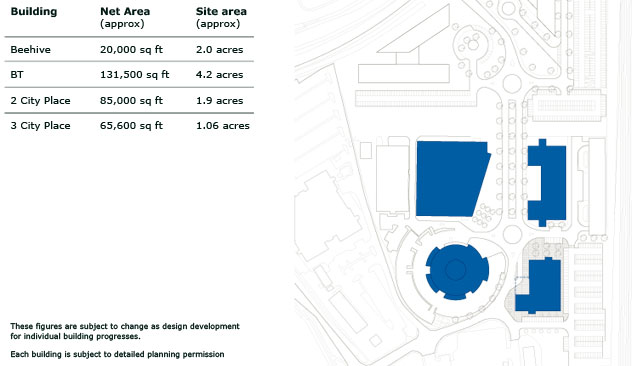
{{#invoke:Labelled list hatnote|labelledList|Main article|Main articles|Main page|Main pages}} Gatwick's original terminal, the Beehive, is included within the City Place Gatwick office complex together with 1, 2 and 3 City Place.<ref>"Cityplacegatwick". Template:Webarchive. City Place Gatwick. Retrieved 12 February 2011.</ref><ref>"Master Plan." Template:Webarchive. City Place Gatwick. Retrieved 12 February 2011.</ref><ref>{{#invoke:citation/CS1|citation |CitationClass=web }}</ref><ref>Template:Cite journal</ref><ref>Template:Cite journal</ref> The complex was developed by BAA Lynton.<ref>"MEPC lands BT Workstyle pre-let at aerodrome Template:Webarchive." Property Week. 17 March 2000. Retrieved 12 February 2011. "Signing the pre-let caps a busy week for BT. It has also pre-let 14,000 sq m (150,000 sq ft) at BAA Lynton's 46,500 sq m (500,000 sq ft) City Place scheme at Gatwick."</ref> Some airlines have had offices at the Beehive, including BEA/British Airways Helicopters,<ref>{{#invoke:citation/CS1|citation |CitationClass=web }}</ref><ref>Classic Aircraft (Gone but not forgotten ... BEA and BA Helicopters), Vol. 44, No. 12, p. 69, Ian Allan Publishing, Hersham, December 2011</ref> Jersey Airlines, Caledonian Airways, Virgin Atlantic and GB Airways.<ref>"The Beehive". GB Airways. Retrieved 19 May 2009.</ref><ref>{{#invoke:citation/CS1|citation |CitationClass=web }}</ref><ref>Template:Cite journal</ref><ref>Template:Cite journal</ref> Other airlines which had headquarters on airport property (including office buildings on the site of, or adjacent to, the original 1930s airport) include British Caledonian,<ref>Template:Cite news</ref><ref>"World Airline Directory." Flight International. 18 May 1972. Supplement 18". Template:Webarchive. "Head Office: Gatwick Airport, Horley, Surrey, England."</ref> British United Airways,<ref>Template:Cite journal</ref> CityFlyer Express,<ref>"World Airline Directory." Flight International. 24–30 March 1999. "64". Template:Webarchive. "Iain Stewart Centre, Beehive Ring Road, Gatwick Airport, Gatwick, West Sussex, RH6 OPB, UK"</ref> Fastjet,<ref>{{#invoke:citation/CS1|citation |CitationClass=web }}</ref> Laker Airways<ref>"World Airline Directory." Flight International. 16 May 1981. 1445 Template:Webarchive. "Head Office: London Gatwick Airport, Horley, Surrey, UK."</ref> and Tradewinds Airways.<ref>Template:Cite journal "Head Office: Gatwick Airport, Horley. Surrey."</ref><ref>World Airline Directory. Flight International. 20 March 1975. 505 Template:Webarchive. "Head Office: Gatwick Airport, Horley, Surrey."</ref>
Gatwick Aviation Museum
{{#invoke:Labelled list hatnote|labelledList|Main article|Main articles|Main page|Main pages}}
Situated to the northwest of the airfield near the village of Charlwood, there is a museum including original items and photographs from Gatwick's history, as well as a variety of military aircraft. It is open Friday, Saturday and Sunday all year round.<ref>{{#invoke:citation/CS1|citation |CitationClass=web }}</ref>
Terminals


The airport has two terminals, South and North, with 65 total gates. Both have shops and restaurants landside and airside, and all areas are accessible to disabled passengers. There are facilities for baby changing and feeding. Business travellers have specialised lounges. The North and South Terminals are connected by a Template:Convert, elevated, two-way automated people mover landside. They are not connected once past security.
South Terminal
South Terminal has 32 gates with jetbridges and 7 remote gates. Pier 1 has gates 1-5, all equipped with jetbridges, Pier 2 has gates 10A and gates 10-28 all with jetbridges, except 10A. Pier 3 has gates 31-39 jetbridges and 90-95 (bus gates). The official opening of the central pier of what is now the South Terminal, with 11 aircraft stands, was on 9 June 1958. Gatwick was one of the world's first airports with an enclosed pier-based terminal, which allowed passengers to walk under cover to waiting areas near the aircraft (with only a short walk outdoors).<ref name="Gatwick_History"/> Another feature of Gatwick's new air terminal was its modular design, permitting subsequent, phased expansion.<ref>Golden Gatwick—50 Years of Aviation, Chapter 8</ref> As passenger numbers grew, a circular satellite pier was added to the terminal building. It was connected to the main terminal by the UK's first automated people mover system.<ref name="Gatwick_History"/> This replaced the original North Pier dating from 1962; the people mover was subsequently replaced with a walkway and travelators.
The South Terminal was temporarily closed from June 2020, and all airlines normally operating from this terminal were relocated to the North Terminal, owing to the sharp decline in passenger traffic as a result of the devastating impact of the COVID-19 pandemic.<ref>{{#invoke:citation/CS1|citation |CitationClass=web }}</ref> It fully reopened in March 2022.<ref>Template:Cite news</ref> During the time it was not in operation, it was used as a remote filming location for the fourteenth series of the television show Taskmaster.<ref>{{#invoke:citation/CS1|citation |CitationClass=web }}</ref>
North Terminal
North Terminal was opened in March 1988 by Queen Elizabeth II.<ref>Gatwick Second Terminal Opens Australian Aviation issue 44 May 1988 page 16</ref> It has 31 gates with jetbridges including three which can support an Airbus A380. Pier 4 has bussing gate 45 and jetbridge gates 46Template:Ndash55. Pier 5 has gates 557-574, all with jetbridges. Pier 6 has gates 101-113, all with jetbridges. Construction began on the North Terminal on land previously earmarked for a second runway in the draft plan of May 1970. This was the largest construction project south of London in the 1980s, costing £200Template:Nbspmillion.<ref name="runway_moratorium"/><ref name="1979_expansion_plans"/><ref>Template:Cite book</ref>Template:R In 1991 a second aircraft pier was added to the North Terminal. On 16 May 2005, the new Pier 6 opened at £110Template:Nbspmillion, adding 11 pier-served aircraft stands. The pier is linked to the North Terminal's main building by the second-largest air passenger bridge in the world,Template:Efn spanning a taxiway and providing passengers with views of the airport and taxiing aircraft.<ref name="Woodley 2014">Template:Cite book</ref>Template:Rp
A large extension to the terminal was opened by former Prime Minister John Major in November 2011.<ref>{{#invoke:citation/CS1|citation |CitationClass=web }}</ref><ref>{{#invoke:citation/CS1|citation |CitationClass=web }}</ref>
Terminal assignments and rearrangements
As part of a seven-year strategic commercial partnership between Gatwick and EasyJet, the airport proposed several changes to individual airlines' terminal locations. These would see EasyJet consolidate all its Gatwick operations in the North Terminal, while British Airways and Virgin Atlantic would swap their terminals. Gatwick believes that these terminal moves improve the airport's operational efficiency and resilience, as the use of different terminals by EasyJet and British Airways reduces pressure on the North Terminal's check-in, security, boarding and ramp areas at peak times. In addition, a terminal swap by Virgin frees up lounge and gate space for BA long-haul passengers in the South Terminal and, unlike BA's current short-haul schedules, Virgin's long-haul schedules do not clash with EasyJet's busy schedule in the North Terminal due to the airlines' differing peak times.<ref name="Lea-2014"/>
It was confirmed in January 2015 that British Airways would move all its flights to the South Terminal in November 2016 while all EasyJet flights would be consolidated in the North Terminal at the same time.<ref>{{#invoke:citation/CS1|citation |CitationClass=web }}</ref><ref name="EasyJet-2015"/> However, it was decided in February 2016 to postpone the agreed relocation of airlines until 25 January 2017, to avoid operational disruptions over the 2016–17 Christmas season and to give all parties involved enough time to deal with any unforeseen issues ahead of the February 2017 half-term holidays.<ref>{{#invoke:citation/CS1|citation |CitationClass=web }}</ref> The relocation of these airlines was accomplished by the revised date of 25 January 2017.<ref>{{#invoke:citation/CS1|citation |CitationClass=web }}</ref>
Airlines and destinations
Template:Update-section The following airlines operate regularly scheduled passenger flights at Gatwick Airport:
Template:Airport destination list
Statistics
Overview
In 2015, Gatwick became the first single-runway airport to handle more than 40Template:Nbspmillion passengers annually.<ref>Template:Cite press release</ref> By 2016, EasyJet accounted for over 40% of Gatwick's total passengers.<ref>Template:Cite news</ref><ref name="LGW_Nos_2016">{{#invoke:citation/CS1|citation |CitationClass=web }}</ref> When ranked by global passenger traffic, Gatwick is the 35th busiest internationally and the eighth busiest airport in Europe. Gatwick is the world's leading low-cost airport<ref>{{#invoke:citation/CS1|citation |CitationClass=web }}</ref> and until March 2017 had the world's busiest single-use runway,Template:Efn with a maximum of 55 aircraft movements per hour.<ref>Template:Cite report</ref><ref>Template:Cite news</ref>
In 2018, 46.1Template:Nbspmillion passengers passed through Gatwick, an increase of 1.1% over the previous year. North Atlantic and other long-haulTemplate:Efnexcluding North Atlantic}} traffic recorded increases over the previous year of 24.4% and 12.7% to 4.04Template:Nbspmillion and 4.65Template:Nbspmillion passengers, respectively. UK,Template:Efn European charter,Template:Efn Irish and European scheduled passenger traffic recorded decreases over the previous year of 8.7%, 5.7%, 1.1% and 0.9% to 3.73Template:Nbspmillion, 2.88Template:Nbspmillion, 1.67Template:Nbspmillion and 29.11Template:Nbspmillion, respectively. Air transport movements decreased by 0.7% to 283,926. Cargo volume increased by 16.1% to 112,676Template:NbspmetricTemplate:Nbsptonnes.<ref name="LGW_2018_GAL_Stats"/>
Compared with a year earlier, January to March 2019 passenger numbers increased by 4% to 9.675Template:Nbspmillion (an increase of 374,700 over January to March 2018). The following changes were recorded amongst individual passenger traffic categories: North Atlantic traffic +15.3% (784,200 passengers); European scheduled traffic +3.9% (5.649Template:Nbspmillion passengers); other long-haulTemplate:Efn traffic +3.2% (1.277Template:Nbspmillion passengers); European charterTemplate:Efn traffic +2.1% (710,900 passengers); Irish traffic +1.6% (412,000 passengers) and UKTemplate:Efn traffic -0.2% (841,700 passengers). Air transport movements increased by 3.3% to 62,392. Cargo volume increased by 7.2% to 27,390 metric tonnes, which was driven by a 7.5% increase in overall long-haul passenger traffic. The growing popularity of the GatwickConnects flight connections assistance service provided by the airport for self-connecting passengers was driven by additional passengers changing flights at Gatwick whose journey originated in Edinburgh (+80%), Jersey (+58%) and Belfast (+50%).<ref>{{#invoke:citation/CS1|citation |CitationClass=web }}</ref>
Busiest routes
| Rank | Destination | Passengers | Change 2023 / 24 |
|---|---|---|---|
| 1 | Edinburgh | 476,152 | Template:Increase 3.64% |
| 2 | Glasgow | 455,095 | Template:Decrease 2.37% |
| 3 | Belfast-Intl | 444,142 | Template:Decrease 8.33% |
| 4 | Jersey | 381,611 | Template:Increase 11.31% |
| 5 | Belfast-City | 277,800 | Template:Increase 18.98% |
| 6 | Guernsey | 254,601 | Template:Decrease 17.22% |
| 7 | Inverness | 222,417 | Template:Decrease 0.25% |
| 8 | Aberdeen | 196,469 | Template:Increase 0.80% |
| 9 | Isle of Man | 165,643 | Template:Increase 3.32% |
| 10 | Newquay | 83,252 | Template:Decrease 0.83% |
| Source: CAA Statistics<ref name="caa2024"/> | |||
Traffic
Gatwick handled 186,172 passengers during its first seven months of operation after the 1956–58 reconstruction; the annual number of passengers passing through the airport was 368,000 in 1959 and 470,000 in 1960.<ref name="Gatwick_History">"Gatwick Airport History", Business & Community Reference Guide for in and around Crawley 2008/09, Wealden Marketing, 2008, p. 85</ref><ref>Template:Cite bookTemplate:Full citation needed</ref> Passenger numbers reached one million for the first time during the 1962–63 fiscal year,Template:Efn with British United Airways (BUA) accounting for four-fifths.<ref>Template:Cite book</ref> The 1.5-million mark was exceeded for the first time during the 1966–67 fiscal year.Template:Efn This was also the first time more than half a million scheduled passengers used the airport.Template:R Gatwick accommodated two million passengers for the first time during the 1967–68 fiscal yearTemplate:Efn and 3Template:Nbspmillion in the 1969–70 fiscal year,Template:Efn with BUA accounting for nearly half.<ref>{{#invoke:citation/CS1|citation |CitationClass=web }}</ref><ref>Template:Cite bookTemplate:Full citation needed</ref> By the early 1970s, 5Template:Nbspmillion passengers used Gatwick each year, with a record 5.7Template:Nbspmillion during the 1973–74 fiscal year.Template:Efn During that period, British Caledonian accounted for approximately half of all charter passengers and three-fourths of scheduled passengers.<ref>Template:Cite bookTemplate:Full citation needed</ref> Within a decade annual passenger numbers doubled, to 10Template:Nbspmillion; they doubled again, to over 20Template:Nbspmillion, by the late 1980s.<ref name="Gatwick_History"/><ref>Template:Cite bookTemplate:Full citation needed</ref><ref name="Iyengar"/><ref name="Iyengar-2"/> By the turn of the millennium, Gatwick handled more than 30Template:Nbspmillion passengers annually.<ref name="Gatwick_History"/>
| Year | Number of passengers Template:Efn |
Percentage change |
Number of aircraft movements Template:Efn |
Freight (tonnes) | |
|---|---|---|---|---|---|
| 2000 | 32,068,540 | – | 260,859 | 318,905 | |
| 2001 | 31,181,770 | Template:DecreaseTemplate:02.8% | 252,543 | 280,098 | |
| 2002 | 29,627,420 | Template:DecreaseTemplate:05.0% | 242,379 | 242,519 | |
| 2003 | 30,005,260 | Template:IncreaseTemplate:01.3% | 242,731 | 222,916 | |
| 2004 | 31,466,770 | Template:IncreaseTemplate:04.9% | 251,195 | 218,204 | |
| 2005 | 32,775,695 | Template:IncreaseTemplate:04.2% | 261,292 | 222,778 | |
| 2006 | 34,163,579 | Template:IncreaseTemplate:04.2% | 263,363 | 211,857 | |
| 2007 | 35,216,113 | Template:IncreaseTemplate:03.1% | 266,550 | 171,078 | |
| 2008 | 34,205,887 | Template:DecreaseTemplate:02.9% | 263,653 | 107,702 | |
| 2009 | 32,392,520 | Template:DecreaseTemplate:05.3% | 251,879 | 74,680 | |
| 2010 | 31,375,290 | Template:DecreaseTemplate:03.1% | 240,500 | 104,032 | |
| 2011 | 33,674,264 | Template:IncreaseTemplate:07.3% | 251,067 | 88,085 | |
| 2012 | 34,235,982 | Template:IncreaseTemplate:01.7% | 246,987 | 97,567 | |
| 2013 | 35,444,206 | Template:IncreaseTemplate:03.5% | 250,520 | 96,724 | |
| 2014 | 38,103,667 | Template:IncreaseTemplate:07.5% | 259,692 | 88,508 | |
| 2015 | 40,269,087 | Template:IncreaseTemplate:05.7% | 267,760 | 73,371 | |
| 2016 | 43,119,628 | Template:IncreaseTemplate:07.1% | 280,666 | 79,588 | |
| 2017 | 45,516,700 | Template:IncreaseTemplate:05.2% | 285,969 | 96,983 | |
| 2018 | 46,075,400 | Template:IncreaseTemplate:01.1% | 283,926 | 112,600 | |
| 2019 | 46,574,786 | Template:IncreaseTemplate:01.1% | 282,896 | 110,358 | |
| 2020 | 10,171,867 | Template:DecreaseTemplate:078.2% | 79,489 | 26,063 | |
| 2021 | 6,260,072 | Template:DecreaseTemplate:038.5% | 52,000 | 11,623 | |
| 2022 | 32,800,000 | Template:IncreaseTemplate:0423.9% | 217,524 | 36,407 | |
| 2023 | 40,894,242 | Template:IncreaseTemplate:024.7% | 253,047 | 61,123 | |
| 2024 | 43,242,000 | Template:IncreaseTemplate:05.7% | 265,358 | 103,961 | |
| Source 2000–2016: UK Civil Aviation Authority<ref>{{#invoke:citation/CS1|citation | CitationClass=web
}}</ref> | ||||
Ground transport
Road

The airport is accessible from a motorway spur road at junction 9A of the M23, which links to the main M23 motorway Template:Convert east at junction 9. The M23 connects with London's orbital motorway, the M25, Template:Convert north; this provides access to much of Greater London, the South East and beyond, and the M23 is the main route for traffic to (and from) the airport. Gatwick is also accessible from the A23, which serves Horley and Redhill to the north and Crawley and Brighton to the south. The A217 provides access northwards to the town of Reigate. The airport has long- and short-stay car parks at the airport and off-site, although these are often full in summer. Local restrictions limit parking at Gatwick.
Gatwick has set goals of 40% public transport use by the time annual passenger traffic reaches 40Template:Nbspmillion (in 2015) and 45% by the time it reaches 45Template:Nbspmillion.<ref>{{#invoke:citation/CS1|citation |CitationClass=web }}</ref>
Rail

{{#invoke:Labelled list hatnote|labelledList|Main article|Main articles|Main page|Main pages}}
Gatwick Airport railway station is located adjacent to the South Terminal and has served the airport since 1958.<ref>{{#invoke:citation/CS1|citation |CitationClass=web }}</ref><ref>{{#invoke:citation/CS1|citation |CitationClass=web }}</ref> It is located on the Brighton Main Line, and is mainly served by Southern, Thameslink, and Gatwick Express. It also receives a half-hourly service operated by Great Western Railway via the North Downs Line.
To the south, Southern, Thameslink, and Gatwick Express all provide direct connections to Brighton. Southern also provides connections to Eastbourne, Littlehampton, Bognor Regis, and Portsmouth Harbour.
To the north, Thameslink provides connections to London Bridge, Gatwick Express provides non-stopping connections to London Victoria, and Southern provides connections to both stations. Thameslink trains continue further north through the Thameslink Core to St Pancras International, Bedford, Peterborough, and Cambridge. Great Western Railway also provides a half-hourly service to Reading via Guildford.
The station provides single-change connections to Heathrow Airport and Luton Airport via northbound Thameslink services. Heathrow Airport can be reached by changing to the Elizabeth line at Farringdon, whilst Luton Airport can be reached by the Luton DART station at Luton Airport Parkway.
London Oyster Cards and contactless cards are accepted on all rail routes from Gatwick Airport into London.<ref>{{#invoke:citation/CS1|citation |CitationClass=web }}</ref><ref>Template:Cite news</ref>
Bus
National Express Coaches operates coaches to Heathrow Airport, London Stansted Airport and cities and towns throughout the region and country. Oxford Bus Company operates direct services to Oxford, and EasyBus operates mini-coaches from both terminals to Earls Court and West Brompton.Template:Citation needed
Local buses connect the North and South Terminals with Crawley, Horley, Redhill, Horsham and Caterham. Services are offered by Metrobus, including Metrobus's Fastway services operated on a partly guided bus rapid transit system which was the first of its kind to be built outside a major city.Template:Citation needed
Bike
Route 21 of the National Cycle Network passes under the South Terminal, allowing virtually traffic-free cycling and walking northwards to Horley and southwards to Three Bridges and Crawley. A goods-style lift runs between the terminal and ground level (labelled "Lift to Cycle Route") near Zone L.Template:Citation needed
Terminal transfer

{{#invoke:Labelled list hatnote|labelledList|Main article|Main articles|Main page|Main pages}}
The airport's North and South Terminals are connected by a Template:Convert, elevated, two-way automated people mover track. The transit shuttle normally consists of two automatic, three-car, driverless trains. Although colloquially known as a "monorail", the shuttle instead runs on a dual, concrete track with rubber tyres.<ref name="hudson">Template:Cite book</ref> The transit is land side, and besides linking the two terminals also links the North terminal to the airport railway station.
The shuttle opened in 1987, along with the North Terminal, and initially used Adtranz C-100 people-mover cars which remained in operation until September 2009, by which time they had travelled a total of Template:Convert. Gatwick began upgrading its shuttle service in April 2008, with a bus replacement service in place from September 2009. A new operating system and shuttle cars (six Bombardier CX-100 vehicles)<ref>Template:Cite press release</ref> were installed, and the guideway and transit stations were refurbished at a total cost of £45Template:Nbspmillion. The system re-opened on 1 July 2010, two months ahead of schedule;<ref>Template:Cite news</ref><ref>Template:Cite press release</ref> it featured live journey information and sensory technology to count the number of passengers at stations.
An earlier transit system, that opened in 1983 to link the main terminal (now the South Terminal) to the (then new) circular satellite pier, was the UK's first automated people-moving system. This system has since been replaced by a walkway-and-moving walkway link, although the remains of the elevated guideway are still visible.<ref name="hudson"/>
Expansion proposals
{{#invoke:Labelled list hatnote|labelledList|Main article|Main articles|Main page|Main pages}} Gatwick has been included in many reviews of airport capacity in southeastern England. Expansion options have included a third terminal and a second runway; although an agreement not to build a second runway was made in 1979 with West Sussex County Council, that agreement expired by its terms after 40 years.<ref name="runway_moratorium"/><ref name="1979_expansion_plans"/><ref>{{#invoke:citation/CS1|citation |CitationClass=web }}</ref> Expanded operations would allow Gatwick to handle more passengers than Heathrow does today, with a new terminal between two wide-spaced runways. This would complement or replace the South Terminal, depending on expected future traffic.<ref>Template:Cite news</ref>
Airport management's proposal for a second runway (south of the existing runway and airport boundary) was unveiled in July 2013. This was shortlisted for further consideration by the Airports Commission in December 2013, and the commission's final report was published in July 2015.<ref>{{#invoke:citation/CS1|citation |CitationClass=web }}</ref><ref>Template:Cite news</ref> Another proposal would extend the North Terminal south, with a passenger bridge in the area currently occupied by aircraft stands without jet bridges.<ref>{{#invoke:citation/CS1|citation |CitationClass=web }}</ref> Gatwick's draft master plan (released for consultation on 13 October 2011) dropped the passenger-bridge plan in favour of a mid-field satellite (next to the control tower) linking to the North Terminal as part of an expanded 2030 single-runway, two-terminal airport.<ref>Draft Gatwick Master Plan (A single runway airport – 2030: 10.2.14 Aprons and piers and Figure A.12, p. 93 and Appendix A – Drawings), Gatwick Airport, West Sussex, 13 October 2011.</ref>
In late 2011, the Department for Transport (DfT) also began a feasibility study for a high-speed rail link between Gatwick and Heathrow as part of a plan combining the airports into a "collective" or "virtual hub", Heathwick. The scheme envisaged a high-speed rail route parallel to the M25, covering Template:Convert in 15 minutes. Trains would have reached speeds of Template:Convert, and passengers would have passed through immigration (or check-in) only once. Reactions to this proposal were largely negative.<ref>Template:Cite news</ref> Another proposal for a high-speed railway link to Heathrow, HS4Air, as part of a scheme to link the High Speed 1 and High Speed 2 railway lines and connect regional cities in Britain to the Channel Tunnel, was rejected in 2018.<ref>Template:Cite magazine</ref>
On 1 July 2015, the Airports Commission submitted its final report, recommending the expansion of Heathrow Airport as opposed to Gatwick. Whilst the commission recognised Gatwick's benefits and relatively fewer environmental consequences than Heathrow, they felt the economic benefits of Gatwick vs. Heathrow were not as great, nor as broad-ranging.<ref>Template:Cite news</ref> Gatwick disputed the findings.<ref>Template:Cite press release</ref>
On 9 September 2021, GAL opened its first public consultation to carry out major works at the runway to increase its capacity from 64Template:Nbspmillion passengers a year to 75Template:Nbspmillion passengers a year by moving the northern "emergency" runway to the north to meet international standards for dual runway use.<ref>{{#invoke:citation/CS1|citation |CitationClass=web }}</ref> Airport management plans to use this runway only for take-offs by all but the largest aircraft. It hoped to receive approval in 2024, with the main works taking 4 years to complete, and 13 years to be fully complete.<ref>{{#invoke:citation/CS1|citation |CitationClass=web }}</ref> Works would also involve a new pier, hotels, terminal expansion and highway improvements including flyovers of the M23 Spur / A23 Airport Way at the terminal roundabouts.<ref>{{#invoke:citation/CS1|citation |CitationClass=web }}</ref> Planning permission for the runway realignment was formally requested in July 2023.<ref>Template:Cite news</ref> The plan would cost around £2.2Template:Nbspbillion, financed by private investors rather than government backing, and would be operational within around five years.<ref>{{#invoke:citation/CS1|citation |CitationClass=web }}</ref>
On 27 February 2025, Transport Secretary Heidi Alexander announced that she was "minded to approve" the proposals, subject to noise mitigation.<ref>{{#invoke:citation/CS1|citation |CitationClass=web }}</ref> A period of additional consultation was announced, pending a final decision in October 2025.<ref>{{#invoke:citation/CS1|citation |CitationClass=web }}</ref>
Ultimately, Gatwick’s expansion is projected to create approximately 14,000 new jobs and inject £1bn annually into the regional economy. Weighing up whether such an economic boost outweighs the environmental impact could be swayed by the ability of Gatwick to successfully implement its high-tech upgrades.<ref>{{#invoke:citation/CS1|citation |CitationClass=web }}</ref>
On 21 September 2025, Gatwick's proposal to move the secondary runway by 12 metres to allow regular use was formally approved by Transport Secretary, Heidi Alexander.<ref>{{#invoke:citation/CS1|citation |CitationClass=web }}</ref>
Accidents and incidents
- 15 September 1936 – A British Airways Ltd de Havilland DH 86 on a night mail flight to Germany crashed on takeoff, killing the airline's chief pilot and two crew members.<ref>Template:Cite journal</ref><ref>Template:Cite journal</ref>
- November 1936 – A British Airways Ltd Fokker F 12 crashed in a wood Template:Convert south of Gatwick on its final approach to the airport under a low ceiling in poor visibility, killing both pilots and seriously injuring the flight engineer.<ref>Template:Cite journal</ref>
- 17 February 1959 – A Turkish Airlines Vickers Viscount 794D (registration: TC-SEV) on an international charter flight crashed in heavy fog at Newdigate, Surrey, on its approach to Gatwick after striking trees. Fourteen of the 24 on board died, and Turkish Prime Minister Adnan Menderes was amongst the survivors.<ref>Template:Cite news</ref><ref name="Incidents">{{#invoke:citation/CS1|citation
|CitationClass=web }}</ref><ref>{{#invoke:citation/CS1|citation |CitationClass=web }}</ref>
- 5 January 1969 – A Boeing 727-113C (registration: YA-FAR) operating as Ariana Afghan Airlines Flight 701 arriving from Frankfurt Airport, Germany, crashed into a house in Fernhill (near Horley, Surrey) in low visibility. The flaps were not extended to maintain flight at final-approach speed. 48 of the 62 on board died, in addition to two on the ground.<ref name="Incidents"/><ref>{{#invoke:citation/CS1|citation
|CitationClass=web }}</ref><ref>{{#invoke:citation/CS1|citation |CitationClass=web }}</ref><ref>{{#invoke:citation/CS1|citation |CitationClass=web }}</ref>
- 28 January 1972 – A British Caledonian Vickers VC10-1109 (registration: G-ARTA) with no passengers aboard sustained severe structural damage as a result of a hard landing at Gatwick at the end of a short ferry flight from Heathrow, where the aircraft had been diverted due to fog at Gatwick. After touching down runway 08 and applying spoilers and reverse thrust, the aircraft became airborne again, bounced twice and landed heavily. This resulted in a burst front wheel tyre, a separated wheel and a crumpled fuselage (immediately in front of and behind the wings).<ref>Template:Cite magazine</ref> A survey of the aircraft's damage revealed that its airframe was bent out of shape, requiring extensive repairs to restore airworthiness. Since the repairs were not cost-effective, the airline's management decided to cannibalise the aircraft for spare parts before scrapping it at Gatwick in 1975.<ref>{{#invoke:citation/CS1|citation
|CitationClass=web }}</ref><ref>{{#invoke:citation/CS1|citation |CitationClass=web }}</ref>
- 20 July 1975 – A British Island Airways (BIA) Handley Page Dart Herald 201 (registration: G-APWF) was involved in a runway accident while departing on a scheduled flight to Guernsey. The aircraft lifted off from runway 26 after a ground run of Template:Convert and appeared airborne for Template:Convert (with its landing gear retracting) before the rear underside of the fuselage settled back onto the runway and brought the aircraft to a stop. An investigation concluded that the landing gear was retracted before the aircraft had become established in a climb and the flap setting and takeoff speed were incorrect. Although the aircraft incurred substantial damage, none of the 45 occupants were hurt.<ref>{{#invoke:citation/CS1|citation
|CitationClass=web }}</ref>
- 29 December 2014 – A Virgin Atlantic Boeing 747-400 (Registration: G-VROM) suffered a loss of hydraulic fluid whilst en route to Las Vegas. Shortly after departure, an alarm prompted the crew to return to Gatwick, when they discovered that an improperly installed actuator had caused the right wing landing gear to not deploy. The aircraft successfully landed on 3 main landing-gear bogies and was returned to service on 11 January 2015.<ref>{{#invoke:citation/CS1|citation
|CitationClass=web }}</ref>
- 19–21 December 2018 – A major disruption to the airport was caused by reports of drone sightings close to the runway. The runway was closed and all flights were suspended for about six hours on 19 December. The airport reopened at 03:01 the next morning until another reported sighting prompted another closing about 45 minutes later. As of 00:15 on 21 December, the airport was still closed with about 110,000 passengers and 760 flights affected.<ref>Template:Cite news</ref> Officials called the drone flying a "deliberate act of disruption", but did not classify it as terrorism.<ref>Template:Cite news</ref> The army was deployed to assist the police in resolving the incident.<ref>Template:Cite news</ref> The runway reopened with limited capacity around 06:00 that day.<ref>Template:Cite news</ref> Authorities suspended flights again from 17:10 to 18:23 on 21 December. Later that day a man and a woman were arrested in connection with the incident;<ref>Template:Cite news</ref><ref>Template:Cite press release</ref> the pair were released without charge on 23 December with Sussex Police saying that they "are no longer suspects".<ref>Template:Cite news</ref>
- 26 February 2020 – A Titan Airways Airbus A321-211 reported an engine surge after takeoff. A few moments later, the other engine stalled. The aircraft landed safely at Gatwick 11 minutes after takeoff. The Air Accidents Investigation Branch determined fuel contamination following defective maintenance had gone undetected for two days and caused the incident. Safety recommendations were made to the European Union Aviation Safety Agency, and changes were made by organisations including Airbus and the International Air Transport Association.<ref>Template:Cite news</ref>
See also
- Airports of London
- List of airports in the United Kingdom and the British Crown Dependencies
- List of busiest airports by passenger traffic
- List of the busiest airports in Europe
References
Notes
Citations
Bibliography
- Gwynne, Peter. (1990) A History of Crawley (2nd Edition) Philmore. Template:ISBN
- King, John, with Tait, Geoff, (1980) Golden Gatwick – 50 Years of Aviation, British Airports Authority.
- King, John, (1986) Gatwick – The Evolution of an Airport, Gatwick Airport Ltd. and Sussex Industrial Archaeology Society. Template:ISBN
- Bain, Gordon, (1994), Gatwick Airport, Airlife Publishing Ltd. Template:ISBN
- Tait, Geoffrey, (1984), The Gatwick Express, G. Tait & Associates Ltd. Template:ISBN
- Template:Cite book
- Template:Cite book
- Template:Cite book
- Template:Cite book
- Template:Cite book
- Template:Cite book
- Template:Cite book
- Template:Cite book
- Wood, Alan. "Hoping for a Junkers: More Recollections on Prewar Airline Exploits From a Fledgling Gatwick Airport". Air Enthusiast, No. 83, September–October 1999, pp. 52–57. Template:ISSN
- Template:Cite book
External links
Template:Sister project Template:Wikivoyage
Template:Transport in London Template:Airports in the United Kingdom Template:Crawley Template:Portal bar Template:Authority control
- Pages with broken file links
- Gatwick Airport
- 1933 establishments in England
- 1958 establishments in England
- Airports established in 1933
- Airports established in 1958
- Airports in the London region
- Airports in West Sussex
- Buildings and structures in Crawley
- Organisations based in Crawley
- Royal Air Force stations in West Sussex
- Transport in Crawley
- Transport in West Sussex