Gelsemium sempervirens
Template:Short description Template:Speciesbox
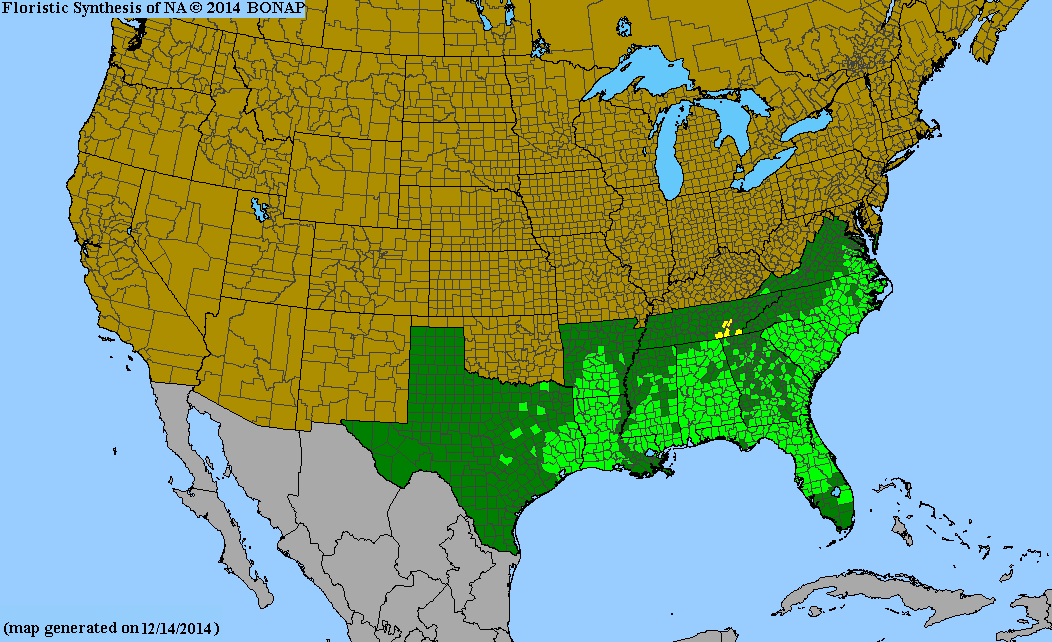
Gelsemium sempervirens is a twining vine in the family Gelsemiaceae, native to subtropical and tropical America: Honduras, Guatemala, Belize, Mexico (Chiapas, Oaxaca, Veracruz, Puebla, Hidalgo),<ref name=heidi>Ornduff, R. 1970. The systematics and breeding system of Gelsemium (Loganiceae). Journal of the Arnold Arboretum 51(1): 1–17 includes description, drawings, distribution map, etc.</ref> and southeastern and south-central United States (from Texas to Virginia).<ref>Biota of North America Program 2014 county distribution map</ref> It has a number of common names including yellow jessamine or confederate jessamine or jasmine,<ref name="AFVP">{{#invoke:citation/CS1|citation |CitationClass=web }}</ref><ref name="GRIN">Template:GRIN</ref> Carolina jasmine or jessamine,<ref name=AFVP/><ref name=GRIN/> evening trumpetflower,<ref name=GRIN/><ref>{{#invoke:citation/CS1|citation |CitationClass=web }}</ref> gelsemium<ref name=GRIN/> and woodbine.<ref name=GRIN/>
Yellow jessamine is the state flower of South Carolina.<ref>{{#invoke:citation/CS1|citation |CitationClass=web }}</ref>
Despite its common name, the species is not a "true jasmine" and not of the genus Jasminum.
Growth
Gelsemium sempervirens can grow to Template:Convert high when given suitable climbing support in trees, with thin stems. The plant is perennial.<ref>Template:PLANTS</ref> The leaves are evergreen, lanceolate, Template:Convert long and Template:Convert broad, and lustrous, dark green. The flowers are borne in clusters, the individual flowers yellow, sometimes with an orange center, trumpet-shaped, Template:Convert long and Template:Convert broad. Its flowers are strongly scented and produce nectar that attracts a range of pollinators.<ref name=heidi/>
History
Some 19th century sources identified Gelsemium sempervirens as a folk remedy for various medical conditions. William Bartram encountered this species (then referred to as Bignonia sempervirens) on his travels along the coasts of the Carolinas and Georgia in 1773.Template:Citation needed
Toxicity
All parts of this plant contain the toxic strychnine-related alkaloids gelsemine and gelseminine and should not be consumed.<ref>{{#invoke:citation/CS1|citation |CitationClass=web }}</ref> The sap may cause skin irritation in sensitive individuals. Children, mistaking this flower for honeysuckle, have been poisoned by sucking the nectar from the flower.<ref>Anthony Knight and Richard Walter. 2001. A Guide to Plant Poisoning of Animals in North America.</ref> The nectar is also toxic to honeybees,<ref>[1] "Nectar Gardening for Butterflies, Honey Bees and Native Bees", Retrieved 2012-08-02</ref> which may cause brood death when gathered by the bees. The nectar may, however, be beneficial to bumblebees. It has been shown that bumblebees fed on gelsemine have a reduced load of Crithidia bombi in their fecal matter after 7 days, although this difference was not significant after 10 days. Reduced parasite load increases foraging efficiency, and pollinators may selectively collect otherwise toxic secondary metabolites as a means of self-medication.<ref>{{#invoke:citation/CS1|citation |CitationClass=web }}</ref>
The plant can be lethal to livestock.<ref>Template:Cite book</ref>
Cultivation
Despite the hazards, this is a popular garden plant in warmer areas, frequently being trained to grow over arbors or to cover walls. In the UK, it has won the Royal Horticultural Society's Award of Garden Merit.<ref name = RHSPF>{{#invoke:citation/CS1|citation |CitationClass=web }}</ref> It can be grown outdoors in mild and coastal areas of the UK (to a lower limit of Template:Convert), but elsewhere must be grown under glass. It requires a sheltered position in full sun or light shade.<ref name = RHSPF/>
Gallery
-
Shrub
-
Flower


See also
References
Further reading
- Template:Cite EB1911 This contains a detailed description of the then-common usage and dosage of the drug.
- Pages with broken file links
- Gelsemiaceae
- Flora of the Southeastern United States
- Flora of Central America
- Medicinal plants of Central America
- Medicinal plants of North America
- Plants described in 1753
- Botanical taxa named by Carl Linnaeus
- Symbols of South Carolina
- Flora of Mexico
- Flora of Texas
- Flora without expected TNC conservation status