Gothi
Template:Short description Template:Distinguish Template:Redirect

Gothi or {{#invoke:Lang|lang}} (plural {{#invoke:Lang|lang}}, fem. {{#invoke:Lang|lang}}; Old Norse: {{#invoke:Lang|lang}}) was a position of political and social prominence in the Icelandic Commonwealth. The term originally had a religious significance, referring to a pagan leader responsible for a religious structure and communal feasts, but the title is primarily known as a secular political title from medieval Iceland.
Etymology
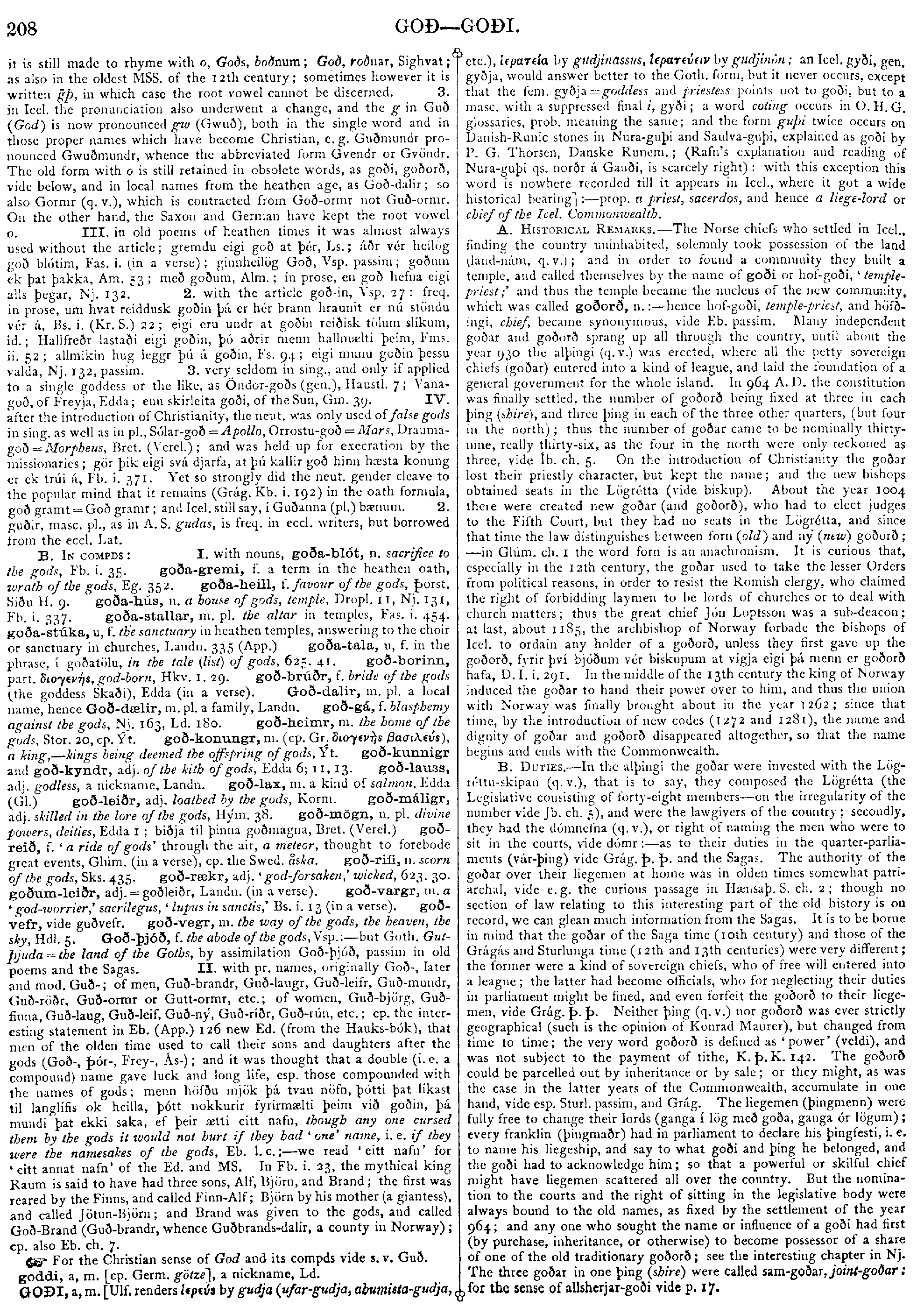
The word derives from {{#invoke:Lang|lang}}, meaning "god".<ref name="byock">Byock, Jesse L. (1993). "Goði". Entry in Medieval Scandinavia, an Encyclopedia (Phillip Pulsiano, ed.), 230–231. Garland: NY and London, Template:ISBN.</ref> It possibly appears in Ulfilas' Gothic language translation of the Bible as Template:Transliteration for "priest", although the corresponding form of this in Icelandic would have been an unattested {{#invoke:Lang|lang}}.<ref name="gothi"/> In Scandinavia, there is one surviving attestation in the Proto-Norse form {{#invoke:Lang|lang}} from the Norwegian Nordhuglo runestone (N KJ65),<ref name="gotiska">The article gotiska in Nationalencyklopedin (1992)</ref><ref>Template:Cite Scandinavian Runic-text Database</ref> and in the later Old Norse form {{#invoke:Lang|lang}} from three Danish runestones: DR 190 Helnæs, DR 192 Flemløse 1 and DR 209 Glavendrup.<ref name="duwel">Klaus Düwel (2008). "Runen als Phänomen der oberen Schichten". Studien zu Literatur, Sprache und Geschichte in Europa. p. 69.</ref> There are a few placenames, such as {{#invoke:Lang|lang}} in Södermanland, Sweden, that probably retain the name.<ref>Hellquist, Elof. (1966). Svensk etymologisk ordbok. C.W.K. Gleerups förlag, Lund. p. 308</ref> Otherwise, there are no further surviving attestations except from Iceland where the {{#invoke:Lang|lang}} would be of historical significance.<ref name="gothi"/>
History
Mainland Scandinavia
Template:Quote box From the pagan era in mainland Scandinavia, the only sources for the title are runestones. The Norwegian Nordhuglo stone from around AD 400 seems to place the title in opposition to magic, using a word related to the Old Norse {{#invoke:Lang|lang}}. The inscription's {{#invoke:Lang|lang}} means "I, {{#invoke:Lang|lang}}" followed by "he who is immune to sorcery" or "he who does not engage in sorcery".<ref>Terje Spurkland (2005). Norwegian Runes and Runic Inscriptions. p. 49.</ref> The three Danish stones are all from Funen. The early Viking Age Helnæs and Flemløse 1 stones provide no details about the function of a {{#invoke:Lang|lang}}, but mention a {{#invoke:Lang|lang}} named Roulv whose name also appears on two other runestones, the lost Avnslev stone and the Flemløse 2 stone. The early 10th-century Glavendrup stone uses the term for a local dignitary who was associated with a {{#invoke:Lang|lang}}, which is a religious structure. It thus attaches the title to a simultaneously secular and religious upper strata.<ref name="duwel" />
Iceland
The most reliable sources about the {{#invoke:Lang|lang}} in Iceland are the Gray Goose Laws, the {{#invoke:Lang|lang}} and the {{#invoke:Lang|lang}}. After the settlement of Iceland, a {{#invoke:Lang|lang}} was usually a wealthy and respected man in his district, for he had to maintain the communal hall or {{#invoke:Lang|lang}} in which community religious observances and feasts were held. The office over which a {{#invoke:Lang|lang}} had leadership was termed a {{#invoke:Lang|lang}}, a word that only appears in Icelandic sources.<ref name="byock" /> Initially many independent {{#invoke:Lang|lang}} were established, until they united under the Althing around 930. In 964, the system was fixed under a constitution that recognized 39 {{#invoke:Lang|lang}}. The role of the {{#invoke:Lang|lang}} as secular leaders is shown in how the word was used synonymously with {{#invoke:Lang|lang}}, meaning chieftain. Over time, and especially after 1000, when the Christian conversion occurred in Iceland, the term lost all religious connotations and came to mean liege-lord or chieftain of the Icelandic Commonwealth.<ref name="gothi">An Icelandic-English dictionary by Richard Cleasby and Gudbrand Vigfusson (1874) p. 208.</ref> A {{#invoke:Lang|lang}} could be bought, shared, traded or inherited. If a woman inherited a {{#invoke:Lang|lang}} she had to leave the leadership to a man.<ref name="byock" /> The office was in many respects treated as private property but was not counted as taxable, and is defined in the Gray Goose Laws as "power and not wealth" ({{#invoke:Lang|lang}}); nevertheless the {{#invoke:Lang|lang}} are frequently portrayed in the sagas as concerned with money and expected to be paid for their services.<ref name="byock" />
During the Icelandic Commonwealth, the responsibilities of a {{#invoke:Lang|lang}} or {{#invoke:Lang|lang}} ("{{#invoke:Lang|lang}} man") included the annual organization of the local assemblies {{#invoke:Lang|lang}} in the spring and {{#invoke:Lang|lang}} in the autumn. At the national Althing, they were voting members of the {{#invoke:Lang|lang}}, the legislative section of the assembly. When quarter courts were introduced in the 960s, the {{#invoke:Lang|lang}} became responsible for nominating judges for the Althing courts. When a court of appeals was established in the early 11th century, they also nominated judges for this court. Further, they had a few formal and informal executive roles, such as confiscating the property of outlaws. They also had a central role in the redistribution of wealth, by holding feasts, giving gifts, making loans, extending hospitality, as well as pricing and helping to distribute imported goods.<ref name="byock" /> The holder of the {{#invoke:Lang|lang}} of the descendants of Ingólfr Arnarson, the first Scandinavian to settle permanently in Iceland, had the ceremonial role of sanctifying the Althing each year, and was called the {{#invoke:Lang|lang}} ("all-people {{#invoke:Lang|lang}}").<ref>Gunnar Karlsson, Goðamenning. Investigation of the role of the goðar (chieftains) in the Old Commonwealth period. Template:ISBN. ISK 4990. (2004)</ref> The followers of a {{#invoke:Lang|lang}} were called {{#invoke:Lang|lang}}. Every free landowner in possession of a certain amount of property was required to be associated with a {{#invoke:Lang|lang}}, although he was free to choose which one—a {{#invoke:Lang|lang}} was not a geographical unit.Template:Citation needed The {{#invoke:Lang|lang}} would help his {{#invoke:Lang|lang}} to bring cases before the court and to enforce their rights, and the {{#invoke:Lang|lang}} would in return provide the {{#invoke:Lang|lang}} with armed manpower for his feuds and carry out legal sentences.<ref name="byock" />
By the 13th century, all the {{#invoke:Lang|lang}} were controlled by five or six families and often united under office holders who in modern studies are known as {{#invoke:Lang|lang}} ("great {{#invoke:Lang|lang}}") or {{#invoke:Lang|lang}} ("great chieftains"). These {{#invoke:Lang|lang}} struggled for regional and sometimes national power, and occasionally sought to become retainers for the Norwegian king. The institution came to an end when the major {{#invoke:Lang|lang}} pledged fealty to king Haakon IV of Norway in 1262–1264, signing the Old Covenant, and the Norwegian crown abolished the {{#invoke:Lang|lang}} system.<ref name="byock" />
Neopaganism
In the early 1970s, the words {{#invoke:Lang|lang}}, {{#invoke:Lang|lang}} and {{#invoke:Lang|lang}} were adopted by the Icelandic neopagan organization {{#invoke:Lang|lang}}. Following this, {{#invoke:Lang|lang}}, {{#invoke:Lang|lang}} or {{#invoke:Lang|lang}} is often used as a priestly title by modern adherents of various denominations of Germanic neopaganism.
See also
References
Further reading
- Aðalsteinsson, Jón Hnefill (1998). "Blót and Þing: The Function of the Tenth-Century GoðiTemplate:-", in A Piece of Horse Liver: Myth, Ritual and Folklore in Old Icelandic Sources, 35–56. Reykjavik. Template:ISBN.