Grande Arche
Template:Short description Template:Infobox building {{#invoke:Lang|lang}} ({{#invoke:IPA|main}}; "The Great Arch of the Defense"), originally called {{#invoke:Lang|lang}} ({{#invoke:IPA|main}}; "Fraternity"), is a monument and building in the business district of La Défense and in the commune of Puteaux, to the west of Paris, France. It is usually known as the {{#invoke:Lang|lang}} or simply as {{#invoke:Lang|lang}}. A Template:Convert cube, La Grande Arche is part of the perspective from the Louvre to Arc de Triomphe, and was one of the Grands Projets of François Mitterrand. The distance from La Grande Arche to Arc de Triomphe is Template:Convert.<ref name=ParisDigest>{{#invoke:citation/CS1|citation |CitationClass=web }}</ref>
Design and construction

A great national design competition was launched in 1982 as the initiative of French president François Mitterrand. Danish architect Johan Otto von Spreckelsen (1929–1987) and Danish engineer Erik Reitzel (1941–2012) designed the winning entry to be a late-20th-century version of the Arc de Triomphe: a monument to humanity and humanitarian ideals rather than military victories. The construction of the monument began in 1985, with most of the work being carried out by French civil engineering company Bouygues. Spreckelsen resigned in July 1986 and ratified the transfer of all his architectural responsibilities to his associate, French architect Paul Andreu. Reitzel continued his work until the monument was completed in 1989. The Grande Arche is in the approximate shape of a cube with a width, height, and depth of Template:Cvt; it has been suggested that the structure looks like a hypercube (a tesseract) projected onto the three-dimensional world.<ref>{{#invoke:citation/CS1|citation |CitationClass=web }}</ref> It has a prestressed concrete frame covered with glass and is covered in Bethel Granite.
{{#invoke:Lang|lang}} was inaugurated in July 1989, with grand military parades that marked the bicentennial of the French Revolution. It completed the line of monuments that forms the {{#invoke:Lang|lang}} running through Paris. The Grande Arche is turned at an angle of 6.33° about the vertical axis. The most important reason for this turn was technical: with a Paris Métro station, an RER station, and a motorway all situated directly underneath the Arche, the angle was the only way to accommodate the structure's giant foundations. In addition, from an architectural point of view, the turn emphasises the depth of the monument and is similar to the turn of the Louvre at the other end of the {{#invoke:Lang|lang}}. In addition, the {{#invoke:Lang|lang}} is placed so that it forms a secondary axis with the two of the highest buildings in Paris at the time, the {{#invoke:Lang|lang}} and the {{#invoke:Lang|lang}}.
The two sides of the Arche house government offices. The roof section was closed in 2010 following an accident without injury<ref>Lemonde.fr, Le Monde (11 August 2010)</ref> and the marble tiles which had begun to peel off were replaced with granite ones. It opened again in 2017 after seven years of renovation work. It features panoramic views of Paris and includes a restaurant and an exhibition area dedicated to photojournalism.<ref>{{#invoke:citation/CS1|citation |CitationClass=web }}</ref>
The void contains skeletal shafts for panoramic lifts and a PTFE-and-fibreglass tensile-membrane sunshade known as the "Cloud" ({{#invoke:Lang|lang}}).<ref>{{#invoke:citation/CS1|citation |CitationClass=web }}</ref>
The Danish architect, von Spreckelsen, chose Italian Carrara marble for the tile cladding of the façade, for the marble's gleaming, milky white exterior. This caused structural problems, as marble is porous, rainwater got into its pores, and when the temperature froze, the ice in its pores cracked the marble, and tiles began buckling and falling down, luckily without, however, hitting, injuring or killing anyone. The monument had to be closed for a few years while French engineers (von Spreckelsen had retired from the project before it was completed and was dead by the time of the collapsing tiles) had the marble tiles removed and replaced with granite quarried in Vermont, which has proved durable, at a cost of some €200M.Template:Citation needed
Gallery
-
View of the Arc de Triomphe from the Grande Arche
-
Christmas decoration at the Grand Arche
-
The Grande Arche seen from the Arc de Triomphe on the Axe historique
-
North façade of the Grande Arche de la Défense
-
Western part of La Défense as seen from the Grande Arche
-
The 2023 La Défense Jazz Festival takes place under the Grande Arche


Tenants
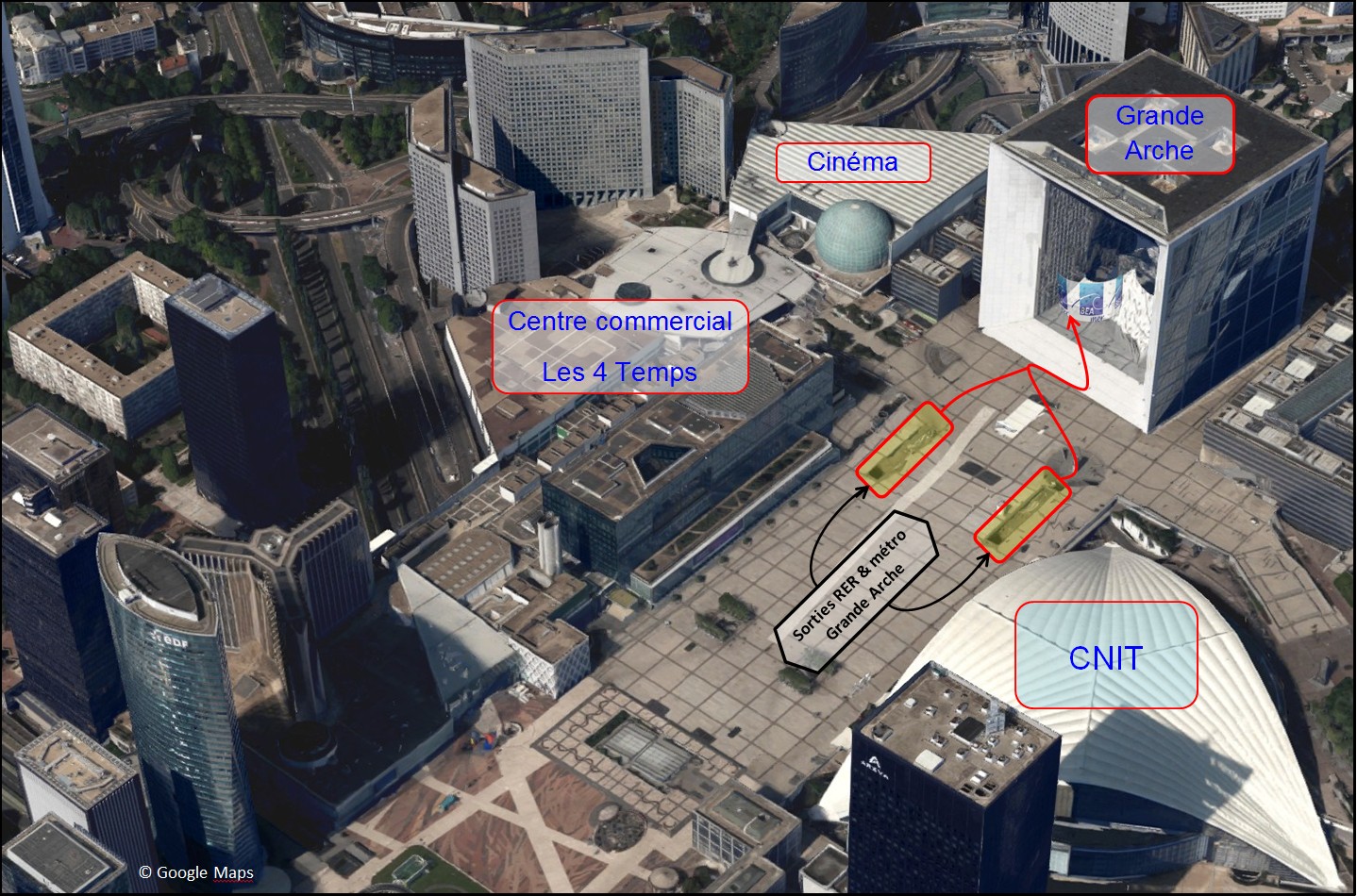
Organisations headquartered in the Grande Arche include the Bureau d'Enquêtes sur les Événements de Mer (BEAmer), the French marine accident investigation agency; and the French Land Transport Accident Investigation Bureau, in the southern portion.<ref>"Contact us." Bureau d'Enquêtes sur les Événements de Mer. Retrieved on 22 June 2017. "Bureau d’enquêtes sur les événements de mer (BEAmer) Arche Sud 92055 LA DEFENSE CEDEX FRANCE" – Note the pedestrian access map</ref><ref>{{#invoke:citation/CS1|citation |CitationClass=web }}</ref>
Cultural representations
Stéphane Demoustier's 2025 film The Great Arch ({{#invoke:Lang|lang}}) dramatized von Spreckelsen's efforts to realize the project.<ref name=mintzer>Jordan Mintzer, "‘The Great Arch’ Review: Claes Bang Captivates as an Unknown Danish Architect Battling French Bureaucrats to Build His Monumental Work". The Hollywood Reporter, 16 May 2025.</ref>
See also
- List of tallest buildings and structures in the Paris region
- {{#invoke:Lang|lang}}
References
Further reading
- François Chaslin et Virginie Picon-Lefebvre, La Grande Arche de La Défense Electa-Moniteur, 1989
- Erik Reitzel Le Cube ouvert. Structures and foundations International conference on tall buildings. Singapore, 1984. Template:ISBN
- Erik Reitzel Les forces dont resultent quelques monuments Parisiens de la Fin du XXe siècle Le pouvoir et la ville à l'époque moderne et contemporaine, Sorbonne 2001. Template:ISBN
External links
- Grande Arche Template:Webarchive (French and English)
- Satellite image from Google Maps
- Panorama during a storm
- Grande Arche (in French)
- ERI.dk
- Grande Arche pictures in Art Days Template:Webarchive
Template:La Défense Template:Puteaux Template:Grands Projets of François Mitterrand Template:Visitor attractions in Paris Template:Skyscrapers in France Template:Authority control Template:Portal bar