Grigory Chukhray
Template:Short description Template:Family name hatnote Template:Infobox film director
Grigory Naumovich ChukhrayTemplate:Efn (23 May 1921Template:Snd28 October 2001) was a Soviet film director and screenwriter of Ukrainian origin.<ref>Template:Cite book</ref> People's Artist of the USSR (1981).<ref name='encyc'>Cinema: Encyclopedic Dictionary // main editor Sergei Yutkevich (1987). — Moscow: Soviet Encyclopedia, 640 pages</ref> He's the father of the Russian film director Pavel Chukhray.
Early life
Grigory Chukhray was born in Melitopol (modern-day Zaporizhzhia Oblast of Ukraine) to Red Army soldiers Naum Zinovievich Rubanov and Claudia Petrovna Chukhray. He was of Ukrainian origin.<ref name='cinema'>Grigori Chukrai, My Cinema. Moscow, 2001, 98 p. Template:ISBN</ref><ref name='podvig'>Award List Template:Webarchive scan at The People's Feat During the Great Patriotic War of 1941—1945 database</ref> His parents divorced when he was three years old. He was raised by a stepfather, Pavel Antonovich Litvinenko, the head of kolkhoz. His mother Claudia Chukhray took an active part in the collectivization and dekulakization of the Ukrainian SSR, then worked as an investigation officer at militsiya.<ref name='cinema' />
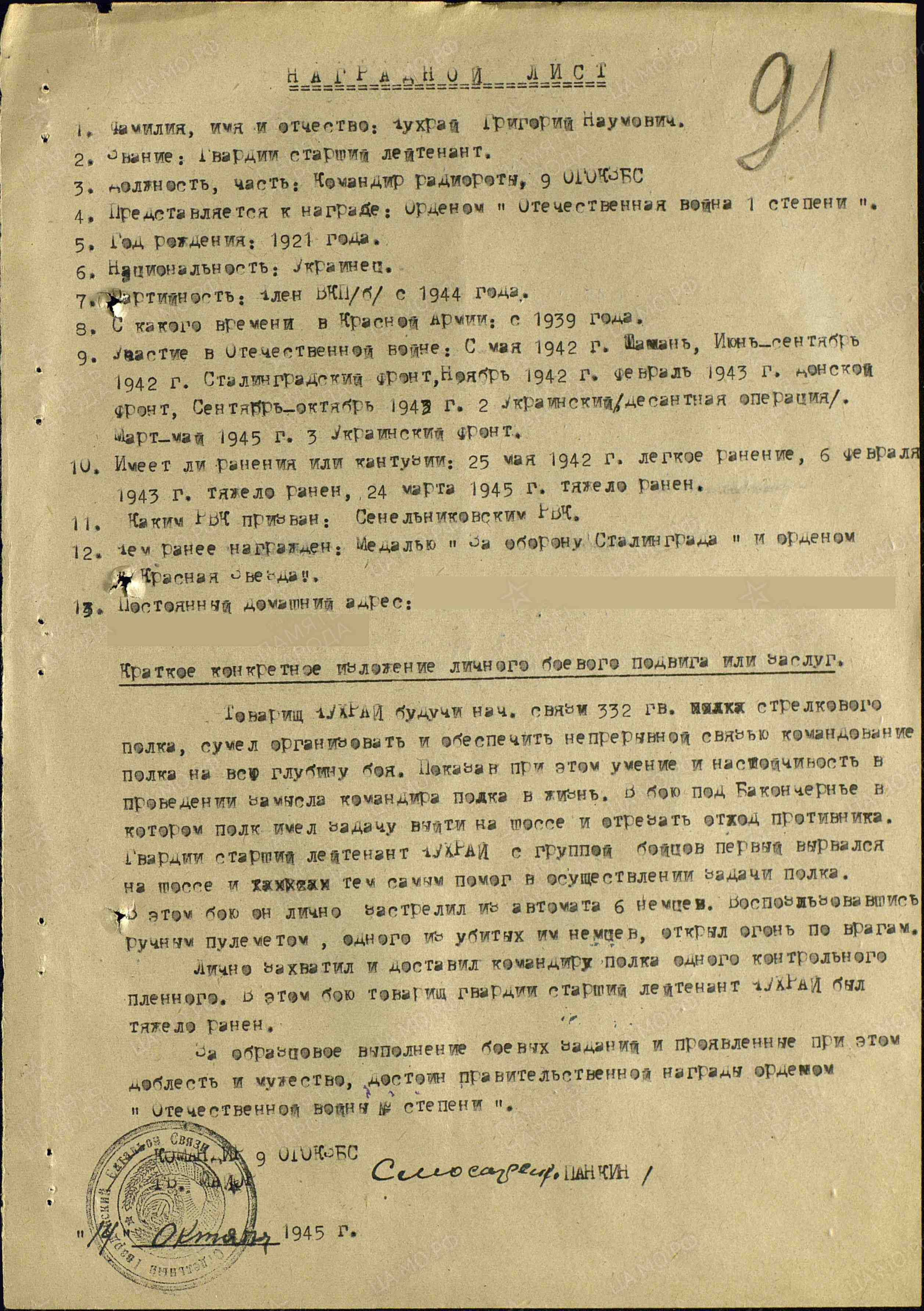
In 1939, he was drafted to the army. A decorated veteran of World War II, Chukhray's wartime experiences profoundly affected him and the majority of his films. He served in the 229th separate communications battalion of the 134th Infantry Division (later part of the 19th Army). He fought at the Southern, Stalingrad and Don Fronts. From 1943 on, he served in airborne troops at the 1st, 2nd and 3rd Ukrainian Fronts and took part in operation "Dnipro Troopers".<ref name="Arkus">{{#invoke:citation/CS1|citation |CitationClass=web }}</ref> He was wounded three times. In 1944, he joined the Communist Party.<ref name='podvig' /><ref>Chukhrai Grigory Naumovich fighting map at The People's Memory 1941—1945 database</ref>
Career
At war's end, he studied filmmaking at VGIK, the course led by Sergei Yutkevich and Mikhail Romm, and then developed his skills as a director's assistant at the Kiev Film Studio. By the mid-1950s, he began writing and directing his own films at the Mosfilm studio, gaining cinematic recognition outside the Soviet Union at the 1957 Cannes Film Festival with his film The Forty-First (1956).<ref name="Arkus"/><ref>{{#invoke:citation/CS1|citation |CitationClass=web }}</ref>
Chukhray directed and co-wrote Ballad of a Soldier (1959). Around the themes of love and the tragedy of war, the film received acclaim at home, earning the Lenin Prize. It was heralded internationally for both its story and cinematic technique. At the 1960 Cannes Film Festival it was awarded a special jury prize for "high humanism and outstanding quality." Ballad of a Soldier premiered in the United States in 1960 at the San Francisco International Film Festival.<ref>Template:Cite book</ref> The film won the Festival's Golden Gate Award, for Best Picture and for Best Director for Grigory Chukhray. Playing worldwide, the following year, it earned the BAFTA Award for Best Film. Grigory Chukhray and script co-writer Valentin Yezhov were also nominated for the 1961 Academy Award for Best Original Screenplay.<ref>{{#invoke:citation/CS1|citation |CitationClass=web }}</ref>
Chukhray's next film was Clear Skies (1961). It told the story of a Soviet pilot who had survived Nazi imprisonment during the war, but was accused of spying. It was one of the first Soviet films to deal with some of the repressive practices under the Soviet leadership of Joseph Stalin. It won the Grand Prix (in a tie with Kaneto Shindo's The Naked Island) at the 2nd Moscow International Film Festival.<ref name="Moscow1961">{{#invoke:citation/CS1|citation |CitationClass=web }}</ref> Two years later Chukhray served as the president of the jury at the 3rd Moscow International Film Festival.<ref name="Moscow1963">{{#invoke:citation/CS1|citation |CitationClass=web }}</ref>
Between 1966 and 1971, Chukhray headed the director's courses at VGIK. In 1965, he founded and headed the Experimental Studio at Mosfilm that produced such films as White Sun of the Desert (1970), The Twelve Chairs (1971), Ivan Vasilievich: Back to the Future (1973), A Slave of Love (1976), and other popular movies. He also served as a member of the State Committee for Cinematography between 1964 and 1991.<ref name='encyc' />

In 1984, Chukhray directed his final Soviet film, together with Yuri Shvyryov: I'll Teach You to Dream. In 1992–1993, he and Rolf Schübel co-directed Todfeinde. Vom Sterben und Überleben in Stalingrad, a joined Russian-Germany documentary in two parts about the Battle of Stalingrad. In this film Chukhray as well as other Russian and German survivors told about their experiences during the battle.
In 1994, Chukhray was awarded a Nika Award for his lifetime contribution to cinema.<ref>Григорий Наумович Чухрай (1921-2001)</ref> In 2001, he published two volumes of memoirs entitled My War and My Cinema, dedicated to his war experience and his work in cinema, respectively.
He was married to Iraida Chukhray (née Penkova), a teacher of Russian language and literature. They had two children: Pavel Chukhray (born 1946), a Russian director, and Elena Chukhray (born 1961), an expert in film studies.
Grigory Chukhray died of heart failure in Moscow in 2001 at the age of eighty. He was buried at the Vagankovo Cemetery, Moscow.
Awards and honors
- Medal "For the Defence of Stalingrad" (1943)
- Order of the Red Star (1944)
- Medal "For the Capture of Vienna" (1945)
- Medal "For the Victory over Germany in the Great Patriotic War 1941–1945" (1945)
- Order of the Patriotic War, 2nd class (1945)
- Lenin Prize (1961)
- Honored Art Worker of the RSFSR (1962)
- Jubilee Medal "Twenty Years of Victory in the Great Patriotic War 1941–1945" (1965)
- People's Artist of the RSFSR (1969)
- Jubilee Medal "In Commemoration of the 100th Anniversary of the Birth of Vladimir Ilyich Lenin" (1970)
- Jubilee Medal "Thirty Years of Victory in the Great Patriotic War 1941–1945" (1975)
- People's Artist of the USSR (1981)
- Order of the Patriotic War, 1st class (1985)
- Nika Award for the Lifetime Achievement Award (1994)
- Order "For Merit to the Fatherland", 4th class (1996)
- Three Orders of the Red Banner of Labour
Filmography
| Year | English Title | Original Title | Notes |
|---|---|---|---|
| 1956 | The Forty-First | Сорок первый | Director; debut film |
| 1959 | Ballad of a Soldier | Баллада о солдате | Director; screenwriter |
| 1961 | Clear Skies | Чистое небо | Director |
| 1965 | There Was an Old Couple | Жили-были старик со старухой | Director |
| 1966 | People! | Люди! | Director |
| 1971 | Memory | Память | Director; documentary |
| 1978 | Untypical Story | Трясина | Director; screenwriter |
| 1979 | Life Is Beautiful | Жизнь прекрасна | Director; screenwriter |
| 1984 | I'll Teach You to Dream | Я научу вас мечтать | Co-director with Yuri Shvyryov; documentary |
See also
Notes
References
External links
- [https://www.imdb.com/{{#if: 0161055
 | name/{{#if:{{#invoke:ustring|match|1=0161055|2=^nm}}
   | Template:Trim/
   | nm0161055/
   }}
 | {{#if: {{#property:P345}}
   | name/Template:First word/
   | find?q=%7B%7B%23if%3A+Grigori+Chukhrai%0A++++++%7C+Grigori+Chukhrai%0A++++++%7C+%5B%5B%3ATemplate%3APAGENAMEBASE%5D%5D%0A++++++%7D%7D&s=nm
   }}
 }}{{#if: 0161055  {{#property:P345}} | {{#switch:
 | award | awards = awards Awards for | biography | bio = bio Biography for
 }}}} {{#if: Grigori Chukhrai
 | Grigori Chukhrai
 | Template:PAGENAMEBASE
 }}] at IMDb{{#if: 0161055{{#property:P345}}
 | Template:EditAtWikidata
 | Template:Main other
}}{{#switch:{{#invoke:string2|matchAny|^nm.........|^nm.......|nm|.........|source=0161055|plain=false}}
 | 1 | 3 =  Template:Main otherTemplate:Preview warning
 | 4 = Template:Main otherTemplate:Preview warning
}}{{#invoke:Check for unknown parameters|check|unknown=Template:Main other|preview=Page using Template:IMDb name with unknown parameter "_VALUE_"|showblankpositional=1| 1 | 2 | id | name | section }}
Template:Grigori Chukhrai Template:BAFTA Best Film recipients Template:Nika Lifetime Achievement Award
- 1921 births
- 2001 deaths
- 20th-century Russian male writers
- 20th-century Russian screenwriters
- People from Melitopol
- Communist Party of the Soviet Union members
- Academic staff of the Gerasimov Institute of Cinematography
- Academic staff of High Courses for Scriptwriters and Film Directors
- Gerasimov Institute of Cinematography alumni
- Bodil Award winners
- Nastro d'Argento winners
- People's Artists of the RSFSR
- People's Artists of the USSR
- Recipients of the Lenin Prize
- Recipients of the Medal of Zhukov
- Recipients of the Nika Award
- Recipients of the Order "For Merit to the Fatherland", 4th class
- Recipients of the Order of the Red Banner of Labour
- Recipients of the Order of the Red Star
- Personnel of the Soviet Airborne Forces
- Russian people of Ukrainian descent
- Russian film directors
- Russian male screenwriters
- Soviet film directors
- Soviet male screenwriters
- Soviet military personnel of World War II
- Ukrainian film directors
- Ukrainian screenwriters
- Burials at Vagankovo Cemetery
- Directors of Best Film BAFTA Award winners