Gwanggaeto the Great
Template:Short description Template:Pp Template:Pp-move Template:Infobox royalty Template:Goguryeo monarchs Gwanggaeto the Great (374–412, r. 391–412)<ref>Template:Cite book</ref> was the nineteenth monarch of Goguryeo. His full posthumous name means "Entombed in Gukgangsang, Broad Expander of Domain,<ref name="Lee">Template:Cite book</ref> Peacemaker,<ref name="name">Template:Cite book</ref> Supreme King", sometimes abbreviated to Hotaewang.<ref name="name" /> His era name is Yeongnak and he is occasionally recorded as Yeongnak Taewang ("Great King" or "Emperor" Yeongnak). Gwanggaeto's imperial reign title meant that Goguryeo was on equal standing as an empire with the imperial dynasties in China.<ref name="Lee" /><ref name="Kim">Template:Cite book</ref><ref name="Jinwung">Template:Cite book</ref>
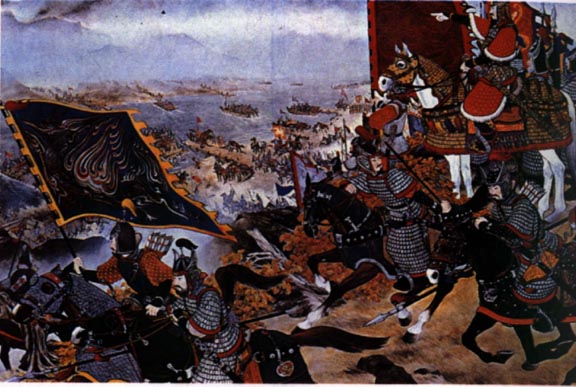
Under Gwanggaeto, Goguryeo began a golden age,<ref>Template:Cite book</ref><ref>Template:Cite book</ref><ref>Template:Cite book</ref> becoming a powerful empire and one of the great powers in East Asia.<ref>Template:Cite book</ref><ref>Template:Cite book</ref><ref>Template:Cite book</ref><ref>Template:Cite book</ref> Gwanggaeto made enormous advances and conquests into: Western Manchuria against Khitan tribes; Inner Mongolia and the Maritime Province of Russia against numerous nations and tribes;<ref>Template:Cite book</ref><ref>Template:Cite book</ref> and the Han River valley in central Korea to control over two-thirds of the Korean peninsula.<ref name="Kim" /><ref name="Jinwung" />
In regard to the Korean Peninsula, Gwanggaeto defeated Baekje, the then most powerful of the Three Kingdoms of Korea,<ref name="Kim" /> in 396, capturing the capital city of Wiryeseong in present-day Seoul.<ref>Template:Cite book</ref> In 399, Silla, the southeastern kingdom of Korea, sought aid from Goguryeo due to incursions by Baekje troops and their Wa allies from the Japanese archipelago.<ref name="Jinwung" /> Gwanggaeto dispatched 50,000 expeditionary troops,<ref>Template:Cite book</ref> crushing his enemies and securing Silla as a de facto protectorate;<ref name="Jinwung" /><ref name="Cengage">Template:Cite book</ref> he thus subdued the other Korean kingdoms and achieved a loose unification of the Korean peninsula under Goguryeo.<ref name="Jinwung" /><ref>Template:Cite book</ref><ref name="KBS1">{{#invoke:citation/CS1|citation |CitationClass=web }}</ref> In his western campaigns, he defeated the Xianbei of the Later Yan empire and conquered the Liaodong peninsula,<ref name="Kim" /> regaining the ancient domain of Gojoseon.<ref name="Jinwung" /><ref name="tong">Template:Cite book</ref>
Gwanggaeto's accomplishments are recorded on the Gwanggaeto Stele, erected in 414 at the supposed site of his tomb in Ji'an along the present-day China–North Korea border.<ref name="maps">Template:Cite book</ref> Constructed by his son and successor Jangsu, the monument to Gwanggaeto the Great is the largest engraved stele in the world.<ref>Template:Cite book</ref><ref>{{#invoke:citation/CS1|citation |CitationClass=web }}</ref>Template:Unreliable source?
Family
- Father: King Gogukyang (Template:Korean)
- Grandfather: King Gogukwon (Template:Korean)
- Unknown wife
- Son: Prince Georyeon (Template:Korean)
- Unknown son; father of Go Seung-cheon (Template:Korean).
Birth and background
At the time of Gwanggaeto's birth, Goguryeo was not as powerful as it once had been. In 371, three years prior to Gwanggaeto's birth, the rival Korean kingdom of Baekje, under the great leadership of Geunchogo, soundly defeated Goguryeo, slaying the monarch Gogukwon and sacking Pyongyang.<ref>Template:Cite book</ref><ref>Template:Cite book</ref> Baekje became one of the dominant powers in East Asia. Baekje's influence was not limited to the Korean peninsula, but extended across the sea to Liaoxi and Shandong in China, taking advantage of the weakened state of Former Qin, and Kyushu in the Japanese archipelago.<ref>Template:Cite book</ref> Goguryeo was inclined to avoid conflicts with its ominous neighbor,<ref name="Middleton" /> while cultivating constructive relations with the Former Qin,<ref>Template:Cite book</ref> the Xianbei, and the Rouran, in order to defend itself from future invasions and to bide time to reshape its legal structure and to initiate military reforms.<ref name="Sosurim">Template:Cite book</ref>
Gogukwon's successor, Sosurim, adopted a foreign policy of appeasement and reconciliation with Baekje,<ref name="Middleton">Template:Cite book</ref> and concentrated on domestic policies to spread Buddhism throughout Goguryeo's social and political systems.<ref>Template:Cite book</ref> Furthermore, due to the defeats that Goguryeo had suffered at the hands of Baekje as well as the proto-Mongol Xianbei, Sosurim instituted military reforms aimed at preventing such defeats in the future.<ref name="Sosurim" /> Sosurim's internal arrangements laid the groundwork for Gwanggaeto's expansion.<ref name="Lee" />
Sosurim's successor, Gogukyang, invaded Later Yan, the successor state of Former Yan, in 385 and Baekje in 386.<ref>{{#invoke:citation/CS1|citation |CitationClass=web }}</ref><ref>{{#invoke:citation/CS1|citation |CitationClass=web }}</ref>
Reign
Rise to power and campaigns against Baekje
Gwanggaeto succeeded his father, Gogukyang, upon Gogukyang's death in 391. Upon Gwanggaeto's coronation, Gwanggaeto adopted the era name Yeongnak (Eternal Rejoicing) and the title Taewang (Supreme King), which was equivalent to "emperor",<ref>Template:Cite journal</ref> affirming that he was an equal to the Imperial rulers of China.<ref name="Lee" /><ref name="Kim" /><ref name="Jinwung" />
In 392, Gwanggaeto led an attack on Baekje with 40,000 troops, capturing 10 walled cities.<ref name="seob">Template:Cite book</ref> In response, Asin, the monarch of Baekje, launched a counterattack on Goguryeo in 393 but was defeated.<ref name="seob" /> Despite the ongoing war, during 393, Gwanggaeto established 9 Buddhist temples in Pyongyang.<ref>Template:Cite book</ref><ref>Template:Cite book</ref> Asin invaded Goguryeo once more in 394, but was defeated again.<ref name="seob" /> After suffering multiple defeats against Goguryeo, Baekje's political stability began to crumble.<ref name="KBS1" /> In 395, Baekje was defeated once more by Goguryeo and was pushed south to its capital of Wiryeseong on the Han River.<ref name="seob" /><ref>Template:Cite book</ref> In the following year, in 396, Gwanggaeto led an assault on Wiryeseong by land and sea, using the Han River, and triumphed over Baekje.<ref name="seob" /> Gwanggaeto captured the Baekje capital and the defeated Asin submitted to him,<ref name="Jinwung" /><ref>Jeon ho-tae, 〈Koguryo, the origin of Korean power & pride〉, Dongbuka History Foundation, 2007. Template:ISBN p.137</ref> surrendering a prince and 10 government ministers.<ref name="seob" /><ref>Template:Cite journal</ref>

Northern conquests
In 395, while his campaign against Baekje was ongoing to the south, Gwanggaeto made an excursion to invade the Khitan Baili clan to the west on the Liao River,<ref>Template:Cite encyclopedia</ref> destroying 3 tribes and 600 to 700 camps.<ref>Template:Cite book</ref> In 398, Gwanggaeto conquered the Sushen people to the northeast,<ref name="Jinwung" /> who were Tungusic ancestors of the Jurchens and Manchus.<ref>Template:Cite book</ref>
In 400, while Gwanggaeto was occupied with Baekje, Gaya, and Wa troops in Silla, the Xianbei state of Later Yan, founded by the Murong clan in present-day Liaoning, attacked Goguryeo.<ref name="seob2">Template:Cite book</ref> Gwanggaeto repulsed the Xianbei troops.<ref name="tong" /><ref name="KBS2">{{#invoke:citation/CS1|citation |CitationClass=web }}</ref> In 402, Gwanggaeto retaliated and conquered the prominent fortress called 宿軍城 near the capital of Later Yan.<ref name="seob2" /><ref>Template:Cite book</ref> In 405 and again in 406, Later Yan troops attacked Goguryeo fortresses in Liaodong (遼東城 in 405, and 木底城 in 406), but were defeated both times.<ref name="seob2" /> Gwanggaeto conquered all of Liaodong.<ref name="Lee" /><ref name="Jinwung" /> By conquering Liaodong, Gwanggaeto recovered the ancient domain of Gojoseon;<ref name="Jinwung" /><ref name="tong" /> Goguryeo controlled Liaodong until the mid-late 7th century.
In 407, Gwanggaeto dispatched 50,000 troops consisting of infantry and cavalry and won a great victory, completely annihilating the enemy troops and pillaging about 10,000 armors and countless war supplies; the opponent can be interpreted as Later Yan, Baekje, or Wa.<ref name="seob2" /><ref>Template:Cite book</ref>
In 410, Gwanggaeto attacked Eastern Buyeo to the northeast.<ref name="seob2" />
Southern campaigns
Template:See also In 400, Silla, another Korean kingdom in the southeast of the Korean peninsula, requested aid from Goguryeo in repelling an allied invasion by Baekje, Gaya, and Wa. Gwanggaeto dispatched 50,000 troops and annihilated the enemy coalition.<ref name="Jinwung" /> Thereupon, Gwanggaeto influenced Silla as a suzerain,<ref name="Cengage" /> and Gaya declined and never recovered. In 402, Gwanggaeto returned Prince Silseong,<ref>Template:Cite journal</ref> who had resided in Goguryeo as a political hostage since 392, back home to Silla and appointed him as the king of Silla.
In 404, Gwanggaeto defeated an attack by the Wa from the Japanese archipelago on the southern border of what was once the Daifang commandery, inflicting enormous casualties on the enemy.<ref name="seob2" /><ref>Template:Cite book</ref><ref>Template:Cite book</ref>
Death and legacy

Gwanggaeto died of an unknown illness in 412 at the age of 38. He was succeeded by his eldest son, Jangsu, who ruled Goguryeo for 79 years until the age of 97,<ref name="Lee" /> the longest reign in East Asian history.<ref>Template:Cite book</ref>
Gwanggaeto's conquests are said to mark the zenith of Korean history, building and consolidating a great empire in Northeast Asia and uniting the Three Kingdoms of Korea under his influence.<ref name="Jinwung" /><ref name="KBS1" /> Gwanggaeto conquered 64 walled cities and 1,400 villages.<ref name="Lee" /><ref name="Jinwung" /> Except for the period of 200 years beginning with Jangsu, who would build upon his father's domain, and the golden age of Balhae, Korea never before or since ruled such a vast territory. There is archaeological evidence that Goguryeo's maximum extent lay even further west in present-day Mongolia, based on discoveries of Goguryeo fortress ruins in Mongolia.<ref>{{#invoke:citation/CS1|citation |CitationClass=web }}</ref><ref>{{#invoke:citation/CS1|citation |CitationClass=web }}</ref><ref>{{#invoke:citation/CS1|citation |CitationClass=web }}</ref> Gwanggaeto established his own era name, Yeongnak Eternal Rejoicing, proclaiming Goguryeo monarchs equal to their counterparts in the Chinese mainland.<ref name="Lee" /><ref name="Kim" /><ref name="Jinwung" />
Gwanggaeto the Great is one of two rulers of Korea whose names are appended with the title "the Great", with the other being Sejong the Great of Joseon, who created Hangul the Korean alphabet, to promote literacy among the common people,<ref>Template:Cite book</ref> and made great advances in science.<ref>Template:Cite book</ref><ref name="science">Template:Cite book</ref>
Gwanggaeto is regarded by Koreans as one of the greatest heroes in Korean history, and is often taken as a potent symbol of Korean nationalism.
The Gwanggaeto Stele, a Template:Convert monument erected by Jangsu in 414, was rediscovered in the late 19th century.<ref name="maps" /> The stele was inscribed with information about Gwanggaeto's reign and achievements, but not all the characters and passages have been preserved. Korean and Japanese scholars disagree on the interpretation in regard to passages on the Wa.
The Republic of Korea Navy operates Gwanggaeto the Great-class destroyers, built by Daewoo Heavy Industries and named in honor of the monarch.
A prominent statue of Gwanggaeto alongside a replica of the Gwanggaeto Stele were erected in the main street of Guri in Gyeonggi Province.<ref>{{#invoke:citation/CS1|citation |CitationClass=web }}</ref><ref>{{#invoke:citation/CS1|citation |CitationClass=web }}</ref>
Depiction in arts and media
Film and television
- Portrayed by Yoo Seung-ho and Bae Yong-joon in the 2007 MBC TV series The Legend.
- Portrayed by Lee Tae-gon in the 2011–2012 KBS1 TV series Gwanggaeto, The Great Conqueror.<ref>{{#invoke:citation/CS1|citation
|CitationClass=web }}</ref>
- Portrayed by Lee Do-yeob in the 2017 KBS1 docudrama Chronicles of Korea.
Literature
Many novels, comics, and games about Gwanggaeto the Great have been released in South Korea.<ref>Template:Cite book</ref><ref>{{#invoke:citation/CS1|citation |CitationClass=web }}</ref><ref>{{#invoke:citation/CS1|citation |CitationClass=web }}</ref>
Games
The popular<ref>{{#invoke:citation/CS1|citation |CitationClass=web }} 5,000,000 - 10,000,000 downloads</ref> and award-winning<ref>{{#invoke:citation/CS1|citation |CitationClass=web }}</ref> Korean mobile game Hero for Kakao features Gwanggaeto as a playable character.<ref>{{#invoke:citation/CS1|citation |CitationClass=web }}</ref>
Age of Empires: World Domination, a mobile game produced in collaboration with series owner Microsoft,<ref>{{#invoke:citation/CS1|citation |CitationClass=web }}</ref> includes Gwanggaeto as a selectable hero of the Korean civilization.<ref>{{#invoke:citation/CS1|citation |CitationClass=web }}</ref>
Others
The International Taekwon-Do Federation created a pattern, or teul, to honor Gwanggaeto the Great. The pattern's diagram represents Gwanggaeto's territorial expansion and recovery of lost territories, and the 39 movements represent the first two numbers of 391 AD, the year when Gwanggaeto came to the throne.<ref>{{#invoke:citation/CS1|citation |CitationClass=web }}</ref>
See also
References
External links
- Template:In lang Campaigns of Gwanggaeto The Great
- Picture of Gwanggaeto The Great
- Template:In lang An Attempt to Reconstruct the King's Southerly Conquest
- Template:In lang [1]
Template:S-start Template:S-hou Template:S-reg Template:S-bef Template:S-ttl Template:S-aft Template:S-end