HMS Archer (D78)
Template:Short description Template:Other ships Template:EngvarB Template:Use dmy dates Template:Infobox ship HMS Archer was a Template:Sclass built by the United States in 1939–1940 and operated by the Royal Navy during World War II. She was built as the cargo ship Mormacland, but was converted to an escort carrier and renamed HMS Archer. Her transmission was a constant cause of problems which led to her being withdrawn from front-line service. She was used as a stores ship and then as an accommodation ship before a refit and subsequent use as a merchant aircraft ferry ship, Empire Lagan.
She was returned to the US Navy, then laid up as Archer before being sold into merchant service and converted to a passenger ship, Anna Salén. She was used to take emigrants to Australia and Canada in the early 1950s. She was sold and renamed Tasmania and after further service as an emigrant ship was converted back to a cargo ship. She was later sold and renamed Union Reliance. She was scrapped after a collision and fire in 1961.
Description and construction
Mormacland was laid down as a Type C3 cargo shipTemplate:Sfn on 1 August 1939, under United States Maritime Commission contract (MC Hull 46),<ref name=Archer>{{#invoke:citation/CS1|citation |CitationClass=web }}</ref> by the Sun Shipbuilding and Drydock Company, Chester, Pennsylvania, as Yard number 184.<ref name=Ships>Template:Cite book</ref> She was launched on 14 December 1939 and completed on 24 April 1940.<ref name=Archer/>
She was powered by four Template:Cvt seven-cylinder<ref>Template:Cite magazine</ref><ref name=Ships/> two-stroke single-acting diesel engines.<ref name=Mormacland/> These drove a single screw<ref name=Ships/> via Westinghouse electro-magnetic slip couplings and Falk single reduction gears. The engines were built by Busch-Sulzer Brothers Diesel Engine Co, St Louis, Missouri with 20½ inches bore and 27 inches stroke (520 mm by 690 mm). They developed a total of Template:Convert<ref name=Mormacland/> each. As HMS Archer, she had a range of Template:Convert at Template:Convert.<ref name=Navsource>{{#invoke:citation/CS1|citation |CitationClass=web }}</ref> The propulsion system was also used on the four sister ships built by Sun Shipbuilding in 1939: Mormacpenn, Mormacyork, Mormacland and Mormacmail
HMS Archer was the only Template:Sclass in service with the Royal Navy during the Second World War. She was converted from the American merchant ship Mormacland which was built at the Sun Shipbuilding and Drydock Company. She was laid down on 1 August 1939, launched on 14 December 1939 and delivered on 24 April 1940.<ref name=co78>Cocker (2008), p.78.</ref><ref name=po29/><ref>{{#invoke:citation/CS1|citation |CitationClass=web }}</ref>
She was converted to an escort aircraft carrier at Newport News Shipbuilding & Drydock Co, Newport News, Virginia and commissioned into the Royal Navy on 17 November 1941.
Archer had a complement of 555 men and an overall length of Template:Convert, a beam of Template:Convert and a height of Template:Convert.<ref name=co78/> She displaced Template:Convert at normal load and Template:Convert at deep load. Propulsion was provided by four diesel engines connected to one shaft giving Template:Convert, which could propel the ship at Template:Convert.<ref name=co79>Cocker (2008), p.79.</ref>
Aircraft facilities were a small combined bridge–flight control on the starboard side and above the Template:Convert-long wooden flight deck, one aircraft lift Template:Convert, one aircraft catapult and nine arrestor wires. Aircraft could be housed in the Template:Convert half hangar below the flight deck.<ref name=po29>Poolman (1972), p.29.</ref><ref name=co79/> Armament comprised three single mounted 4-inch dual purpose anti-aircraft guns and fifteen 20 mm cannons on single or twin mounts.<ref name=co79/> She had the capacity for fifteen aircraft which could be a mixture of Grumman Martlet or Hawker Sea Hurricane fighter aircraft and Fairey Swordfish or Grumman Avenger anti-submarine aircraft.<ref name=co79/>
Service history
Mormacland was assessed at Template:GRT.<ref name=Mormacland>{{#invoke:citation/CS1|citation |CitationClass=web }}</ref> She was operated by Moore-McCormack Lines Inc., with New York as her homeport, until 6 March 1941 when she was requisitioned by the United States NavyTemplate:Sfn and sent to Newport News Shipbuilding & Drydock Co, Newport News, Virginia, for conversion to an aircraft carrier.<ref name=Ships/>
BAVG 1
When requisitioned by the US Navy, Mormacland was designated BAVG-1, the first hull of the series intended for delivery to the Royal Navy. The conversion consisted of a lightweight wooden flight deck on a truss frame being added on top of the ship which covered about 70% of the ship's length. The deck was serviced by a single lift aft where the aircraft hangar was situated.<ref name=Archer/> The conversion was completed on 15 November 1941.<ref name=Archer/> As converted, she was transferred to the Royal Navy.Template:Sfn
Archer was a sister of the Template:USS. Like the Long Island, the Archer had no island structure. Her original bridge was retained and extended at the sides to provide visibility. Her funnel was replaced by twin diesel vents to either side of the flight deck. Her Busch-Sulzer engines sometimes produced so much black smoke that landing aircraft couldn't see the batman or flight deck.<ref name=Archer/>
HMS Archer
Two days after the conversion was completed, BAVG-1 was transferred to and commissioned in the Royal Navy as part of the Lend-Lease program.<ref name=Ships/> On 23 December 1941, three US Navy Grumman F4F Wildcats landed on Archer for trials to the launch accelerator. The accelerator misfired, causing the first aircraft to dive into the sea as sufficient airspeed had not been gained. The remaining two aircraft were successfully flown off. Archer put into the Philadelphia Naval Shipyard on 24 December 1941 for repairs to the accelerator, which had been damaged in the misfire. On 2 January 1942, Archer successfully completed her sea trials. On 9 January, she sailed down the Delaware River bound for Norfolk, Virginia, where she was to load aircraft for ferrying to the United Kingdom. Her gyro compass failed near Goose Island and then her engines developed problems. After repairs were effected she arrived at Norfolk and on 12 January she embarked eleven Martlet Is.<ref name=Archer/>
She departed Norfolk on 13 January but was soon in trouble, as her steering developed a fault and her gyro compass failed. Repairs were made and she set course for Kingston, Jamaica.<ref name=Archer/> Later that day Archer had a collision with the Template:GRT U.S. freighter Brazos some Template:Convert east of Charleston, South Carolina (Template:Coord).<ref>{{#invoke:citation/CS1|citation |CitationClass=web }}</ref><ref>{{#invoke:citation/CS1|citation |CitationClass=web }}</ref><ref name=NYT142>Template:Cite journal</ref><ref>Template:Cite journal</ref> Archer sustained damage to her bow, and eventually settled down at the bow by 5 degrees after the damage and flooding had been contained. Both ships were dead in the water. The 35 crewmembers of Brazos transferred to Archer in their own lifeboats and Brazos sank on 14 January. ArcherTemplate:'s captain had radioed for assistance and at first light started to make for the coast, but as her propeller was half out of the water, progress was minimal. On 16 January, Archer rendezvoused with US Coast Guard tug Template:USCGC which unsuccessfully attempted to tow Archer. It was decided that Archer should continue under her own power until a more powerful tug could assist her. On 17 January, Template:USS reached her and proceeded to tow her to Charleston, where she arrived on 21 January. She entered dry dock on 28 January for repairs, which took about six weeks.<ref name=Archer/>
On 7 March 1942, Archer embarked twelve Martlets for delivery to Template:HMS and her own four Fairey Swordfish aircraft of 834 Squadron which had flown out from Jamaica. She sailed on 18 March for San Juan, Puerto Rico, in company with Template:HMS and two destroyers as part of Convoy AS 2. On 22 March Archer again had problems with her steering gear. She put into San Juan on 23 March and rejoined the convoy on 24 March. Anti-submarine patrols were carried out without a sighting, although one Swordfish was badly damaged on 30 March when it lost its tailhook and ended up in the safety barrier. Although her engines and gyro compass continued to give trouble, she arrived at Freetown. Sierra Leone on 3 April. On 9 April, ArcherTemplate:'s twelve brand new Martlets were transferred to Illustrious and two Martlets from Illustrious were transferred to Archer.<ref name=Archer/>
On 15 June 1942, one of her Swordfish aircraft became the first ever aircraft to land on Ascension Island. The aircraft's crew were looking for survivors from SS Lyle Park which had been sunk by Template:GS. They landed to pass on a message destined for the Admiralty.<ref name=FAA/>
ArcherTemplate:'s powerplant continued to give trouble, particularly the electro-magnetic clutches. If the clutch disengaged the engines would race at high revs and had to be shut down in order for repairs to be made. This was particularly problematic if aircraft were flying or there were enemy submarines nearby. On 26 June, Archer departed Freetown bound for Bermuda, where she was to undergo repairs. Work started on 15 July and took some fourteen weeks to complete. Archer then sailed to New York City where she joined Convoy UGS 2 which departed New York on 2 November bound for Casablanca, Morocco. She ferried 30 Curtiss P-40 Warhawks and US personnel to Casablanca. She then sailed to Gibraltar to join convoy MKF 3 which departed Gibraltar on 27 November. When Archer arrived in the UK, she was sent to Liverpool for another refit which commenced on 4 December. Her flight deck was lengthened at this refit.<ref name=Archer/>

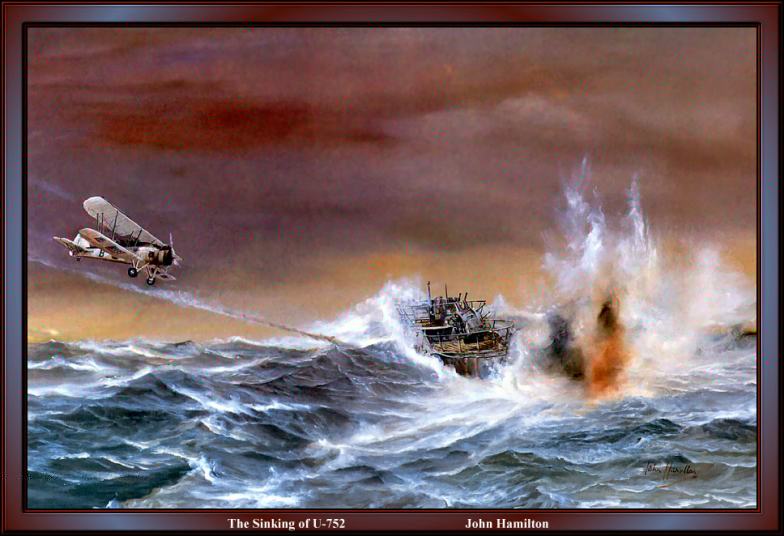
On 19 February 1943, Archer embarked nine Martlet Vs of 892 Squadron and on 28 February embarked nine Swordfish Mk II aircraft of 819 Squadron.<ref name=Archer/> She was inspected by King George VI the following day and then sent to shipyards on the Clyde and at Belfast for further rectification work. In early May, Archer joined the 4th Escort Group off Iceland on convoy support operations.<ref name=Archer/> She joined Convoy ONS 6 on 9 May and then Convoy ON 182 on 12 May, leaving these convoys on 14 May. On 21 May she joined Convoy HX 239.<ref name=Convoy>{{#invoke:citation/CS1|citation |CitationClass=web }}</ref> On 23 May, a Swordfish II of 819 Squadron sank U-752 with a Rocket Spear, a new weapon,<ref name=FAA/> at Template:Coord. The thirteen survivors were rescued by Template:HMS.<ref name=Convoy/> U-752 was the first German U-boat to be sunk with rockets and only the second to be sunk by aircraft that operated from an escort aircraft carrier.<ref name=Archer/> Archer left Convoy HX 239 on 24 May. She then joined Convoy KMS 18B on 26 June and left that convoy on 3 July.<ref name=Convoy/> She was then withdrawn from the 4th Escort Group to take part in exercises in the Irish Sea. Following these exercises, she was sent to the Bay of Biscay on anti-submarine patrol duty, but was withdrawn from this after a week due to a lack of U-boat activity and further defects. She arrived at Devonport on 27 July and work commenced the following day. Archer then sailed to the Clyde for engine repairs, arriving on 3 August.<ref name=Archer/>
It was found that Archer had extensive defects and she was decommissioned with effect from 6 November 1943. She was relegated to use as a stores ship at Gare Loch. In March 1944, Archer was towed to Loch Alsh where she was used as an accommodation ship until August when she was sent to Belfast for repairs to enable her to be used as an aircraft ferry ship. Repairs were to take seven and a half months.<ref name=Archer/>
Archer was the first of thirty-eight US-built converted C3 Escort Carriers turned over to Great Britain during the period 1941–1944,<ref name=Ace>{{#invoke:citation/CS1|citation |CitationClass=web }}</ref> and one of five motor ships (the remainder were powered by geared turbines). Unlike the others, Archer was powered by four diesel engines instead of two.<ref name=FAA>{{#invoke:citation/CS1|citation |CitationClass=web }}</ref>
Empire Lagan
On completion of the repairs on 15 March 1945,<ref name=Archer/> HMS Archer was transferred to the Ministry of War Transport and renamed Empire Lagan.<ref name=Ships/> She was used to ferry aircraft to the United Kingdom. Converted to a cargo ship,<ref name="Plowman">Plowman, Peter (2006): Australian Migrant Ships 1946–1977. Rosenberg Publishing Pty Ltd. Pp 58–59. Template:ISBN</ref> she operated under the management of the Blue Funnel Line<ref name=Archer/> and later A Holt & Co. Empire Lagan was homeported in London.<ref name=Lagan>{{#invoke:citation/CS1|citation |CitationClass=web }}</ref> Empire Lagan returned to the US in Convoy UC 69, which departed Liverpool on 24 May 1945 and arrived at New York on 3 June 1945. She then sailed to Norfolk, Virginia.<ref name=UC69>{{#invoke:citation/CS1|citation |CitationClass=web }}</ref>
Archer
On 9 January 1946,<ref name=FAA/> Empire Lagan was returned to the US Navy and renamed USS Archer. She was stricken from the US Navy register on 26 February 1946.<ref name=Archer/> MV Archer was laid up at Norfolk, Virginia.<ref name=Ships/> On 30 September 1947 she was sold to Mr J F Luley, New York for commercial service.<ref name=Danfs>Template:Cite DANFS</ref>
Anna Salén
.jpg)
In 1948 Archer was bought by Swedish businessman Sven Salén, and registered under the ownership of Rederi Pulp AB;<ref name=Archer/> her homeport was Stockholm.<ref name=Stockholm>{{#invoke:citation/CS1|citation |CitationClass=web }}</ref> She was renamed Anna Salén and, after initial conversion into a bulk carrier at the Bethlehem Shipyard in Baltimore, took a load of coal from the US to Italy.<ref name="Plowman" /> By this time the owners had obtained a contract from the International Refugee Organization to transport Displaced Persons from Europe to Australia<ref name=Ships/><ref name=Plowman/> and Canada.<ref name=Archer/> After arrival in Italy, Anna Salén was then converted to a passenger ship, with basic accommodation being built into the cargo holds<ref name=Plowman/> and the superstructure being extended from the foc's'le to the stern.<ref name=Ships/> There was accommodation for 1500 passengers in a single class.<ref name=Plowman/> After the rebuild she was Template:GRT. Her maiden voyage as a passenger ship (22 May—21 June 1949) was from Naples, Italy, to Melbourne and Sydney.<ref name=Plowman/><ref name=Film/> In December 1949, on her fourth<ref name=Plowman/><ref name="fifthfleet">Ann Tündern-Smith: fifthfleet.net > Ships of the Fifth Fleet Retrieved 19 January 2014.</ref> voyage to Australia as Anna Salén she broke down in the Indian Ocean<ref name=Mende>{{#invoke:citation/CS1|citation |CitationClass=web }}</ref> and limped into Aden, where her passengers were transferred to another ship, the Skaugum, to complete their voyage.<ref name=Plowman/> After repairs were completed, Anna Salén resumed service. Her next two voyages, beginning on 20 June and 27 November 1950, departed from Bremerhaven bound for Australia.<ref name=Plowman/><ref name="fifthfleet" /> During the latter journey, one of the emigrants, Herr Gustav Kovaks, made a film about the voyage.<ref name=Film/><ref name=Maker>{{#invoke:citation/CS1|citation |CitationClass=web }}</ref> It was later widely shown in Germany to give people a view of how the emigration process worked. Anna Salén arrived at Fremantle on 31 December 1950 and sailed for Melbourne later that day. It was realised that she couldn't make Melbourne before the New Year, so for political reasons Anna Salén was ordered back to Fremantle where all 1,522 passengers were disembarked.<ref name=Film>{{#invoke:citation/CS1|citation |CitationClass=web }}</ref>
In the early to mid-1950s, Anna Salén was used between Europe, Saigon and Australia.<ref name=Mende/> On 8 September 1951, Ursula K. Le Guin and her brother Karl Kroeber sailed from Southampton to New York on Anna Salén,<ref>{{#invoke:citation/CS1|citation |CitationClass=web }}</ref> returning from a holiday in Europe. Later that year, on 26 December 1951, Anna Salén came across the Canadian coaster SS Mayfall flying a distress signal. She had encountered bad weather and run out of fuel. Anna Salén towed Mayfall to St Johns and then continued her journey to Halifax<ref name=Rescue>{{#invoke:citation/CS1|citation |CitationClass=web }}</ref> On 13 August 1952, Anna Salén collided with the Template:GRT Norwegian whaler SS Thorshovdi in the Pentland Firth. She put into Lyness with damage to her bows.<ref name=Whaler>{{#invoke:citation/CS1|citation |CitationClass=web }}</ref> On 2 July 1953 Anna Salén departed Bremen, West Germany to make a round trip to Quebec, Canada<ref name=List/> The journey took seven days. She continued to transport new migrants to Australia through 1954. She was sold in 1955 to a Greek buyer.<ref name=Ships/>
Tasmania
Anna Salén was bought by Compagnia Navigazione Tasmania SA, Piraeus and renamed Tasmania. She was placed under the management of Hellenic Mediterranean Lines and used on routes between French ports and Australia.<ref name=Ships/> and also on the Piraeus – Melbourne route of Hellenic Mediterranean Lines.<ref name=Archer/> In 1958, she was converted to a cargo ship of Template:GRT.<ref name=List>{{#invoke:citation/CS1|citation |CitationClass=web }}</ref> She was sold to a Taiwanese buyer in 1961.<ref name=Ships/>
Union Reliance
Tasmania was bought by the China Union Lines of Taipei. She was renamed Union Reliance.<ref name=Ships/> She was used on routes between Taipei and the US.<ref name=Mende/> On 7 November 1961, she collided with the Template:GRT Norwegian tanker MV Berea in the Houston Ship Channel. As a result of the collision, Union Reliance caught fire and then ran aground.<ref name=Ships/> Twelve people aboard the Union Reliance were killed in the collision and subsequent fire. Union Reliance was abandoned by her owners.<ref name=Court>{{#invoke:citation/CS1|citation |CitationClass=web }}</ref> The wreck was removed on 9 November<ref name=Ships/> by the United States authorities<ref name=Court/> and towed to Galveston, Texas<ref name=Ships/> China Union Lines refused to make payment for this, and filed a Petition for Exoneration from, or Limitation of Liability. The Court ordered that Union Reliance and her cargo be sold to pay off costs incurred by the United States authorities. On 12 January 1962, Union Reliance was sold for US$109,100 for scrap.<ref name=Court/> She was scrapped at New Orleans in March 1962.<ref name=Ships/>
Official Number and code letters
Official Numbers were a forerunner to IMO Numbers. Mormacland had the US Official Number 239370 and used the Code Letters WDSH.<ref name=Mormacland/> Empire Lagan had the UK Official Number 180557 and used the Code Letters GNCX<ref name="Lagan"/>
References
Bibliography
- Template:Cite book
- Template:Cite book
- Template:Cite book
- {{#invoke:citation/CS1|citation
|CitationClass=web }}
External links
Template:Military navigation Template:Type C3 ships Template:Empire ships Template:1961 shipwrecks
- Long Island-class escort carriers
- Type C3 ships of the Royal Navy
- 1939 ships
- Escort carriers of the Royal Navy
- World War II aircraft carriers of the United Kingdom
- Empire ships
- Ships built by the Sun Shipbuilding & Drydock Company
- World War II merchant ships of the United Kingdom
- Merchant ships of Sweden
- Cargo ships of Greece
- Cargo ships of Taiwan
- Maritime incidents in 1961