HMS Dorsetshire (40)
Template:Short description Template:Other ships Template:Good article Template:EngvarB Template:Use dmy dates
Template:Infobox ship imageTemplate:Infobox ship careerTemplate:Infobox ship characteristicsHMS Dorsetshire (pennant number 40) was a Template:Sclass2 heavy cruiser of the British Royal Navy, named after the English county, now usually known as Dorset. The ship was a member of the Norfolk sub-class, of which Template:HMS was the only other unit; the County class comprised a further eleven ships in two other sub-classes. Dorsetshire was built at the Portsmouth Dockyard; her keel was laid in September 1927, she was launched in January 1929, and was completed in September 1930. Dorsetshire was armed with a main battery of eight Template:Cvt guns, and had a top speed of Template:Convert.
Dorsetshire served initially in the Atlantic Fleet in the early 1930s, before moving to become the flagship of the Commander-in-Chief, Africa in 1933, and then to the China Station in late 1935. She remained there until the outbreak of the Second World War in September 1939, when she was transferred to the South Atlantic. There, she reinforced the search for the German heavy cruiser Template:Ship. In late May 1941, Dorsetshire took part in the final engagement with the battleship Bismarck, which ended when Dorsetshire was ordered to close and torpedo the crippled German battleship. She joined searches for the heavy cruiser Template:Ship in August and the auxiliary cruiser Template:Ship in November.
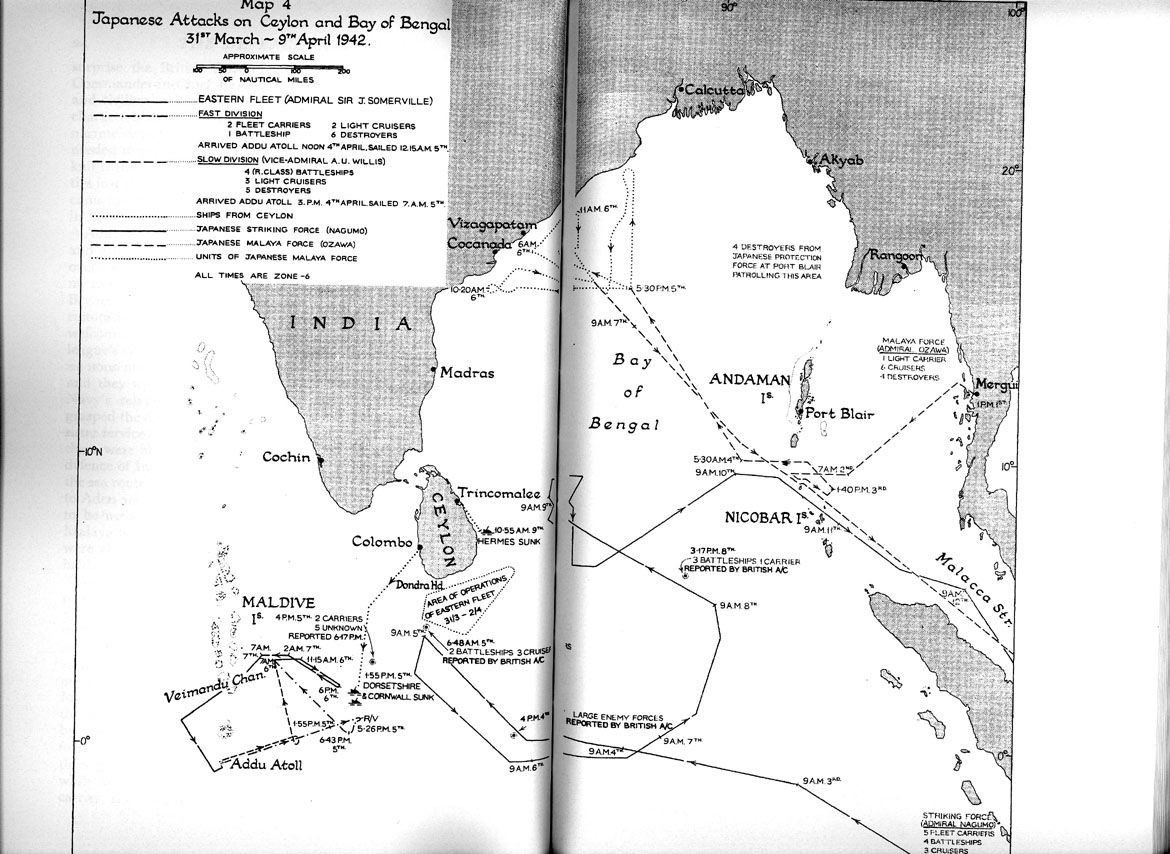
In March 1942, Dorsetshire was transferred to the Eastern Fleet to support British forces in the recently opened Pacific Theatre of the war. At the end of the month, the Japanese fast carrier task force—the Kido Butai—launched the Indian Ocean raid. On 5 April, Japanese aircraft spotted Dorsetshire and her sister Template:HMS while en route to Colombo; a force of dive bombers then attacked the two ships and sank them. More than 1,100 men were rescued the next day, out of a combined crew of over 1,500.
Description
{{#invoke:Labelled list hatnote|labelledList|Main article|Main articles|Main page|Main pages}}

Dorsetshire was at maximum Template:Cvt long overall, and had a beam of Template:Cvt and a draught of Template:Cvt. She displaced Template:Convert at standard displacement, in compliance with the tonnage restriction of the Washington Naval Treaty, and up to Template:Convert at full load. Dorsetshire was propelled by four Parsons steam turbines that drove four screw propellers. Steam was provided by eight oil-fired 3-drum water-tube boilers. The turbines were rated at Template:Cvt and produced a top speed of Template:Convert. The ship had a capacity of Template:Convert of fuel oil as built, which provided a cruising radius of Template:Convert at a speed of Template:Convert. She had a crew of 710 officers and enlisted men.Template:SfnTemplate:Sfn
Dorsetshire was armed with a main battery of eight [[BL 8 inch Mk VIII naval gun|BL Template:Cvt Mk VIII 50-cal. guns]] in four twin turrets, in two superfiring pairs forward and aft. As built, the cruiser had a secondary battery that included four Template:Cvt dual-purpose guns (DP) in single mounts. She also carried four QF 2-pounder anti-aircraft guns, also in single mounts. Her armament was rounded out by eight Template:Cvt torpedo tubes mounted in two quadruple launchers.Template:Sfn
Unlike most heavy cruisers, the County-class cruisers dispensed with traditional belt armour and used Template:Cvt side plating to protect the hulls against shell fragments only. The ammunition magazines received Template:Cvt of armour plate on the sides. The gun turrets and their supporting barbettes also received only 1 in splinter protection.Template:Sfn
In 1931, Dorsetshire began to carry a seaplane; a catapult was installed the following year to allow her to launch the aircraft while underway. In 1937, her secondary battery was overhauled. Eight QF 4-inch Mk XVI DP guns in twin turrets replaced the single mounts, and the single 2-pounders were replaced with eight twin-mounts. During the Second World War, her anti-aircraft battery was strengthened by the addition of nine Template:Convert guns.Template:Sfn
Service history
Pre-war
Dorsetshire was laid down at the Portsmouth Dockyard on 21 September 1927 and was launched on 21 January 1929. After completing fitting-out work on 30 September 1930 she was commissioned into the Royal Navy.Template:Sfn Upon commissioning, Dorsetshire became the flagship of the 2nd Cruiser Squadron.Template:Sfn In 1931, she was part of the Atlantic Fleet during the Invergordon Mutiny. During the incident, some of her men initially refused to assemble for duty but after an hour and a half, the ship's officers had restored order and no further unrest troubled Dorsetshire during the mutiny.Template:Sfn From 1933–1935, she served as the flagship for the Commander-in-Chief, Africa; she was replaced by Template:HMS.Template:Sfn By September 1935, Dorsetshire was assigned to the China Station.Template:Sfn From 1–4 February 1937, Dorsetshire, the aircraft carrier Template:HMS and the cruiser Template:HMS participated in an exercise to test the defences of Singapore against a hypothetical Japanese attack.Template:Sfn
Second World War

At the start of the Second World War in September 1939, Dorsetshire was still on the China Station.Template:Sfn In October, Dorsetshire—with other Royal Navy ships—was sent to South American waters in pursuit of the German heavy cruiser Template:Ship, which was attacking British merchant traffic in the area. Dorsetshire was assigned with her sister ship Template:HMS and the aircraft carrier Template:HMS.Template:Sfn Dorsetshire had just arrived in Simonstown, South Africa, from Colombo on 9 December, with orders to proceed to Tristan da Cunha and then to Port Stanley in the Falkland Islands to relieve Template:HMS. After departing Simonstown, she received the order to join the hunt for Admiral Graf Spee.Template:Sfn She left South Africa on 13 December in company with the cruiser Template:HMS and was in transit on 17 December when the Germans scuttled Admiral Graf Spee following the Battle of the River Plate.Template:Sfn
Exeter had been badly damaged in the battle with Admiral Graf Spee, and Dorsetshire escorted her back to Britain in January 1940, before returning to South American waters to search for German supply ships.Template:Sfn On 11 February, her reconnaissance aircraft spotted the German supply freighter Wakama Template:Cvt off the coast of Brazil, which was promptly scuttled by her crew.Template:Sfn Dorsetshire arrived on the scene shortly thereafter, picked up ten officers and thirty-five crewmen and sank Wakama to prevent her from being a navigational hazard.Template:SfnTemplate:Sfn The following month, the President of Panama, Augusto Samuel Boyd, sent a formal complaint to the British government protesting against DorsetshireTemplate:'s violation of the Pan-American Security Zone in the Wakama incident.Template:Sfn
In May, Dorsetshire underwent a short refit in Simonstown, before returning to Britain for a more thorough overhaul.Template:Sfn On 23 June, she set out from Freetown to watch the French battleship Template:Ship, which left Dakar for Casablanca two days later. While en route, Dorsetshire rendezvoused with the aircraft carrier Hermes off Dakar. Richelieu was ordered to return to Dakar by Admiral François Darlan later that day and she arrived on 27 June. Dorsetshire continued to monitor the French Navy off Dakar and on 3 July, the French submarines Template:Ship and Template:Ship attempted to intercept her. Dorsetshire was able to evade their attacks through high-speed manoeuvres. On 5 July, Hermes and the Australian cruiser Template:HMAS joined her there. On 7 July, the squadron was ordered to issue an ultimatum to the French fleet, to either surrender and be interned under British control or to scuttle their ships; the French refused, so a fast sloop was sent in to drop depth charges under the stern of Richelieu to disable her screws.Template:Sfn
On 4 September, she was dry-docked at Durban and on the 20th she arrived back in Simonstown. She sailed for Sierra Leone the next day. Operating in the Indian Ocean, on 18 November she bombarded Zante in Italian Somaliland. On 18 December she departed to join the search for the heavy cruiser Template:Ship, which had recently sunk the British refrigerator ship Duquesa in the South Atlantic. The British were unsuccessful in their search and Admiral Scheer remained at large.Template:Sfn
Bismarck

{{#invoke:Labelled list hatnote|labelledList|Main article|Main articles|Main page|Main pages}}
By May 1941, Dorsetshire had been assigned to Force H, along with the aircraft carrier Template:HMS, the battlecruiser Template:HMS, and the light cruiser Template:HMS. Dorsetshire was at that time commanded by Captain Benjamin Martin.Template:Sfn Late in the month, the German battleship Template:Ship and heavy cruiser Template:Ship broke out into the North Atlantic to attack convoys sailing for Britain, and Dorsetshire was one of the ships deployed to hunt the German raiders. Dorsetshire had been escorting convoy SL74 from Sierra Leone to the UK on 26 May, when she received the order to leave the convoy and join the search for Bismarck; she was some Template:Cvt south of BismarckTemplate:'s location. Dorsetshire steamed at top speed, though heavy seas later in the night forced her to reduce to Template:Convert and later to Template:Convert. By 08:33, Dorsetshire encountered the destroyer Template:HMS, which had been engaging Bismarck throughout the night. The German battleship's gun flashes could be seen, only Template:Cvt away, by 08:50.Template:Sfn<ref>Template:Cite news</ref>
Shortly thereafter, Dorsetshire took part in [[last battle of the battleship Bismarck|BismarckTemplate:'s last battle]]; after the battleships Template:HMS and Template:HMS neutralised BismarckTemplate:'s main battery early in the engagement, Dorsetshire and other warships—including her sister Template:HMS—closed in to join the attack.Template:Sfn Dorsetshire opened fire at a range of Template:Cvt, but poor visibility forced her to check her fire for lengthy periods.Template:Sfn In the course of the engagement, she fired 254 shells from her main battery. In the final moments of the battle, she was ordered to move closer and torpedo Bismarck and fired three torpedoes, two of which hit the crippled battleship.Template:SfnTemplate:Sfn The Germans had by this time detonated scuttling charges, which with the damage inflicted by the British, caused Bismarck to rapidly sink at 10:40.Template:Sfn
Dorsetshire and the destroyer Template:HMS then moved in to pick up survivors. Martin had ropes lowered down the sides of the ship so the men in the water could climb aboard. A reported U-boat sighting forced the two ships to break off the rescue effort. Historians Holger Herwig and David Bercuson state that only 110 men were rescued: 85 aboard Dorsetshire and 25 aboard Maori.Template:Sfn Historian Angus Konstam, however, writes that his research indicated a total of 116 saved, 86 on Dorsetshire (one of whom died), 25 on Maori, 3 rescued by Template:Ship and a further 2 picked up by the German weather ship Template:Ship.<ref>Template:Cite book</ref>
Rodney, King George V and the destroyers Template:HMS, Template:HMS and Cossack had meanwhile begun to steam north-west to return to Scapa Flow. After abandoning the rescue effort, Dorsetshire and Maori caught up with the rest of the fleet shortly after 12:00. Late that night, as the fleet steamed off Britain, Dorsetshire was detached to stop in the Tyne. She had suffered no casualties in the battle with Bismarck.Template:Sfn
Deployment to South Africa and the Indian Ocean

In late August, Dorsetshire participated in the search for the heavy cruiser Template:Ship. Dorsetshire, Eagle and the light cruiser Template:HMS left Freetown on 29 August, though they were unable to locate the German raider.Template:Sfn On 4 November, Dorsetshire and the auxiliary cruiser Template:HMS, were sent to investigate reports of a German surface raider in the South Atlantic but neither ship found anything.Template:Sfn In November–December, WS-24, a convoy of 10 troop transport ships, steamed out from Halifax, Canada en route to Basra, Iraq. After arriving in Cape Town on 9 December, Dorsetshire took over the escort duties and the convoy was diverted to Bombay, where it arrived on 24 December.Template:Sfn
Dorsetshire was deployed in November, to join the search for the German commerce raider Template:Ship, that had been attacking Allied shipping off the coast of Africa. Admiral Algernon Willis formed Task Force 3, with Dorsetshire and Template:HMS to patrol likely refuelling locations for Atlantis.Template:Sfn On 1 December, Dorsetshire intercepted the German supply ship Python, based on Ultra intelligence. The German ship was refuelling a pair of U-boats— Template:GS and Template:Ship—in the South Atlantic. The U-boats dived while Python tried to flee. UA fired five torpedoes at Dorsetshire but all missed her due to her evasive manoeuvres. Dorsetshire fired a salvo to stop Python and the latter's crew abandoned the ship, after detonating scuttling charges. Dorsetshire left the Germans in their boats, since the U-boats still presented too much of a threat for the British to pick up the Germans.Template:SfnTemplate:Sfn
Loss

In 1942, Dorsetshire, under the command of Augustus Agar, was assigned to the Eastern Fleet in the Indian Ocean. In March, Dorsetshire was assigned to Force A, which was commanded by Admiral James Somerville, with the battleship Template:HMS and the carriers Template:HMS and Template:HMS. Somerville received reports of an impending Japanese attack in the Indian Ocean—the Indian Ocean raid—and so he put his fleet to sea on 31 March. Having not encountered any hostile forces by 4 April, he withdrew to refuel. Dorsetshire and her sister ship Cornwall were sent to Colombo to replenish their fuel.Template:Sfn
The next day, she and Cornwall were spotted by reconnaissance aircraft from the heavy cruiser Template:Ship. The two British cruisers were attacked by a force of 53 Aichi D3A2 "Val" dive bombers Template:Convert southwest of Ceylon. In the span of about eight minutes, Dorsetshire was hit by ten Template:Cvt and Template:Cvt bombs and several near misses; she sank stern first at about 13:50. One of the bombs detonated an ammunition magazine and contributed to her rapid sinking. Cornwall was hit eight times and sank bow first about ten minutes later. Between the two ships, 1,122 men out of a total of 1,546 were picked up by the cruiser Template:HMS and the destroyers Template:HMS and Template:HMS the next day.Template:SfnTemplate:Sfn
Footnotes
References
- Template:Cite book
- Template:Cite book
- Template:Cite book
- Template:Cite book
- Template:Cite book
- Template:Cite book
- Template:Cite book
- Template:Cite book
- Template:Cite book
- Template:Cite book
- Template:Cite book
- Template:Cite book
- Template:Cite book
- Template:Cite book
- Template:Cite book
- Template:Cite book
Further reading
External links
Template:Coord Template:Military navigation Template:April 1942 shipwrecks
- Pages with broken file links
- Kent-class cruisers
- County-class cruisers of the Royal Navy
- Ships built in Portsmouth
- 1929 ships
- World War II cruisers of the United Kingdom
- World War II shipwrecks in the Indian Ocean
- Maritime incidents in April 1942
- Cruisers sunk by aircraft
- Ships sunk by Japanese aircraft
- Naval magazine explosions