Hurricane Beulah
Template:Short description Template:Other storms Template:Infobox weather eventTemplate:Infobox weather event/NWSTemplate:Infobox weather event/EffectsTemplate:Infobox weather event/Footer
Hurricane Beulah was an intense Category 5 hurricane which impacted the Greater Antilles, Mexico, and Texas in September 1967. The second tropical storm, second hurricane, only major hurricane, and strongest storm in the 1967 Atlantic hurricane season, Beulah tracked through the Caribbean, struck the Yucatán Peninsula of Mexico as a major hurricane, and moved west-northwestward into the Gulf of Mexico, briefly becoming a Category 5 hurricane. The hurricane made landfall just north of the mouth of the Rio Grande as a Category 3 hurricane. It spawned 115 tornadoes across Texas, which established a new record for the highest amount of tornadoes produced by a tropical cyclone. Due to its slow movement over Texas, Beulah led to significant flooding. Throughout its path, at least 59 people were killed and total damage reached $234.6 million (1967 USD), of which $200 million occurred in the United States, $26.9 million occurred in Mexico, and $7.65 million occurred in the eastern Caribbean.
Meteorological history
Template:Storm path On August 22, 1967, an ESSA-5 satellite image depicted an area of enhanced convection—shower and thunderstorm activity—east of the Western High Plateau in Cameroon over central Africa. Reaching the western slopes of the mountains two days later, the tropical wave became more coherent with clouds condensing along its axis. As it moved over west Africa, cyclonic rotation became apparent about Template:Convert above the surface. A research paper published in 1969 refers to the disturbance as a depression as it neared the west coast of Africa;<ref name="disturbancepaper"/> however, this significantly differs from the official Atlantic hurricane database, which does not mention the system at that time,Template:Atlantic hurricane best track as a surface circulation likely did not exist. Regardless, the system emerged over the Atlantic Ocean around 12°N on August 28, as represented by barometric pressure falls in Dakar, Senegal.<ref name="disturbancepaper">Template:Cite journal</ref> Once over water, the system interacted with the Intertropical Convergence Zone and continued westward along an undulating path with no further organization. It was not until a United States Navy weather reconnaissance plane flew into the disturbance on September 4, while it was located east of the Lesser Antilles, that signs of development were apparent. Corresponding observations from ships in the region on September 5 confirmed the existence of a 1010 mbar (hPa; Template:Convert) low-pressure area.<ref name="MWR">Template:Cite journal</ref> In light of this, the disturbance was classified as a tropical depression at 12:00 UTC that day, with its center situated roughly Template:Convert east-northeast of Barbados.<ref name="HURDAT"/>
A slow-moving system, the depression steadily organized as it approached the Lesser Antilles. Observations from aircraft reconnaissance indicated that the system attained gale-force winds by 12:00 UTC on September 7, resulting in its upgrade to a tropical storm. It was also assigned the name Beulah, making it the second named storm of the 1967 season. Shortly after being named, Beulah clipped the southern coast of Martinique and entered the eastern Caribbean. Feeding off the warm waters of the Caribbean, the cyclone quickly strengthened and reached Category 1 hurricane intensity by 18:00 UTC on September 8. Rapid deepening ensued thereafter, with the storm's central pressure falling to 940 mbar (hPa; Template:Convert) the following day, as it passed Template:Convert south of Puerto Rico.<ref name="MWR"/> At this time, 1-minute sustained winds were estimated to be at least Template:Convert, ranking Beulah as a Category 4 hurricane on the Saffir–Simpson hurricane scale (SSHS).<ref name="HURDAT"/> Upon reaching this strength, weather radar imagery from San Juan, Puerto Rico showed that Beulah featured a Template:Convert wide eye, surrounded by an intense eyewall about Template:Convert thick.<ref name="Radar"/>

During the evening of September 9, Beulah turned westward as weak ridge developed over the Bahamas, between it and the newly formed Tropical Storm Doria.<ref name="MWR"/> The powerful storm weakened somewhat as an eyewall replacement cycle began to take shape. During this phase, the inner-eye of Beulah contracted to roughly Template:Convert in diameter while a second eyewall spanned an area Template:Convert across. The smaller eye soon dissipated, and the larger one became the single, dominant feature by the morning of September 10. The completion of this process marked the first time that an eyewall replacement cycle was observed in its entirety.<ref name="Radar">Template:Cite journal</ref> The aforementioned westward turn placed the Dominican Republic in the line of danger, an area still reeling from the devastating effects of Hurricane Inez just one year prior. However, the storm unexpectedly collapsed as it approached the Barahona Peninsula and struck the area as a greatly weakened, though still significant, Category 1 hurricane, with estimated winds of Template:Convert around 18:00 UTC on September 11.<ref name="MWR"/><ref name="HURDAT"/>
Skirting the southern coast of Haiti's Tiburon Peninsula, Beulah further degraded to a tropical storm by the morning of September 12. Unseasonably strong wind shear associated with the jet stream, resulting from an upper-level trough to the north, and the cyclone's interaction with land were responsible for the dramatic degradation. By the time it had cleared Haiti, Beulah was no more than a minimal tropical storm, with sustained winds near Template:Convert.<ref name="MWR"/> The storm's central pressure had also risen by roughly 60 mbar (hPa; Template:Convert) to 1000 mbar (hPa; Template:Convert).<ref name="HURDAT"/> Originally seen as a threat to Jamaica, northeasterly flow induced a southerly component to the track and pushed the cyclone south of the island on September 13. The shear previously impeding organization abated on September 14, and a ridge re-established itself to Beulah's north, allowing the storm to resume a west-northwest to northwest track. The upper-level changes led to a favorable environment for intensification, and Beulah regained hurricane strength by 12:00 UTC on September 14, while located about Template:Convert south-southeast of Havana, Cuba.<ref name="MWR"/><ref name="HURDAT"/><ref name="Prelim">{{#invoke:citation/CS1|citation |CitationClass=web }}</ref>

Moving through the climatologically favorable western Caribbean,<ref name="MWR"/> Beulah quickly regained Category 3 major hurricane status on September 15, with 1-minute sustained winds estimated at Template:Convert.<ref name="HURDAT"/> The storm's central pressure fell to Template:Convert on September 16, before some weakening took place. Beulah ultimately made landfall on Cozumel Island, with winds of at least Template:Convert later that day, and struck the mainland Yucatán Peninsula hours later. Despite moving over land, little weakening took place by the time the hurricane emerged over the Gulf of Mexico about 24 hours later.<ref name="MWR"/> The hurricane maintained its intensity throughout September 18, as it moved west-northwest to southern Tamaulipas, Mexico.<ref name="HURDAT"/> However, on September 19, a pronounced phase of rapid intensification, took place as Beulah turned northwest to the Rio Grande Valley region. Aircraft reconnaissance throughout the day found falling pressures and ultimately measured a value of 923 mbar (hPa; Template:Convert) around 18:00 UTC. This was the second-lowest pressure ever recorded by aircraft at the time, behind a 920 mbar (hPa; Template:Convert) measurement in Hurricane Hattie of 1961.<ref name="MWR"/> Beulah was estimated to have achieved its peak intensity shortly thereafter, as a Category 5 hurricane with maximum 1-minute sustained winds estimated at Template:Convert.<ref name="HURDAT"/>
Regarded as the third-largest hurricane on record at the time,<ref name="DRTX">Template:Cite report</ref> Beulah moved along a slowing, erratic, and somewhat cycloidal path. Slight weakening ensued as it neared land and Beulah ultimately made its final landfall south of Brownsville, Texas, near the mouth of the Rio Grande around 13:00 UTC on September 20. No direct measurements exist at the core of the hurricane as it moved ashore; however, based on a minimum pressure of 951 mbar (hPa; Template:Convert) in Brownsville, the hurricane likely struck land with a central pressure below that value.<ref name="MWR"/> A vessel anchored in the Port of Brownsville measured peak wind gusts of Template:Convert, equivalent to a low-end Category 4 hurricane.<ref name="Prelim"/><ref name="DRTX"/> According to the National Hurricane Center, Beulah struck as a Category 3 hurricane, and was originally thought to have had a central pressure of 950 mbar (hPa; Template:Convert) at landfall,<ref>Template:Cite report</ref> but a 2020 re-evaluation as part of the Atlantic hurricane reanalysis project lowered this to 940 mbar (Template:Convert).<ref name="reanal">Template:Cite report</ref> Once over land, the hurricane slowly weakened as it remained relatively close to the coast. Sustained winds dropped below hurricane-force on September 21, roughly 24 hours after landfall. The system subsequently stalled near Alice, Texas, before turning to the southwest.<ref name="MWR"/> It was initially thought that, after diminishing to a tropical depression late on September 22,<ref name="HURDAT"/> Beulah's circulation finally dissipated over the mountainous terrain of Nuevo León, Mexico;<ref name="MWR"/> however, the 2020 reanalysis concluded that Beulah survived through at least September 24, when it reemerged into the Gulf of Mexico, crossing the Mexican coast between the cities of Tampico and Tuxpan.<ref name="reanal" /> Due to a lack of suitable observations, it is unknown how much longer after this Beulah continued to exist as a tropical depression over the southern Gulf of Mexico before degenerating into an open trough.<ref name="reanal" />
Preparations

Hispaniola
Following Beulah's rapid intensification on September 9, a hurricane watch was issued for the whole of Hispaniola on September 9, with emphasis on a threat to the southern coast. Warnings were soon raised for areas between Barahona and Cabo Engaño in the Dominican Republic.<ref name="Prelim"/>
Across the Dominican Republic, an estimated 200,000 people evacuated from coastal areas.<ref name="MWR"/>
United States
Beginning on the afternoon of September 17, people were advised to remain off the beaches of Padre, Mustang, and St. Joseph Islands. Immediate evacuation of Port Aransas and Mustang, Padre, and St. Joseph Islands was advised on the morning of September 19. Most residents and others on the islands evacuated, including the personnel of Padre Island National Seashore. About 40 persons remained on the islands, including about 20 at Port Aransas. Immediate evacuation of Rockport and Live Oak and Lamar Peninsulas was advised in the evening of September 19. These areas and the towns of Ingleside and Aransas Pass were nearly completely evacuated. About 50 persons remained in Rockport. The evacuation of the University of Corpus Christi was advised on the morning of September 20, and Corpus Christi Beach and parts of Flour Bluff were also evacuated. During the storm there were 30,000 people in shelters in Nueces and San Patricio Counties, including 6,000 in Corpus Christi.<ref>National Weather Service Office Corpus Christi, Texas. Hurricane Beulah. Template:Webarchive Retrieved on 2007-06-23.</ref>
Impact
Eastern Caribbean

Prior to Beulah, a stationary trough over the Lesser Antilles produced torrential rainfall throughout the region, setting the stage for significant flooding.<ref name="MWR"/> On September 7, Beulah brought torrential rains to the already saturated region, with reports of more than Template:Convert received by the Weather Bureau. The French West Indies, and especially Martinique, suffering the brunt of the storm.<ref name="Lewiston1">Template:Cite news</ref> During an 18‑hour span, Template:Convert fell on the island. Severe flooding claimed 15 lives on Martinique and destroyed many homes.<ref name="MWR"/><ref name="Lewiston2">Template:Cite news</ref> Parts of Fort-de-France were inundated by Template:Convert of water while the Martinique International Airport saw Template:Convert of flooding. The banana crop sustained extensive losses.<ref name="Lewiston1"/><ref name="Lewiston2"/> Across the island nearly 1,000 residents were left homeless, including 400 in Fort-de-France.<ref name="RDF1">Template:Cite newsTemplate:Subscription required</ref> Damage on the island amounted to $4.5 million.<ref name="MWR"/> Supplies of fresh water were severely limited for two days following the storm.<ref name="RDF1"/>
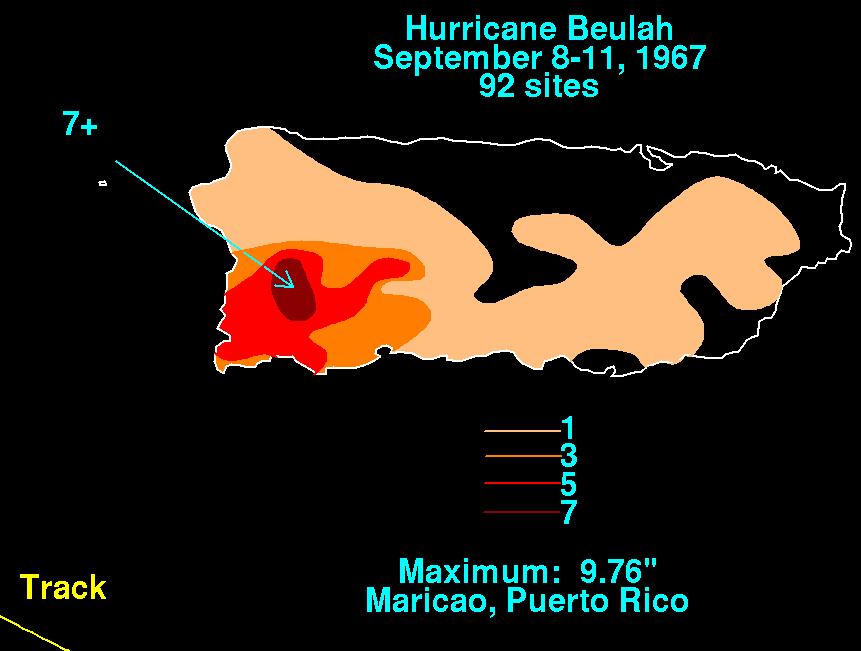
Heavy rains triggered flooding and landslides across St. Vincent, blocking numerous roads and causing some damage. Two children were killed after a boulder, dislodged by the rains, crashed into their home.<ref>Template:Cite newsTemplate:Subscription required</ref> Damage on St. Lucia reached $3 million, mainly stemming from the banana crop which was largely ruined.<ref name="MWR"/> The periphery of the hurricane brought rainfall primarily to southwestern Puerto Rico, where a maximum of Template:Convert fell at Maricao.<ref>David M. Roth. Hurricane Beulah Black Background, Color-Filled Image for Puerto Rico. Template:Webarchive Retrieved on 2008-02-28.</ref> One person lost their life on the island and damage was a minimal $150,000.<ref name="MWR"/>
Owing to effective evacuations, only two people lost their lives in the Dominican Republic. The core of Beulah impacted areas devastated by Hurricane Inez a year prior, leaving extensive damage in its wake.<ref name="MWR"/> Media reports indicated that more than 1,000 people were left homeless across the Barahona Peninsula.<ref>Template:Cite newsTemplate:Subscription required</ref> Flash flooding affected the southern coasts of both the Dominican Republic and Haiti.<ref>Template:Cite newsTemplate:Subscription required</ref>
Beulah had limited impact on Jamaica as it brushed the island as a weak tropical storm.<ref name="MWR"/> According to newspapers, gale-force winds affected the nation though there were no reports of damage.<ref>Template:Cite newsTemplate:Subscription required</ref>
Mexico

Striking Cozumel Island and the Yucatán Peninsula on September 17 as a Category 2 hurricane, Beulah caused considerable damage and killed 11 people across the region. Wind gusts up to Template:Convert severed communication lines, downed power lines and felled trees.<ref name="Prelim"/> The Puerto Morelos lighthouse on the Riviera Maya was undermined by the storm; it was never torn down and the leaning tower remains a tourist attraction in the area.<ref>Lougheed, p. 6</ref> In Mérida, Yucatán, winds were recorded up to Template:Convert. Under the force of the powerful winds, several structures collapsed across the Peninsula, resulting in six fatalities.<ref name="TB1"/> Nearly every buildings on Cozumel Island sustained damage, roughly half of which lost their roofs.<ref>Template:Cite news</ref> Four people were also killed in Playa del Carmen. Along the coast, Beulah's storm surge flooded areas within Template:Convert of the coastline, washing out roads and leaving "graveyards of boats."<ref name="TB1">Template:Cite news</ref> Throughout the Yucatán Peninsula, an estimated 5,000 people were left homeless and at least 30,000 were affected by the storm.<ref>Template:Cite news</ref>
Throughout Mexico, Beulah killed 19 people.<ref name="MWR" /> Economic losses across Tampico reached 500 million pesos.<ref>{{#invoke:citation/CS1|citation |CitationClass=web }}</ref> Across the Yucatán Peninsula, the Government of Mexico set up an air lift of food and medical supplies to isolated areas by September 18.<ref name="TB1"/>
United States

In Texas the Lower Rio Grande Valley, the four-county region that comprises deep south Texas, was inundated with torrential rains and compound flooding effects. Within a 36‑hour period, the hurricane dropped over Template:Convert of rain near Beeville, Texas.<ref>David M. Roth. Hurricane Beulah Rainfall Page. Template:Webarchive Retrieved on 2007-06-23.</ref> Falfurrias received more rain from Beulah than it normally records during one year. Areas south of Laredo, San Antonio, and Matagorda were isolated for more than a week due to the resulting flood.<ref name="DRTX"/> On September 28, President Lyndon Baines Johnson declared twenty-four counties in southern Texas a disaster area.<ref>Texas State Historical Association. Hurricane Beulah wracks Texas coast. Template:Webarchive Retrieved on 2007-06-23.</ref>
Hurricane Beulah produced Template:Convert of storm tide surge, crossing North Padre Island at Nueces County Park No. 1.<ref>{{#invoke:citation/CS1|citation |CitationClass=web }}</ref> The storm also caused 31 cuts through Padre Island, all occurring south of a point 30 miles south of Corpus Christi. The height of the storm surge diminished near South Padre Island toward Port Isabel, Texas, where flooding from tides ranged from 4.7 to 8 ft. The highest sustained wind was Template:Convert, reported aboard the SS Shirley Lykes, which was anchored in the Port of Brownsville. <ref>{{#invoke:citation/CS1|citation |CitationClass=web }}</ref> Winds as high as Template:Convert were measured at the Brownsville National Weather Service office at landfall. Since the hurricane bent the anemometer 30 degrees from the vertical, it is possible the winds at Brownsville were underestimated.<ref name="IAH">National Weather Service Office Houston/Galveston, Texas. PUBLIC INFORMATION STATEMENT. Template:Webarchive Retrieved on 2007-06-23.</ref> Gusts of over Template:Convert were recorded as far inland as the towns of McAllen, Edinburg, Mission, and Pharr, some Template:Convert from the gulf coast. Beulah spawned a record 115 tornadoes<ref>Robert Orton. Tornadoes Associated With Hurricane Beulah on September 19-23, 1967. Template:Webarchive Retrieved on 2007-06-23.</ref> which destroyed homes, commercial property, and inflicted serious damage on the region's agricultural industry. The tornado record from Beulah would survive until Hurricane Ivan set a new record in 2004. The Rio Grande Valley's citrus industry, based on cultivation of the famous "Ruby Red" grapefruit, was particularly hard hit.
Animal life in the region responded in various ways to survive. Ants survived the floods by congregating in spheres of living colonies and floated down streams to safety. Predaceous beetle larvae preyed on frogs and rodents. Crustaceans from the beaches migrated en masse to the protection of high ground.<ref>N. E. Flitters. Hurricane Beulah. A report in retrospect on the hurricane and its effect on biological processes in the Rio Grande Valley. Retrieved on 2007-06-23.</ref>
Hurricane Beulah caused an estimated US$200 million in damage. Sources report 15 total deaths in Texas from the storm.<ref name="MWR" />
Retirement
Template:See also Due to the number of fatalities and extensive damage the system caused from the Lesser Antilles to Texas, the name Beulah was retired following the 1967 season, and will never be used for an Atlantic basin tropical cyclone again.<ref>{{#invoke:citation/CS1|citation |CitationClass=web }}</ref> It was replaced with Beth for the 1971 season.<ref>Template:Cite report</ref>
See also
- List of Category 5 Atlantic hurricanes
- List of tornadoes spawned by tropical cyclones
- List of wettest tropical cyclones in Texas
- Hurricane Harvey (2017) – another hurricane that caused severe flooding in Texas
References
- Works cited
External links
- Major Hurricane Beulah – September 20, 1967, National Weather Service
- Hurricane Beulah HPC Rainfall Page
Template:Retired Atlantic hurricanes Template:Category 5 Atlantic hurricanes Template:1967 Atlantic hurricane season buttons Template:Authority control Template:Portal bar
- Pages with broken file links
- Category 5 Atlantic hurricanes
- Retired Atlantic hurricanes
- 1967 Atlantic hurricane season
- Hurricanes in the Windward Islands
- Hurricanes in Martinique
- Hurricanes in Saint Lucia
- Hurricanes in Texas
- Atlantic hurricanes in Mexico
- 1967 in Mexico
- History of British Saint Lucia
- Floods in Texas