Hurricane Donna
Template:Short description Template:About Template:Good article Template:Use mdy dates Template:Infobox weather eventTemplate:Infobox weather event/NWSTemplate:Infobox weather event/EffectsTemplate:Infobox weather event/Footer
Hurricane Donna, known in Puerto Rico as Hurricane San Lorenzo, was the strongest hurricane of the 1960 Atlantic hurricane season, and caused severe damage to the Lesser Antilles, the Greater Antilles, and the East Coast of the United States, especially Florida, in August and September. The fifth tropical cyclone, third hurricane, and first major hurricane of the season, Donna developed south of Cape Verde on August 29, spawned by a tropical wave to which 63 deaths from a plane crash in Senegal were attributed. The depression strengthened into Tropical Storm Donna by the following day. Donna moved west-northwestward at roughly Template:Cvt and by September 1, it reached hurricane status. Over the next three days, Donna deepened significantly and reached maximum sustained winds of Template:Convert on September 4. Thereafter, it maintained intensity as it struck the Lesser Antilles later that day. On Sint Maarten, the storm left a quarter of the island's population homeless and killed seven people. An additional five deaths were reported in Anguilla, and there were seven other fatalities throughout the Virgin Islands. In Puerto Rico, severe flash flooding led to 107 fatalities, 85 of them in Humacao alone.
Donna further intensified to a Category 4 hurricane early on September 6, and attained peak winds of Template:Convert twenty-four hours later. The storm then weakened over the next few days, making multiple landfalls in The Bahamas as a Category 3 hurricane. Donna generated severe wind gusts of up to Template:Convert over southern portions of the archipelago nation, and prolific rains affected the country and the nearby Turks and Caicos Islands. Several small island communities in the southern regions of The Bahamas were leveled, but no damage total or fatalities were reported.
As it neared the United States, Donna encountered weaker steering currents, turned northwestward, and re-intensified. Early on September 10, Donna made landfall on the Florida Keys with winds of Template:Convert, the most severe observed there since 1935. Donna then weakened as it paralleled the southwestern Florida peninsula, making landfall south of Naples with winds of Template:Convert. In the Florida Keys, coastal flooding severely damaged 75% of buildings, destroyed several subdivisions in Marathon. On the mainland, 5,200 houses were damaged, which does not include the 75% of homes damaged at Fort Myers Beach; 50% of buildings were also destroyed in the city of Everglades. Crop losses were also extensive. A total of 50% of the grapefruit crop was lost, 10% of the orange and tangerine crop was lost, and the avocado crop was almost destroyed. In the state of Florida alone, there were 13 deaths and $300 million in losses.
Donna weakened over Florida and was a Category 1 hurricane when it re-emerged into the Atlantic from North Florida. By early on September 12, the storm made landfall near Topsail Beach, North Carolina, as a Category 2 hurricane. Donna brought tornadoes and wind gusts up to Template:Convert, damaging or destroying several buildings in Eastern North Carolina, while crops were damaged as far as Template:Convert inland. Additionally, storm surge caused significant beach erosion and structural damage at Wilmington and Nags Head. Eight people were killed and there were over 100 injuries. Later on September 12, Donna reemerged into the Atlantic Ocean and continued to move northeastward. The storm struck Long Island, New York, late on September 12 and rapidly weakened inland. On the following day, Donna became extratropical over Maine.
Meteorological history
Template:Storm path On August 29, a tropical wave exited the west coast of Africa near Dakar. That day, it is estimated a tropical depression developed along the wave southeast of Cape Verde. There was a lack of data for several days, but it is estimated that the system gradually intensified. On September 2, ships in the region suggested there was a tropical storm after reporting winds of over Template:Convert. That day, the Hurricane Hunters flew into the system and observed a well-defined eye, along with winds of Template:Cvt.<ref name="mwr" /> Based on the data, the United States Weather Bureau office in San Juan, Puerto Rico, initiated advisories on Hurricane Donna at 22:00 UTC on September 2,<ref>Template:Cite report</ref> about Template:Convert east of the Lesser Antilles.<ref name="prelim1">Template:Cite report</ref> It is estimated that the storm attained hurricane status a day prior. The Azores High to the north was unusually powerful, which caused Donna to move to the west-northwest.<ref name="mwr">Template:Cite journal</ref> When advisories began, Donna was intensifying into a major hurricane, which is the equivalent of a Category 3 or higher on the Saffir-Simpson hurricane wind scale; it would ultimately maintain this status for nearly eight days.Template:Atlantic hurricane best track
Continuing to the west-northwest, Donna strengthened further, attaining maximum sustained winds of Template:Convert at 00:00 UTC on September 4—an intensity it maintained for two more days.Template:Atlantic hurricane best track Operationally, winds were estimated to be Template:Convert.<ref>Template:Cite report</ref><ref name=WU>{{#invoke:citation/CS1|citation |CitationClass=web }}</ref> Late on September 4, the eye of Donna moved over Barbuda, Saint Barthélemy, Saint Martin, and Anguilla, and passed just south of Anegada. Donna was then well-organized, described in the Monthly Weather Review as akin to "an intense, idealized hurricane." A weakening trough to the north turned the hurricane more northwesterly, bringing it within Template:Convert of the north coast of Puerto Rico.<ref name="mwr" /> The storm then underwent further intensification to Category 4 status on September 6, and reached its first peak of Template:Convert by 00:00 UTC on September 7.Template:Atlantic hurricane best track At that time, Donna began turning more to the west as a ridge built to its north, and it soon weakened back to Category 3 status. Over the next few days, the intense hurricane moved slowly through the southern Bahamas without defined steering currents, and the eye passed near or over Mayaguana, Acklins, Fortune Island, and Ragged Island.<ref name="mwr" />
While passing through the Straits of Florida, Donna brushed the northern coast of Cuba on September 9 with gale-force winds. Subsequently, a cold front moved eastward through the United States and weakened the ridge, causing the hurricane to turn more to the northwest. It re-intensified over warm sea surface temperatures,<ref name="mwr" /> and the hurricane's minimum barometric pressure dropped to Template:Cvt on September 10.Template:Atlantic hurricane best track Between 02:00 and 03:00 UTC that day, the Template:Convert eye of Donna crossed through the Florida Keys at Conch Key, just northeast of Marathon, with sustained winds of Template:Convert and gusts to Template:Cvt. The hurricane continued to the northwest along the southwest coast of Florida, weakening due to interaction with the peninsula, before making landfall on Goodland, a short distance east of Marco Island, with winds of Template:Convert.Template:Atlantic hurricane best track<ref name="mwr" /> Donna then traversed Naples and Fort Myers before turning inland to the northeast.
At 0800 UTC on September 11, Donna exited Daytona Beach into the western Atlantic with winds of about Template:Convert, still as an organized hurricane. Accelerating to the northeast due to an approaching trough, the hurricane re-intensified slightly before making landfall near Wilmington, North Carolina, early on September 12 with winds of Template:Convert. At 0900 UTC that day, Donna again emerged over open waters near Virginia, although it had weakened, and the eye expanded to over Template:Convert in diameter. Late on September 12, the hurricane made landfall near Brookhaven, New York, as a low-end Category 2 hurricane with sustained winds of Template:Convert.Template:Atlantic hurricane best track<ref name="mwr" /><ref name="metasummary">Template:Cite report</ref> On September 13, Donna became extratropical over northern Maine before entering eastern Canada, having become associated with the approaching cold front. After moving across Quebec and Labrador, Donna reached the Labrador Sea and dissipated early on September 14.<ref name="mwr" />Template:Atlantic hurricane best track
Preparations
.jpg)
At noon on September 3, a hurricane watch was issued for the Leeward Islands, which at 6 p.m. was upgraded to a warning. Also at 6 p.m., hurricane watches were raised for Puerto Rico and the Virgin Islands, which at 6 a.m. on September 4, were upgraded to warnings. By 6 a.m. on September 5, hurricane warnings were dropped for the Leeward Islands, and at 9 a.m., southwest Puerto Rico and the Virgin Island's hurricane warnings were downgraded to gale warnings. By noon, all remaining hurricane warnings for Puerto Rico were changed to gale warnings.<ref name="watchwarnings" /> In Puerto Rico, flood warnings were issued on September 5, although some residents in the region did not heed the notice; many returned to their homes after the hurricane passed to the north.<ref name="mwr" /> On Vieques Island, about 1,700 United States Marines evacuated to naval ships.<ref name="ap952">Template:Cite news</ref> Officials advised small boats to remain at port, and thousands of residents evacuated to schools set up as Red Cross shelters.<ref name="ap95">Template:Cite news</ref> Along the Cuban coast, about 3,000 people evacuated inland or to churches and schools;<ref name="upi99">Template:Cite news</ref><ref name="ws99" /> while in the Bahamas, stores closed and boats were sent to port.<ref name="upi98" />
Beginning on September 7, hurricane watches were put in place for the Florida coast from Key West to Melbourne. The next day, the watches were upgraded to hurricane warnings from Key West to Key Largo, with hurricane watches raised on the west coast northward to Fort Myers, and gale warnings issued from Key Largo to Vero Beach. By September 11, hurricane warnings were in effect for southern Florida from Daytona Beach on the east coast to Cedar Key on the west coast, including Lake Okeechobee. Gale warnings were in place northward from Cedar Key to St. Marks, as well as from Daytona Beach northward to Savannah, Georgia.<ref name="watchwarnings">Template:Cite report</ref> Evacuations in the Florida Keys disrupted traffic along the Overseas Highway.<ref name="upi99" /> The Air Force evacuated 90 Boeing B-47 Stratojets from Homestead Air Reserve Base (At that time Homestead AFB). At Cape Canaveral, the threat of the storm caused the launching of two missiles to be postponed.<ref name="upi98">Template:Cite news</ref> Most flights out of Miami International Airport were canceled during the storm's approach. Officials closed schools in Miami and the Florida Keys,<ref name="ws99" /> and recommended residents in low-lying areas of the Florida Keys and southwestern Florida to evacuate. Ultimately, about 12,000 people in southern Florida sought refuge in storm shelters, two of which were damaged during the storm.<ref name="ap911" /> In Miami-Dade County alone, there were 77 storm shelters housing 10,000 people.<ref>Template:Cite news</ref>
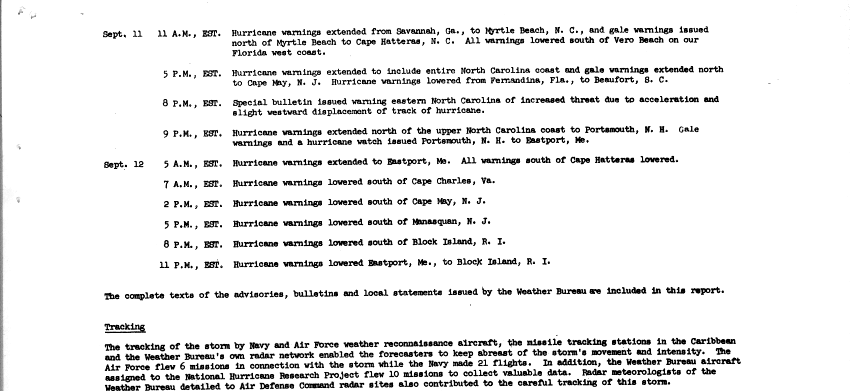
At 5 p.m. on September 10, gale warnings were extended northward to Myrtle Beach. At 11 p.m., hurricane warnings were lowered in the Florida Keys but extended northward from Daytona Beach to Savannah, Georgia.<ref name="watchwarnings" /> At 11 a.m. on September 11, all warnings were lowered south of Vero Beach and along the Florida west coast, while hurricane warnings were extended northward from Savannah to Myrtle Beach. At 5 p.m., hurricane warnings were lowered south of Fernandina Beach, while they were extended northward to include the entire North Carolina coast. Gale warnings were issued northward to Cape May. At 9 p.m., hurricane warnings were extended northward to Portsmouth, New Hampshire, while gale warnings and a hurricane watch were issued northward to Eastport, Maine.<ref name="watchwarnings2" /> Ships at dock in Newport, Rhode Island were towed out into the bay to weather the storm.<ref>Ron Fritz (2008). Template:Usurped Ron Fritz. Retrieved on 2008-10-10.</ref> On September 12 at 5 a.m., hurricane warnings were extended northward to Eastport, and dropped south of Cape Hatteras. At 7 a.m., hurricane warnings were lowered south of Cape Charles. At 2 p.m., hurricane warnings were dropped south of Cape May. At 5 p.m., hurricane warnings were discontinued south of Manasquan, New Jersey. At 8 p.m., hurricane warnings expired south of Block Island. By 11 p.m. on September 12, all hurricane warnings had been lowered.<ref name="watchwarnings2">Hurricane "Donna" Chronology page 2, September 2-13, 1960. Template:Webarchive United States Weather Bureau Office of Climatology (1960). Retrieved on 2008-10-10.</ref>
Impact

Hurricane Donna was a very destructive hurricane that caused extensive damage from the Lesser Antilles to New England. At least 364 people were killed by the hurricane and property damage was estimated at $900 million (1960 USD).<ref name="DonnaDeaths">Edward N. Rappaport and Jose Fernandez-Partagas. The Deadliest Atlantic Tropical Cyclones, 1492-1996. Template:Webarchive National Hurricane Center. Retrieved on 2008-10-13.</ref>
West Africa
The precursor to Hurricane Donna brought severe weather to the Dakar area of Senegal.<ref name="valate">Template:Cite report</ref> Air France Flight 343, which was flying from Paris, France to Abidjan, Ivory Coast, attempted to land at the Léopold Sédar Senghor International Airport as a layover. However, due to squally weather, the plane instead crashed into the Atlantic Ocean, killing all 63 people on board.<ref name="asn">Template:Cite report</ref> Heavy rainfall was also reported in Cape Verde on August 30.<ref name="mwr" />
Caribbean
Hurricane Donna caused very extensive damage on Saint-Martin, killed 7 and left at least a quarter of the island's population homeless. A weather station in Sint Maarten reported sustained wind gusts of Template:Convert and a Template:Convert pressure reading in the main airport.<ref name="mwr" />
Donna killed two people on Antigua.<ref name="ap96">Template:Cite news</ref> During the passing of Hurricane Donna, Anguilla recorded five deaths, including a woman who died when the roof of her house collapsed.
.jpg)
Despite passing only Template:Convert north of the island, Donna caused only minor damage on St. Thomas in the United States Virgin Islands. A station there reported a wind gust of Template:Convert.<ref name="mwr" /> Some fences were toppled, while several houses were reported to have been damaged or destroyed. Electrical and telephone services were also disrupted. The highest daily rainfall total on the island was Template:Convert, causing minor local flooding. On Saint John, several small boats capsized.
While passing to the north of Puerto Rico, Donna produced winds of Template:Convert in San Juan. Along the north coast of the island, high tides of around Template:Convert and strong waves caused coastal flooding.<ref name="mwr" /> The hurricane dropped torrential rainfall, peaking at Template:Convert at Naguabo in the central portion of the island. Large areas of eastern Puerto Rico received over Template:Convert of precipitation.<ref name="rain">Template:Cite report</ref> The hurricane left about 2,500 people homeless on the island.<ref name="upi98" /> Despite advanced warning of the floods, the hurricane killed 107 people on the island, of which 84 were in Humacao.<ref name="mwr" />
In Haiti, the southern periphery of the hurricane killed three people in Port au Prince.<ref name="ap96" /> Later, Donna brushed the north coast of Cuba with strong winds and heavy rainfall,<ref name="mwr" /> causing damage along much of the coast.<ref name="upi99" /> In Gibara, the storm wrecked 80 houses.<ref name="ws99">Template:Cite news</ref>
Turks and Caicos and Bahamas
.jpg)
On Grand Turk in the Turks and Caicos, Donna produced winds of Template:Convert, as the strongest winds remained north of the island. However, the storm dropped heavy rainfall of over Template:Convert, much of which fell in a 12‑hour period.<ref name="mwr" /> Despite the rains, damage there was minor.<ref name="upi98" />
In the Bahamas, the anemometer at Ragged Island blew away after registering a Template:Convert wind gust. At Mayaguana, where residents evacuated to a missile tracking base, hurricane-force winds raged for 13 hours.<ref name="mwr" /> The winds largely destroyed the village of Abraham's Bay on the island.<ref name="ap99">Template:Cite newsTemplate:Dead link</ref> Andros experienced hurricane-force winds for a few hours, and winds on Fortune Island were estimated at Template:Convert before the anemometer blew away. The strongest winds remained south of the northwestern Bahamas, which limited damage there.<ref name="mwr" /> Donna cut communications between several islands.<ref name="upi98" />
Several small island communities in the southern Bahamas were leveled. North Caicos reported Template:Convert of rainfall in 24 hours.<ref>2007 Hurricane Guide: Are You Prepared? Turks & Caicos Islands Red Cross (2007). Retrieved on 2008-10-10.</ref>
United States
There were 50 people reported dead in the United States, with damages totaling to $3.35 billion.<ref>{{#invoke:citation/CS1|citation |CitationClass=web }}</ref> Donna crossed directly over United States Air Force radar station Texas Tower 4, causing severe damage to the structure and leading to its eventual loss in January 1961.<ref>{{#invoke:citation/CS1|citation |CitationClass=web }}</ref>
Donna was the only hurricane to affect every state along the East Coast with hurricane-force winds.<ref>{{#invoke:citation/CS1|citation |CitationClass=web }}</ref>
Florida
.jpg)
.jpg)
The U.S. state of Florida received the most damage from Hurricane Donna. Portions of southern and western Florida received over Template:Convert of rainfall from the hurricane, peaking at Template:Convert.<ref name="rain" /> Strong winds were observed in the state, with a sustained wind speed of Template:Convert in Tavernier and a gusts up to Template:Convert at Sombrero Key Light.<ref name="stormdata" /> In Miami, winds reached Template:Cvt. Southeast of the city, high waves washed a Template:Convert freighter onshore an island.<ref name="ap911">Template:Cite news</ref> The highest observed storm surge of Template:Cvt was reported at Marathon. The hurricane also lashed Southwest Florida, where tides were Template:Convert above normal.<ref name="stormdata" />
.jpg)
In the Florida Keys, some areas experienced "almost complete destruction".<ref name="stormdata" /> In Key West, one death was confirmed, and 71 people were injured. About 564 homes were demolished, and an additional 1,382 were damaged, 583 of them severely.<ref>Template:Cite report</ref> Farther north, an estimated 75% of buildings were extensively damaged between Marathon and Tavernier. In the former, tides inundated the city and destroyed several subdivisions. Storm surge inundated parts of the Overseas Highway.<ref name="stormdata" /> Six bridges between Marathon and Craig Key had been nearly or entirely swept away.<ref name="evans">Template:Cite news Template:Free access</ref> Many boats and docks were severely damaged or destroyed. Additionally, the pipeline supplying water to the Florida Keys was wrecked in three places.<ref name="stormdata" />

In Miami-Dade County (then Dade County), thousands of low-lying homes in the Homestead area were flooded.<ref name="NCDC2"/> The storm also overturned 25 mobile homes and caused one death in the city. While telephone service remained mostly uninterrupted, approximately 152,000 people lost electricity.<ref name="at a glance">Template:Cite news Template:Free access</ref> Donna was the first hurricane to affect Miami, Florida, since Hurricane King in October 1950.<ref name="NCDC2">Template:Cite journal</ref> Although structural damage in and around Miami was generally light, winds shattered windows and uprooted trees. Heavy precipitation inundated streets.<ref name="at a glance"/> Overall, 857 houses in Dade County were destroyed, while about 2,317 others suffered damage. Significant agricultural losses were also reported.<ref name="NCDC2"/> About 100 homes in Broward County reported minor damage.<ref name="red cross1"/> In Boca Raton and Delray Beach, damage was mostly limited to downed billboard signs and shattered windows.<ref name="PBP 9/11 Local">Template:Cite news Template:Free access
- "Little Damage From Donna In Local Area", p. 1
- "Little Damage", p. 6 Template:Webarchive</ref>Template:Rp Boynton Beach observed wind gusts up to Template:Convert at the inlet.<ref name="PBP 9/11 Local"/>Template:Rp Storm surge covered State Road A1A with mud and sand.<ref name="PBP 9/11 Local"/>Template:Rp In North Palm Beach, winds shattered a few windows and destroyed a shopping center sign.<ref name="PBP 9/11 Local"/>Template:Rp A fire destroyed a cocktail lounge in Juno Beach after response teams were unable to extinguish the blaze due to high winds.<ref>Template:Cite news Template:Free access</ref>

Large tracts of mangrove forest were lost in the western portion of Everglades National Park, while at least 35% of the white heron population in the park were killed.<ref name="Dunion">Template:Cite journal</ref> The lodge and marina at Flamingo, as well as a ranger's way station near Cape Sable, were virtually destroyed.<ref name="evans"/> Tides from Fort Myers Beach southward ranged between Template:Convert above normal. In Everglades City, about 50% of buildings were destroyed due to strong winds and coastal flooding, and roofs were blown off or damaged.<ref name="stormdata" /> Floodwaters reached about Template:Convert in height inside the historic Collier County Courthouse, forcing refugees taking shelter in the building to evacuate to the second floor.<ref name="lost civilization">Template:Cite news Template:Free access</ref> The city briefly became inaccessible due to inundated roads. Thousands of trees were toppled,<ref name="stormdata" /> blocking portions of the Tamiami Trail.<ref name="ap911" /> Approximately half of the homes in Chokoloskee were destroyed, while floodwaters entered a number of homes in Ochopee. The community of Immokalee reported about $3 million in damage. In Naples, storm surge entered many high-priced homes, while the Template:Convert fishing pier was wrecked. A total of 19 cottages and 12 mobile homes at Gordon Pass were damaged beyond repairs. Throughout Naples, Donna demolished 87 homes and damaged 614 others in Everglades City. The Miami News described Vanderbilt Beach as being reduced to "another welter of splintered homes."<ref name="lost civilization"/> Throughout Collier County, strong winds and coastal flooding combined destroyed 153 homes, severely damaged 409 others, and caused minor damage to 1,049 dwellings.<ref name="red cross1">Template:Cite report</ref>

Donna left about $3 million in property damage and two deaths in Fort Myers. A new church in Bradenton was destroyed, while much of the city was left without power.<ref name="at a glance"/> In Winter Haven, 13 homes were destroyed, 100 others suffered major damage, and 2,400 dwellings experienced minor damage. One person was killed in the city.<ref name="red cross1"/> The turn into southern Florida lessened damage in the Tampa area.<ref>Template:Cite news</ref> High winds deroofed an armory building in Dade City sheltering 150 people.<ref name="at a glance"/> In Volusia County, Donna destroyed 10 homes, severely damaged 112 homes, and caused minor damage to 1,100 others, while 25 buildings were demolished, 400 substantially damaged, and inflicted minor damage to 750 others. One fatality occurred in the county.<ref name="red cross1"/><ref>Template:Cite report</ref>
.jpg)
Throughout the state of Florida, the storm destroyed 2,156 homes and trailers, severely damaged 3,903, and inflicted minor impact on 30,524 others. Approximately 391 farm buildings were destroyed, an additional 989 suffered extensive impact, and 2,499 others received minor damage. Roughly 174 buildings were demolished, 1,029 received major impact, and 4,254 suffered minor damage. Additionally, 281 boats were destroyed or severely damaged. A total of 50% of grapefruit crop was lost, 10% of the orange and tangerine crops were ruined, and the avocado crop was almost destroyed. With at least $350 million in damage in Florida alone, Donna was the costliest hurricane to impact the state, at the time. Additionally, there were 14 confirmed fatalities: six from drowning, four from heart attacks, two from automobile accidents, and two from electrocution. About 1,188 others were injured.<ref>Template:Cite news</ref>
Southeastern United States and Mid-Atlantic

The storm brought minor impact to Georgia. Wind gusts of Template:Cvt along the coast felled trees and tree limbs, resulting in electrical and telephone-service outages. In Brunswick, GA, a power outage at the power plant caused a minor explosion. Heavy rainfall temporarily flooded some streets in the city. Further north in South Carolina, gale-force winds were reported along the coast, but caused little damage. An F3 tornado struck areas just north of Downtown Charleston, destroying several houses and severely damaging a number of others. There were 10 injuries, some of which were caused by flying glass. Damage from this tornado was over $500,000. An F1 tornado also touched down in Garden City Beach, destroying or extensively damaging six buildings.<ref name="stormdata">Template:Cite report</ref><ref name=Tordata>{{#invoke:citation/CS1|citation |CitationClass=web }}</ref> In Beaufort County, many trees were uprooted, power lines were downed, homes were unroofed, piers were destroyed, and there was significant damage to corn and soybean crops.<ref name="bccc">Template:Cite news</ref>
.jpg)
In North Carolina, Donna brought two tornadoes to the state. An F1 tornado damaged several small buildings in Bladen County. An F2 tornado in Sampson County destroyed a dwelling with eight occupants, all of whom were hospitalized.<ref name=Tordata/> Along the coast, wind gusts as high as Template:Convert damaged or destroyed several buildings. Additionally crops were damaged as far as Template:Convert inland. Storm tides ranging from Template:Convert above normal caused significant beach erosion and structural damage at Wilmington and Nags Head.<ref name="stormdata" /> Additionally, Topsail Beach was reported to have been 50% destroyed. In Southport, the town docks were almost completely demolished.<ref name="sno">Template:Cite news</ref> There were eight deaths, including three from drowning, two from falling trees, two from weather-related traffic accidents, and one from electrocution. At least 100 people were injured enough to require hospitalization.<ref name="stormdata" /> Damage in North Carolina exceeded $5 million, with the worst impact occurring in New Hanover County.<ref name="sno" />
In Virginia, the east coast of the state reported hurricane-force winds, while gusts reached up to Template:Convert in Virginia Beach.<ref name="valate" /> Strong winds toppled trees and electrical wires, which blocked streets. Additionally, buildings suffered roof damage and broken windows; some structures were completely destroyed. Offshore, rough seas sank or destroyed numerous small crafts, while a Template:Convert vessel was driven aground. The storm killed three people in Virginia; two of the deaths occurred when a barge collided with a freighter and later sank, and another after a man attempted to safeguard his boat. Strong winds and heavy rains were observed in eastern Maryland. Ocean City suffered the worst impact, with over $300,000 in property damage. The storm also damaged crops in the area, especially corn and apples. Effects from the storm in Delaware were similar, with property damage and considerable losses to corn and apple crops. In Pennsylvania, wind gusts up to Template:Convert in the southeastern portions of the state toppled many trees and utility wires. Heavy rains and poor drainage in some areas flooded basements, lawns, and streets. Low-lying areas in Bucks and Montgomery counties were inundated with up to Template:Convert of water after many streams and creeks nearby overflowed. One death in the state was reported after a boy was swept into a swollen creek behind his home in Sharon Hill.<ref name="stormdata" />
Winds as strong as Template:Convert were observed along the coast of New Jersey. Rainfall in the state was generally between Template:Convert,<ref name="stormdata" /> with a peak of Template:Convert near Hammonton.Template:Tropical Cyclone Rainfall in the Mid Atlantic United States Damage from the storm was most severe in Atlantic, Cape May, Monmouth, and Ocean counties, where numerous boats, docks, boardwalks, and cottages were damaged or destroyed.<ref name="stormdata" /> A resort area in Cliffwood Beach, New Jersey saw its boardwalk and tourist attractions destroyed by the hurricane, and the area has never recovered. Losses to agriculture were significant, with damage to apple and peach trees "considerable", the former of which lost about one-third of its crops. Wind damage to corn, Sudan grass, and sorghum resulted in a delay in their harvest. Nine deaths were reported in the state of New Jersey. In southeastern New York, the eye of Donna crossed 10 miles to the eastern tip of Long Island. Heavy rains, hurricane-force winds, and "unprecedented" high tides were observed. Severe small stream flooding caused significant damage, especially on Long Island, the waterfront of New York City, and further north in Greene County. The storm caused three fatalities in the state, two from drowning and another from a person crushed by a falling tree.<ref name="stormdata" />
The eye of Hurricane Donna crossed near the Connecticut and Rhode Island state line, thus much of the damage in Connecticut was in far eastern sections. Strong winds left 15,000 people without telephone service, while 88,000 homes lost electricity. Along the coast, tides caused beach erosion, inundated streets, and weakened foundations. Four seaside cottages were destroyed. Crop damage was isolated and mainly limited to apples and corn. In Rhode Island, the storm brought a wind gust as strong as Template:Convert to Block Island. Telephone and electrical services were severely disrupted. Along the coast, high tides significantly damaged or destroyed about 200 homes at Narragansett Bay and Warwick cove. Damage to these vessels collectively totaled to over $2 million. Agriculture also suffered impact, particularly to fruit, timber, and poultry, especially in Newport and Portsmouth.<ref name="stormdata" />
Elsewhere in North America

Strong winds were also observed in Massachusetts, with a wind gust of Template:Convert at the Blue Hill Observatory.<ref name="mwr" /> Extensive losses to apple orchards occurred, as the fruit was blown out of trees. Widespread telephone and power outages were reported.<ref name="stormdata" /> The strong southwest winds associated with Donna, in combination with very little rainfall, led to a significant deposit of salt spray, which whitewashed southwest-facing windows. Many trees and shrubs saw their leaves brown due to the salt.<ref>{{#invoke:citation/CS1|citation |CitationClass=web }}</ref> However, in other areas, Template:Convert of precipitation fell, causing some washouts and local flooding. Waves along the coast ripped small boats and pleasure craft from their moorings and subsequently smashed them against rocks or seawalls.<ref name="stormdata" />
In Vermont, winds damaged trees, tree branches, and power lines, causing telephone and electrical service outages in a few communities. Rainfall totals ranged Template:Convert, resulting in washouts in some areas. Damage to apple orchards totaled $50,000. Along the coast of New Hampshire, many boats were smashed or damaged in some way. Strong winds felled trees and power lines, causing residents in the southern portions of the state to lose telephone service and electricity. Additionally, apple orchards suffered $200,000 in damage. Rainfall in the state peaked at Template:Convert near Peterborough, resulting in local flooding and washouts.<ref name="stormdata" />
.jpg)
Along the coast, large waves damaged 15 to 20 boats in Falmouth, Maine harbor. Total boat damage was estimated at $250,000. Coastal residents in low-lying beach areas of Cumberland and York counties were evacuated in Maine. Several counties lost power during the storm. In Southwest Harbor, lightning struck the Dirigo Hotel, causing a fire that resulted in $100,000 in damages. Winds caused a loss of telephone and electrical services in the Auburn-Lewiston area due to falling trees or tree branches. Television antennas were damaged, as were several signs, including a Sears sign. In addition, 25% to 40% of the apple crop was destroyed.<ref>Template:Cite report</ref>
After becoming extratropical, the remnants of Donna continued northeastward into New Brunswick, Quebec, and then Labrador. Wind gusts of Template:Cvt in Quebec snapped electrical poles and trees. One death occurred when a man suffered a heart attack when his home was threatened by a fire. Additionally, weather-related traffic accidents in the province resulted in two injuries.<ref>Template:Cite report</ref>
Aftermath
Following the storm, President of the United States Dwight D. Eisenhower issued a disaster declaration for Florida and North Carolina, allowing residents of those states to be eligible for public assistance.<ref>Template:Cite report</ref><ref>Template:Cite report</ref>
The United States military sent a plane carrying doctors and food from Patrick Air Force Base to Mayaguana in the Bahamas.<ref name="ap99" /> Crews of doctors and workers with food and supplies left from Key West and Miami to traverse the Florida Keys, bringing aid to affected residents.<ref name="ap911" /> In Marathon, a large reconstruction program rehabilitated the key by Christmas.<ref>Template:Cite news</ref>
Coral reefs were damaged in the Key Largo National Marine Sanctuary by the hurricane.<ref>{{#invoke:citation/CS1|citation |CitationClass=web }}</ref> Donna caused a significant negative impact on aquatic life in north Florida Bay. Marine life was either stranded by retreating salt water which had been driven inland or killed by muddied waters in its wake. Oxygen depletion due to animals perishing in the hurricane caused additional mortality. Although salinity levels returned to normal within six weeks, dissolved oxygen concentrations remained quite low for a longer time frame. Marine life was scarce for several months in areas of greatest oxygen depletion. Sports fishing in the area took a few months to recover. Juvenile pink shrimp moved from their estuarine nursery grounds into deeper water about Template:Convert offshore, where they were subsequently captured by fishermen.<ref>Template:Cite journal</ref> A Caspian tern was swept up the North American coast well to the north of its traditional breeding grounds, to Nova Scotia, which was witnessed four hours after the storm went by Digby Neck.<ref>{{#invoke:citation/CS1|citation |CitationClass=web }}</ref>
Retirement
Template:See also Because of storm's devastating impact, the name Donna was retired by the U.S. Weather Bureau following the 1960 season, and will never again be used for another Atlantic hurricane. Donna was replaced with Dora for the 1964 season.<ref>{{#invoke:citation/CS1|citation |CitationClass=web }}</ref><ref>Template:Cite news</ref>
Depictions in popular culture
Nobel Prize-winner John Steinbeck wrote about Hurricane Donna in his 1962 non-fiction memoir Travels with Charley: In Search of America. Steinbeck had had a truck fitted with a custom camper-shell for a journey he intended to take across the United States, accompanied by his poodle Charley. He planned on leaving after Labor Day from his home in Sag Harbor, Long Island, New York. Steinbeck delayed his trip slightly due to Donna, which made a direct hit on Long Island. Steinbeck wrote of saving his boat during the middle of the hurricane, during which he jumped into the water and was blown to shore clinging to a fallen branch driven by the high winds. It was an exploit which foreshadowed his fearless, or even reckless, state of mind to dive into the unknown.<ref>Template:Cite book</ref>
The winds of Donna can be seen in the feature film Blast of Silence (1961); the final scenes on Long Island had been previously scheduled, and the filmmakers decided to go ahead and shoot the exterior scene despite the hurricane.<ref>{{#invoke:citation/CS1|citation |CitationClass=web }}</ref>
See also
- List of Category 4 Atlantic hurricanes
- List of Delaware hurricanes
- List of disasters in the United States by death toll
- List of Florida hurricanes (1950–74)
- List of New England hurricanes
- List of New York hurricanes
- List of North Carolina hurricanes (1950–79)
- List of wettest tropical cyclones in Massachusetts
- Hurricane Luis (1995) – similarly strong hurricane that struck the northeastern Caribbean Sea, but subsequently turned out to sea
- Hurricane Charley (2004) – similar track across I-4 corridor
- Hurricane Wilma (2005) – also caused major damage in southern Florida along a southwest to northeast track
- Hurricane Irma (2017) – another intense hurricane with a similar track in Florida
- Hurricane Isaias (2020) – similarly affected the entire east coast of the United States
- Hurricane Ian (2022) – a storm with a similar track, particularly through the Florida Peninsula
References
External links
- Images of Donna, Naples Daily News, Naples, Fla.
- Historic Images of Florida Hurricanes, Florida State Archives
- Donna, NOAA Hurricane Research Division
- Donna, HPC Rainfall Page
Template:Category 4 Atlantic hurricanes Template:Retired Atlantic hurricanes Template:1960 Atlantic hurricane season buttons
- Pages with broken file links
- 1960 Atlantic hurricane season
- Category 4 Atlantic hurricanes
- Cape Verde hurricanes
- Retired Atlantic hurricanes
- Hurricanes in the Leeward Islands
- Hurricanes in Guadeloupe
- Hurricanes in Antigua and Barbuda
- Hurricanes in Montserrat
- Hurricanes in Saint Kitts and Nevis
- Hurricanes in Saint Barthélemy
- Hurricanes in Sint Eustatius
- Hurricanes in Saint Martin (island)
- Hurricanes in Saba (island)
- Hurricanes in Anguilla
- Hurricanes in the British Virgin Islands
- Hurricanes in the United States Virgin Islands
- Hurricanes in Puerto Rico
- Hurricanes in the Turks and Caicos Islands
- Hurricanes in the Bahamas
- Hurricanes in Cuba
- Hurricanes in Florida
- Hurricanes in Georgia (U.S. state)
- Hurricanes in South Carolina
- Hurricanes in North Carolina
- Hurricanes in New Jersey
- Hurricanes in New York (state)
- Hurricanes in Rhode Island
- Hurricanes in Virginia
- Hurricanes in New England
- 1960 in the Caribbean
- 1960 meteorology
- Tropical cyclones in 1960
- Articles containing video clips
- 1960 natural disasters in the United States
- Saint Christopher-Nevis-Anguilla
- History of British Antigua and Barbuda