Hurricane Joan–Miriam
Template:Short description Template:Redirect2 Template:Use mdy dates Template:Infobox weather eventTemplate:Infobox weather event/NWSTemplate:Infobox weather event/EffectsTemplate:Infobox weather event/Footer
Hurricane Joan was a long lived and powerful tropical cyclone that caused death and destruction in over a dozen countries in the Caribbean and Central America. Moving on a due west course for nearly two weeks in October 1988, Hurricane Joan caused widespread flooding and over 200 deaths after moving into Central America. Widespread suffering and economic crises were exacerbated by Joan, primarily across Nicaragua, as heavy rains and high winds impacted those near the hurricane's path.
After crossing Central America into the Pacific, the cyclone was renamed Tropical Storm Miriam, with the system's dissipation occurring southwest of Mexico. Joan–Miriam was the final hurricane of the 1988 Atlantic hurricane season and the final named storm of the Pacific hurricane season.<ref name=MWR>Template:Cite journal</ref><ref name=NHCJoanp2/><ref name=NHCJoanp3>{{#invoke:citation/CS1|citation |CitationClass=web }}</ref>
Meteorological history
Template:Storm path At the time, Joan was one of the latest tropical cyclones to form in the central Atlantic in any season.<ref name=Padgett>{{#invoke:citation/CS1|citation |CitationClass=web }}</ref> It formed from an area of convection in the Intertropical Convergence Zone that moved off the coast of Africa early in October. It developed banding and was upgraded to Tropical Depression Seventeen on October 10 and later designated as Tropical Storm Joan while located at low latitude in the central Atlantic Ocean.<ref name=NHCJoanp1>{{#invoke:citation/CS1|citation |CitationClass=web }}</ref>

Joan gradually strengthened as it passed over the southern Windward Islands on October 15. It continued heading west in response to a strong ridge, and passed over the Guajira Peninsula on October 17.<ref name=NHCJoanp1/> After entering the extreme southwestern Caribbean Sea, Joan strengthened into a hurricane. It then slowly executed a small counterclockwise loop, possibly in response to the nearby Tropical Depression Eighteen.<ref name="NHCJoanp2">Dr. Harold P. Gerrish. NHC Joan report p. 2 accessed April 10, 2006. Archived from the original on July 25, 2020.</ref> Upwelling caused by the quasi-stationary hurricane weakened the system. As the nearby depression dissipated, Joan resumed its westward track. A strong anticyclone over the southwestern Caribbean Sea created an extremely favorable environment, and Joan underwent rapid deepening at a rate of 38 millibars in the space of a day.<ref name=Padgett/> With a minimum pressure of 932 millibars, Joan was one of the strongest October hurricanes since 1961.<ref name=Padgett/> At the time, it was located at 12°N, the southernmost Category 4 hurricane ever recorded at the time.<ref name=NHCJoanp1/> That record has since been broken by Hurricane Ivan.<ref name="NHCJoanp2"/><ref name=NHCIvan>{{#invoke:citation/CS1|citation |CitationClass=web }}</ref><ref name=NHCJoanp7>{{#invoke:citation/CS1|citation |CitationClass=web }}</ref>
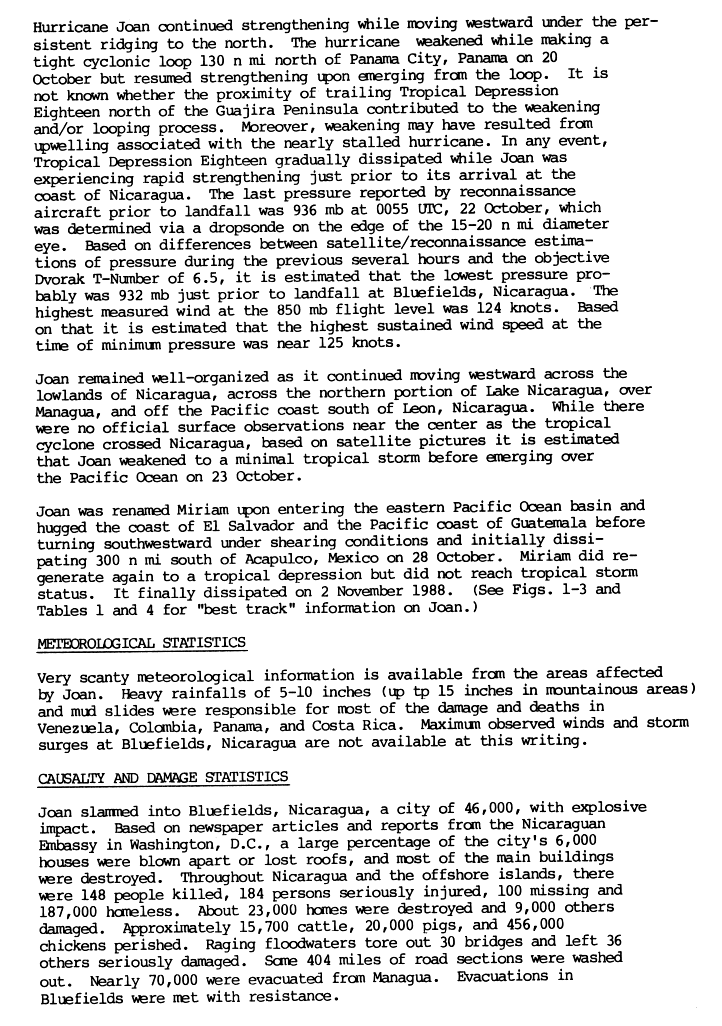

Joan made landfall just south of Bluefields on October 22.<ref name=NHCJoanp7/> It passed over the northern portion of Lake Nicaragua, passed over Managua, and entered the Pacific Ocean near Leon on October 23.<ref name=NHCJoanp2/> Joan remained a hurricane or tropical storm during its entire passage over Central America, and was a minimal tropical storm when it reached the Pacific.<ref name=NHCJoanp2/> As per the policy at the time, Joan was renamed Miriam.<ref name=NHCJoanp2/>
Tropical Storm Miriam hugged the coast of Central America and reached its peak of 986 millibars on October 24.<ref name=NHCMiriamp1>Dr. Harold P. Gerrish. NHC Miriam report p. 1 accessed April 10, 2006</ref> Ordinarily, a pressure this low would indicate a Category 1 hurricane, but due to its disorganized convection, Miriam was not upgraded to a hurricane.<ref name=NHCMiriamp1/> Land interaction and wind shear weakened Miriam to a tropical depression on October 26. Low-level winds carried the system out to sea, and its convection dissipated on October 28.<ref name=NHCMiriamp1/>
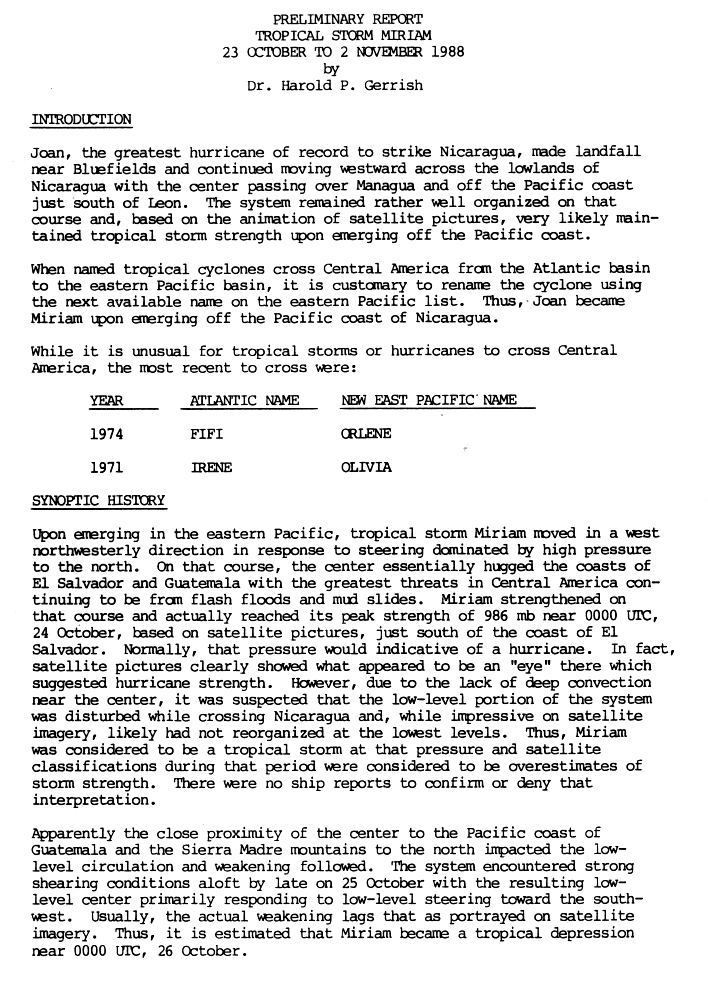
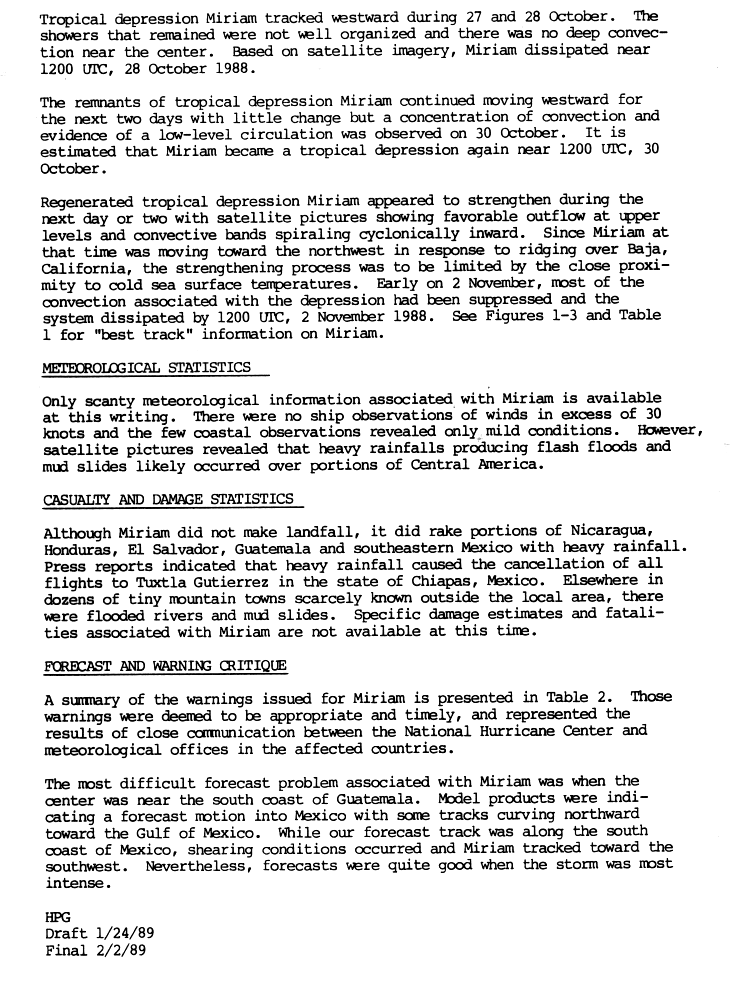
Miriam's remnants continued out to sea, and they regenerated on October 30. The tropical depression hung on for the next few days, until its second, and final, dissipation on November 2.<ref name=NHCMiriamp2>Dr. Harold P. Gerrish. NHC Miriam report p. 2 accessed April 10, 2006</ref>
Unusual path
Hurricane Joan's path through the southern Caribbean in late October was highly unusual. Most October storms in the Atlantic gravitate towards the northern portion of the Caribbean, and often recurve quickly.<ref name="NHC Climatology">National Hurricane Center. NHC Tropical Cyclone Climatology Template:Webarchive accessed April 10, 2006</ref> Joan took the southernmost path of an Atlantic-basin tropical cyclone in the Northern Hemisphere since a June system in 1933, although Hurricane Irene in 1971 took a path that was just north of Joan's.<ref name=NHCJoanp1/> Joan-Miriam was also unusual in that it survived the passage from the Atlantic to Pacific Ocean. Only thirteen other storms have been known to survive the crossover between the Atlantic and Pacific oceans.<ref name=NHCe15>Stephen Caparotta, D. Walston, Steven Young and Gary Padgett. NHC Tropical Cyclone FAQ Subject E15 accessed April 10, 2006</ref>
Preparations
Tropical storm watches and later warnings were issued for the Windward Islands as far north as Martinique on October 13. They were dropped over the subsequent two days as Joan passed through. Along the coast of South America, additional warnings were raised and later dropped as Joan paralleled the coast.<ref name=NHCJoanp8>Dr. Harold P. Gerrish. NHC Joan report p. 8 accessed April 10, 2006</ref>
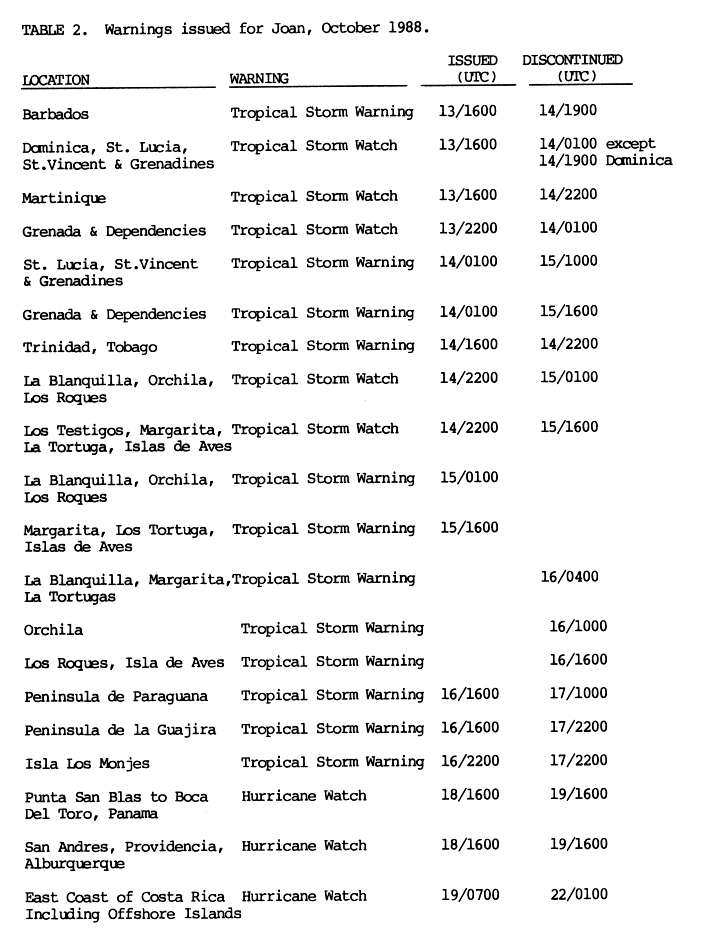
The first hurricane watches were issued for parts of Panama, and Providencia starting on October 18. The watch area was expanded to include Costa Rica and Nicaragua on October 19 as the watches were upgraded to warnings. These warnings provided several hours' worth of lead time, allowing evacuations and preparations to be made.<ref name=NHCJoanp9>Dr. Harold P. Gerrish. NHC Joan report p. 9 accessed April 10, 2006</ref> In addition, flash flood and mudslide warnings were issued for western Panama, Costa Rica, Honduras, and Nicaragua starting on October 21.
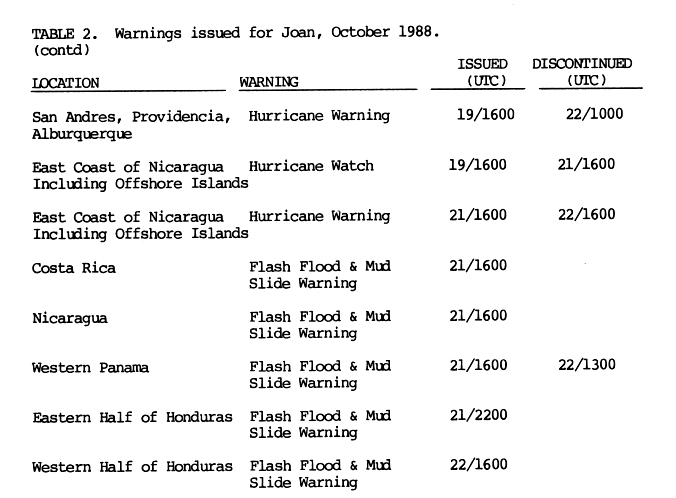
In response to Miriam, the flood and mudslide warnings issued because of Joan were not lifted until October 23 and 25. Tropical Storm warnings were issued for the Pacific coast of Nicaragua, El Salvador, and the Gulf of Fonseca on October 24. They were dropped the next day. Guatemala was placed under a warning on October 24. In addition, new flash flood and mudslide warnings were raised for Guatemala and the Mexican state of Chiapas on October 24 and 25, respectively. All warnings and watches were discontinued later on October 25 as Miriam turned away from the coast.<ref name=NHCMiriamp4>Dr. Harold P. Gerrish. NHC Miriam report p. 4 accessed April 10, 2006</ref>

Despite the dangers from the intense hurricane, evacuations in Bluefields were met with resistance and disbelief from residents.<ref name=NHCJoanp3/> In Managua, 70,000 people were evacuated to safe areas.<ref name=NHCJoanp2/> In the remaining areas of Nicaragua, 300,000 people were evacuated.<ref name=Fox>Fox, Robert Nicaragua Still Reeling in Wake of a Hurricane Template:Webarchive accessed April 10, 2006</ref> In Costa Rica, a total of 55,000 people were evacuated.<ref name=NHCJoanp4>{{#invoke:citation/CS1|citation |CitationClass=web }}</ref>
Impact
| Impact by Country | ||
|---|---|---|
| Country | Deaths | Damage |
| Nicaragua | 148-248 | $751.1 million |
| Costa Rica | 28-46 | $60 million |
| Colombia | 25 | $1 billion |
| Venezuela | 11 | Unknown |
| Panama | 7 | $60 million |
| Total | 216-337 | $1.85 billion |
Hurricane Joan killed at least 216 people, with 118 unaccounted for. The total cost of damage was around $2 billion (1988 USD).<ref name=MWR/> All of the deaths and most of the damage were due to the Joan portion of Hurricane Joan–Miriam.<ref name=NHCMiriamp2/>
Lesser Antilles
No casualties were reported in the Windward Islands, including Grenada, where, on October 15, Joan made landfall.<ref name=NHCJoanp3/> Passing just south, Joan brought rough seas and winds of Template:Convert with gusts to Template:Convert to the islands of Aruba, Bonaire, and Curaçao on October 16, damaging coastal facilities and roofs. Structural damage from the storm was estimated at $1.5 million (1988 USD). Increased moisture in Joan's wake caused persistent rainfall on the islands for several days, leading to widespread flooding.<ref>Template:Cite report</ref> In Trinidad and Tobago, Joan was described as a "minor inconvenience".<ref name=T&T>Trinidad and Tobago Meteorological Service, Tropical Cyclones Affecting Trinidad and Tobago, 1725 to 2000 Template:Webarchive p 14. Accessed February 18, 2007</ref> Sustained winds up to Template:Convert with gusts up to Template:Convert were recorded on Grenada. Heavy rains amounted to Template:Convert in St. George's. Significant flooding was reported throughout the island, resulting in hundreds of thousands of dollars in damage.<ref name="EoHDL203">David Longshore Encyclopedia of Hurricanes, Typhoons, and Cyclones pg. 203</ref> A rare invasion of African desert locusts in the Windward Islands were blamed on the storm.<ref>Template:Cite journal</ref>

South America
In Venezuela, 11 people were killed due to flash-flooding caused by heavy rains. Landslides and flooding killed 25 people in Colombia. The rains and flooding left 27,000 people homeless.<ref name=NHCJoanp3/> Throughout Colombia, damages amounted to $1 billion.<ref name="UNDHA">{{#invoke:citation/CS1|citation |CitationClass=web }} Template:Dead link</ref>
Nicaragua
Most of the destruction was in Nicaragua. Throughout the country where it caused catastrophic economic damage, 148 people perished, 184 were badly hurt, and 100 were unaccounted for. Roughly 23,300 homes were destroyed, with 6,000 being damaged.<ref name=NHCJoanp2/> Many settlements on the Atlantic coast of the country were completely destroyed.<ref name=Fox/> The national electric company had Template:Convert of downed power lines, at the cost of 2.5 million USD (1988 dollars).<ref name=Preston>Preston, Julia, Washington Post (1988) Response Tepid to Managua's Aid Plea accessed April 10, 2006</ref> A port being constructed with Bulgarian help at El Bluff was severely damaged. On a brighter note, public health measures managed to keep the death toll lower than it could have been.<ref name=Fox/>
Bluefields was hit with extreme impact. Almost all of the 7,500 structures in the city were demolished<ref name="EoHDL203"/> or had their roofs blown off. The majority of the main buildings in the city were destroyed.<ref name=NHCJoanp2/> The hurricane also wreaked havoc on agriculture in the country. Around 15,700 head of cattle, 20,000 pigs, and 456,000 chickens were killed.<ref name=NHCJoanp2/> The hurricane caused severe disruption in most of Nicaragua's remaining rain forests in the areas it hit, and also stripped trees of leaves.<ref name=Vetiver>Vetiver Network International. Vetiver as a Component of World Relief's Sustainable Agriculture Program in Nicaragua accessed April 11, 2006</ref> In the southeast rain forests, Joan toppled or snapped 80 percent of the trees and completely destroyed Template:Convert of canopy.<ref>Template:Cite journal</ref> Hurricane Joan caused transportation difficulties in the country. Floodwaters destroyed 30 bridges and seriously damaged 36 others. Roads totaling Template:Convert in length were washed away.<ref name=NHCJoanp2/>
In an unfortunate coincidence, Hurricane Joan hit shortly after an armed conflict in the region had started to cool off. The hurricane destroyed much of the infrastructure in Nicaragua, contributing to a recession that was already underway. The losses to cash crops severely reduced exports to under 200 million dollars (1988 USD).<ref name=Preston/> These factors combined to aggravate a recession and deepen the economic crisis. Government spending to rebuild infrastructure negated recently introduced anti-inflation measures. Hurricane Joan was a partial cause of Nicaraguans being, on average, worse-off than they were in the 1970s.<ref name="Historical Background">United States Library of Congress. Nicaragua Historical Background accessed April 11, 2006</ref> In all, the storm left at least 250,000 people homeless.<ref name="EoHDL204">David Longshore Encyclopedia of Hurricanes, Typhoons, and Cyclones pg. 204</ref> Total damages in the country amounted to $751.1 million.<ref name="UNDHA"/> Joan was the first major hurricane to strike Nicaragua since Edith in 1971.

Rest of Central America
In Costa Rica, 28 people were killed, 75 were injured, and 18 were missing. Rainfall caused 20 rivers to burst their banks, flooding 75 settlements, including the city of Quepos, Costa Rica on the Pacific coast. At Ciudad Neily, Costa Rica, the Rio Corredores broke through a dike. In total, 7,500 Costa Ricans were rendered homeless.<ref name=NHCJoanp3/> Damages in Costa Rica amounted to $65 million.<ref>Template:Cite news</ref>
In the remaining portions of Central America, heavy rainfall, locally exceeding Template:Convert, was reported. These rains caused flooding and landslides, especially in mountainous regions.<ref name=NHCJoanp2/> Those heavy rains caused seven deaths in Panama and left $60 million in damages.<ref>Template:Cite journal</ref>
Mexico
In Mexico, heavy rainfall associated with Tropical Storm Miriam caused the cancellation of flights from the airport at Tuxtla Gutiérrez. The highest rainfall reported recorded was Template:Convert at Lázaro Cárdenas.<ref>Hydrometeorological Prediction Center. Hurricane Joan-Miriam. Retrieved on 2007-01-31.</ref> In small settlements, rivers were flooded and mudslides were reported. Casualties from the flooding are not known.<ref name=NHCMiriamp2/>
Aftermath
The response to requests for international aid was moderate. American church groups, Cuba, and Mexico collectively contributed around 2,500 tons of food and medicine. The Canadian, Swedish, West German, Spanish, and Dutch governments contributed aid amounting to 2 million dollars (1988) each. No aid was sent by the United States government. The Soviet Union contributed an unknown sum.<ref name=Preston/> The slow response to requests for aid was contributed to by the Sandinista Government's actions, which was viewed by a few anonymous diplomats from other countries who commented to the press, as undermining the peace process championed by Óscar Arias.<ref name=Preston/> Those actions were the July 10 arrests of opposition activists and the closing down of independent radio stations.<ref name=Preston/> In addition, the government also barred foreign humanitarian groups from receiving American aid, as well as turning back a relief shipment days before the storm.<ref name=Preston/>
On October 28, 1988, the United Nations General Assembly passed without a vote Resolution 17 of its 43rd session in response to the disaster. The resolution called on countries to contribute to the relief effort.<ref name="United Nations">United Nations General Assembly Resolution 43/17: Emergency assistance to Nicaragua, Costa Rica, Panama and other countries affected by hurricane (sic) Joan accessed April 11, 2006</ref>
Retirement
Template:See also On account of the deaths and destruction caused by the hurricane in the Atlantic basin, the name Joan was retired by the World Meteorological Organization in the spring of 1989. The name Miriam was not retired.<ref>{{#invoke:citation/CS1|citation |CitationClass=web }}</ref> Joan was replaced with Joyce for the 1994 Atlantic hurricane season.<ref>Template:Cite report</ref>
See also
- List of Atlantic–Pacific crossover hurricanes
- List of Category 4 Atlantic hurricanes
- List of Eastern Pacific tropical storms
- Hurricane Irene–Olivia (1971)
- Hurricane Fifi–Orlene (1974)
- Tropical Storm Bret (1993)
- Hurricane Otto (2016)
- Hurricane Iota (2020)
References
External links
- Joan path
- Miriam path
- Joan preliminary report
- Miriam preliminary report
- Miriam advisories
- Atlantic to Pacific crossover storms


Template:Good article Template:Retired Atlantic hurricanes Template:Category 4 Atlantic hurricanes Template:List of Atlantic–Pacific crossover hurricanes Template:1988 Atlantic hurricane season buttons Template:1988 Pacific hurricane season buttons Template:Authority control
- Pages with broken file links
- 1988 Atlantic hurricane season
- Cape Verde hurricanes
- Category 4 Atlantic hurricanes
- 1988 Pacific hurricane season
- Eastern Pacific tropical storms
- Retired Atlantic hurricanes
- Hurricanes in Nicaragua
- Hurricanes in Colombia
- Hurricanes in Venezuela
- Hurricanes in Barbados
- Pacific hurricanes in Mexico
- Hurricanes in Grenada
- Hurricanes in El Salvador
- Hurricanes in Guatemala
- 1988 in Venezuela
- 1988 in Colombia
- 1988 in Barbados
- 1988 in Grenada
- 1988 in Panama
- 1988 in Costa Rica
- 1988 in Nicaragua
- 1988 in El Salvador
- 1988 in Guatemala
- Hurricanes in the ABC islands (Leeward Antilles)
- Tropical cyclones in 1988
- Hurricanes in Costa Rica
- Hurricanes in Panama