John Cole (journalist)
Template:Short description Template:Use dmy dates Template:Use British English Template:Infobox person
John Morrison Cole (23 November 1927 – 7 November 2013)<ref name=BBC24867047/> was a Northern Irish journalist and broadcaster, best known for his work with the BBC. Cole served as deputy editor of The Guardian and The Observer and, from 1981 to 1992, was the BBC's political editor.<ref name="bbc.co.uk">Template:Cite news</ref> Donald Macintyre, in an obituary in The Independent, described him as "the most recognisable and respected broadcast political journalist since World War II."<ref name=Indy_obit />
Early life
Cole was born in Belfast, Northern Ireland, in 1927 to George Cole, an electrical engineer, and his wife Alice. The family were Ulster Protestants, and Cole identified himself as British. He received his formal education at the Belfast Royal Academy.<ref name="guardian obit"/>
Journalism career
Print journalism
Cole started his career in print journalism in 1945, aged 17, joining the Belfast Telegraph as a reporter and industrial correspondent. He subsequently worked as a political reporter for the paper.<ref name="guardian obit"/><ref name=BBCObit/> He gained a scoop when he interviewed the then Prime Minister, Clement Attlee, who was holidaying in Ireland.<ref name=BBCObit/>
He joined The Guardian, then the Manchester Guardian, in 1956, reporting on industrial issues. He transferred to the London office in 1957 as the paper's labour correspondent.<ref name="guardian obit"/> Appointed news editor in 1963, succeeding Nesta Roberts,<ref>Geoffrey Taylor, "Nesta Roberts: The first woman to run the news desk on a national newspaper", The Guardian, 18 January 2009, accessed 14 August 2021</ref> Cole took on the task of reorganising the paper's "amateurish" system for gathering news.<ref name="guardian obit"/> He headed opposition to a proposed merger with The Times in the mid-1960s, and later served as deputy editor under Alastair Hetherington. When Hetherington left in 1975, Cole was in the running for the editorship, but failed to secure the post, for reasons which may have included his commitment to the cause of unionism in Northern Ireland, as well as what was seen by some as inflexibility and a lack of flair.<ref name="guardian obit"/> Unwilling to continue at The Guardian, Cole then joined The Observer as deputy editor under Donald Trelford, remaining there for six years.<ref name="guardian obit"/>
Peter Preston, who beat Cole to the editorship of The Guardian, describes him as "a great labour correspondent", "a driving news editor" and "a vivid presence" at the newspaper.<ref name=Preston>John Cole was a vivid presence at the Guardian – and loved a good argument The Guardian, 8 November 2013; Retrieved 9 November 2013</ref> Colleague David McKie wrote that one of his strengths was "to ask the awkward question that punctured glib assumptions and casual simplicities."<ref name="guardian obit"/>
Television
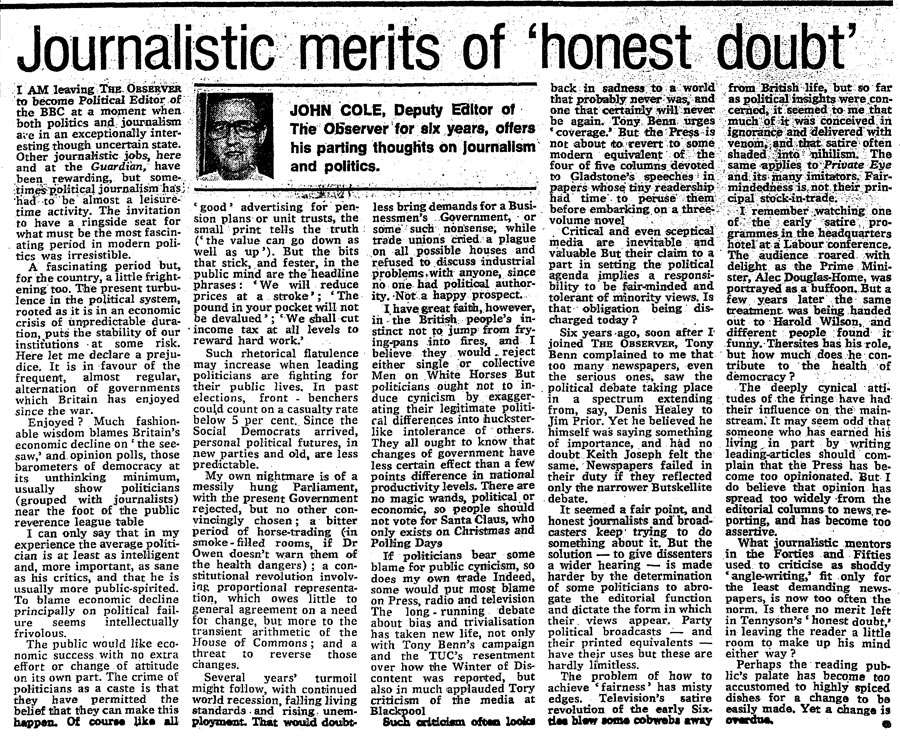
After Tiny Rowland took over as proprietor of The Observer in 1981, Cole gave evidence against him at the Monopolies Commission. The following day he got a call from the BBC offering him the job of political editor, succeeding John Simpson.<ref name=BBCObit/> Cole commented on his switch from print to television journalism: "The invitation to have a ringside seat for what must be the most fascinating period in modern politics was irresistible."<ref>Cole J. Journalistic merits of honest doubt The Observer, 25 October 1981; Retrieved 9 November 2013</ref> He had little previous television experience but proved a "natural broadcaster." Reporting through most of the premiership of Margaret Thatcher, he became a familiar figure on television and radio.<ref name=BBCObit/>
His health was put under strain by the workload and he suffered a heart attack in February 1984.<ref name="guardian obit"/> Returning to report on that year's conference season, he covered the Brighton hotel bombing, getting a "memorable"<ref name=BBCObit/> interview with Thatcher on the pavement in its immediate aftermath, in which she declared that the Tory conference would take place as normal.<ref name=Indy_obit>John Cole: The most recognisable and respected broadcast political journalist since World War II The Independent, 8 November 2013; Retrieved 9 November 2013</ref><ref name=BBCObit/><ref>TV Interview for BBC (immediate reaction to Brighton Bomb) “The conference will go on, as usual” Margaret Thatcher Foundation; Retrieved 9 November 2013</ref> An astute observer of the political scene, Cole was one of the earliest to forecast Thatcher's resignation as prime minister in 1990,<ref name=Indy_obit /><ref name="guardian obit"/><ref name=BBCObit/> in what McKie refers to as "perhaps his greatest exclusive."<ref name="guardian obit"/> Donald Macintyre writes that he "did more than any single figure to create popular understanding of the turbulent 1980s".<ref name=Indy_obit />
Cole established a strong reputation for his "gentle but probing" interviewing style, for his political assessments,<ref name=BBCObit/> and for presenting analysis rather than "bland reporting."<ref name=robinson /> McKie considers him to have "revolutionised the routine broadcast reporting of politics",<ref name="guardian obit"/> while Macintyre states that he "pioneered the best in modern political broadcast journalism."<ref name=Indy_obit /> "Held in enormous affection by viewers,"<ref>"Honest John" The Independent, 2 June 1995; Retrieved 7 November 2013</ref> Cole was trusted by both politicians and the public.<ref name=Indy_obit /> He was known for "speaking in the language used by ordinary people" rather than "so-called Westminster experts" and for "articulat[ing] the viewpoint of the ordinary man or woman in the street."<ref>John Cole, the last of the old breed of TV journalist Template:Webarchive The Telegraph, 8 November 2013; Retrieved 9 November 2013</ref> His distinctive Northern Irish accent – lampooned by Private Eye and Spitting Image, who made a puppet representing him – led the way for BBC broadcasters with regional accents.<ref name=BBCObit/><ref name=robinson>Remembering John Cole BBC News, 8 November 2013; Retrieved 9 November 2013</ref>
He retired as political editor in 1992 (aged 65), compulsory at that date,<ref name=BBCObit/> but continued to appear on television, including making programmes on golf and travel.<ref name="guardian obit"/> He also continued to appear on the BBC programme Westminster Live for several years after he retired as political editor.
Writing
In addition to his journalistic writing, Cole authored several books. The earliest were The Poor of the Earth, on developing countries, and The Thatcher Years (1987). After his retirement as BBC political editor, he spent more time writing. His political memoir, As It Seemed To Me, appeared in 1995 and became a best-seller.<ref name="guardian obit"/> He also published a novel, A Clouded Peace (2001), set in his birthplace of Belfast in 1977.<ref name="guardian obit"/><ref>Two pints of Guinness and a ceasefire, please The Observer, 22 April 2001; Retrieved 9 November 2013</ref>
In 2007 he wrote an article for the British Journalism Review, blaming both politicians and the media for the fact that parliamentarians were held in such low esteem, being particularly scathing of Alastair Campbell's influence during Tony Blair's premiership.<ref name=BBCObit/>
Awards
In 1966, the Eisenhower Fellowships selected Cole to represent Great Britain. He received the Royal Television Society's Journalist of the Year award in 1991.<ref name=BBCObit/> After his retirement in 1992, he was awarded an honorary degree from the Open University as Doctor of the University,<ref>Open University: Cumulative list of Honorary Graduates from 1973 to 2013 Template:Webarchive. Retrieved 9 November 2013</ref> and received the Richard Dimbleby Award from BAFTA in 1993.<ref name=BBCObit/> He turned down a CBE in 1993, citing the former Guardian newspaper rule that journalists could only accept gifts which could be consumed within 24 hours.<ref name=BBCObit>Template:Cite news</ref>
Personal life
In his private life Cole was a supporter of the Labour Party, and was a believer in the trades union movement. He considered that the combating of unemployment was one of the most important political issues. He was a British Republican, and a committed Christian, associating in the latter part of his life with the United Reformed Church at Kingston upon Thames.<ref name="guardian obit">Template:Cite news</ref> He was described by colleague Peter Preston as "warm, generous and the kind of colleague we all wished to be."<ref name=Preston />
He married Madge around 1956.<ref name="guardian obit" /> The couple had four sons and nine grandchildren.<ref name=BBC24867047>{{#invoke:citation/CS1|citation |CitationClass=web }}</ref>
Death
Cole suffered health problems in retirement including heart problems and two minor strokes. In 2009 he was diagnosed with cancer. He subsequently developed aphasia.<ref name="guardian obit" /> Cole died at his home at Claygate in the county of Surrey on 7 November 2013.<ref name=BBC24867047/><ref name="guardian obit" />
Tributes
Tributes were paid by journalists, broadcasters and politicians across the political spectrum.<ref name=BBC24867047/> Prime Minister David Cameron called him a "titan at the BBC" and an "extraordinary broadcaster".<ref name=BBC24867047/> Labour party leader Ed Miliband said that "my generation grew up watching John Cole. He conveyed the drama and importance of politics."<ref name=tributes>{{#invoke:citation/CS1|citation |CitationClass=web }}</ref> The Scottish First Minister Alex Salmond said that Cole was "an extremely able journalist but also extraordinarily helpful and generous to a young politician."<ref name=tributes/> The BBC's political editor at the time, Nick Robinson, wrote that Cole "shaped the way all in my trade do our jobs".<ref name=tributes/>
References
External links
- [https://www.imdb.com/{{#if: 1938977
 | name/{{#if:{{#invoke:ustring|match|1=1938977|2=^nm}}
   | Template:Trim/
   | nm1938977/
   }}
 | {{#if: {{#property:P345}}
   | name/Template:First word/
   | find?q=%7B%7B%23if%3A+John+Cole%0A++++++%7C+John+Cole%0A++++++%7C+%5B%5B%3ATemplate%3APAGENAMEBASE%5D%5D%0A++++++%7D%7D&s=nm
   }}
 }}{{#if: 1938977  {{#property:P345}} | {{#switch:
 | award | awards = awards Awards for | biography | bio = bio Biography for
 }}}} {{#if: John Cole
 | John Cole
 | Template:PAGENAMEBASE
 }}] at IMDb{{#if: 1938977{{#property:P345}}
 | Template:EditAtWikidata
 | Template:Main other
}}{{#switch:{{#invoke:string2|matchAny|^nm.........|^nm.......|nm|.........|source=1938977|plain=false}}
 | 1 | 3 =  Template:Main otherTemplate:Preview warning
 | 4 = Template:Main otherTemplate:Preview warning
}}{{#invoke:Check for unknown parameters|check|unknown=Template:Main other|preview=Page using Template:IMDb name with unknown parameter "_VALUE_"|showblankpositional=1| 1 | 2 | id | name | section }}
Template:S-start Template:S-media Template:Succession box Template:Succession box Template:Succession box Template:S-end Template:Authority control
- 1927 births
- 2013 deaths
- Protestants from Northern Ireland
- People educated at the Belfast Royal Academy
- Alumni of the University of London
- Journalists from Belfast
- Broadcasters from Belfast
- BBC newsreaders and journalists
- British political journalists
- Belfast Telegraph people
- The Guardian journalists
- The Observer people
- British male novelists
- 21st-century British novelists
- 21st-century male writers from Northern Ireland
- British republicans