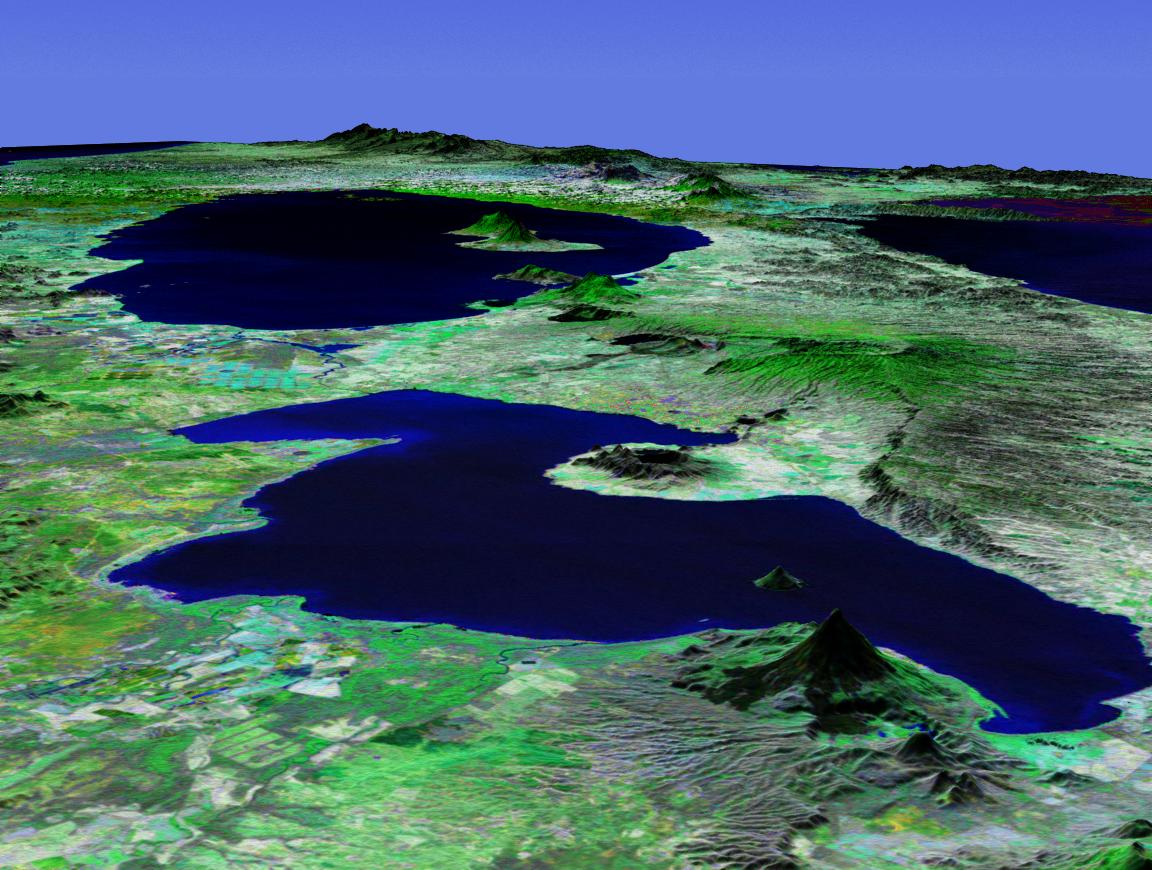
Lake Managua
Template:Short description Template:Infobox body of water Lake Managua (Template:Langx, {{#invoke:IPA|main}}), also known as Lake Xolotlán ({{#invoke:Lang|lang}}), is a freshwater lake in Nicaragua. At 1,042 km², it is approximately Template:Convert long and Template:Convert wide. Similarly to the name of Lake Nicaragua, its other name comes from the Nahuatl language, possibly from the Spanish Tlaxcaltec and Mexica allies but most likely from the Nicarao tribes that had already settled in the region.<ref>{{#invoke:citation/CS1|citation |CitationClass=web }}</ref> The city of Managua, the capital of Nicaragua, lies on its southwestern shore.
Islands
There are two uninhabited lake islands:
- Template:Interlanguage link, a volcanic island. There is another nearby volcano, on the mainland: Momotombo.
- Isla Rosa, an islet
Flooding
The level of Lake Managua rises significantly during periods of heavy rain. The highest water level was recorded during the flooding of 1933.<ref name=haynes/>
The lake rose 3 metres (10 ft) in five days during Hurricane Mitch in 1998, destroying the homes of many who lived on its edge. An even higher flooding occurred in September/October 2010.<ref name=haynes/> Since then, the city has prohibited residential use of the most flood-prone areas, those with the elevation below 42.76 meters above sea level.<ref name=haynes/>
Pollution
Lake Managua was described by some authors as "the most contaminated lake in Central America."<ref name=haynes>Douglas Haynes, [The Lake at the Bottom of the Bottom]. VQR, Summer 2011</ref> The lake had been severely polluted, mostly by decades of sewage being dumped into the lake.<ref>Hazel Plunkett. Nicaragua: A Guide to the People, Politics and Culture. Interlink Books, Dec 1, 2001. pg. 71</ref> The city sewers have drained into the lake since 1927.<ref name=haynes/> It was only in 2009 that a modern wastewater treatment plant (built and operated by the British company Biwater) was opened in Managua, but even it treats only 40% of the city's wastewater.<ref name=haynes/>
The lake today has no stable outlet, with only occasional floods to Lake Nicaragua through the Tipitapa River. Pollutants are thus concentrated.<ref name="digitalcommons.unl.edu">Thorson, Thomas B., "The Status of the Lake Nicaragua Shark: An Updated Appraisal" (1976). Investigations of the Ichthyofauna of Nicaraguan Lakes.Paper 41.</ref> Despite the pollution, some of the people of Managua still live along the lake's shores and eat the fish from it.<ref name=haynes/>
In 2007 the Template:Wikt-lang area was dredged, and the sediment hauled off on barges. A strong odor which permeated the area from the sediment disappeared. A stone rip-rap and concrete wharf was constructed, and a sightseeing boat called La Novia de Xolotlán makes hour-long lake tours when there are sufficient tourists.
Lake Managua was virtually dead, biologically speaking until a new wastewater treatment plant saved the lake and turned it into a recreational area for Nicaragua.
Wildlife
About 20 fish species still survive in Lake Managua.<ref name=haynes/>
While joined to Lake Nicaragua, the bull sharks of that lake cannot migrate to Lake Managua due to a Template:Convert waterfall on the Tipitapa River.<ref name="digitalcommons.unl.edu"/>