MV Goya
Template:Short description Template:About
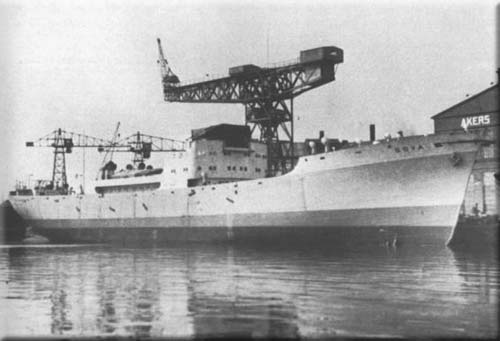
Template:Infobox ship imageTemplate:Infobox ship careerTemplate:Infobox ship careerTemplate:Infobox ship characteristicsGoya was a Norwegian motor freighter used as a troop transport by Nazi Germany and sunk with a massive loss of life near the end of World War II.
Completed in 1940 for the Johan Ludwig Mowinckel Rederi company, the ship was named after Spanish artist Francisco Goya. Following Germany's invasion of Norway that year, she was seized by the Kriegsmarine and pressed into service as a troop transport.
Near the end of the war, Goya took part in Operation Hannibal, the evacuation of German military and civilian personnel from remaining pockets held by the Germans along the Baltic Sea. Loaded with thousands of refugees, the ship was sunk on 16 April 1945 by the Soviet submarine L-3. Most of the crew and passengers died in the sinking.
The sinking of Goya was one of the biggest single-incident maritime losses of life of the war, and one of the largest such losses in history, with just 183 survivors out of roughly 6,700 passengers and crew.Template:Sfn
Early service
Goya was originally built as a freighter by the Akers Mekaniske Verksted shipyard in Oslo, Norway, in 1940. The ship was Template:Convert long and Template:Convert wide, had a capacity of 5,230 GRT, and a top speed of 18 knots. Following the German occupation of Norway, the ship was seized by Germany and in 1942 refitted as an auxiliary transport vessel for German U-boats.Template:Sfn In 1943, Goya was turned into a depot ship (tender), providing support to smaller vessels, but the following year was moved to Memel (present-day Klaipėda, Lithuania), where she was used as a target ship for torpedo practice by the 24th U-boat Flotilla.Template:Sfn
In 1945, during Operation Hannibal, Goya was used as an evacuation ship, moving people west from the eastern and southern Baltic.Template:Sfn Her commanding officer was Captain Plünnecke.Template:Sfn Goya was marked as a hospital ship and carried over 1,000 hospital beds for very seriously wounded and immobile soldiers.
Sinking
On 16 April 1945, Goya was sailing from Hel, around the Hel Peninsula and across the Baltic Sea to Kiel in western Germany. Besides Goya, the convoy included two smaller vessels (Kronenfels and steam tug Aegir), and two minesweeper convoy escorts, Template:Ship and Template:Ship.Template:SfnTemplate:Sfn Goya was just one of over 1,000 ships commissioned to participate in the Operation Hannibal evacuations organised by Kriegsmarine Commander-in-Chief Karl Dönitz. The ship (meant to accommodate 850 crew members), was crowded with over 7,000 evacuees, military personnel, and wounded soldiers.
Four hours after leaving the port of Hel, and while close to the southern tip of the Hel Peninsula, the convoy was attacked by Soviet bombers. During the air raids, a bomb they dropped hit Goya (causing minimal damage).Template:Sfn After rounding the Hel Peninsula, and leaving Gdansk Bay, several miles north of Cape Rixhöft (Cape Rozewie), the convoy was sighted by Soviet minelayer submarine L-3, which also carried torpedoes.Template:SfnTemplate:Sfn While Goya normally was faster than submarines, the convoy was slowed by engine problems on the Kronenfels, which in turn necessitated a 20-minute stop for repairs.Template:Sfn At (exactly) four minutes before midnight (local time), L-3 Captain Vladimir Konovalov gave the order to fire a spread of four torpedoes.Template:SfnTemplate:Sfn Two of these hit Goya; one struck amidships, the second exploded in the stern, sending an immense plume of fire and smoke into the sky.Template:Sfn The impact of the torpedoes was so great that the ship's masts collapsed (onto refugees sleeping on the top deck). Within moments,Template:Vague the ship broke in two, with fire consuming its upper portions. Shortly after midnight (and less than four minutes after torpedo impact) Goya sank, drowning thousands in their beds.Template:SfnTemplate:SfnTemplate:Sfn
Casualties
Goya, a freighter not equipped with the safety features of a passenger ship, sank to a depth of approximately Template:Convert.Template:Sfn Given the speed of the sinking, most passengers went down with her or died of hypothermia in the cold waters of the Baltic Sea.
The exact death toll is difficult to estimate. Authors cite the total number of passengers as "over 6,000",Template:SfnTemplate:Sfn 6,700,Template:Sfn or 7,200,Template:Sfn although the exact number might never be known; evacuated military personnel and civilians fleeing German enclaves in East Prussia and occupied Poland boarded ships in chaotic circumstances and often occupied all available space aboard. In any event, the death toll exceeded 6,000 and most likely reached 7,000, making the sinking one of the worst maritime disasters in history, exceeded only by the January 1945 sinking of the Wilhelm Gustloff.
The exact number of survivors is also a matter of dispute; most estimates place it at approximately 182 people saved (176 soldiers and 6 civilians), of whom nine died shortly afterwards.Template:Sfn However, other figures are also cited, notably 172 and 183.Template:SfnTemplate:Sfn
Discovery of wreck
Template:More citations needed The position of the wreck had long been known to Polish fishermen but was not identified and referred to as "Wreck No. 88" on Polish Navy maps. On 26 August 2002, the wreck was discovered by Polish technical divers Grzegorz Dominik, Michał Porada, and Marek Jagodziński, who also salvaged the ship's compass.
Exactly 58 years after the sinking of Goya, the wreck was located on 16 April 2003 by an international expedition under the direction of Ulrich Restemeyer, aided by 3D-Sonar scanning. The position records of GoyaTemplate:'s accompanying ships were found to be incorrect, probably made during a hasty escape. During the rediscovery, another, smaller, ship was seen on the surface above the wreck and initially thought to carry fishermen. But when Restemeyer's ship, the Fritz Reuter, approached, the other vessel, seemingly carrying divers, left.
The wreck lies at a depth of 76 meters below the surface of the Baltic Sea and is in remarkably good condition, though covered with nets. The wreck is littered with human remains. Survivors have lain wreaths at the surface to show their condolences for the 6,000 people who lost their lives here.
Shortly after the discovery, the wreck was officially declared a war grave by the Polish Maritime Office in Gdynia.Template:Sfn In 2006, the decision was published in an official government gazette of the Pomeranian Voivodeship, making it illegal to dive within 500 metres of the wreck.Template:Sfn
See also
- Cap Arcona
- Wilhelm Gustloff
- Steuben
- List by death toll of ships sunk by submarines
- Armenia
- Iosif Stalin
References
Sources
- Template:In lang Template:Cite book
- Template:In lang Template:Cite book
- Template:In lang Template:Cite journalTemplate:Dead link
- Template:In lang Template:Cite book
- Template:In lang Template:Cite encyclopedia
- Template:In lang {{#invoke:citation/CS1|citation
|CitationClass=web }}
Further reading
- Fritz Brustat-Naval: Unternehmen Rettung, Koehlers Verlagsgesellschaft, Hamburg, 2001, Template:ISBN.
- Ernst Fredmann: Sie kamen übers Meer - Die größte Rettungsaktion der Geschichte, Pfälzische Verlagsges, Template:ISBN.
- Heinz Schön: Ostsee '45, Motorbuch Verlag Stuttgart, 1995, Template:ISBN.
- Williams, David, Wartime Disasters at Sea. Near Yeovil: Patrick Stephens Limited, 1997.
External links
- The expedition searching for the wreck of the Goya 12 – 22 April 2003 with the MS Fritz Reuter and an MDR-Team (in German)
- Photograph of SS Goya
- Troop ships
- World War II merchant ships of Germany
- World War II merchant ships of Norway
- World War II passenger ships of Germany
- World War II shipwrecks in the Baltic Sea
- Ships sunk by Soviet submarines
- Maritime incidents in April 1945
- Germany–Soviet Union military relations
- 1940 ships
- Ships built in Oslo
- Shipwrecks of Poland