Moses Jacob Ezekiel
Template:Short description Template:Infobox artist
Moses Jacob Ezekiel, also known as Moses "Ritter von" Ezekiel (October 28, 1844 – March 27, 1917), was an American sculptor who lived and worked in Rome for the majority of his career. Ezekiel was "the first American-born Jewish artist to receive international acclaim".<ref name=Lj/><ref>Nash (2014), p. xi.</ref> Ezekiel was an ardent supporter, in both his writings and in his works, of the Lost Cause view of history, asserting that in the Battle of New Market he had "never fought for slavery, but for states' rights and for free trade."<ref>{{#invoke:citation/CS1|citation |CitationClass=web }}</ref> In a eulogy, President Warren Harding described him as "a great Virginian, a great artist, a great American, and a great citizen of world fame."<ref>{{#invoke:citation/CS1|citation |CitationClass=web }}</ref>
He was a cadet at the Virginia Military Institute (VMI) and served in the Confederate Army during the American Civil War, including at the Battle of New Market.<ref name="Plain"/>
After the war, he completed his degree at VMI, and a few years later went to Berlin, studying at the Prussian Academy of Art. He subsequently moved to Rome, where he lived and worked most of his life, selling his works internationally, including several commissions in the United States.
He has been described as a "Confederate expatriate"<ref name=Plain>Template:Cite news</ref> and a "proud Southerner",<ref name=Moment/> and the Confederate battle flag hung in his Rome studio for 40 years.<ref name=Plain/> The most famous of his monuments is the Confederate Memorial in Arlington National Cemetery, which he thought of as the "crowning achievement of his career."<ref name=Sue>Template:Cite news</ref> The monument was removed on December 20, 2023;<ref>{{#invoke:citation/CS1|citation |CitationClass=web }}</ref> on August 5, 2025 it was announced that the monument would be reinstated.
Early life
Ezekiel was born in Richmond, Virginia, the son of Jacob Ezekiel (1812–1899), an Ashkenazi Jew. His mother, Catherine de Castro Ezekiel, was Sephardic.<ref name=Nyt/><ref name=Artes>Template:Cite news</ref> His grandparents had emigrated from Holland in the early 1800s, settling first in Philadelphia and later in Richmond.<ref name=Cohen/>Template:Rp His father was a cotton merchant<ref name=Artes/> and bookbinder, "a good writer and a well-read man, who possessed the complete works of Maimonides".<ref name=Baths/>Template:Rp While in the book-binding business in Baltimore (1833–34), Jacob founded the Hebrew Benevolent Society of Baltimore.<ref name=Necro>Template:Cite magazine</ref> Jacob moved to Richmond in 1834, entering the dry-goods business with first one, then another brother-in-law.<ref name=Generations/>Template:Rp He was secretary of the synagogue Kahal Kadosh Beth Shalome "and spokesman of the Jews of Richmond".<ref name=Generations/>Template:Rp In Cincinnati, Jacob served as Secretary of the Board of Hebrew Union College. He was a charter member of B'nai B'rith.<ref>Template:Cite news</ref>
The seventh child,<ref name="Cohen" />Template:RpTemplate:Refn Moses had three brothers and eight sisters,<ref>Template:Cite news</ref>Template:Refn at least one of which was stillborn.<ref name=Baths/>Template:Rp He was brought up as an observant Jew by his grandparents, to whom his parents sent him to live due to financial difficulties.<ref name=Moment>Template:Cite news</ref><ref name=Cohen/>Template:RpTemplate:Refn They owned a dry-goods store that sold suits and women's dresses for slaves about to be sold. They also owned a few slaves.<ref name=Plain/><ref name=Sue/> Moses "was sent to a 'pay' school", that of "old Mr. Burton Davis",<ref name=Baths/>Template:Rp and he attended dancing school.<ref name=Baths>Template:Cite book</ref>Template:Rp
Virginia Military Institute and the Civil War

When Fort Sumter was fired upon and Virginia seceded, Ezekiel enrolled in the Virginia Military Institute in Lexington, Virginia,<ref name=Artes/> the first Jewish cadet to do so.<ref>Template:Cite news</ref> He was Corporal of the Guard that accompanied the coffin of Stonewall Jackson (a Virginia Military Institute instructor) at his burial in Lexington in 1863.<ref name=Cohen/>Template:Rp<ref name=Generations/>
He and other cadets from VMI marched eighty miles north and fought at the Battle of New Market, providing crucially needed reinforcements against the army of Union General Franz Sigel. Wounded in the fight, he recovered and was reassigned with other surviving cadets to serve as drill instructors for new Confederate recruits. Shortly before the end of the war, he joined a last-ditch effort to defend Lexington during Grant's Richmond-Petersburg campaign.<ref name="Vmi" /> When peace was declared, he returned to VMI to finish his education, graduating in 1866.
Sculpture
He then studied anatomy at the Medical College of Virginia in 1866–68, thinking of becoming a doctor.<ref name="Baths" />Template:Rp<ref name="Cohen" />Template:Rp In 1867–68, he was superintendent of the Richmond Hebrew Sunday School.<ref>Template:Cite news</ref> He moved in with his parents in Cincinnati in 1868; his parents had moved there, where their oldest daughter Hannah lived, after losing their business in Richmond to fire.<ref name="Baths" />Template:Rp<ref name="Cohen" />Template:Rp While not there long, in his memoirs he called Cincinnati his home.<ref name="Inquirer">Template:Cite news</ref>
In Cincinnati he began the study of sculpture<ref name="Plain" /> at the Art School of J. Insco Williams and in the studio of Thomas Dow Jones.<ref name="Baths" />Template:Rp<ref name="Vmi" /> Moving to Berlin in 1869, he studied at the Prussian Academy of Art under Professor Albert Wolf.
Needing money, in 1873, during the Franco-Prussian War, he was a war correspondent for the New York Herald,<ref name=Philipson/>Template:Rp and he was arrested and imprisoned "for a time" as a spy for France.<ref name=Nyt>Template:Cite news</ref> He was admitted into the Society of Artists, Berlin, and at age 29 was the first foreigner to win the Michael Beer Prix de Rome, for a bas relief entitled Israel. The prize of $1,000 provided for two years of study in Rome,<ref name=Bush>Template:Cite news</ref>Template:Rp but he traveled to Rome by way of the United States, where he had not been for five years,<ref name=Baths/>Template:Rp as he had "unexpectedly" received a commission from B'nai B'rith for a monument to religious liberty.<ref name=Baths/>Template:Rp<ref name=Cohen/>Template:Rp
Rome studio
Arriving in Rome in 1874, Ezekiel fell in love with the city, which he soon made his home. It was there that he completed the sculptures and paintings for which he is famous.
Ezekiel's life and studio in Rome were lavish.<ref name=":1">Template:Cite book</ref> "He dressed like a dandy and spent extravagantly on entertaining friends, clients, and potential clients."<ref name=Artes/> His studio in Rome was in the former Baths of Diocletian, where every Friday afternoon he had open house.<ref name=Bush/>Template:Rp It was called "one of the Show Places of the Eternal City, magnificent in proportions and stored with fine art works."<ref name=Art>Template:Cite news</ref> and many visitors left descriptions of it.<ref name=Philipson>Template:Cite news</ref>Template:Rp
Among the visitors to his studio were:
- Gabriele d'Annunzio<ref name="Baths" />Template:Rp
- Queen of Italy Margherita of Savoy<ref name="Baths" />Template:Rp
- General and future President Ulysses Grant<ref name="Baths" />Template:Rp
- Franz Liszt<ref name="Baths" />Template:Rp
- U.S. ambassador to Italy John Stallo<ref name="Baths" />Template:Rp
- Cardinal Gustav Adolf Hohenlohe<ref name="Baths" />
- writer Annie Besant<ref name="Baths" />Template:Rp
- railroad magnate Melville Ingalls<ref name="Baths" />Template:Rp
- engineer Benjamin Hotchkiss, and
- Emperor Wilhelm II of Germany<ref name="Baths" />Template:Rp
Here also he made the acquaintance of Franz Liszt and Cardinal Gustave von Hohenlohe, the Papal representative of Austria. Thus, naturally, busts of these two famous men are included in Ezekiel's oeuvre.<ref name=Bush />
A lecture in his studio was attended by 150 people.<ref name="Baths" />Template:Rp He also hosted musicales there,<ref name="Chyet" />Template:Rp where could be heard "the finest music by the greatest talent".<ref name="Baths" />Template:Rp
Ezekiel occupied this studio from 1879 to 1910.<ref name=Chyet>Template:Cite news</ref>Template:Rp After 30 years, the government "demand[ed] the possession of this part of the ruins as an adjunct to the National Roman Museum. On leaving there he was given by the municipal authorities the Tower of Belisarius on the Pincian Hill overlooking the Borghese Gardens, which furnished him a home for the rest of his years, while he took a studio and work rooms in the Via Fausta and just off the Piazza del Popolo."<ref name="Bush" />Template:Rp
Personal life

Although Ezekiel never married, he had a daughter, Alice Johnson (1859–1924). According to a census document of July 14, 1860, Alice Johnson was 10 months old, suggesting she was born in September 1859. She would therefore have been conceived at the beginning of 1859<ref name="Dan">Template:Cite book</ref> when Moses was 14. Her mother was Isabella, a "beautiful mulatto housemaid" of his father.<ref name="Dan" />Template:Rp After graduating from Howard University, Alice became a schoolteacher and married Daniel Hale Williams in 1898, who was also mixed race. He became a prominent, pioneering heart surgeon. They lived in Chicago for much of his career.<ref>The Booker T. Washington Papers, Vol.9, footnote, p. 396, November 1907, U. of Illinois Press Template:Webarchive</ref><ref>Helen Buckler, Doctor Dan: Pioneer in American Surgery, (originally published before 1923; reprinted by Nabu Press, 2011), pp. 147-58, 226-27. Another edition, published in 1968, is Buckler's Daniel Hale Williams, Negro Surgeon.</ref><ref>Template:Cite news</ref>
Isabella visited Moses in Rome with Alice, but returned shortly thereafter. Moses never refers to Alice in his Memoirs, and there is no record of any other contact between them.
In 1872, in Berlin, he met Fedor Encke (1851–1926), the "illegitimate grandson of King Friedrich Wilhelm II of Prussia."<ref name=Moment/> Encke was a portrait painter later commissioned to do portraits of Theodore Roosevelt and John Pierpont Morgan, among others; he also painted Ezekiel.<ref Name=Cohen>Template:Cite book</ref>Template:Rp The pair "traveled together often and socialized with Europe's elites, including Hungarian composer Franz Liszt, French actress Sarah Bernhardt and Queen Margherita of Italy."<ref name=Moment/> Encke accompanied Ezekiel on a visit to the United States.<ref name=Cohen/>Template:Rp According to writer Michael Feldberg, Ezekiel and Encke had "a forty-five year homosexual relationship…that neither acknowledged publicly."<ref name="Artes" /> About this relationship, Ezekiel was always circumspect in his letters and memoirs, referring to Encke only as his "traveling companion" and "my dear friend."<ref name="Baths" />Template:Rp<ref>Nash (2014), p. 78.</ref>
Biographer Peter Adam Nash, in The Life and Times of Moses Jacob Ezekiel, describes Ezekiel as homosexual, but Nash does not produce any direct evidence for this; Nash's assumption is made from his research of Ezekiel's papers and of their social and historical context.<ref>Nash (2014), pp. xi, 50, 78-79, 100, 119-120.</ref> Samantha Baskind's book about Ezekiel, based on six years of archival research and study, does not find any evidence to substantiate this assertion.<ref name=":1" />
Awards and honors
In his lifetime, Ezekiel received numerous honors: he was decorated by King Umberto I of Italy, the "Crosses for Merit and Art" from the German Emperor, another from Prince Frederick Johann of Saxe-Meiningen, and the awards of "Chevalier" (Cavaliere) and "Officer of the Crown of Italy" (1910) from King Victor Emmanuel III of Italy. Ezekiel received the Gold Medal of the Royal Society of Palermo, Italy; the silver medal at the 1904 Louisiana Purchase Exposition in St. Louis, Missouri; and the Raphael Medal from the Art Society of Urbino, Italy.
The honorific "Sir" by which Ezekiel is often referred is technically incorrect, as Ezekiel was never knighted by the monarch of the United Kingdom. More properly, his title was "Cavaliere" Moses Ezekiel, because of his Italian knighthood, or Moses "Ritter von" Ezekiel, because of his German honors. Ezekiel translated his Italian title into the English "Sir" on his visiting cards, resulting in the honorific by which he became known in English-speaking countries.<ref>Template:Cite book</ref>
In 1904, he was presented the New Market Cross of Honor at VMI by the Government of Virginia as one of the 294 cadets who fought at the Battle of New Market.
Grave

Ezekiel died in his studio in Rome, Italy during the First World War,<ref>Template:Cite book</ref> and was temporarily entombed there. In 1921, he was reinterred at the foot of his Confederate Memorial in Section 16 of Arlington National Cemetery. The inscription on his grave reads "Moses J. Ezekiel Sergeant of Company C Battalion of Cadets of the Virginia Military Institute."
Legacy
Critical assessments
Compared to Michelangelo in 1876,<ref name="Baths" /> Ezekiel's fame has not stood the test of time. "Famous in his day, he is almost forgotten now" (1986).<ref name="Inquirer" /> According to his biographer Peter Nash, "You wouldn't go to Rome to make new, progressive art."<ref name="Moment" /> "He could not accept modern art", and "rejected" Rodin, whom he considered "pretentious".<ref name="Baths" />Template:Rp<ref>Template:Cite news</ref> After noting the awards he received during his life, Sue Eisenfeld wrote in 2018:
<templatestyles src="Template:Blockquote/styles.css" />
But in death, the art world ignored and forgot him because he never innovated; he emulated the classical style of the previous masters, focusing on the full human figure and historical and allegorical subjects, even when the time for that style had come and gone.<ref name="Plain" />{{#if:|
|}}{{#if:|
— {{#if:|, in }}Template:Comma separated entries
}}{{#invoke:Check for unknown parameters|check|unknown=Template:Main other|preview=Page using Template:Blockquote with unknown parameter "_VALUE_"|ignoreblank=y| 1 | 2 | 3 | 4 | 5 | author | by | char | character | cite | class | content | multiline | personquoted | publication | quote | quotesource | quotetext | sign | source | style | text | title | ts }}
"As was his custom with his monuments, Ezekiel proceeded meticulously to reflect historical accuracy,"<ref name="Baths" />Template:Rp according to the editors of his memoirs.
<templatestyles src="Template:Blockquote/styles.css" />
[But his works] are utterly devoid of innovations or daring new modes of representation. His prime concern was the literary and historical idea behind the work…. But he failed to realize, like other 19th-century artists, that noble thoughts alone do not guarantee that the works they inspire will be great art… he frequently sacrificed his design to accurate depiction and photographic truth.<ref name="Sue" />{{#if:|
|}}{{#if:|
— {{#if:|, in }}Template:Comma separated entries
}}{{#invoke:Check for unknown parameters|check|unknown=Template:Main other|preview=Page using Template:Blockquote with unknown parameter "_VALUE_"|ignoreblank=y| 1 | 2 | 3 | 4 | 5 | author | by | char | character | cite | class | content | multiline | personquoted | publication | quote | quotesource | quotetext | sign | source | style | text | title | ts }}
"Lost Cause" movement
{{#invoke:Labelled list hatnote|labelledList|Main article|Main articles|Main page|Main pages}}
Another factor possibly contributing to his relative obscurity may be his devotion to the Confederacy.<ref name="Moment" />
Ezekiel's sculptures of Confederate heroes are the most visible manifestation of, and a significant factor in the legitimacy of, the Lost Cause of the Confederacy, which he espoused.<ref name="Moment" />
Ezekiel's work has been identified as integral to this sympathetic view of the Civil War.<ref name="Moment" /> He depicted Confederate leaders, like Stonewall Jackson, or fallen soldiers like the VMI students, as heroes. "But no monument exemplifies the Lost Cause narrative better than Ezekiel's Confederate Memorial in Arlington, where the woman representing the South appears to be protecting the black figures below."<ref name="Moment" /> According to his relative Judith Ezekiel, "This statue was a very, very deliberate part of revisionist history of racist America."<ref name="Moment" /> According to historian Gabriel Reich, "the statue functions as propaganda for the Lost Cause.… It couldn't be worse."<ref name="Moment" />
On August 20, 2017, in the aftermath of the Unite the right rally in Charlottesville, Virginia — members of Ezekiel's extended family sent a letter to the Washington Post, asking for the Arlington monument's removal:
<templatestyles src="Template:Blockquote/styles.css" />
Like most such monuments, this statue intended to rewrite history to justify the Confederacy and the subsequent racist Jim Crow laws. It glorifies the fight to own human beings, and, in its portrayal of African Americans, implies their collusion. As proud as our family may be of Moses's artistic prowess, we — some twenty Ezekiels — say remove that statue. Take it out of its honored spot in Arlington National Cemetery and put it in a museum that makes clear its oppressive history.<ref>Template:Cite news</ref>{{#if:|
|}}{{#if:|
— {{#if:|, in }}Template:Comma separated entries
}}{{#invoke:Check for unknown parameters|check|unknown=Template:Main other|preview=Page using Template:Blockquote with unknown parameter "_VALUE_"|ignoreblank=y| 1 | 2 | 3 | 4 | 5 | author | by | char | character | cite | class | content | multiline | personquoted | publication | quote | quotesource | quotetext | sign | source | style | text | title | ts }}
Template:As of, plans were under way to remove the statue from Arlington, with plans to relocate it to the New Market Battlefield State Historical Park.<ref>Template:Cite news</ref> Ezekiel had a personal link to the New Market site as he fought for the Confederacy and was wounded at this battlefield.
Works

In the early 1880s, Ezekiel created eleven larger-than-life sized statues of famous artists. These were installed in niches on the façade of the Corcoran Gallery of Art's original building (later the Smithsonian's Renwick Gallery). In the early 1960s, they were removed to the Norfolk Botanical Garden in Norfolk, Virginia.<ref>{{#invoke:citation/CS1|citation |CitationClass=web }}</ref>
Among his other works was a memorial at VMI, Virginia Mourning Her Dead (1903), for which he declined payment.<ref name=Artes/> It was installed in the small cemetery where six of the 10 VMI cadets killed at the Battle of New Market are buried. He also created a Confederate memorial which he called New South (1914); it was installed at Arlington National Cemetery. Many of his works were of famous leaders.
One word frequently used by Ezekiel as well as others to describe his statues<ref name="Baths" />Template:Rp is "colossal": his "genius often asserts itself in colossal figures and emblematic monuments".<ref>Template:Cite book</ref> His never-built statue of Johns Hopkins, founder of Johns Hopkins University, was to have been over 15 feet (4.6 m) high, with a "colossal" bust of Hopkins, in bronze, 21⁄2 times life size.<ref name="newspapers.com">Template:Cite news</ref> His most important statues are huge, and in one case he claimed that it was the largest statue ever made.
Lists of Ezekiel's works are found in the introduction to his Memoirs,<ref name="Baths" />Template:Rp in an obituary in Art and Archaeology,<ref name="Bush" /> and in the New York Times.<ref name="Nyt" />
Ezekiel was a postwar friend of Robert E. Lee, who recommended he become "an artist",<ref name=Plain/><ref name=Moment/><ref name=Baths/>Template:Rp and Ezekiel once remarked "the one work I would love to do above anything else in the world"<ref name=Baths/>Template:Rp was a public sculpture of Robert E. Lee. But, despite entering at least four contests to do so, this ambition was not realized.<ref name=Plain/>
Statues
- Religious Liberty (1876), commissioned by B'nai Brith, originally installed in Fairmount Park, Philadelphia, later moved to the National Museum of American Jewish History in the same city. "colossal."<ref name="Bush" />Template:Rp
- artists Phidias, Raphael, Durer, Michelangelo, Titian, Murillo, Da Vinci, Correggio, Van Dyke, Canova, Thomas Crawford (1879–1884), originally installed in niches on the façade of the Corcoran Gallery of Art, Washington, DC., later moved to "Statuary Vista", Norfolk Botanical Garden, Norfolk, Virginia.<ref>Statuary Vista Template:Webarchive from Norfolk Botanical Garden.</ref> Template:As of there was a campaign to restore them.<ref>Template:Citation</ref>
- Spinoza statuette (1883), Hebrew Union College, donated by the artist for fundraising.<ref>Template:Cite news</ref>
- Mrs. Andrew Dickson White (Mary Amanda Outwater) (1889), Sage Chapel, Cornell University
- Christopher Columbus (1892), Arrigo Park, Chicago, Illinois.<ref>Columbus Statue Template:Webarchive from Waymarking.com.</ref> Bronze, "faced with gold mosaic". Commissioned for the 1893 World's Columbian Exposition (Chicago World's Fair), which Ezekiel attended. Placed over the entrance to the Columbus Memorial building.<ref>Template:Cite news</ref>
- Jesse Seligman (1895)
- Thomas Jefferson (1901), Louisville Metro Hall, Louisville, Kentucky.
- A 1910 replica is at the University of Virginia, Charlottesville, Virginia.
- Virginia Mourning Her Dead (1903), Virginia Military Institute, Lexington, Virginia. "Colossal."<ref name="Bush" />Template:Rp
- A replica is at the former Museum of the Confederacy, (the American Civil War Museum, Richmond, Virginia).
- Anthony J. Drexel (1904), Drexel University, Philadelphia, Pennsylvania.
- Blind Homer with His Student Guide 1881? (1907), University of Virginia, Charlottesville, Virginia.
- Jennie McGraw Fiske (1908), Sage Chapel, Cornell University
- Stonewall Jackson (1910), West Virginia State Capitol, Charleston, West Virginia.<ref>{{#invoke:citation/CS1|citation
|CitationClass=web }}</ref>
- A 1912 replica at the VMI in Lexington, Virginia (moved in 2020)
- Southern, at the Confederate Cemetery on Johnson's Island, Ohio, a 1910 commission from the United Daughters of the Confederacy.<ref>{{#invoke:citation/CS1|citation
|CitationClass=web }}</ref><ref name="Register">Template:Cite news</ref>
- John Warwick Daniel, (c. 1913), Lynchburg, Virginia.
- Confederate Memorial (1914), Arlington National Cemetery, Arlington, Virginia.<ref>Confederate Soldiers Memorial Template:Webarchive from Arlington National Cemetery.</ref>
- Edgar Allan Poe (Ezekiel's last work), 1915, Wyman Park, Baltimore, Maryland
- Neptune, date and location unknown, for Nettuno, Italy.
- Napoleon of St. Helena, statue in Rome, Italy.
- Edgar Allan Poe (1917), University of Baltimore, Baltimore, Maryland.<ref>Poe Statue Template:Webarchive from University of Baltimore Law School.</ref>
Reliefs
- Israel, 1873 (Skirball Museum, Los Angeles)
- Jacob Ezekiel, the artist's father, 1874 (Skirball Museum, Los Angeles)
- Catherine Ezekiel, the artist's mother, 1874 (Skirball Museum, Los Angeles)
Busts
- Bust of Friedrich Hassaurek
- Robert E. Lee (1886), Virginia Military Institute Museum
- Isaac Mayer Wise, Hebrew Union College, Cincinnati
- Goldwin Smith, 1906, Uris Library, Cornell University<ref>{{#invoke:citation/CS1|citation
|CitationClass=web }}</ref>
- Head of Anthony J. Drexel (1905), Drexel University, Philadelphia, Pennsylvania
- Bust of General Robert E. Lee
- Bust of Percy Bysshe Shelley in the Keats-Shelley Memorial House, Piazza di Spagna, Rome
- Bust of Franz Liszt.
- Bust of Jessica (1880), Smithsonian American Art Museum, Washington, DC.<ref>Jessica Template:Webarchive from Flickr.</ref>
- Bust of Judith (c. 1880), Cincinnati Art Museum, Cincinnati, Ohio.<ref>Judith from Cincinnati Art Museum.</ref>
- In 1888 he completed a bust of Hopkins professor Charles D. Morris.<ref name="newspapers.com" />
- Ecce Homo (1884), Cincinnati Art Museum, Cincinnati, Ohio.<ref>Ecce Homo, (sculpture) Template:Webarchive from Smithsonian Institution CollectionsSearchCenter.</ref>
- Bust of Thomas Jefferson (1888), United States Capitol, Washington, DC.<ref>Jefferson Template:Webarchive from U.S. Senate.</ref>
- Christ in the Tomb<ref name="Bush" />Template:Rp
- Napoleon at St. Helena
- The Martyr, or Christ Bound to the Cross
- David Singing his Song of Glory
- Judith Slaying Holofernes
- Jessica
- Portia
- the allegorical Jefferson Monument for Louisville, Kentucky, and a replica in front of the University of Virginia at Charlottesville
- Lord Sherbrooke Memorial in Westminster Abbey, London, England
- Senator Daniels at Lynchburg, Virginia
- Bust of Washington ("colossal"<ref name="alumni-bulletin">Template:Cite journal</ref>Template:Rp)<ref name="Philipson" />Template:Rp) in the Cincinnati Art Museum.
- Eve Hearing the Voice (1876), Cincinnati Art Museum, Cincinnati, Ohio.<ref>Eve Hearing the Voice from Cincinnati Art Museum.</ref>
- Faith (1877), Peabody Institute, Baltimore, Maryland.<ref>Faith Template:Webarchive from Peabody Art Collection.</ref>
- Marcus Aurelius (1903)<ref>{{#invoke:citation/CS1|citation
|CitationClass=web }}</ref>
- Marcus Junius Brutus (1903)<ref>{{#invoke:citation/CS1|citation
|CitationClass=web }}</ref>
- Bust of Governor Andrew Gregg Curtin (1912), Smith Memorial Arch, West Fairmount Park, Philadelphia, Pennsylvania.<ref>Governor Curtin bust Template:Webarchive from Philadelphia Public Art.</ref>
- Andrew Dickson White, Uris Library, Cornell University<ref name=":0">{{#invoke:citation/CS1|citation
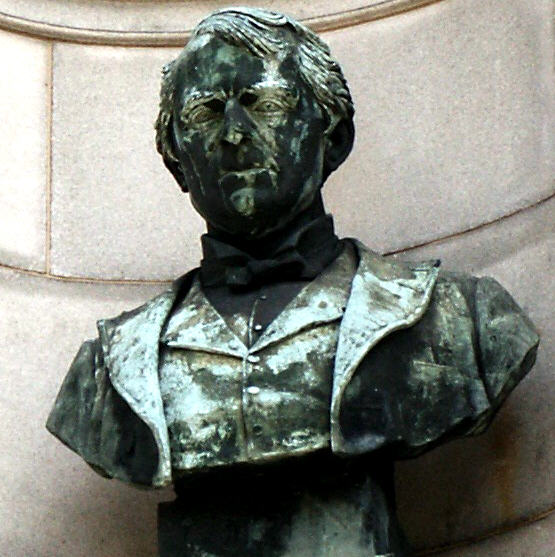
|CitationClass=web }}</ref>
- Mary Outwater White, Uris Library, Cornell University<ref name=":0" />
Archival material
The American Jewish Archives, in Cincinnati, has a "Moses Jacob Ezekiel Collection." It "includes original and photocopies of Ezekiel's correspondence and writings, photographs of many of his works, biographies, genealogies, memorial tributes, correspondence of Ezekiel's biographers, articles and newsclippings concerning Ezekiel and miscellaneous items."<ref>{{#invoke:citation/CS1|citation |CitationClass=web }}</ref>
Virginia Military Institute has two boxes of Ezekiel papers. "Included is correspondence to Virginia Military Institute Superintendent Edward West Nichols and others, 1867 – 1917, some relating to the design of the Battle of New Market memorial sculpture Virginia Mourning Her Dead; pen and ink sketches by Ezekiel (ca. 67 items); the typed manuscript of Ezekiel's autobiography, Memoirs from the Baths of Diocletian, and miscellaneous printed material."<ref name=Vmi>{{#invoke:citation/CS1|citation |CitationClass=web }}/</ref> Ezekiel's Memoirs, a fundamental source, were unknown until they were rediscovered in the Hebrew Union Archives by the two rabbis, who after much editorial work, prepared them for publication in 1975. They were called "gossipy" but "readable" in a review.<ref name=Lj>Template:Cite news</ref>
Some additional material is in the archives of Congregation Beth Ahabah, of Richmond,<ref name=Generations/> which contains the archive of Jacob Ezekiel's synagogue, Kahal Kadosh Beth Shalome, the Hebrew Union College of Cincinnati, on whose board of directors Jacob was secretary, and the organizations such as B'nai Brith and United Daughters of the Confederacy that commissioned sculptures.
Gallery
-
Bas relief of Sarah Workum, private collection.
-
Virginia Mourning Her Dead (1903), Virginia Military Institute, Lexington, VA.
-
Anthony J. Drexel (1904), Drexel University, Philadelphia, PA.
-
Bust of Anthony J. Drexel (1905), Drexel University, Philadelphia, PA.
-
Blind Homer with His Student Guide (1907), University of Virginia, Charlottesville, VA.
-
The Lookout (1910), Confederate Cemetery, Johnson's Island, OH.
-
Jefferson Monument (1910), University of Virginia, Charlottesville, VA.
-
Bust of Andrew Gregg Curtin (1912), Smith Memorial Arch, Philadelphia, Pennsylvania.
-
Confederate Memorial (Arlington National Cemetery) (1914), Arlington, VA.
-
Statue of Edgar Allan Poe (1917), University of Baltimore, Baltimore, Maryland.


'
In popular culture
Ezekiel was portrayed by Josh Zuckerman in the 2014 film Field of Lost Shoes, which depicted the Battle of New Market.
Ezekiel is the sculptor Askol in Carel Vosmaer's novel The Amazon, in which Ezekiel's studio is described in detail,<ref name="Baths" />Template:Rp<ref>Template:Cite book.</ref> It is also described in Mary Agnes Tincker's The Jewel in the Lotus;<ref name="Baths" />Template:Rp<ref>Template:Cite book</ref> "the opening pages depict the studio of Salathiel, the sculptor, the original of which character in the novel was Moses Ezekiel."<ref name="Philipson" />Template:Rp
A poem about his Israel was written by Pietschmann, of Berlin.<ref name="Philipson" />Template:Rp
Gabriele d'Annunzio wrote a poem, "To Moie Ezekiel," in 1887.<ref name="Baths" />Template:Rp
A description of his studio by Lilian V. de Bosis was published in the May 1891 issue of 'kTye Esquiline.<ref name="Philipson" />Template:Rp
See also
- Herbert Barbee
- Edmonia Lewis, another American sculptor in Rome
Notes
References
Bibliography
- Baskind, Samantha, "These 11 Marble Sculptures of Iconic Artists Once Decorated One of America’s First Art Museums. What Happened to Them?" Smithsonian Magazine, (2025).
- Baskind, Samantha, “Moses Jacob Ezekiel, Eve Hearing the Voice,” MAVCOR Journal 5, no. 1 (2021).
- Baskind, Samantha, “Moses Jacob Ezekiel's Portrait Bust of Rabbi Isaac Mayer Wise (1899),” American Jewish Archives Journal 73, no. 2 (2021): 18–29.
- Baskind, Samantha, “The Jewish Sculptor of the Confederacy,” Tablet Magazine (January 21, 2021).
- Baskind, Samantha, “An Enduring Monument: Moses Jacob Ezekiel's Religious Liberty (1876).” Weitzman National Museum of American Jewish History, Philadelphia, PA (November 2020).
- Cohen, Stan and Keith Gibson. Moses Ezekiel: Civil War Soldier, Renowned Sculptor, Pictorial Histories Publishing Company, Inc., 2007. Template:ISBN
- Template:Cite news
- Template:Cite book
- Leepson, Marc. "Sculpting the Cause", Civil War Times Illustrated, Vol. 46, Issue 9, November–December 2007.
- Template:Cite book
- Template:Cite journal
- Template:Cite news
- Template:Cite journal
Video
External links
- Pages with broken file links
- 1844 births
- 1917 deaths
- Jewish American sculptors
- Military personnel from Richmond, Virginia
- Confederate States Army soldiers
- People of Virginia in the American Civil War
- Confederate Jews
- Burials at Arlington National Cemetery
- Artists from Richmond, Virginia
- Sculptors from Virginia
- Jewish American military personnel
- American people of Sephardic-Jewish descent
- 19th-century American sculptors
- 19th-century American male artists
- American male sculptors
- 20th-century American sculptors
- New Market cadets
- Virginia Military Institute alumni
- American expatriates in Italy
- 19th-century American Sephardic Jews
- Neo-Confederates
- Confederate expatriates
- American LGBTQ sculptors
- LGBTQ people from Virginia
- LGBTQ conservatism in the United States
- 19th-century American LGBTQ people
- LGBTQ Jews
- Prussian Academy of Arts alumni
- American people of Dutch-Jewish descent
- 20th-century American male artists