Novator KS-172
Template:Short description Template:Use dmy dates Template:Infobox weapon
The Novator KS-172 is a Russian air-to-air missile project designed as an "AWACS killer"<ref name="Fisher" /> at ranges up to 400 km. The missile had various names during its history, including K-100, Izdeliye 172 ('project 172'), AAM-L (RVV-L), KS–172, KS-1, 172S-1 and R-172. The airframe appears to have been derived from the 9K37 Buk surface-to-air missile (SAM) but development stalled in the mid-1990s for lack of funds.<ref name="Fisher" /> It appeared to have restarted in 2004 after a deal with India, who wants to produce the missile in India for their Su-30MKI fighters.
Development
Modern air forces have become dependent on airborne radars typically carried by converted airliners and transport aircraft such as the E-3 Sentry and A-50 'Mainstay'. They also depend on similar aircraft for inflight refuelling (e.g. Vickers VC10), maritime patrol (e.g. CP-140 Aurora), reconnaissance and electronic warfare (e.g. Tu-16 'Badger' E & J) and C4ISTAR (e.g. VC-25 "Air Force One"). The loss of just one of these aircraft can have a significant effect on fighting capability, and they are usually heavily defended by fighter escorts. A long-range air-to-air missile offers the prospect of bringing down the target without having to fight a way through the fighter screen. Given the potential importance of "blinding" Western AWACS, Russia has devoted considerable resources to this area. The R-37 missile is an evolution of their R-33 ( with a range of up to Template:Convert, and there have been persistent rumours – if little hard evidence – of an air-to-air missile with a range of Template:Convert based on Zvezda's Kh-31 anti-radar/anti-shipping missile or its Chinese derivative, the YJ-91.
NPO Novator started work in 1991 on a very long-range air-to-air missile with the Russian project designation Izdeliye 172.<ref name="JanesALW3024">Template:Citation</ref> Initially called the AAM-L (RVV-L), it made its first public appearance at the International Defence Exhibition in Abu Dhabi in early 1993,<ref name="Saradzhyan" /> followed by the Moscow Air Show later that year.<ref name="JanesALW3024"/> It was described as having a range of Template:Convert; the mockup on display had a strong resemblance to the 9K37M1 Buk-M (SA-11 'Gadfly'). Apparently some flight-testing was done on a Su-27, but it appears that the Russians withdrew funding for the project soon afterwards.
The missile resurfaced as the KS–172 in 1999,<ref name="Saradzhyan">Template:Citation</ref> as part of a new export-led strategy<ref name="NIC">Template:Citation</ref> whereby foreign investment in a Template:Convert-range export model<ref name="Saradzhyan"/> would ultimately fund a version for the Russian airforce.<ref name="NIC" /> Again it appears that there were no takers.
In late 2003, the missile was offered again on the export market as the 172S-1.<ref name="JanesALW3024"/> In March 2004, India was reported to have invested in the project and to be "negotiating a partnership" to develop the "R-172".<ref>Template:Citation</ref> In May 2005 the Indians were said to have finalised "an arrangement to fund final development and licence produce the weapon" in a joint venture similar to that which produced the successful BrahMos cruise missile.<ref name="DT">Template:Citation</ref> Since then the missile has had a higher profile, appearing at the 2005 Moscow Air Show<ref name="JanesALW3024"/> on a Su-30 as the K-172,<ref name="Fisher">Template:Citation</ref> and a modified version being shown at the 2007 Moscow Air Show designated as the K-100-1. This name first appeared in a Sukhoi document in 2006,<ref name="JanesALW3024"/> and sources such as Jane's now refer to the missile as the K-100.<ref name="JanesALW3024"/> Supposedly the development was stopped and the project closed by 2010. However, reports which appeared in May 2025 indicated that the missile has entered service with the Russian Air Force to arm the upgraded Mikoyan MiG-31BM interceptor aircraft.<ref>{{#invoke:citation/CS1|citation |CitationClass=web }}</ref>
Design
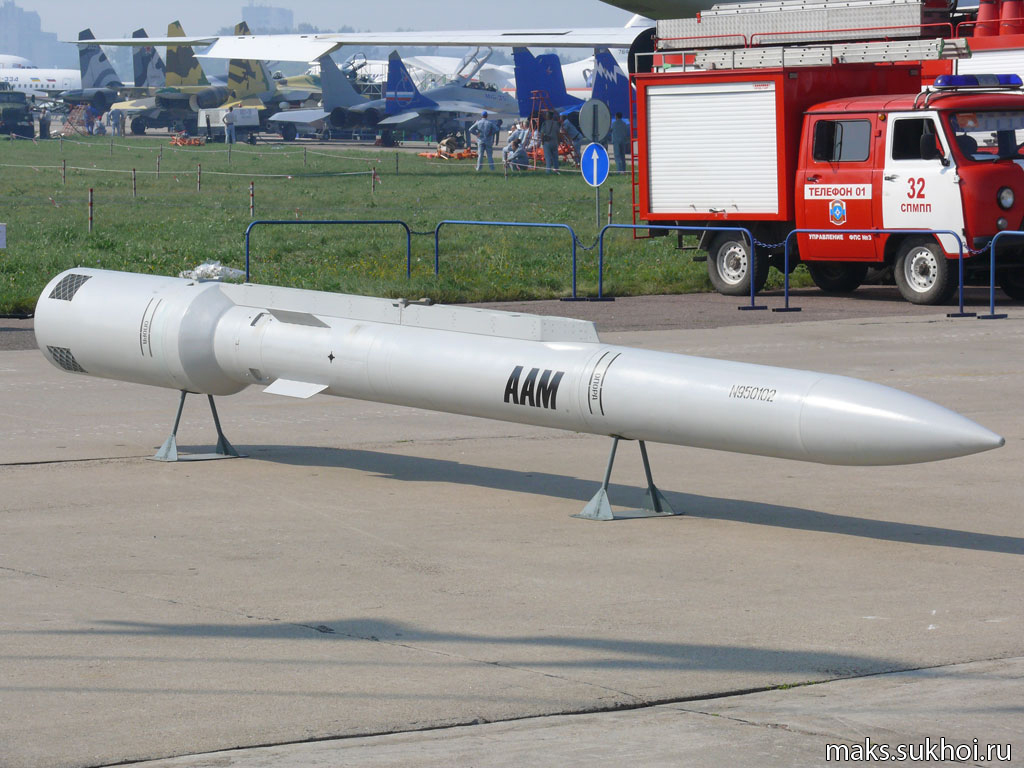
_missile.jpg)
The mockup shown in 1993 had a strong resemblance to the Buk airframe, but since the Indians became involved there have been some changes. An Indian magazine gave the specifications of the KS–172 in April 2004 as a core 6.01 m long and 40 cm in diameter with a wingspan of 61 cm, with a booster of 1.4 m, and 748 kg total weight.<ref name="Force">Template:Citation</ref> It had a solid fuel tandem rocket booster capable of speeds up to Template:Convert, 12g manoeuvring, and an adaptive HE fragmentation warhead.<ref name="Force" /> Development would concentrate on the seeker head, autopilot, resistance to jamming and a steering system with 3D thrust vector control (TVC).<ref name="Force" />
In May 2005 it was reported that there were two versions, with and without a rocket booster, with ranges of 400 km and 300 km respectively.<ref name="DT" /> At the MAKS (air show) in August 2005, a range of 300 km was quoted for a streamlined missile with a small booster and fins on both booster and fuselage.<ref name="Fisher" /> However the model shown at the 2007 MAKS airshow under the name K-100 was closer to the original 1993 mockup in the photo above, with different-shaped fins that were further up the fuselage, and an even larger booster with TVC vents.<ref name="photos">See photos in "External links" section</ref> At the same show it was shown under the wing of a Su-35BM, implying that at least two could be carried by Flanker-class aircraft rather than just one on the centreline.
Guidance is by inertial navigation until the missile is close enough to the target to use active radar for terminal homing.<ref name="Force" /> The K-100 has an enlarged (Template:Convert) derivative of the Agat 9B-1103M seeker used in the R-27 (air-to-air missile) (AA-10 'Alamo').<ref name="JDW">Template:Citation</ref> It has a lock-on range of Template:Convert, described by an Agat designer as "one fifth or less of the overall range".<ref name="JDW" />
Variants
- KS-172
File:Sketch-of-KS-172-missile 1993.svg

- Prototype in 1993.
- KS-172S-1
File:Sketch-of-KS-172S1-missile 2003.svg

- Prototype in 2003.
Similar weapons
- R-37 (missile) (AA-X-13/AA-13 'Arrow') was developed from the R-33 (missile) (AA-9 'Amos') and is intended for the Sukhoi Su-35 Flanker-E, Sukhoi Su-37 Flanker-F, MiG 1.42 MFI and other future fighters.<ref name="DT" /> According to Defence Today the range depends on the flight profile, from Template:Convert for a direct shot<ref name="DT" /> to Template:Convert for a cruise glide profile.<ref name="DT" /> Jane's reports two variants, the R-37 and the R-37M; the latter has a jettisonable rocket booster that increases the range to "300-400km" (160–220nmi).<ref name="JanesALW3600">Template:Citation</ref> Work on the missile appears to have restarted in late 2006,<ref name="JanesALW3600"/> as part of the MiG-31BM programme<ref name="JanesALW3600"/> to update the Foxhound with a new radar and ground attack capability.
- Kh-31 (AS-17 'Krypton') – the Chinese have licensed the anti-radar version (Kh-31P) of this Russian air-to-surface missile, and may be working on an "AWACS killer" variant of their YJ-91 derivative.<ref name="DT" /> The Russians claim the anti-shipping version, the Kh-31A, can be adapted for use as an AWACS killer.<ref name="DT" />
- AIM-54 Phoenix – Now retired, a Template:Convert-range missile that was carried by the US Navy's F-14 Tomcat.
- AIM-152 AAAM- intended replaced for the AIM-54 Phoenix but cancelled after the cold war ended.
- AIM-97 Seekbat - based on the Standard Missile SAM, the Seekbat was an extremely long-ranged missile designed to shoot down the MiG-25 Foxbat, which at the time had almost mythical performance estimates. When the real-world performance of the Foxbat was found to be dramatically less impressive, development was cancelled.
- AIM-174B Gunslinger - an American long range naval surface to air missile that was developed into the AIM-174B Gunslinger , an air-launched version of the RIM-174 Standard ERAM / SM-6 for the US Navy.
- AIM-260 JATM
See also
References
External links
- sukhoi.ru – unofficial site with photos from MAKS air show; photos 10,12 and 13 show the K-100 on the ground of which maks2007d1013.jpg is perhaps the best.
Template:Russian and Soviet missiles
Template:Russian and Soviet military designation sequences