Phan Thi Kim Phuc
Template:Short description Template:Family name hatnote Template:Redirect Template:Use mdy dates Template:Infobox person Phan Thị Kim Phúc Template:Post-nominals ({{#invoke:IPA|main}}; born April 6, 1963), referred to informally as the girl in the picture<ref>Template:Cite book</ref> and the napalm girl, is a South Vietnamese-born Canadian woman best known as the child depicted in the Pulitzer Prize–winning photograph, titled The Terror of War, taken at Trảng Bàng during the Vietnam War on June 8, 1972.
The image shows a nine-year-old Phúc running naked on a road after being severely burned on her back by a South Vietnamese Air Force napalm attack.<ref>Template:Cite news</ref> The image became one of the most iconic and powerful symbols of the war, influencing global public opinion and anti-war movements.
After years of medical treatment for her injuries, Phúc eventually moved to Canada, where she became a citizen and later founded the Kim Foundation International, a nonprofit organization dedicated to helping child victims of war.<ref name=":0" /> She has since become a UNESCO Goodwill Ambassador and a prominent advocate for peace and reconciliation, frequently sharing her experiences to promote healing and understanding.
Her story has been widely documented in books, interviews, and documentaries, highlighting her journey from war victim to humanitarian. Despite enduring lifelong physical and emotional scars, Phúc continues to use her platform to support survivors of conflict and raise awareness about the humanitarian impact of war.
Vietnam War napalm attack
Phan Thi Kim Phúc and her family lived in Trảng Bàng in South Vietnam. On June 8, 1972, South Vietnamese planes dropped napalm on Trảng Bàng, which had been attacked and occupied by North Vietnamese forces.<ref name=boston/> Phúc joined a group of civilians and South Vietnamese soldiers who were fleeing from the Caodai Temple to the safety of South Vietnamese-held positions.<ref>{{#invoke:citation/CS1|citation |CitationClass=web }}</ref> The Republic of Vietnam Air Force pilot flying an A-1E Skyraider mistook the group for enemy soldiers and diverted to attack.<ref>Template:Cite news</ref><ref>{{#invoke:citation/CS1|citation |CitationClass=web }}</ref> The bombing killed two of Phúc's cousins and two other villagers. Phúc received third degree burns after her clothing was burned by the fire.<ref>Template:Cite news</ref>
Images and rescue
{{#invoke:Labelled list hatnote|labelledList|Main article|Main articles|Main page|Main pages}} Photographer Nick Ut sold the Associated Press (AP) a photograph of Phúc running naked amid other fleeing villagers, South Vietnamese soldiers, and other press photographers. Ut was attributed as the photographer, but this has been contested without clear resolution since the release of The Stringer in 2025. In an interview many years later, Phúc recalled she was yelling, Nóng quá, nóng quá ("So hot, so hot") in the picture. The New York Times editors were at first hesitant to consider the photo for publication because of the nudity, but they eventually approved it. A cropped version of the photo—with the press photographers to the right removed—was featured on the front page of The New York Times the next day. Titled "The Terror of War", it later earned a Pulitzer Prize<ref>{{#invoke:citation/CS1|citation |CitationClass=web }}</ref> and was chosen as the World Press Photo of the Year for 1973.<ref>{{#invoke:citation/CS1|citation |CitationClass=web }}</ref>
Ut took Phúc and the other injured children to Barsky Hospital in Saigon, where it was determined that her burns were so severe that she probably would not survive.<ref>{{#invoke:citation/CS1|citation |CitationClass=web }}</ref><ref>{{#invoke:citation/CS1|citation |CitationClass=web }}</ref> However, after a 14-month hospital stay and 17 surgical procedures, including skin grafts, she was able to return home. A number of the early operations were performed by Finnish plastic surgeon Template:Interlanguage link.<ref>Template:Cite news</ref><ref>Template:Cite book</ref> It was only after treatment at a special hospital in Ludwigshafen, West Germany, in 1982, that Phúc was able to properly move again.<ref>{{#invoke:citation/CS1|citation |CitationClass=web }}</ref> Ut continued to visit Phúc until he was evacuated to the United States during the fall of Saigon.<ref name="digital-journalist">{{#invoke:citation/CS1|citation |CitationClass=web }}</ref>

Less publicized is the film,<ref>{{#invoke:citation/CS1|citation |CitationClass=web }}</ref> shot by British television cameraman Alan Downes for the British Independent Television News (ITN) and his Vietnamese counterpart Le Phuc Dinh, who was working for the American television network NBC, which shows the events just before and after the photograph was taken.<ref>Template:Cite AV media</ref><ref>{{#invoke:citation/CS1|citation |CitationClass=web }}</ref><ref>Graphic A&E TV Network clip Template:Dead link includes interviews with Kim and reporters.</ref> In the top-left frame, a man stands and appears to take photographs as a passing airplane drops bombs. A group of children, Phúc among them, run away in fear. After a few seconds, she encounters the reporters dressed in military fatigues,<ref name=story>Template:Cite news</ref> including Christopher Wain (top-right frame), who gave her water and poured some over her burns.<ref name="story"/> As she turns sideways, the severity of the burns on her arm and back can be seen (bottom-left frame). A crying woman, Phúc's grandmother, Tao, runs in the opposite direction holding her badly burned grandchild, 3-year-old Danh, Phúc's cousin, who died of his injuries (bottom-right frame). Sections of the film shot were included in Hearts and Minds (1974), the Academy Award-winning documentary about the Vietnam War directed by Peter Davis.<ref>Template:Cite news "Hearts and Minds is also the movie that enshrined the now-household images of the naked Vietnamese girl, also made famous by Nick Út's Pulitzer Prize-winning photographs, running from a napalm attack, her body a patchwork of burns, and the infant in a woman's arms, suffering from the same injuries, skin hanging off its body."</ref>
Adult life
In 1982, Phúc was removed from her university as a young adult studying medicine and used as a propaganda symbol by the communist government of Vietnam.<ref>{{#invoke:citation/CS1|citation |CitationClass=web }}</ref><ref>{{#invoke:citation/CS1|citation |CitationClass=web }}</ref> Due to constant pain, she considered suicide, but later that year she found a New Testament in a library that led her to become a Christian and towards forgiveness.<ref>{{#invoke:citation/CS1|citation |CitationClass=web }}</ref> In 1986, she was granted permission to continue her studies in Cuba, where she learned Spanish and was trained as a pharmacist. Phúc met Ut for the first time in fourteen years in Havana in 1989, and the two have been meeting and speaking over telephone regularly ever since.<ref name="digital-journalist"/> Prime Minister of Vietnam Phạm Văn Đồng became her friend and patron. After arriving in Cuba, she met Bui Huy Toan, another Vietnamese student, whom she married in 1992.<ref name=boston/>
In 1993, on the way to their honeymoon in Moscow, they left the plane during a refuelling stop in Gander, Newfoundland, and asked for political asylum in Canada, which was granted.<ref name=":0">Template:Cite news</ref> The couple now live in Ajax, Ontario, and have two children.<ref name=boston>Template:Cite news</ref> In 1996, Phúc met the surgeons who had saved her life. The following year she became a Canadian citizen.<ref>{{#invoke:citation/CS1|citation |CitationClass=web }}</ref>
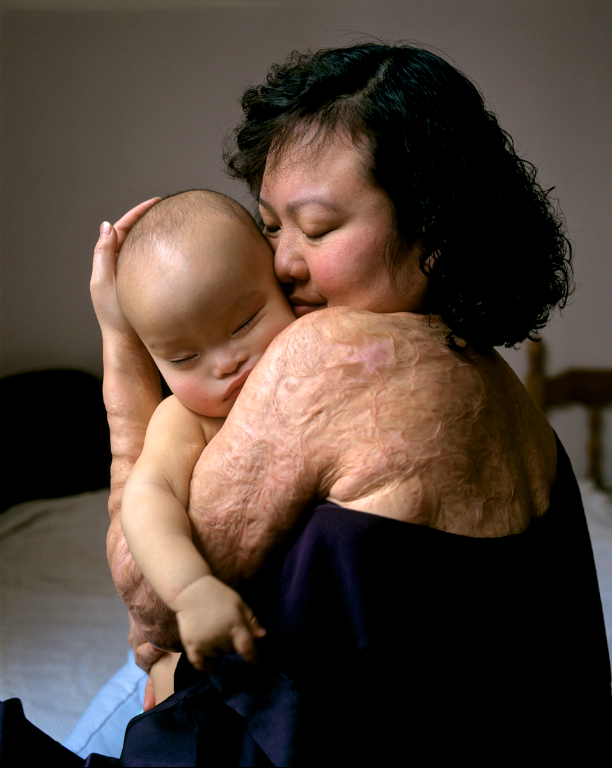
In 2015, it was reported that she was receiving laser treatment, provided free of charge at a hospital in Miami, US, to reduce the scarring on her left arm and back.<ref>Template:Cite news</ref><ref>Archived at GhostarchiveTemplate:Cbignore and the Wayback MachineTemplate:Cbignore: {{#invoke:citation/CS1|citation |CitationClass=web }}Template:Cbignore</ref><ref>Archived at GhostarchiveTemplate:Cbignore and the Wayback MachineTemplate:Cbignore: {{#invoke:citation/CS1|citation |CitationClass=web }}Template:Cbignore</ref><ref>Archived at GhostarchiveTemplate:Cbignore and the Wayback MachineTemplate:Cbignore: {{#invoke:citation/CS1|citation |CitationClass=web }}Template:Cbignore</ref>
Activism
In 1997, she established the first Kim Phúc Foundation in the U.S., with the aim of providing medical and psychological assistance to child victims of war.<ref name= BBC8678478/> Later, other foundations were set up, with the same name, under an umbrella organization, Kim Phúc Foundation International.<ref>{{#invoke:citation/CS1|citation |CitationClass=web }}</ref>
In 2004, Phúc spoke at the University of Connecticut about her life and experience, learning how to be "strong in the face of pain" and how compassion and love helped her heal.<ref>Omara-Otunnu, Elizabeth, "Napalm Survivor Tells of Healing After Vietnam War" Template:Webarchive, UConn Advance, November 8, 2004. Retrieved December 29, 2010.</ref>
On December 28, 2009, National Public Radio broadcast her spoken essay, "The Long Road to Forgiveness", for the This I Believe series.<ref name="this i believe">{{#invoke:citation/CS1|citation |CitationClass=web }}</ref> In May 2010, Phúc was reunited by the BBC with ITN correspondent Christopher Wain, who helped to save her life. On May 18, 2010, Phúc appeared on the BBC Radio 4 programme ItTemplate:'s My Story.<ref name= BBC8678478>Template:Cite news</ref> In the programme, Phúc related how she was involved through her foundation in the efforts to secure medical treatment in Canada for Ali Abbas, who had lost both arms in a rocket attack on Baghdad during the invasion of Iraq in 2003.<ref name= story />
In a December 21, 2017, article for The Wall Street Journal, Phúc wrote that the physical trauma she suffered in the napalm strike still required treatment, but that "even worse than the physical pain was the emotional and spiritual pain." This led directly to her conversion to Christianity, which she credits with healing the psychological trauma of living over forty years being known to the world as "Napalm Girl". "My faith in Jesus Christ is what has enabled me to forgive those who had wronged me," she wrote, "no matter how severe those wrongs were."<ref>{{#invoke:citation/CS1|citation |CitationClass=web }}</ref>
In July 2022, Phúc in person welcomed 236 Ukrainian refugees with children aboard a special flight, arranged by an organization called Solidaire, from Warsaw to Regina, Saskatchewan, Canada, in an airplane displaying her iconic 1972 photo on its side.<ref name="CBC-2022-08-03">Template:Cite news</ref>
Recognition
On November 10, 1994, Phúc was named a UNESCO Goodwill Ambassador.<ref name="CBC-2022-08-03" /> In 1996, Phúc gave a speech at the United States Vietnam Veterans Memorial on Veterans Day. In her speech, she said that one cannot change the past, but everyone can work together for a peaceful future. John Plummer, a pastor and Vietnam veteran who said he took part in coordinating the air strike with the Republic of Vietnam Air Force, met with Phúc briefly and was publicly forgiven. Plummer later admitted he had lied about his supposed role in the bombing, saying he was "caught up in the emotion at the Vietnam Veterans Memorial on the day Phuc spoke".<ref>Template:Cite news</ref> Canadian filmmaker Shelley Saywell made a documentary about their meeting.<ref>Template:Cite encyclopedia</ref>
Her biography, The Girl in the Picture, was written by Denise Chong and published in 1999.
In 2003, Belgian composer Eric Geurts wrote the song "The Girl in the Picture", dedicated to Phúc. It was released on Flying Snowman Records, with all profits going to the Kim Phúc Foundation, and re-released in 2021 as part of Eric's album Leave a Mark.<ref>{{#invoke:citation/CS1|citation |CitationClass=web }}</ref>
Awards
On October 22, 2004, Phúc was made a member of the Order of Ontario, and received an honorary Doctorate of Law from York University for her work supporting child victims of war around the world. On October 27, 2005, she was awarded an honorary degree in law from Queen's University in Kingston, Ontario.<ref>{{#invoke:citation/CS1|citation |CitationClass=web }}</ref> On June 2, 2011, she was awarded the honorary degree of Doctor of Laws from the University of Lethbridge.<ref>{{#invoke:citation/CS1|citation |CitationClass=web }} Template:Dead link</ref> On May 19, 2016, she was awarded a Doctor of Civil Law, Honoris Causa by Saint Mary's University (Halifax).
On February 11, 2019, Phúc was awarded the 2019 Template:Interlanguage link<ref>{{#invoke:citation/CS1|citation |CitationClass=web }}</ref> in recognition of her work with UNESCO and as an activist for peace.<ref>{{#invoke:citation/CS1|citation |CitationClass=web }}</ref>
Retrospective works
The Girl in the Picture: The Kim Phúc Story, the Photograph and the Vietnam War, by Denise Chong, is a 1999 biographical and historical book tracing the life story of Phúc. Chong's historical coverage emphasizes the life, especially the school and family life, of Phúc from before the attack, through convalescence, and into the present time. The book deals primarily with Vietnamese and American relationships during the Vietnam War, while examining themes of war, racism, immigration, political turmoil, repression, poverty, and international relationships through the lens of family and particularly through the eyes and everyday lives of women. Phúc and her mother, Nu, provide the lens through which readers of The Girl in the Picture experience war, strife, and the development of communism in Vietnam. Like Chong's first book, The Girl in the Picture was shortlisted for the Governor General's Award for English-language non-fiction.<ref>Template:Cite encyclopedia</ref>
See also
- Execution of Nguyễn Văn Lém – Another iconic image from the Vietnam War
- Thích Quảng Đức – Vietnamese monk whose self-immolation was photographed
- Censorship by Facebook § Image censorship – Facebook censored the picture of the running Kim Phúc
- List of photographs considered the most important
References
Further reading
- Template:Cite news.
- {{#invoke:citation/CS1|citation
|CitationClass=web }}
External links
- Kim Phuc Foundation
- UNESCO: Kim Phúc Phan Thi
- {{#invoke:citation/CS1|citation
|CitationClass=web }}
- {{#invoke:citation/CS1|citation
|CitationClass=web }}
- {{#invoke:citation/CS1|citation
|CitationClass=web }}
- {{#invoke:citation/CS1|citation
|CitationClass=web }} (including 2003 photo)
- Archival Video: Napalm Girl Phan Thị Kim Phúc
- {{#invoke:citation/CS1|citation
|CitationClass=web }}
- Joe McNally (2010). "Phan Thị Kim Phúc, 1995 (photograph)". joemcnally.com.
- Pages with broken file links
- 1963 births
- Living people
- 1972 in Vietnam
- Photographs of children in war
- Child victims of war
- Converts to Christianity
- Members of the Order of Ontario
- People from Ajax, Ontario
- People from Tây Ninh province
- University of Havana alumni
- Vietnam War casualties
- Vietnamese evangelicals
- Vietnamese emigrants to Canada
- Vietnamese people of the Vietnam War
- Canadian evangelicals
- Naturalized citizens of Canada
- Vietnam War photographs
- People notable for being the subject of a specific photograph
- 1972 in art
- UNESCO goodwill ambassadors
- Burn survivors
- Vietnamese anti-war activists