S-300 missile system
Template:Short description Template:Redirect Template:Pp-extended Template:Use dmy dates Template:Infobox weapon
The S-300 (NATO reporting name SA-10 Grumble) is a series of long-range surface-to-air missile systems developed by the former Soviet Union. It was produced by NPO Almaz for the Soviet Air Defence Forces to defend against air raids and cruise missiles.
It is used by Russia, Ukraine, and other former Eastern Bloc countries, along with Bulgaria and Greece. It is also used by China, Iran, and other countries in Asia.
The system is fully automated, though manual observation and operation are also possible.<ref>{{#invoke:citation/CS1|citation |CitationClass=web }}</ref> Each targeting radar provides target designation for the central command post. The command post compares the data received from the targeting radars and filters out false targets. The central command post has both active and passive target detection modes.<ref>{{#invoke:citation/CS1|citation |CitationClass=web }}</ref><ref name="modernarmy.ru">{{#invoke:citation/CS1|citation |CitationClass=web }}</ref> Missiles have a maximum range of Template:Convert from the command post.
The successor to the S-300 is the S-400 (NATO reporting name SA-21 Growler), which entered service on 28 April 2007.
Variations and upgrades
There are currently three main variations of the S-300, named S-300V, S-300P, S-300F. The production of the S-300 started in 1975,<ref name="km.ru" /> with the tests for the S-300P variant being completed in 1978. The tests for the S-300V variant were conducted in 1983, and its anti-ballistic capabilities were tested in 1987.<ref name="soldiering.ru">{{#invoke:citation/CS1|citation |CitationClass=web }}</ref> Numerous versions have since emerged with different missiles, improved radars, better resistance to countermeasures, longer range, and better capability at targeting aircraft flying at very low altitude as well as incoming munitions, such as anti-radiation missiles or glide bombs.
S-300 system family tree
Template:Tree chart/start Template:Tree chart Template:Tree chart Template:Tree chart Template:Tree chart Template:Tree chart Template:Tree chart Template:Tree chart Template:Tree chart Template:Tree chart Template:Tree chart Template:Tree chart Template:Tree chart Template:Tree chart Template:Tree chart/end
S-300P (SA-10)
The total production for the S-300P systems was 3,000 launchers and 28,000 missiles through 2012.<ref name="inbsite.com">{{#invoke:citation/CS1|citation |CitationClass=web }}</ref>
Template:Anchor S-300P/S-300PT
The S-300P/S-300PT (Template:Langx, NATO reporting name SA-10A Grumble A<ref name="WEG">Template:Cite book</ref>) is the original version of the S-300.<ref name="Janes-SA-10">{{#invoke:citation/CS1|citation |CitationClass=web }}Template:Dead link</ref> The P suffix stands for PVO-Strany (Template:Langx, or country air defence). In 1987, over 80 of these systems were active, mainly around Moscow. An S-300PT unit consists of a 36D6 (NATO reporting name Tin Shield) surveillance radar, a 30N6 (FLAP LID) fire control system, and 5P85-1 launch vehicles. The 5P85-1 vehicles are semi-trailer trucks. A 76N6 (CLAM SHELL) low-altitude detection radar is usually also a part of the unit.<ref name="astronautix">{{#invoke:citation/CS1|citation |CitationClass=web }}</ref>
The S-300PT had a passive electronically scanned array radar and had the ability to engage multiple targets with a single fire-control system. Since the original system was semi-mobile, it took just over one hour to set up for firing. It ran the risk of the missile hot launch system scorching the transporter erector launcher (TEL).<ref name="dtig10">{{#invoke:citation/CS1|citation |CitationClass=web }}</ref>
It was originally intended to use a track-via-missile (TVM) guidance system. However, the TVM system had problems tracking targets below Template:Convert, allowing incoming SEAD aircraft to effectively utilize terrain masking to avoid tracking. To improve tracking of low-altitude targets, a command-guidance system was added to guide the missile for the initial part of the flight.<ref name="dtig10" /> This allowed the minimum engagement altitude to be set to Template:Convert.
Improvements to the S-300P resulted in several sub-versions for both domestic and international markets. The S-300PT-1 and S-300PT-1A are incremental upgrades of the original S-300PT system, using a new 5V55KD missile and a cold launch method. The time it took to set the system up was reduced to 30 minutes and trajectory optimizations allowed the 5V55KD to reach ranges up to Template:Convert.<ref name="dtig10" />
Template:Anchor S-300PS/S-300PM

The S-300PS/S-300PM (Russian С-300ПC/С-300ПМ, NATO reporting name SA-10B Grumble B<ref name="WEG" />) was introduced in 1985 (according to Russia)<ref>{{#invoke:citation/CS1|citation |CitationClass=web }}</ref> and is the only version thought to have been fitted with a nuclear warhead. This model saw the introduction of the modern TEL and mobile radar and command-post vehicles that were all based on the MAZ-7910 8×8 truck.<ref name="Janes-SA-10" /> This model also featured new 5V55R missiles, which increased the maximum engagement range to Template:Convert and introduced a terminal semi-active radar homing (SARH) guidance mode.<ref>{{#invoke:citation/CS1|citation |CitationClass=web }}</ref><ref>{{#invoke:citation/CS1|citation |CitationClass=web }}</ref> The surveillance radar of these systems was designated 30N6. Also introduced with this version was the distinction between self-propelled and towed TELs. The towed TEL is designated 5P85T. Mobile TELs were the 5P85S and 5P85D. The 5P85D was a "slave" TEL, being controlled by a 5P85S "master" TEL. The "master" TEL is identifiable thanks to the large equipment container behind the cabin; in the "slave" TEL this area is not enclosed and is used for cable or spare tyre storage.
Template:Anchor S-300PMU
Development of a modernized variant for export, called the S-300PMU (Template:Langx, NATO reporting name SA-10C Grumble C<ref name="WEG" />), was completed in 1985.Template:Sfn The PMU variant was fielded with the 5V55K (range Template:Convert) and 5V55R (range Template:Convert) missiles.Template:Sfn<ref name="FAS-PMU">{{#invoke:citation/CS1|citation |CitationClass=web }}</ref> Radars used for the S-300PMU complex included the 30N6 (NATO: "Flap Lid") target engagement radar, the 76N6 (NATO: "Clam Shell") low altitude detection radar, and the ST-68U (NATO: "Tin Shield") 3D search radar.Template:Sfn In addition, the 64N6 (NATO: "Big Bird") radar was used as a search radar at the regimental command post (an S-300PMU regiment typically consisted of three missile batteries).<ref name="FAS-PMU" /> The S-300PMU could engage targets with a radar cross section of at least Template:Convert and a maximum velocity of Template:Convert at altitudes between Template:Convert and Template:Convert.Template:Sfn It could also engage surface targets at ranges up to Template:Convert.Template:SfnTemplate:Clarify
Template:Anchor S-300PMU-1/2 (SA-20A/B)

The Template:AnchorS-300PMU-1 (Template:Langx, NATO reporting name SA-20A Gargoyle<ref name="WEG" />) was also introduced in 1993, with the new and larger 48N6 missiles for the first time in a land-based system, and keeping all the same performance improvements from the S-300PM version, including the increased speed, range, SAGG guidance, and ABM capability.<ref name="Janes-SA-20">{{#invoke:citation/CS1|citation |CitationClass=web }}Template:Dead link</ref> The warhead is slightly smaller than the naval version at Template:Convert. This version also saw the introduction of the new and more capable 30N6E TOMB STONE radar.
The S-300PMU-1 was introduced in 1993, using different missile types in a single system for the first time. In addition to the 5V55R and 48N6E missiles, the S-300PMU-1 can utilise two new missiles, the 9M96E1 and 9M96E2. Both are significantly smaller than the previous missiles, at Template:Convert, respectively, and carry a smaller Template:Convert warhead. The 9M96E1 has an engagement range of Template:Convert, and the 9M96E2 of Template:Convert. They are still carried 4 per TEL. Rather than just relying on aerodynamic fins for manoeuvring, they use a gas-dynamic system which allows them to have an excellent probability of kill (Pk) despite the much smaller warhead. The Pk is estimated at 0.7 against a tactical ballistic missile, for either missile. The S-300PMU-1 typically uses the 83M6E command-and-control system, although it is also compatible with the older Baikal-1E and Senezh-M1E CCS command-and-control systems. The 83M6E system incorporates the 64N6E (BIG BIRD) surveillance/detection radar. The fire control/illumination and guidance radar used is the 30N6E(1), optionally matched with a 76N6 low-altitude detection radar and a 96L6E all-altitude detection radar. The 83M6E command-and-control system can control up to 12 TELs, both the self-propelled 5P85SE vehicle and the 5P85TE towed launchers. Generally, support vehicles are also included, such as the 40V6M tow vehicle, intended for lifting of the antenna post.<ref>{{#invoke:citation/CS1|citation |CitationClass=web }}</ref>
China developed its own version of the S-300PMU-1, called HQ-15. Previously, the missile was referred to in a Western think tankTemplate:Which as the HQ-10, causing confusion with the unrelated HQ-10 short-range point-defense missile system.<ref name="mdaa-hq15">{{#invoke:citation/CS1|citation |CitationClass=web }}</ref>

The Template:AnchorS-300PMU-2 Favorit (Template:Langx, NATO reporting name SA-20B Gargoyle<ref name="WEG" />), introduced in 1997 (presented ready 1996), is an upgrade to the S-300PMU-1 with a range of Template:Convert with the introduction of the 48N6E2 missile. This system is apparently capable against not just short-range ballistic missiles, but also medium-range ballistic missiles. It uses the 83M6E2 command and control system, consisting of the 54K6E2 command post vehicle and the 64N6E2 surveillance/detection radar. It employs the 30N6E2 fire control/illumination and guidance radar. Like the S-300PMU-1, 12 TELs can be controlled, with any mix of 5P85SE2 self-propelled and 5P85TE2 trailer launchers. Optionally it can make use of the 96L6E all-altitude detection radar and 76N6 low-altitude detection radar.<ref name="Almaz">{{#invoke:citation/CS1|citation |CitationClass=web }}</ref><ref name="mdaa-hq15" />
S-300F
Template:Anchor Sea-based S-300F (SA-N-6)

The S-300F Fort (Template:Langx, DoD designation SA-N-6, F suffix for Template:Langx or Naval) was introduced in 1984 as the original ship-based (naval) version of the S-300P system developed by Altair, with the new 5V55RM missile with range extended to Template:Convert and maximum target speed up to Mach 4, while the engagement altitude was reduced to Template:Convert. The naval version utilises the TOP SAIL or TOP STEER, TOP PAIR, and 3R41 Volna (TOP DOME) radar, and utilises command guidance with a terminal SARH mode. Its first installation and sea trials were on a Template:Sclass2 and it is also installed on Template:Sclasss and Template:Sclasss. It is stored in eight (Slava) or twelve (Kirov) 8-missile rotary launchers below decks. The export version of this system is known as Rif (Template:Langx or reef). The NATO name, found also in colloquial use, is Grumble.Template:Citation needed
Template:Anchor Sea-based S-300FM (SA-N-20)
The S-300FM Fort-M (Template:Langx, DoD designation SA-N-20) is another naval version of the system, installed only on the Kirov-class cruiser Template:Ship, and introducing the new 48N6 missile. It was introduced in 1990 and has a missile speed of approximately Mach 6 for a maximum target engagement speed of up to Mach 8.5, a warhead size of Template:Convert, an engagement range of Template:Convert, and an altitude envelope of Template:Convert. The new missiles also introduced a track-via-missile guidance method and the ability to intercept short-range ballistic missiles. This system makes use of the TOMB STONE MOD rather than TOP DOME radar. The export version is called the Rif-M. Two Rif-M systems were purchased by China in 2002 and installed on the Type 051C air-defence guided-missile destroyers.Template:Citation needed
S-300V (SA-12)

The S-300V, starting with the 9M83 missile, entered service in 1983, and it was fully integrated in 1988.<ref name="modernarmy.ru" /><ref name="rg.ru">Template:Cite news</ref><ref>{{#invoke:citation/CS1|citation |CitationClass=web }}</ref>

The 9K81 S-300V Antey-300 (Template:Langx – named after Antaeus, NATO reporting name SA-12 Gladiator/Giant) varies from the other designs in the series.<ref name="modernarmy.ru" /> It was built by Antey rather than Almaz,<ref name="Janes-SA-12">{{#invoke:citation/CS1|citation |CitationClass=web }}Template:Dead link</ref> and its 9M82 and 9M83 missiles were designed by NPO Novator. The V suffix stands for Voyska (ground forces). It was designed to be the top-tier army air defence system, replacing the 2K11 Krug, providing a defence against ballistic missiles, cruise missiles, and aircraft. The 9M83 (SA-12A Gladiator) missiles have a maximum engagement range of around Template:Convert, while the 9M82 (SA-12B Giant) missiles can engage targets out to Template:Convert and up to altitudes of around Template:Convert. In both cases the warhead is around Template:Convert.
While it was created from the same project, hence sharing the common S-300 designation with the S-300P air defense family, the S-300V had different priorities that resulted in a different design. The S-300V system is carried on tracked MT-T transporters, which gives it better cross-country mobility than the S-300Ps moving on 8×8 wheeled transporters. Its search, tracking, and command systems are more distributed than the S-300P's. For example, while both have mechanically scanning radar for target acquisition (9S15 BILL BOARD A), the battery level 9S32 GRILL PAN has an autonomous search ability and SARH delegated to illumination radar on transporter erector launcher and radar (TELAR) vehicles. The early 30N6 FLAP LID on the S-300P handles tracking and illumination, but is not equipped with an autonomous search capability (later upgraded). 9S15 can simultaneously carry out active (3 coordinates) and passive (2 positions) searches for targets.<ref name="modernarmy.ru"/>


The S-300V places a greater emphasis on the anti-ballistic missile (ABM) mission, with a dedicated 9M82 (SA-12B Giant) anti-ballistic missile. This missile is larger and only two can be on each TELAR. It also has a dedicated ABM radar: the 9S19 HIGH SCREEN phased-array radar at battalion level. A typical S-300V battalion consists of a target-detection-and-designation unit, a guidance radar, and up to 6 TELARs. The detection-and-designation unit consists of the 9S457-1 command post, a 9S15MV or 9S15MT BILL BOARD all-round surveillance radar, and a 9S19M2 HIGH SCREEN sector surveillance radar.<ref name=FAS_S300>{{#invoke:citation/CS1|citation |CitationClass=web }}</ref> The S-300V uses the 9S32-1 GRILL PAN multi-channel guidance radar. Four types of missile-launcher vehicles can be used with the system:<ref name=FAS_S300/>
- Transporter erector launcher and radar (TELAR) vehicles, which not only transport the missiles, but also fire and guide them (including radar illumination and targeting.<ref>{{#invoke:citation/CS1|citation
|CitationClass=web }}</ref>) There are two models: the 9A83-1 TELAR holding four 9M83 Gladiator missiles and the 9A82 TELAR holding two 9M82 Giant missiles.<ref name=FAS_S300/>
- Launcher/loader vehicles (LLV), which transport the missiles and can reload the TELARs, and also fire missiles under the control of a TELAR. There are two models: the 9A84 LLV holding two 9M83 Gladiator missiles and the 9A85 LLV holding two 9M82 Giant missiles.
The target detection ranges for each radar vary based on the radar cross-section of the target:<ref>{{#invoke:citation/CS1|citation |CitationClass=web }}</ref>
- 9S15M – Template:Convert with a Template:Convert cross section and Template:Convert with a Template:Convert cross section.
- 9S19M2 – Template:Convert with an unknown cross-section; it contains two passive electronically scanned arrays with a very high resistance to interference.
- 9S32M (TELAR 9A82/9A83) – range is limited to Template:Convert, can work independently, or receive target designation from the S-300V, or a variety of other target designation data systems (AWACS aircraft and various ground-based radar). Targets with a radar cross-section of Template:Convert are detected at ranges up to Template:Convert and are locked on at Template:Convert. The 9S32 detection range against MGM-52 Lance missiles is Template:Convert, aircraft missiles Template:Convert, fighter or ballistic missile (MGM-31 Pershing) Template:Convert (all of which the U.S. removed from service in 1991).<ref>{{#invoke:citation/CS1|citation
|CitationClass=web }}</ref><ref>Template:Cite book</ref>
- The ability to hit a target with a cross section of Template:Convert at a distance of Template:Convert (aiming system in the rocket (10/3 seconds before the missiles hit the target)).Template:Citation needed In addition, the guidance system inside the rocket supplements missile guidance systems commands from the 9A82 / 9A83 and 9S32, and the missile guidance systems to passively work with the radar illumination and radiation of the 9A82 / 9A83.Template:Citation needed
A S-300V system may be controlled by the upper level command post system 9S52 Polyana-D4 integrating it with the Buk missile system into a brigade.
China has built its own version of the S-300V called HQ-18.<ref name=FAS_S300 />
S-300VM (SA-23)
{{#invoke:Labelled list hatnote|labelledList|Main article|Main articles|Main page|Main pages}}The S-300VM (Antey 2500) is an upgrade of the S-300V. It consists of a new command-post vehicle, the 9S457ME, and a selection of new radars. These consist of the 9S15M2, 9S15MT2E, and 9S15MV2E all-round surveillance radars, and the 9S19ME sector surveillance radar. The upgraded guidance radar has the GRAU index of 9S32ME. The system can still employ up to six TELARs, the 9A84ME launchers (up to 4 9M83ME missiles), and up to 6 launcher/loader vehicles assigned to each launcher (2 9M83ME missiles each). An upgraded version, dubbed S-300V4, will be delivered to the Russian army in 2011.Template:Citation needed
The Antey-2500 complex is the export version developed separately from the S-300 family and has been exported to Venezuela for an estimated export price of US$1 billion. The system has one type of missile in two versions, basic and amended, with a sustainer stage that doubles the range (up to Template:Convert, according to other data, up to Template:Convert), and can simultaneously engage up to 24 aircraft or 16 ballistic targets in various combinations.
It became the first system in the world capable of simultaneously engaging cruise missiles, aircraft, and ballistic targets. It also contains a private-sector radar for countering targets when affected by interference.<ref name="rbase.new-factoria.ru">{{#invoke:citation/CS1|citation |CitationClass=web }}</ref>
S-300V4
The S-300V4 is also called S-300VMD.Template:Citation needed It was developed to target high-value airborne targets, such as AWACS aircraft, at long distances.<ref>{{#invoke:citation/CS1|citation |CitationClass=web }}</ref><ref>Template:Cite news</ref> Different versions of the NPO Novator 9M82MD<ref>Template:Cite magazine</ref> S-300V4 missiles have a range of Template:Convert at Mach 7.5 or a range of Template:Convert at Mach 9, and can destroy maneuvering targets even at very high altitudes.<ref>{{#invoke:citation/CS1|citation |CitationClass=web }}</ref><ref name="RIA_S300V4">Template:Cite news</ref> An export version exists, marketed as the Antey-4000.<ref>Template:Cite news</ref>
S-400 (SA-21)
{{#invoke:Labelled list hatnote|labelledList|Main article|Main articles|Main page|Main pages}} Template:Weasel
The S-400 Triumf (Template:Langx, formerly known as the S-300PMU-3/С-300ПМУ-3, NATO reporting name SA-21 Growler) was introduced in 1999 and featured a new, larger missile and several upgrades and new features. The project encountered delays since its original announcement, and deployment only began on a small scale in 2006. With an engagement range of up to Template:Convert, depending on the missile variant used, it was specifically designed to counter stealth aircraft.{{ safesubst:#invoke:Unsubst||date=__DATE__ |$B= Template:Fix }} It is by far the most advanced version, incorporating the ability to survive PGM threats and counter advanced jammers by using automatic frequency hopping.<ref>{{#invoke:citation/CS1|citation |CitationClass=web }}</ref>
Specifications
S-300 variants will work together in various combinations, although interoperability between different variants is limited. Various higher-level mobile commands can coordinate certain variants at various locations into a single battery, and also integrate that battery with other air defence systems.<ref name="almaz-antey.ru" /> A management system, consisting of command control and radars allows for fully automatic initiation and effective management of up to one hundred targets located up to Template:Convert from the base station. Many tasks – detection, tracking, target setting, target designation, target acquisition, missile guidance, and assessment of results – can be dealt with automatically. The operator controls the target detection and the launch of rockets. In a complex environment, manual intervention is possible. Few of the previous systems possessed such capabilities.Template:Vague
The S-300 is a multi-channel anti-aircraft missile system whose variants can engage ballistic missiles as well as aircraft and are able to allocate up to 12 missiles to up to 6 different targets. The system can destroy ground targets at a range of Template:Convert,<ref name="soldiering.ru" /><ref name="naviny.by">Template:Cite news</ref> and when launched on a ballistic trajectory, can reach up to Template:Convert.<ref name="naviny.by" /> Its vertically-launched missiles allow for the engagement of flying targets in any direction without traversing the launcher.<ref name="rbase.new-factoria.ru" /><ref>{{#invoke:citation/CS1|citation |CitationClass=web }}</ref>
Early versions are guided by the 30N6 FLAP LID or naval 3R41 Volna (TOP DOME) radar using command guidance with terminal semi-active radar homing. Later versions use the 30N6 FLAP LID B or TOMB STONE radar to guide the missiles via command guidance/seeker-aided ground guidance (SAGG), similar to the U.S.-made Patriot's TVM guidance scheme. The earlier 30N6 FLAP LID A can guide up to four missiles at a time to up to four targets, and can track up to 24 targets at once. The 30N6E FLAP LID B can guide up to two missiles per target to up to six targets simultaneously. Early models can successfully engage targets flying at up to Mach 2.5, or around Mach 8.5 for later models, with one missile potentially being launched every three seconds. The mobile control centre is able to manage up to 12 TELs simultaneously.
The original warhead weighed Template:Convert, intermediate warheads weighed Template:Convert, and the latest warhead weighs Template:Convert. Each warhead is equipped with a proximity fuse and a contact fuse. A warhead will expel from 19,000<ref name="naviny.by" /> to 36,000 metal fragments upon detonation, depending on missile type. The missiles themselves weigh between Template:Convert. Missiles are catapulted clear of the launching tubes before their rocket motors fire, and can accelerate at up to 100 g (1 km/s2). They launch straight upwards and then tip over towards their target, removing the need to aim the missiles before launch. The missiles are steered with a combination of control fins and thrust vectoring vanes. The sections below give exact specifications of the radar and missiles in the different S-300 versions. Since the S-300PM, most vehicles are interchangeable across variations.
Radar
The 30N6 FLAP LID A is mounted on a small trailer. The 64N6 BIG BIRD is mounted on a large trailer along with a generator and is typically towed with an 8-wheeled truck. The 76N6 CLAM SHELL (5N66M<ref name="ausairpower.net">{{#invoke:citation/CS1|citation |CitationClass=web }}</ref> etc.) is mounted on a large trailer with a mast that is between Template:Convert tall. It is usually used with a mast. With the mast, it has a target detection range of Template:Convert if altitude of the target is Template:Convert above the ground.<ref name="ausairpower.net" />
The original S-300P utilises a combination of the 5N66M continuous-wave radar Doppler radar for target acquisition and the 30N6 FLAP LID A I/J-band phased-array digitally-steered tracking-and-engagement radar. Both are mounted on trailers. In addition, there is a trailer-mounted command centre and up to twelve trailer-mounted erector/launchers with four missiles each. The S-300PS/PM is similar but uses an upgraded 30N6 tracking-and-engagement radar with an integrated command post and has truck-mounted TELs.
If the battery was employed in an anti-ballistic-missile or anti-cruise-missile role, the 64N6 BIG BIRD E/F-band radar would also be included. It is capable of detecting ballistic missiles up to Template:Convert away, travelling at up to Template:Convert, and cruise missiles up to Template:Convert away. It also employs electronic-beam steering and performs a scan once every twelve seconds.
The 36D6 TIN SHIELD radar can also be used to augment the S-300 system to provide earlier target detection than the FLAP LID radar allows. It can detect a missile-sized target flying at an altitude of Template:Convert at least Template:Convert away, at an altitude of Template:Convert at least Template:Convert away, and at high altitude up to Template:Convert away. In addition a 64N6 BIG BIRD E/F band target-acquisition radar can be used, which has a maximum detection range of Template:Convert.
The S-300 FC Radar Flap Lid can be mounted on a standard pylon.
| GRAU index | NATO reporting name | Specialisation | Target detection range | Simultaneously detected targets | NATO frequency band | First used with | Notes |
|---|---|---|---|---|---|---|---|
| 36D6 | TIN SHIELD | – | Template:Convert | 120 | E/F | S-300P | Industrial designation: ST-68UM 350 kW to 1.23 MW power |
| 76N6 | CLAM SHELL | Low altitude detection | I | S-300P | |||
| 76N6 | CLAM SHELL | Low altitude detection | Template:Convert | 180 | I | S-300PMU | 1.4 kW FM continuous wave |
| 64N6 | BIG BIRD | Regiment radar | Template:Convert | 300 | C | S-300PMU-1 | |
| 96L6E | CHEESE BOARD | All altitude detection | 300 km | 100 | S-300PMU-1 | ||
| 9S15 | BILL BOARD | – | Template:Convert | 250 | F | S-300V | |
| 9S19 | HIGH SCREEN | Sector tracking | 16 | S-300V | |||
| MR-75Template:Efn | TOP STEER | Naval | 300 km | D/E | S-300F | ||
| MR-800 VoskhodTemplate:Efn | TOP PAIR | Naval | Template:Convert | C/D/E/F | S-300F |
| GRAU index | NATO reporting name | NATO frequency band | Target detection range | Simultaneously tracked targets | Simultaneously engaged targets | First used with | Notes |
|---|---|---|---|---|---|---|---|
| 30N6 | FLAP LID A | I/J | 4 | 4 | S-300P | ||
| 30N6E(1) | FLAP LID B | H-J | Template:Convert | 6 | 6 | S-300PMU | Phased array |
| 30N6E2 | FLAP LID B | I/J | 200 km | 6 | 6 | S-300PMU-2 | |
| 9S32-1 | GRILL PAN | Multi-band | Template:Convert | 6 | 6 | S-300V | |
| 3R41 Volna | TOP DOME | I/J | Template:Convert | S-300F |
Missiles

| GRAU index | Year of initial production | Range | Maximum velocity | Maximum target Speed | Length | Diameter | Weight | Warhead | Guidance | First used with |
|---|---|---|---|---|---|---|---|---|---|---|
| citation | CitationClass=web
}}</ref> || 1975<ref name="zaloga p21">Template:Harvnb</ref> || Template:Convert<ref name="zaloga p21"/> || Template:Convert<ref name="zaloga p21"/> || Template:Convert<ref name="zaloga p21"/> || Template:Convert<ref name="zaloga p21"/> || Template:Convert<ref name="zaloga p21"/> || Template:Convert<ref name="zaloga p21"/> || Template:Convert<ref name="zaloga p21"/> || Command<ref name="zaloga p10">Template:Harvnb</ref> || S-300P | |||||||||
| citation | CitationClass=web
}}</ref> || 1981<ref name="zaloga p21"/> || Template:Convert<ref name="zaloga p21"/> || Template:Convert<ref name="zaloga p21"/> || Template:Convert<ref name="zaloga p21"/> || Template:Convert<ref name="zaloga p21"/> || Template:Convert<ref name="zaloga p21"/> || Template:Convert<ref name="zaloga p21"/> || Template:Convert<ref name="zaloga p21"/> || Track-via-missile<ref name="zaloga p10"/> || S-300P | |||||||||
| 5V55KD<ref name="zaloga p13">Template:Harvnb</ref> | after 1982<ref name="pvo.guns.ru" /> | Template:ConvertTemplate:Citation needed | 1,900 m/s (4,250 mph)Template:Citation needed | 1,150 m/s (2,572 mph)Template:Citation needed | Template:ConvertTemplate:Citation needed | 450mmTemplate:Citation needed | Template:ConvertTemplate:Citation needed | Template:ConvertTemplate:Citation needed | Command | S-300PTTemplate:Citation needed |
| 5V55RUD<ref name="zaloga p13"/> | Track-via-missile | |||||||||
| 5V55UTemplate:Citation needed | 1992 | Template:Convert | 2,000 m/s (4,470 mph) | Template:Convert | 450mm | Template:Convert | Template:Convert | SAGG | S-300PT | |
| 48N6 | 1990<ref name="zaloga p21"/> | Template:Convert<ref name="zaloga p21"/> | Template:Convert<ref name="zaloga p21"/> | Template:Convert<ref name="zaloga p21"/> | Template:Convert<ref name="zaloga p21"/> | Template:Convert<ref name="zaloga p21"/> | Template:Convert<ref name="zaloga p21"/> | Template:Convert<ref name="zaloga p21"/> | S-300PM<ref>Template:Harvnb</ref> | |
| 48N6P-01Template:Citation needed | 1992 | Template:Convert | 2,000 m/s (4,470 mph) | 2,800 m/s (6,415 mph) | Template:Convert | 519mm | Template:Convert | Template:Convert | SAGG | S-300PMU |
| 9M82 | Template:ConvertTemplate:Citation needed Template:Convert altTemplate:Citation needed |
Template:Convert<ref name="zaloga p38"/> | Template:ConvertTemplate:Citation needed | 1215mm | Template:Convert<ref name="zaloga p38"/> | Template:Convert<ref name="zaloga pp36,40">Template:Harvnb</ref> | Semi-active radar homing/Command<ref name="zaloga pp36,40"/> | S-300V | ||
| 9M83 | 1985<ref name="zaloga p38">Template:Harvnb</ref> | Template:ConvertTemplate:Citation needed Template:Convert altTemplate:Citation needed |
Template:Convert<ref name="zaloga p36">Template:Harvnb</ref> | Template:ConvertTemplate:Citation needed | 915mmTemplate:Citation needed | Template:Convert<ref name="zaloga p38"/> | Template:Convert<ref name="zaloga p36"/> | Semi-active radar homing/Command<ref name="zaloga p36"/> | S-300V | |
| 9M83METemplate:Citation needed | 1990 | Template:Convert | S-300VM | |||||||
| 9M96E1 | 1999 | Template:Convert | citation | CitationClass=web
}}</ref> (2,010 mph) || 4,800–5,000 m/s | ||||||
| 9M96E2 | 1999 | Template:Convert | 1,000 m/s<ref name="dtig" /> (2,240 mph) | 4,800–5,000 m/s (10,737–11,185 mph) |
240mm | Template:Convert | Template:Convert | Active radar homing | S-300PMU | |
| 40N6 | 2018<ref name="zaloga p21" /> | Template:Convert<ref>Template:Harvnb</ref> | Active radar homing | S-400 |
Means of camouflage and protection
Decoys – sometimes equipped with additional devices to simulate electromagnetic radiation in the infrared, optical, and radar - are used for imitating components of S-300 system.<ref>{{#invoke:citation/CS1|citation |CitationClass=web }}</ref>
Additional means of masking are used, such as MKT-2, MKT-3 and Volchitsa-KR camouflage nets.
34Ya6E Gazetchik-E system might be used for protection against anti-radiation missiles.<ref>{{#invoke:citation/CS1|citation |CitationClass=web }}</ref> A combined MAWS/decoy/aerosole/chaff system is claimed by the developer to have the 85% to 95% probability to defeat a single attacking HARM missile. SPN-30 and Pelena-1 radar jamming systems are also used against airborne radars.<ref>{{#invoke:citation/CS1|citation |CitationClass=web }}</ref>
When using a prepared position for prolonged time, revetments might be used for TELs and additional equipment.<ref>{{#invoke:citation/CS1|citation |CitationClass=web }}</ref>
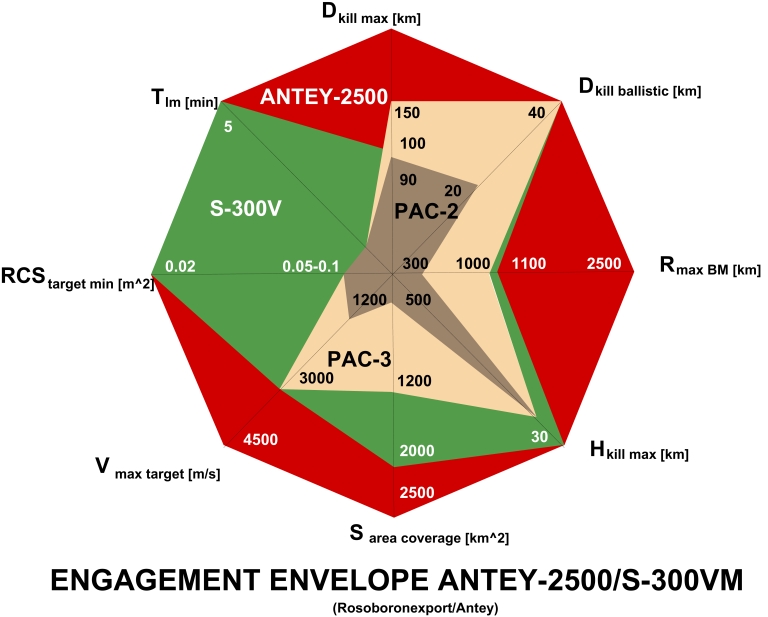
Comparison with other systems
| Official designation of unit | S-300PMU<ref name="ReferenceA">{{#invoke:citation/CS1|citation | CitationClass=web
}}</ref> |
S-300PMU1<ref name="ReferenceC">{{#invoke:citation/CS1|citation | CitationClass=web
}}</ref> |
S-300PMU2 <ref name="almaz-antey.ru">{{#invoke:citation/CS1|citation | CitationClass=web
}}</ref> |
S-300VM<ref name="almaz-antey.ru" />/S-300V4<ref name="RIA_S300V4" /> | Patriot PAC-2Template:Citation needed | Patriot PAC-3Template:Citation needed | |
|---|---|---|---|---|---|---|---|---|---|---|
| Range of, km |
aerodynamic target | 5–90 | 5–150 | 3–200 | citation | CitationClass=web
}}</ref> |
3–160 | citation | CitationClass=web
}}</ref> / 0.3–20<ref name="militaryparitet.com">{{#invoke:citation/CS1|citation |
CitationClass=web
}}</ref> |
| ballistic targets | at most 35 | at most 40 | 5–40 | 40 | 20 | 15–45Template:Citation needed (20)<ref name="designation-systems.net">{{#invoke:citation/CS1|citation | CitationClass=web
}}</ref> possible max 50<ref name="militaryparitet.com" /> | |||
| Height defeat, km |
aerodynamic target | 0.025–27 | 0.01–27 | 0.01–27 | 0.025–30 /?–37 | 0.06–24 | 15<ref name="designation-systems.net" />Template:Better source needed | |||
| ballistic targets | (?) | (?) | 2–25 | 1–30 | 3–12<ref name="300 -1">{{#invoke:citation/CS1|citation | CitationClass=web
}}</ref> || 15(?).<ref name="designation-systems.net" /> 15, possible max 20.<ref name="ReferenceB" /> | ||||
| Maximum target speed, m/s | 1,150, at most 1,300 (for the escort 3000)<ref name="300 -1" /> | at most 2,800 (for the escort 10000 km/h)<ref name="ReferenceC" /><ref name="300 -1" /> | at most 2,800 | 4,500 of ballistic targets<ref name="almaz-antey.ru" /> | at most 2,200<ref name="300 -1" /> | at most 1,600<ref name="designation-systems.net" />Template:Better source needed | ||||
| Maximum speed of the rocket complex, m/s | at most 2,000<ref name="ReferenceA" /> Template:Better source needed | 2000<ref name="ReferenceC" /> | 1,900 | 2,600 and 1,700<ref name="designation-systems.net" />/7.5M or 9M (more 3000) and (?) | 1,700<ref name="uhlib.ru">{{#invoke:citation/CS1|citation | CitationClass=web
}}</ref> || (?) approximately 1,500<ref name="militaryparitet.com" />Template:Citation needed | ||||
| Number of simultaneously guided anti-aircraft missiles by one unit | at most 12 | at most 12 | citation | CitationClass=web
}}</ref>|| at most 48Template:Citation needed |
at most 9 Template:Citation needed | |||||
| Number of simultaneously engaged targets by one unit | at most 6 | at most 6 | at most 36<ref name="auto1" /> | citation | CitationClass=web
}}</ref> |
at most 9Template:Citation needed | at most 9 | |||
| Mass of a rocket, kg | 1,400–1,600 | (?) | 330–1,900 | (?) | 900 | 312 | ||||
| Warhead weight, kg | 150 | (?) | citation | CitationClass=web
}}</ref>|| (?) |
91 | 74 | ||||
| Minimum time between missile launches, seconds | 3–5 | 3–5 | 3 (0 at start from different
CARRIERS MISSILES) |
1.5 (0 at start from different
CARRIERS MISSILES) |
3–4 (1<ref name="uhlib.ru" /> at start from different
CARRIERS MISSILES) |
(?) | ||||
| Set up time and clotting time of starting complex, minutes | 5 | 5 | 5 | 5 | 15/30<ref name="300 -1" /> | 15/30(?) | ||||
| Means of transportation | Wheeled | Wheeled | Wheeled | tracked | semi trailer | semi trailer | ||||
Operational history
Russian officials have stated that the system has performed well in real-world exercises.<ref name="arms-expo.ru">{{#invoke:citation/CS1|citation |CitationClass=web }}</ref> In 1991, 1992, and 1993, various versions of the S-300 destroyed ballistic missiles and other objects in exercises, with a high success rate (90% or more if 1 missile interceptor is used).<ref name="arms-expo.ru" /><ref>Template:Cite news</ref><ref>{{#invoke:citation/CS1|citation |CitationClass=web }}</ref><ref name="rosbalt.ru">Template:Cite news</ref>
In 1995, it was the first system to destroy a R-17 Elbrus Scud missile in the air.<ref name="rosbalt.ru" /> China is to test the S-300PMU2's effectiveness in destroying targets in real exercises. The planned targets include a UAV (Template:Convert), a simulated strategic bomber (Template:Convert), tactical missiles (range of the system to the point of interception Template:Convert and a height of Template:Convert), and pinpoint missiles. In April 2005, NATO held a combat exercise in France and Germany called Trial Hammer 05 to practice Suppression of Enemy Air Defenses missions. The Slovak Air Force brought an S-300PMU along, providing an opportunity for NATO to become familiar with the system.<ref name="jmr">{{#invoke:citation/CS1|citation |CitationClass=web }}</ref><ref>{{#invoke:citation/CS1|citation |CitationClass=web }}</ref>
Israel's purchase of F-35 Lightning II fighters was allegedly intended in part to nullify the threat of S-300 missiles that were, at the time the fighters were initially sought, part of a potential arms sale to Iran.<ref>Template:Cite news</ref> The fighter jets were eventually deployed by Israel in late October 2024 and disabled Iran's last three S-300 batteries<ref>{{#invoke:citation/CS1|citation |CitationClass=web }}</ref> in the first wave in a three-waved airstrike, thereby severely compromising Iran's air defenses.<ref>{{#invoke:citation/CS1|citation |CitationClass=web }}</ref>
In 2010, Russia announced that its military had deployed the S-300 systems in breakaway Abkhazia in 2008, leading to condemnation from the government of Georgia.<ref>Template:Cite news</ref>
Syria
{{#invoke:Labelled list hatnote|labelledList|Main article|Main articles|Main page|Main pages}}
After a Russian Sukhoi Su-24 was shot down over Syria in November 2015, Russia deployed S-300 and S-400 systems to the region – some to the Khmeimim Air Base, some with the Template:Ship.<ref>{{#invoke:citation/CS1|citation |CitationClass=web }}</ref>
On 17 September 2018, a Syrian S-200 system downed a Russian military plane, killing 15 Russian service members. Moscow accused Israel of indirectly causing this incident, and announced that to keep its troops safe, it would supply Syria with modern S-300 anti-missile rocket systems.<ref>Template:Cite news</ref><ref>Template:Cite news</ref> Israeli Prime Minister Benjamin Netanyahu objected to the move in a telephone call with Russian president Vladimir Putin, stating that the delivery of S-300 anti-missile rocket systems to "irresponsible players" would be dangerous for the region.<ref>Template:Cite news</ref>
In 2020, Syrian military officials criticized the S-300 air defense systems supplied by Russia, saying they failed to protect Syrian sites from Israeli strikes.<ref>{{#invoke:citation/CS1|citation |CitationClass=web }}</ref> One official criticized the detection abilities of the system's radar.<ref>Template:Cite news</ref>
On 17 May 2022, Israel said that a Russian-operated S-300 missile system fired a missile at a F-16 operated by the IAF. If confirmed, it would be the first time Russian forces have fired on Israeli jets.<ref>Template:Cite news</ref> According to Channel 13 news, Russia fired 13 missiles at an Israeli F-16, but none of the jets were intercepted by the missile salvos.<ref>{{#invoke:citation/CS1|citation |CitationClass=web }}</ref><ref>Template:Cite news</ref> On 26 July, Israeli Defence Minister Benny Gantz confirmed the initial report of one missile being fired by a Russian-operated S-300 system. However, he downplayed the incident as a "one-off", further stating that "our jets weren't even in the area". As the missile had not locked on, it was no threat to Israeli jets. It still remains the first use of an S-300 against the Israeli Air Force.<ref>Template:Cite news</ref>
2020 Nagorno-Karabakh conflict
{{#invoke:Labelled list hatnote|labelledList|Main article|Main articles|Main page|Main pages}}
During the 2020 Nagorno-Karabakh conflict, the S-300 system took active part in an armed conflict for the first time, different versions being listed in the active inventory of both sides. The Armenian systems were initially deployed around Yerevan. On 29 September 2020, Azerbaijan reported that Armenia was moving its S-300 systems closer to the conflict zone,<ref>Template:Cite news</ref> and vowed their destruction.<ref>Template:Cite news</ref> On 30 September 2020, Azerbaijani Armed Forces claimed the destruction of an Armenian S-300 system without providing further details.<ref>{{#invoke:citation/CS1|citation |CitationClass=web }}</ref><ref>Template:Cite news</ref> The first alleged combat firing of the S-300 happened during the night between 1 and 2 October when the Armenian Ministry of Defense claimed that Armenian S-300s had downed three Azerbaijani drones (not missiles as initially claimed) bound for Yerevan.<ref>Template:Cite news</ref><ref>{{#invoke:citation/CS1|citation |CitationClass=web }}</ref>
On 17 October 2020, Azerbaijani Armed Forces claimed the destruction of two radar elements<ref>Template:Cite press release</ref> that were part of an active Armenian S-300 SAM site being hit by a Bayraktar TB2 UCAV.<ref>{{#invoke:citation/CS1|citation |CitationClass=web }}</ref><ref>Template:Cite news</ref>
2022 Russian invasion of Ukraine
{{#invoke:Labelled list hatnote|labelledList|Main article|Main articles|Main page|Main pages}}
At the time of the Russian invasion of Ukraine on 24 February 2022, Ukraine had around 100 active S-300 batteries with as many as 300 launchers inherited upon the collapse of the Soviet Union in 1991. By 8 April, the Russians had knocked out at least 21 of the S-300 launchers that outside analysts confirmed with photos or videos, with the actual total of destroyed launchers likely higher. Ukrainian President Volodymyr Zelenskyy, in his message of 16 March to the U.S. Congress, had consequently asked specifically for help acquiring more of the long-range missiles. "You know what kind of defense systems we need: S-300 and other similar systems", Zelenskyy said.<ref name="forbes"/>
The United States and its allies tried to figure out how to deliver S-300s to Ukraine. One plan was for Slovakia to transfer to Ukraine its single battery of S-300s, in exchange for the United States or some other country supplying Slovakia with a new air-defense system, such as the American-made Patriot. A few days after Zelenskyy asked for S-300s, Germany agreed to deploy some of its Patriots to Slovakia, as part of a NATO battlegroup.<ref name="forbes">Template:Cite magazine</ref>
On 30 March, Prime Minister Eduard Heger of Slovakia told CNN that he supported sending some of his country's own S-300s to Ukraine "because this is the equipment that Ukraine needs the most". On 8 April, U.S. President Joe Biden confirmed that Slovakia had transferred a Soviet-era S-300 system to Ukraine and said that the U.S. would reposition an American Patriot missile system to Slovakia in return.<ref>Template:Cite news</ref> It appears that only one battery that was donated, which was a system that Slovakia inherited from the dissolution of Czechoslovakia in 1993.<ref>Template:Cite news</ref>
On 11 April, the Associated Press reported Russia's claims to have destroyed several air defense systems in Ukraine over the previous two days, indicating a renewed push to gain air superiority and take out weapons Kyiv described as crucial, ahead of a broad new Russian offensive in the east. Moscow claimed to have hit four S-300 missile launchers provided by a European country it did not name, but never showed any concrete evidence of that. Slovakia had given Ukraine such a system the previous week, but denied that it had been destroyed. Russia previously reported two strikes on similar systems in other places.Template:Citation needed
In early April, Iran also reportedly returned a large number of S-300 systems, for use against Ukraine, which it had purchased from Russia in 2007, along with a quantity of its own Iranian-made version, the Bavar-373, which has similar capabilities.<ref>{{#invoke:citation/CS1|citation |CitationClass=web }}</ref> Iran Foreign Minister Amir Abdollahian refuted allegations of arms transfers to Russia in a call with Ukraine Foreign Minister Dmytro Kuleba.<ref>Template:Cite tweet</ref>
On 8 July, the governor of the Mykolaiv Oblast, Vitaly Kim, claimed that Russia had been using S-300 missiles in a land-attack role by fitting them with GPS guidance and that some 12 missiles were fired using such guidance.<ref>{{#invoke:citation/CS1|citation |CitationClass=web }}</ref> On 30 September, The Wall Street Journal reported the claim of Kyrylo Tymoshenko, an adviser to President Zelenskyy, that 16 Russian S-300 missiles configured for ground-attack struck near Zaporizhzhia, killing at least 30 civilians and wounding 50 others.<ref name="WSJ-S300">Template:Cite news</ref> Debris from S-300 missiles was found after having struck buildings in Kharkiv on 8 October.<ref name="bbc1" /> Analysts from McKenzie Intelligence Services and the Center for Strategic and International Studies said that these missiles were likely from Russian systems repurposed for ground attack due to the dwindling stock of more precise dedicated anti-surface missiles.<ref name="bbc1">Template:Cite news</ref>
Stationary surface targets do not necessarily require retrofitting, as the original design accommodates them – particularly those that emit radiation, such as radars, which S-300 missiles can target precisely with onboard radiation tracking.<ref name="naviny.by" /> However, some of the reported surface-to-surface missile strikes by S-300 missiles may actually be instances of Ukrainian S-300s failing to intercept targets, and subsequently falling onto civilian areas on the ground. The most notable case of such unintentional strikes occurred on 15 November 2022, when a stray S-300 missile on a ballistic trajectory fell near the village of Przewodow in Poland, killing 2.<ref>Template:Cite news</ref><ref>Template:Cite news</ref>
On 14 April 2023, Sloviansk was hit by seven S-300 missiles, which killed at least 11 people.<ref>Template:Cite news</ref> Russian S-300 strikes in Pokrovsk Raion on 6 January 2024 killed 11 and injured 8 according to local officials.<ref>{{#invoke:citation/CS1|citation |CitationClass=web }}</ref>
On 10 June 2024, Ukrainian forces launched an attack near Chornomorskiy in Crimea destroying S-300 missile launchers.<ref>Template:Cite news</ref>
On 21 August 2024, the Ukrainian military claimed to have struck a Russian S-300 air defense system in Rostov Oblast possibly with a Neptune missile.<ref>{{#invoke:citation/CS1|citation |CitationClass=web }}</ref><ref>{{#invoke:citation/CS1|citation |CitationClass=web }}</ref>
Operators and other versions


.jpg)

The S-300 is mainly used in Eastern Europe and Asia, although sources are inconsistent about which countries possess the system.<ref name="cns">{{#invoke:citation/CS1|citation |CitationClass=web }}</ref>
- Template:ALG – 8 regiments of S-300PMU2<ref>{{#invoke:citation/CS1|citation
|CitationClass=web }}</ref><ref>{{#invoke:citation/CS1|citation |CitationClass=web }}</ref>
- Template:ARM – 50 systems, unknown variant<ref>Template:Cite news</ref>
- Template:AZE bought two S-300PMU2 (SA-20B) SAM battalions for US$300 million in 2010, delivered in 2011<ref>{{#invoke:citation/CS1|citation
|CitationClass=web }}</ref>
- Template:BLR – S-300PS systems delivered from Russia in 2007 to replace older S-300 model in the Belarusian inventory.<ref>{{#invoke:citation/CS1|citation
|CitationClass=web }}</ref> Four divisions of S-300 missiles to be delivered in 2014.Template:Citation needed
- Template:BUL – 8 S-300 launchers in service as of 2024.<ref name="IISS2022_p26132">International Institute for Strategic Studies: The Military Balance 2024</ref> Divided into 2 units with 6 launchers each .<ref name="IISS2022_p2613">International Institute for Strategic Studies: The Military Balance 2024</ref>
- Template:PRC – China first acquired the S-300PMU-1 in 1993, and later became the first customer of the S-300PMU-2, in 2004.<ref>Template:Cite magazine</ref><ref name="missilethreat.com">{{#invoke:citation/CS1|citation
|CitationClass=web }}</ref> China also built the HQ-15 with the maximum range upgraded from Template:Convert. The total number of the S-300PMU/1/2 and HQ-15/18 batteries in the PLA are approximately 40 and 60, respectively, as of 2008. The total number of the missiles is well above 1,600, with about 300 launcher platforms.<ref name="sinodefence1">{{#invoke:citation/CS1|citation |CitationClass=web }}</ref> Five such SAM battalions are deployed and in active duty around the Beijing region, six battalions are in the Taiwan strait region, and the rest are in major cities such as Shanghai, Chengdu, and Dalian. Two Rif (SA-N-6) systems were purchased in 2002 for the Chinese Navy's Type 051C destroyers. By 2011, China had obtained 15 battalions (4 systems) of the S-300PMU-2.Template:Citation needed
- Template:EGY – The S-300VM "Antey-2500" missile system was ordered in 2014, as part of a billion-dollar Egyptian-Russian arms deal signed later that year.<ref>{{#invoke:citation/CS1|citation
|CitationClass=web }}</ref><ref>Template:Cite news</ref> The $1 billion contract comprises 4 batteries, a command post and other external elements.<ref>Template:Cite news</ref><ref>Template:Cite news</ref> In 2015, Russia started delivering the system components, and Egyptian soldiers began their training in Russian training centers.Template:Citation needed By the end of 2017, all batteries had been delivered to Egypt.<ref>Template:Cite news</ref> Russia is in talks with Egypt on the delivery of additional Antey-2500 systems.<ref>Template:Cite news</ref>
- Template:IRN – Originally purchased in 2007. Russia maintained a self-imposed ban on the sale of the S-300 until the easing of some US sanctions as part of the Iran nuclear deal framework in April 2015 and subsequent Joint Comprehensive Plan of Action. Iran received four S-300PMU2 batteries from Russia in 2016, each consisting of a 96L6E target-acquisition radar, a 30N6E2 target-engagement radar, and four 5P85TE2 towed transporter-erector-launchers (TELs).<ref>Template:Cite news</ref> The systems are supported by two 64N6E2 battle-management radars and linked using FL-95 antenna masts. The S-300s are operated by the Islamic Republic of Iran Air Defense Force. During air strikes on military targets in Iran in April and on Oct. 26 2024, Israeli aircraft disabled all of Iran's Russian S-300 anti-aircraft missile systems<ref>{{#invoke:citation/CS1|citation
|CitationClass=web }}</ref> after Iranian radar systems were “breached” causing their screens to freeze.<ref>{{#invoke:citation/CS1|citation |CitationClass=web }}</ref>
- Template:KAZ<ref name="inbsite.com" /><ref>{{#invoke:citation/CS1|citation
|CitationClass=web }}</ref> – 10 battalions after the refurbishment (PS – version)<ref>{{#invoke:citation/CS1|citation |CitationClass=web }}</ref> (2009 or later), 5 free of charge (2014),<ref>Template:Cite news</ref> and 5 free of charge (2015).<ref>{{#invoke:citation/CS1|citation |CitationClass=web }}</ref>
- Template:PRK – North Korea has conducted tests with a system called Pongae-5 (KN-06).<ref>Template:Cite news</ref>
- Template:RUS – All variations. (1900 (S-300PT/PS/PMU, 200 S-300V/S-300V1 in 2010)),<ref>Template:Cite report</ref> 2000 total launchers.<ref name="warfare1">{{#invoke:citation/CS1|citation
|CitationClass=web }}</ref> All production in 1994 (actually 1990) or older, all the S-300PM complexes have been repairing and upgrading (Favorit-S).<ref>{{#invoke:citation/CS1|citation |CitationClass=web }}</ref> The S-300P/PT has been retired before 2008, some S-300PS are in service, but were to be retired in 2012–2013. Modernization of all S-300P units to the S-300PM1 version was to end in 2014. The useful life of each was increased by 5 years. PM 1 was upgraded to version PM 2. By 2015, the S-300V4 was to have been delivered. Modernization of all S-300Vs to S-300V4s was to end in 2012.<ref>{{#invoke:citation/CS1|citation |CitationClass=web }}</ref><ref>{{#invoke:citation/CS1|citation |CitationClass=web }}</ref>
- Template:UKR – S-300PT, S-300PS, S-300PMU, S-300V1.<ref>{{#invoke:citation/CS1|citation
|CitationClass=web }}</ref>Template:Better source needed Only six systems were kept in working order between 2004 and 2014; as a result, only 40% of Ukrainian S-300 systems were in good condition prior to 2014.<ref>{{#invoke:citation/CS1|citation |CitationClass=web }}</ref> Due to the war with Russia, Ukraine started repairing and bringing back to service several armaments, including several S-300 batteries,<ref>Template:Cite news</ref> with at least 4 batteries overhauled in 2014–15. 34 launchers remained in Crimea after the 2014 Russian annexation of Crimea.<ref>Template:Cite news</ref> Prior to the 2022 Russian invasion of Ukraine, the country had around 100 batteries.<ref>Template:Cite news</ref><ref>Template:Cite magazine</ref> It received an additional battery from Slovakia in April 2022.<ref>Template:Cite news</ref>
- Template:VEN – Ordered 2 battalions of S-300VM "Antey-2500", which were delivered in May 2012.<ref>Template:Cite news</ref><ref>Template:Cite magazine</ref>
- Template:VIE – Bought two S-300PMU-1 systems (12 launchers) for nearly $300 million<ref name="asiatimes">Template:Cite news</ref> and RLS 96L6 after 2009.<ref>{{#invoke:citation/CS1|citation
|CitationClass=web }}</ref> The systems were likely upgraded to the S-300PMU2 standard.<ref>Template:Cite magazine</ref>
Former operators
- Template:CZS – One battalion created in 1990. Passed to Slovakia in 1993.<ref>{{#invoke:citation/CS1|citation
|CitationClass=web }}</ref>
- Template:GDR – One S-300PMU system delivered in 1989.Template:Sfn Inspected by West German Air Force personnel in late August 1990.Template:Sfn Returned to the Soviet Union in September 1990 as "sensitive technology" after negotiations between East Germany and the USSR.Template:Sfn
- Template:GRC – An S-300 PMU1 system acquired after the Cyprus Missile Crisis and operated by HAF on Crete, consisting of 1 regiment/4 systems/8 fire units/32 launchers / 175 missiles.<ref>{{#invoke:citation/CS1|citation
|CitationClass=web }}</ref> Greece first fired an S-300 during the White Eagle 2013 military exercise, which was the first time it was used since it had been bought 15 years earlier.<ref>{{#invoke:citation/CS1|citation |CitationClass=web }}</ref><ref>{{#invoke:citation/CS1|citation |CitationClass=web }}</ref> According to Greek Defence Minister Nikos Panagiotopoulos Greece was prepared to transfer its S-300 system to Ukraine in exchange for a PAC-3 Patriot missile system. Additionally stating that: "The same procedure applies to any other Russian made air defense system that they may want to send to Ukraine."<ref>{{#invoke:citation/CS1|citation |CitationClass=web }}</ref><ref>{{#invoke:citation/CS1|citation |CitationClass=web }}</ref> However, ultimately, the Greek PM Kyriakos Mitsotakis denied Greece's preparedness to send the S-300 to Ukraine for concerns that this move would create a gap in Greece's air defence.<ref>{{#invoke:citation/CS1|citation |CitationClass=web }}</ref><ref>{{#invoke:citation/CS1|citation |CitationClass=web }}</ref> Despite initially being wanted by Ukraine, the Hellenic Air Force will be sending the S-300 to Armenia.<ref>{{#invoke:citation/CS1|citation |CitationClass=web }}</ref><ref>{{#invoke:citation/CS1|citation |CitationClass=web }}</ref>
- Template:SVK – One S-300PMU battery and 48 5V55R missiles inherited from Czechoslovakia. 3 missiles were fired during an exercise in Bulgaria in 2015.<ref>Template:Cite magazine</ref> The battery was donated to Ukraine in April 2022 in response to the 2022 Russian invasion of Ukraine.<ref>Template:Cite news</ref>
- Template:Flag – An order for 6 systems was signed in 2010.<ref>Template:Cite news</ref> Syrian crews underwent training in Russia, and some of the S-300 components were delivered to Syria in 2013. Later, due to the weapons embargo against Syria and at the request of Israel, the deliveries were halted.Template:Efn After the Russian Su-24 shootdown in November 2015, S-300 missile batteries were officially deployed to Latakia province for the protection of the Russian naval base and warships at Tartus. These are operated by Russian crews.Template:Citation needed Russia was reconsidering deliveries of the S-300 to Syria after the missile strikes against Syria in April 2018, but this did not happen.Template:Citation needed Following the Syrian military's downing of a Russian Il-20 aircraft in Syria in September 2018, using a S-200 system (for which Russia held Israel responsible), Russian defense minister Sergei Shoigu on 24 September said that within two weeks, the Syrian Army would receive S-300 systems. Though the S-300 variant was not specified, the stated range of the system was to be Template:Convert.<ref name="tassshoigus300">Template:Cite news</ref><ref>{{#invoke:citation/CS1|citation
|CitationClass=web }}</ref><ref name="shoigukommer">Template:Cite news</ref><ref>Template:Cite news</ref><ref>Template:Cite news</ref> On 2 October 2018, Shoigu told President Putin during a broadcast meeting that the delivery of the S-300 system to Syria had been completed a day prior.<ref>Template:Cite news</ref><ref>{{#invoke:citation/CS1|citation |CitationClass=web }}</ref> On 8 October 2018, the Russian news agency TASS reported that three S-300PM battalions had been given to Syria free of charge, citing "On 1 October three battalion sets of S-300PM systems of eight launchers each were delivered to Syria". According to the source, the deliveries also included more than 100 surface-to-air missiles for each battalion.<ref>{{#invoke:citation/CS1|citation |CitationClass=web }}</ref> It is operated by the Syrian Air Defense Force. In 2022, the systems were removed from Syria.
- Template:USSR – Passed onto successor states.
Evaluation-only operators
- Template:USA – S-300P, devoid of electronics, purchased from Belarus in 1994.<ref>Template:Cite news</ref> S-300V was purchased in Russia officially in the 1990sTemplate:Clarify (complete set (except for 9S32 GRILL PAN multi-channel guidance radar)).<ref>Template:Cite news</ref>
Cancelled
- Template:CYP – S-300 PMU1 system transferred to Greece after the Cyprus Missile Crisis and operated by the HAF on Crete.
See also
Gallery
S-300V
{{#invoke:Gallery|gallery}}
S-300P/PT/PS
{{#invoke:Gallery|gallery}}
S-300PMU2
{{#invoke:Gallery|gallery}}
Notes
References
Sources
External links
- S-300 | CSIS Missile Threat
- S-300 and various other system (in English language) in the Russia (official developer site).
- Australian Air Power: Part 1 and Part 2
- www.dtig.org detailed overview of the S-300P & S-300V family.
- Almaz S-300 – China's "Offensive" Air Defence
- Soviet/Russian Missile Designations
- S-300PMU2 Favorit Template:Webarchive EnemyForces.com
- Almaz S-300P/PT/PS/PMU/PMU-1/PMU-2
- 76N6 Clam Shell Acquisition Radar
- Template:Cite journal
- Matching of the Patriot (1/2/3) against the S-300 (v/ Antey 2500). In English. Used 8 parameters. Admonition. This test is not officially authenticated but not refuted.
- Aviation Week S-300 Surface-To-Air Missile System Template:Webarchive
Template:Russian SAM systemsTemplate:Russian and Soviet military designation sequences Template:Russian and Soviet missiles
- Pages with broken file links
- Almaz-Antey products
- Anti-ballistic missiles of the Soviet Union
- Cold War surface-to-air missiles of the Soviet Union
- Missile defense
- Military vehicles introduced in the 1970s
- Naval surface-to-air missiles
- Self-propelled anti-aircraft weapons of the Soviet Union
- Surface-to-air missiles of the Soviet Union