Sepulveda Dam
Template:Use American English Template:Use mdy dates Template:Infobox dam
The Sepulveda Dam is a dry dam constructed by the U.S. Army Corps of Engineers to withhold winter flood waters along the Los Angeles River. Completed in 1941, at a cost of $6,650,561 (Template:Inflation), it is located south of center in the San Fernando Valley, approximately Template:Convert east of the river's source in the western end of the Valley, in Los Angeles, California.<ref name=mp2011>{{#invoke:citation/CS1|citation |CitationClass=web }}</ref>
Sepulveda Dam, along with Hansen Dam located in the north San Fernando Valley, was constructed in response to the historic 1938 floods which killed 144 people. The dam's Template:Convert capacity would allow it to hold back roughly Template:Convert of runoff from the Template:Convert of catchment upstream. It was placed at what was the then-current edge of the city. East of the dam, the river was crowded into a narrow channel by the city's growth. The flood control basin is a large and undeveloped area in the center of the Valley, used mostly for wildlife refuge and recreation. After the 1938 Los Angeles River flood, the channelization of all the Valley's dry washes was created with dry, concrete-lined river bottoms. Currently these are being devolved in part as interconnecting bike paths.<ref name=splhist>{{#invoke:citation/CS1|citation |CitationClass=web }}</ref>
Behind the dam, the Sepulveda Basin is home to several large recreation areas including Woodley Park, a model aircraft field, The Japanese Garden, a wildlife refuge,<ref>{{#invoke:citation/CS1|citation |CitationClass=web }}</ref> a water reclamation plant, and an armory. The facilities are compatible with occasional inundation from reservoir impoundment.<ref>Template:Cite press releaseTemplate:Dead linkTemplate:Cbignore</ref>
History


When the 1914 flood caused $10 million in damages to the developing basin areas, a public outcry began for action to address the recurring flooding problems. During the following year, the Los Angeles County Flood Control District was formed. Some of the early flood control efforts included smaller areas of channelization and the planning for needed reservoirs. Taxpayers approved bond issues in 1917 and 1924 to build the first major dams. However, they were not willing to provide enough funding for the much needed and substantial infrastructure downstream of these dams. After two more destructive floods in the 1930s, most notably the 1938 flood, federal assistance was requested. The Army Corps of Engineers took a lead role in channelizing the river and constructing several dams which would create flood control basins behind them. Channelization began in 1938, and by 1960 the project was completed to form the present Template:Convert engineered waterway. Included in this work were Hansen Dam, completed in 1940 and followed by Sepulveda Dam in 1941.<ref>{{#invoke:citation/CS1|citation |CitationClass=web }}</ref> In 1973, Burbank Boulevard was built through the Sepulveda Basin, and Woodley Ave was also built in the recreation area in 1975.

During the 2028 Summer Olympics, the area around the dam will host basketball (3x3), BMX racing/BMX freestyle, modern pentathlon, and skateboarding.<ref>{{#invoke:citation/CS1|citation |CitationClass=web }}</ref>
Access
Transit users can exit the G Line at either Balboa station or Woodley station.<ref>{{#invoke:citation/CS1|citation |CitationClass=web }}</ref>
Sepulveda Basin Recreation Area
The Template:Convert Sepulveda Basin Recreation Area is a flood control basin in Encino managed by the Los Angeles City Department of Recreation and Parks.<ref>{{#invoke:citation/CS1|citation |CitationClass=web }}</ref><ref name=laparks>{{#invoke:citation/CS1|citation |CitationClass=web }}</ref><ref>{{#invoke:citation/CS1|citation |CitationClass=web }}</ref>
Woodley Park
Woodley Park is a large city park located on Woodley Avenue between Victory and Burbank Boulevards. The Leo Magnus Cricket Complex, a dog park, and group picnic areas are within the park. The park was opened in 1975.
The Japanese Garden is a Template:Convert public Japanese garden located on the grounds of the Tillman Water Reclamation Plant adjacent to Woodley Park.<ref name=garden>The Japanese Garden website . accessed 28 June 2016.</ref>

Lake Balboa Park
Lake Balboa Park, also known as Anthony C. Beilenson Park, is an Template:Convert park and water recreation facility with boat rentals and fishing. Lake Balboa is a Template:Convert lake filled with water reclaimed from the Tillman Water Reclamation Plant.<ref name=lakebalboa>City of Los Angeles Parks Department: Lake Balboa Park (Anthony C. Beilenson Park) Template:Webarchive</ref><ref>Map of Lake Balboa Park</ref> It also has barbecue pits, children's play area, picnic tables, and covered picnic pavilions.<ref name=lakebalboa/> There are many Flowering cherry trees (Prunus serrulata 'Pink Cloud') in the park.<ref>Wikimedia gallery: Cherry trees and blossoms at Lake Balboa Park</ref>
The Balboa Station on the G Line is located at the north end of the park, at Balboa Boulevard.
Sepulveda Basin Wildlife Reserve
The Sepulveda Basin Wildlife Reserve is at the southeast end of the Sepulveda Flood Control Basin and Recreation Area.<ref name=wildlife>SepulvedaBasinWildlife.org: Sepulveda Basin Wildlife Reserve website</ref> It has two sections, the North Reserve and South Reserve, located north and south of Burbank Boulevard.<ref>North Reserve, Sepulveda Basin Wildlife Reserve</ref><ref>South Reserve, Sepulveda Basin Wildlife Reserve</ref> Both have nature paths and hiking trails.<ref name=wildlife/><ref name=map>Sepulveda Basin Wildlife Reserve Trails Map</ref> Access and parking are in eastern Woodley Park near to the Tillman Water Reclamation Plant, or from Burbank Boulevard east of Woodley Avenue.<ref name=map/>
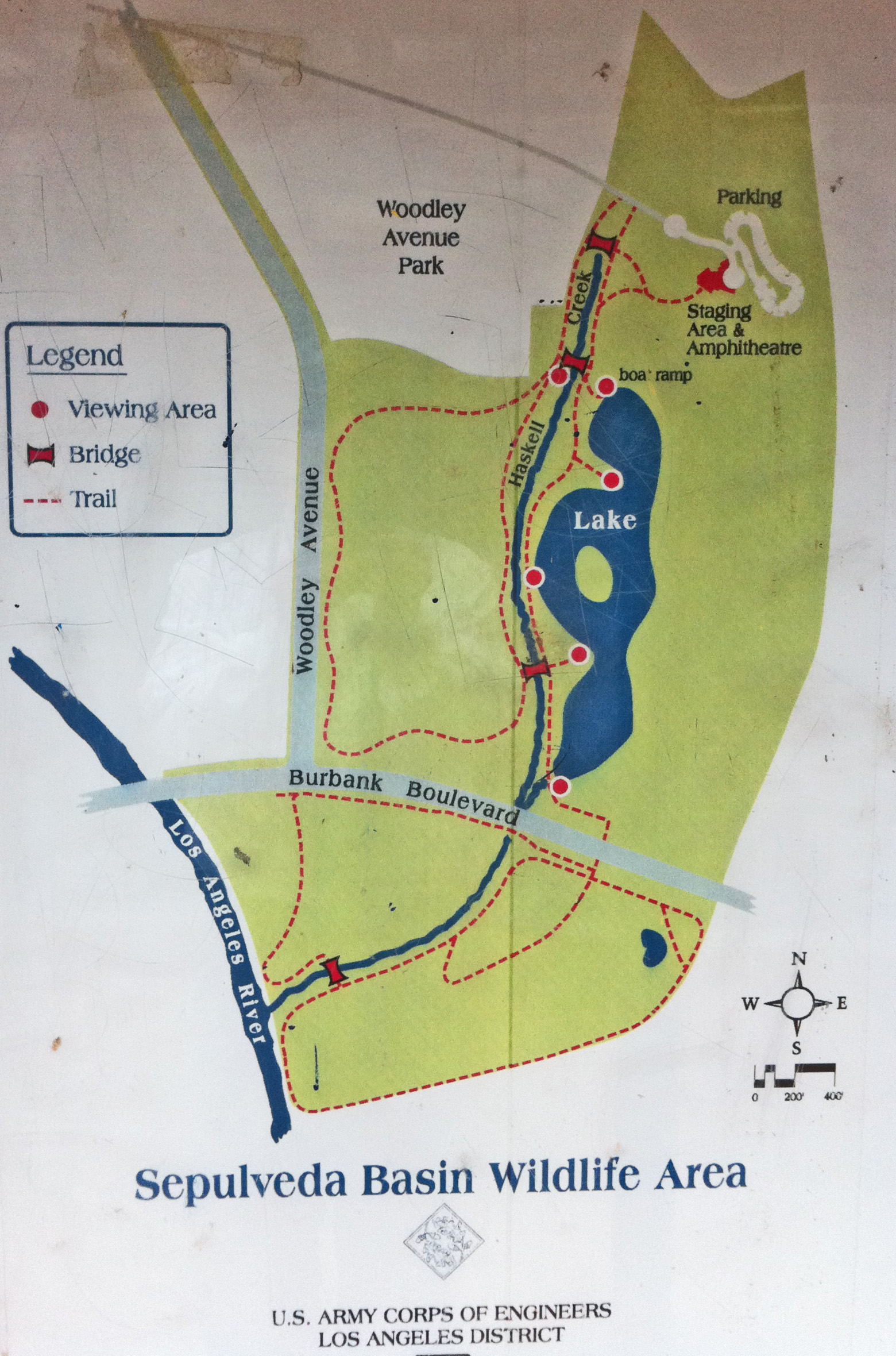
Haskell Creek flows through the nature preserve, and there are several wildlife ponds.<ref name=wildlife/> Over 200 species of birds have been seen in the basin.<ref>Wildlife of the Sepulveda Basin Wildlife Reserve</ref> Many, attracted by the water, gather here during fall and spring migrations.<ref name=wildlife/> The Sepulveda Basin Wildlife Reserve is an ongoing habitat restoration project, with locally native California plants.<ref name=flora>Flora of the Sepulveda Basin Wildlife Reserve</ref> Native trees include Fremont's cottonwood (Populus fremontii), Coast live oak (Quercus agrifolia ), Valley Oak (Quercus lobata), California Black Walnut (Juglans californica), and California sycamore (Platanus racemosa).<ref name=flora/>
.JPG)
Sepulveda Dam Recreation Area Bike Path

The Sepulveda Dam Recreation Area Bike Path is a Template:Convert bicycle path route looping around the recreation area.<ref name=bikepath>L.A. Bike Paths.com: Sepulveda Dam Recreation Area Bike Path</ref> This "very popular bike path"<ref name="bradybook">Template:Cite book</ref> runs from Victory Boulevard near the San Diego Freeway (I-405), westward to White Oak Avenue, south on White Oak to Burbank Boulevard, east on Burbank to Woodley Boulevard, and north on Woodley returning to Victory Boulevard.<ref name=bikepath/> Public access is continuous along it. The ride features no steep or sustained hills, and has a maximum grade of no more than 2%.<ref name="bradybook" />
A shorter route heads south on Balboa Boulevard, which crosses a natural stretch of the Los Angeles River that lined with native Arroyo willows, California sycamores, and other California native plants.<ref name=bikepath/>
The bikeway "cruises around the Balboa Sports Center and several golf courses, and has several open areas with spectacular views of into the mountains to the north and east."<ref name="brun"> Template:Cite book </ref>
The loop sections along Victory and Burbank can be frequented by joggers. The bike path can seasonally have burr-bearing weeds, which may cause flats in less durable tires. The Apollo II Model Airplane Field is visible from the path.<ref name="bradybook" />
There is ample free parking available in the public park, sports field, and/or golf course parking lots on Burbank, Woodley and Balboa Boulevards.<ref name=bikepath/>
"Not all of [the park’s bike paths] show up on the official city Rec and Parks map or Google maps. The bike paths connect to play areas along Lake Balboa, several bathrooms, natural areas (including a natural soft-bottom stretch of the L.A. River), and to the cross-valley Orange Line bike path."
To access the park from the Orange Bikeway start at Victory Boulevard and Balboa Boulevard, go south, then turn east on a bike way.<ref>{{#invoke:citation/CS1|citation |CitationClass=web }}</ref>
The Sepulveda Basin bike paths are accessible from Granada Hills via the Template:Convert Class III path on Woodley Ave.
Sepulveda Basin River Recreation Zone
The Sepulveda Basin River Recreation Zone extends from above Balboa Boulevard to the confluence of Haskell Creek below Burbank Boulevard. It is open for recreational non-motorized boating during the summer, with restricted access to some protected wildlife areas along the banks.<ref>{{#invoke:citation/CS1|citation |CitationClass=web }}</ref>
Other facilities
Other recreation facilities within the Sepulveda Dam Recreation Area include:<ref name=laparks/>
- Balboa Sports Complex, with a children's play area, community room, indoor gym; and lighted: baseball diamonds, basketball courts, soccer fields, football field, handball courts, tennis courts, and volleyball courts.<ref>City of Los Angeles Parks Department: Balboa Sports Complex Template:Webarchive</ref>
- Hjelte Sports Center, with softball diamonds.<ref>Los Angeles Magazine: "Along Burbank Boulevard in Encino is a place called the Hjelte Sports Center. What’s a Hjelte, and how do you say it?", by Chris Nichols , 20 June 2011.</ref>
- Sepulveda Garden Center, a community garden with 800 garden plots on Template:Convert, and public activity center building.<ref>{{#invoke:citation/CS1|citation
|CitationClass=web }}</ref>
- Sherman Oaks Castle Park, with miniature golf, an arcade, and batting cages.<ref>{{#invoke:citation/CS1|citation
|CitationClass=web }}</ref>
- Encino Golf Course, Balboa Golf Course, and Woodley Lakes Golf Course (all 18-hole).
- Apollo XI Field for model airplanes.<ref>Flying SoCal.com: Apollo XI Field at the Sepulveda Basin</ref>
See also
References
External links
- Friends of the Sepulveda Basin, organization website
- Friends of Lake Balboa Template:Webarchive, organization website
- SAN FERNANDO VALLEY BIKE ROUTE
Template:LA County dams Template:2028 Summer Olympic venues Template:Olympic venues basketball Template:Olympic venues cycling Template:Olympic venues modern pentathlon
- Pages with broken file links
- Dams in Los Angeles County, California
- Los Angeles River
- Buildings and structures in the San Fernando Valley
- United States Army Corps of Engineers dams
- Parks in the San Fernando Valley
- Parks in Los Angeles
- Encino, Los Angeles
- Lake Balboa, Los Angeles
- Van Nuys, Los Angeles
- Dams completed in 1941
- 1941 establishments in California
- Geography of the San Fernando Valley
- Landmarks in Los Angeles
- 20th century in Los Angeles
- Moderne architecture in California
- PWA Moderne architecture in California
- Venues of the 2028 Summer Olympics
- Olympic skateboarding venues
- Olympic cycling venues
- Olympic basketball venues
- Olympic modern pentathlon venues