Shepherdia canadensis
Template:Short description Template:Speciesbox
Shepherdia canadensis, commonly called Canada buffaloberry, russet buffaloberry,<ref>Template:PLANTS</ref> soopolallie, soapberry, or foamberry (Ktunaxa: {{#invoke:Lang|lang}})<ref>{{#invoke:citation/CS1|citation |CitationClass=web }}</ref> is one of a small number of shrubs of the genus Shepherdia that bears edible berries.
Description
The plant is a deciduous shrub, growing to a maximum of Template:Convert.<ref name="tktimb">Template:Cite book</ref> The leaves are Template:Convert long, green above, and whitish and brownish below. The fruit is usually red,<ref name="tktimb" /> but one variety has yellow berries.Template:Citation needed The berries have a bitter taste.<ref name="tktimb" />
It is a non-legume nitrogen fixer.<ref name="FEIS">{{#invoke:citation/CS1|citation |CitationClass=web }}</ref>
{{#invoke:Gallery|gallery}}
Etymology
The common name of the plant in British Columbia is "soopolallie", a word derived from the historic Chinook Jargon trading language spoken in the North American Pacific Northwest in the 19th and early 20th centuries. The name is a composite of the Chinook words "soop" (soap) and "olallie" (berry).<ref name="nancy">Turner, Nancy J., Laurence C. Thompson, M. Terry Thompson, and Annie Z. York. 1990. Thompson Ethnobotany. Royal British Columbia Museum: Victoria. pp. 209-11.Template:Isbn missing</ref>Template:Isbn missing
Distribution and habitat
The species is widespread in all of Canada, except in Prince Edward Island, and in the western and northern United States, including Alaska<ref>Biota of North America Program 2014 state-level distribution map</ref> and Idaho.<ref>Template:Cite news</ref>
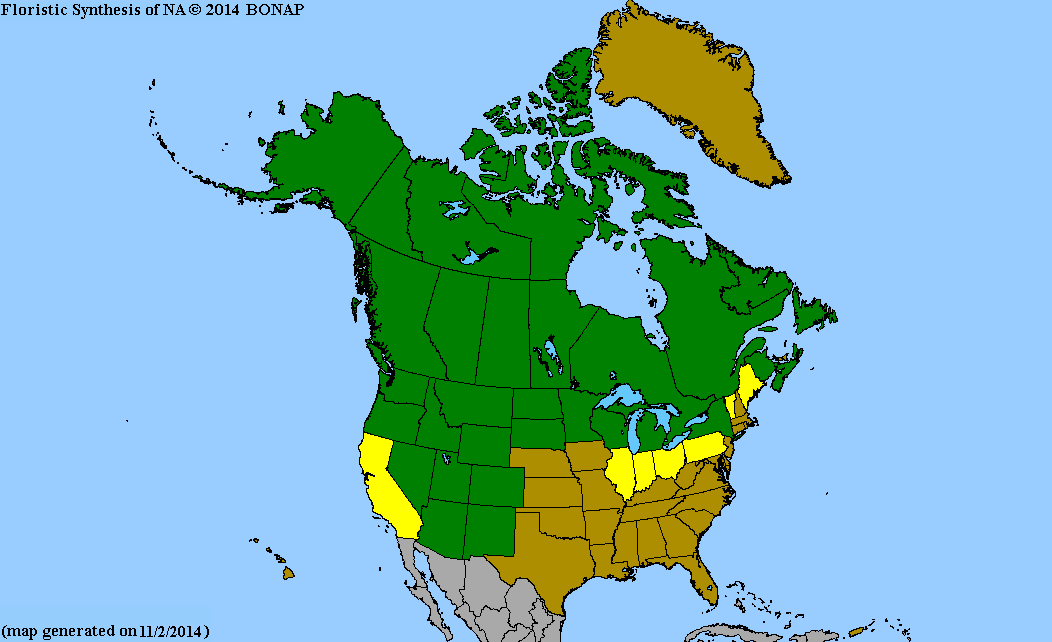
It grows in openings and forest understories.<ref name="tktimb" />
Uses
The fruit is edible,<ref name="tktimb" /> but the saponin chemicals it contains may cause gastrointestinal irritation if large quantities are consumed.Template:Fact Unrelated plants in the genus Sapindus, also commonly denominated "soapberry," produce toxic saponins.<ref name="Xu">Template:Cite journal</ref>
Some Canadian First Nations peoples such as Nlaka'pamux (Thompson), St'at'imc (Lillooet), and Secwepemc (Shuswap) in the Province of British Columbia extensively collect the berries. The bitter berries (which may be sweetened by frosts)<ref name=":0">Template:Cite book</ref> are processed with other berries as Indian ice cream.Template:Fact The saponins create a foam when the berry is whipped into a dessert dish.<ref name=":0" /> First Nations peoples believe that the berry has many health properties. Native-themed restaurants in British Columbia have occasionally offered the berries on their menus.<ref name=nancy/>Template:Isbn missing
References
External links
- Indigenous cuisine in Canada
- Berries
- Shepherdia
- Flora of Eastern Canada
- Flora of the North-Central United States
- Flora of the Northeastern United States
- Flora of the South-Central United States
- Flora of the Southwestern United States
- Flora of Subarctic America
- Flora of Western Canada
- Plants described in 1753
- Flora of the Northwestern United States
- Botanical taxa named by Carl Linnaeus
- Taxa named by Thomas Nuttall